To opt out of these daily Black History emails from the Voting Rights Alliance,
please reply back to this email.
|
|
Maggie Lena Walker (1864 – 1934)
2022 Edition
|
|
Click the buttons below to share this article to your social networks: |
|
The Transformative Justice Coalition and the Voting Rights Alliance, in honor of Black History Month, are reviving the daily special series devoted to sharing the legacies and stories of the sheroes, heroes, and events in the fight for Black suffrage. This series was created in 2017 and will add 9 NEW articles this year. In addition to these daily newsletters all February long, this series also incorporates daily social media posts; an interactive calendar; and, website blog posts to spread the word broadly.
We encourage everyone to share this series to your networks and on social media under the hashtag #VRABlackHistory. You can also tweet us @TJC_DC to share your own facts.
|
|
Reporting by: Caitlyn Cobb. All sources are cited throughout the article with a complete reference list at the bottom of the page.
Today, February 17th, 2022 we honor Maggie Lena Walker. Please note that the below version is a newly re-edited version of the original 2020 article. This special 2022 edition has been reformatted to set the scene for tomorrow's first NEW 2022 article which will detail the Black massacres that occurred when White Supremacists terrorized Black voters after the passage of the 15th Amendment. While honoring Maggie Lena Walker's little known voting rights legacy, this new edition aims to also highlight the vicious voter suppression tactics used against Black communities during the time period between the passage of the 15th and 19th Amendments.
The original 2020 Version was written specifically for the Centennial Anniversary of the 19th Amendment, and the main highlight was Maggie Lena Walker's work in organizing pre-registration meetings in 1920 in Richmond, Virginia after the ratification of the 19th Amendment. Those meetings led to a huge voter registration drive for African American women and resulted in the highest rate of African American women registered to vote in Richmond that year. Not only did Maggie lead this voter registration movement, fighting against discrimination and racism in the voter registration process for Black women. In 1921, Maggie became the first and only African American woman to run on a gubernatorial ticket in Richmond. While Maggie is best remembered for founding the Saint Luke Penny Savings Bank in Richmond, Virginia, she also founded or was an active member of organizations which supported women’s suffrage.
The major difference between the original version and this new version isn't new content, but a reorganization of the original article, although some content from the original has been removed from this version. All references for any further reading or sources are listed at the end of this article and this bibliography is the same as the original. |
|
Introduction: Making the Voting Rights Biography of Maggie Lena Walker
There is a lot of information on Maggie Lena Walker. Her childhood and the year of her birth, which she modestly tried to hide, is no secret, unlike too many of the Black women suffragettes where data is hard to find. The daughter of a freed slave and businesswoman, she was born to a mixed race couple who couldn’t marry. She was involved with the semi-successful first protest against segregated graduations the day before she would graduate high school. She is most famous for being the first African American woman to own a bank, the Saint Luke Penny Savings Bank in Richmond, Virginia. That bank survived the Great Depression by merging with Second Street Saving Bank and becoming the present-day Consolidated Bank and Trust Company, which until it was sold in 2009 to the larger White-owned Adams National Bank (No author, 2009), was the oldest continuously existing Black-owned and Black-run bank in the country.
Maggie Walker has a statue to her and her house has been preserved as a historical site. Her full name is etched in stone in Richmond and by historical societies. Yet, she is one of the erased Black women when it comes to her work with the suffragette movement. For all the information about her and her great financial work, none is more lacking then her political work. Her activism for the vote is commonly reduced to a mere sentence: “Maggie also spearheaded 1920 voter registration drives after the passage of the Nineteenth Amendment”. It’s as if her work for Black women suffrage was not interwoven throughout her speeches; her run on an all-black ticket; and, her entire work for Black women’s equality.
Maggie Lena Walker, you are erased no more. We are bringing political power back to your name, and headlines will hail you as an entrepreneur, business woman, educator, and civil and voting rights leader. For all those reasons stated above, this article will focus only on Maggie Lena Walker’s voting rights work, even with this new 2022 edition. A huge thanks goes out to the Maggie Lena Walker Foundation for aiding in my research in 2020 into Maggie’s suffrage activities.
Richmond, Virginia Voting Rights Landscape (1870 – 1920)
“In Richmond, as elsewhere, a system of race and class oppression including segregation, disenfranchisement, relegation to the lowest rungs of the occupational strata, and enforcement of racial subordination through intimidation was fully in place by the early twentieth century. In Richmond between 1885 and 1915 all Blacks were removed from the city council; the only predominately Black political district, Jackson Ward, was gerrymandered out of existence; the state constitutional convention disenfranchised the majority of Black Virginians, first the railroads and streetcars and later the jails, juries, and neighborhoods were segregated; Black principals were removed from the public schools and the right of Blacks to teach was questioned; the state legislature decided to substitute white for Black control of Virginia Normal School and College and to strike ‘and College’ from both name and function; and numerous other restrictions were imposed.” (Jacqueline, Cynthia, & Claudine, 2004, p. 55)
Maggie Lena Walker was supportive of African American men attaining the right to vote through the 15th Amendment (1870), understanding progress is slow moving, but still significant nonetheless. In New Jersey in 1903, during her speaking tour in the urban North East promoting the Saint Luke Penny Savings Bank, an article quoted a portion of her speech in which she made a statement about the role of women being to get behind men to make sure they were voting in the best interests of women. This quote is not seen as anti-suffrage or anti-women’s rights, but rather her response to the moment of voting rights just recently being taken away from Black men during the Jim Crow Era.
Maggie Walker believed the vote was important in furthering African Americans as a whole. We know from her diaries and journals, newspaper articles, and small quotes from her speeches her views concerning suffrage and the importance of it for the entire African American community. To her, the fact that African American men were being disenfranchised was all the more reason for women to make sure men who could vote did, and to further ensure they voted in the best interests of all African Americans.
Maggie was very much against segregation and sexism. Though lighter skinned with her White father, Maggie was still very much Black. Like so many other African American women in the Women’s Suffrage Movement, she understood the intersectionality of her race and gender, and the special barriers she faced. Sometime between 1903 and 1912, possibly from articles of European women going to jail over their right to vote, her thinking shifted from her 1903 statements to a stance of women to have a more active and public role in politics: it was no longer enough to make sure only men were as informed as possible; women also needed to vote and women voting was the most important thing to her.
In another speech, Maggie calls out men to be good “race men”, playing on African American’s men’s thinking of a man’s role being to protect women. She states that supporting women in business and political ventures is also protecting them and furthering African Americans as a whole.
“[Maggie Walker] argued, ‘Who is so helpless as the Negro woman? Who is so circumscribed and hemmed in, in the race of life, in the struggle for bread, meat and clothing as the Negro woman?’…Furthermore, she insisted that organization and expansion of women’s roles economically and politically were essential ingredients without which the community, the race, and even Black men could not achieve their full potential. The way in which Walker described Black women’s relationship to society, combined with the collective activities in which she engaged, give us some insight into her understanding of the relationship between women’s struggle and race struggle” (Jacqueline, Cynthia, & Claudine, 2004, p.51-52).
The Women’s Suffrage Movement has a very volatile and racist history in Virginia as it was aligned with White Supremacy, by both those who opposed Women’s Suffrage and for those who supported it. This brings to light the fragile considerations of Black women publicly supporting the right for women to vote: it was both a dangerous position for a Black woman to align herself with suffrage and a position that could tank women’s suffrage as a whole. At the same time, to align oneself- privately or publicly – against women’s suffrage could be seen as supporting those using racism as a reason for denying women the right to vote. (Hewitt & Lebsock, 1993, pp. 68-81). Aside from these considerations, even after the 19th Amendment, Black women knew they would be subject to the same disenfranchisement laws that kept Black men from voting.
The 19th Amendment's Ratification
The day the 19th Amendment was ratified, Maggie was not in Richmond to register herself to vote; however, she still experienced the benefits of the ratification immediately in a very unique way. Mid-August of 1920, before the 19th Amendment was ratified, Maggie Walker hosted a huge annual conference for her organization, the Independent Order of St. Luke. After the conference, she took a vacation, traveling to Atlantic City for a little while and visiting friends in New York. She then headed to Philadelphia to attend the National Negro Business League Convention.
At this convention, for the very first time, the National Negro Business League allowed women to hold high office within the organization as the League responds to the moment of the ratification of the 19th Amendment, honoring women who in federal politics were attempting to achieve full inclusion. Maggie Walker and Mrs. Booker T. Washington, as she was referred to in the newspapers, were appointed to high offices within the organization that they had never been allowed to hold prior to that point.
According to Maggie’s diaries, she registered to vote the very next day after arriving back from the convention on September 9th or 10th after paying her poll tax of $1.50. There is an important reminder for us in Maggie detailing how she paid a poll tax to register to vote because, as stated earlier, even though Black women knew that suffrage for women represented a fundamental step forward, they also knew that any rule or law that was on the books that already limited the vote for Black men would also apply to them. There was a widespread awareness among Black women that voting was a good thing technically; however, Black women weren’t going to be able to take advantage of it. The 1902 Virginia State Constitution which instituted the poll tax applied to Black women now, as did the same restrictions that had been in effect for decades in Virginia that eliminated 90% of the African American male vote.
Meanwhile, in Richmond, prior to September 20th, The New Leader reported, “Swamped by a rush of women voters, both white and colored, Central Registrar William S. Woodson threw up his hands this morning and called for help” (Hewitt & Lebsock, 1993, p. 83). “A second room and a deputy were found so that the crowd could be segregated. ‘It was impossible for Central Registrar Woodson to supervise so many, and as a result the whole throng, white and colored, were milling about giving each other aid, suggestion and instructions, regardless of the plain provision of the consitition [sic]’” (Hewitt & Lebsock, 1993, pp. 83-84).
“When the registration books were opened in early September, Virginia women initially presented themselves in modest numbers. With about two weeks to go, however, observers in many parts of the state reported a surge of applicants. In Richmond, the Times-Dispatch called the numbers ‘amazing’ and ‘phenomenal’. The editor of the Times-Dispatch had every reason to be impressed, having claimed to the last ditch that white women did not want the vote and would not exercise it if they had it. Once the women of Richmond proved the contrary, the Times-Dispatch began to keep daily tabs on the proceedings at city hall.” (Hewitt & Lebsock, 1993, p. 83)
Maggie Walker played a pivotal role in the surge of women registrants in Richmond.
Maggie Walker Fights Against Discrimination and Helps Register Thousands of Black Women
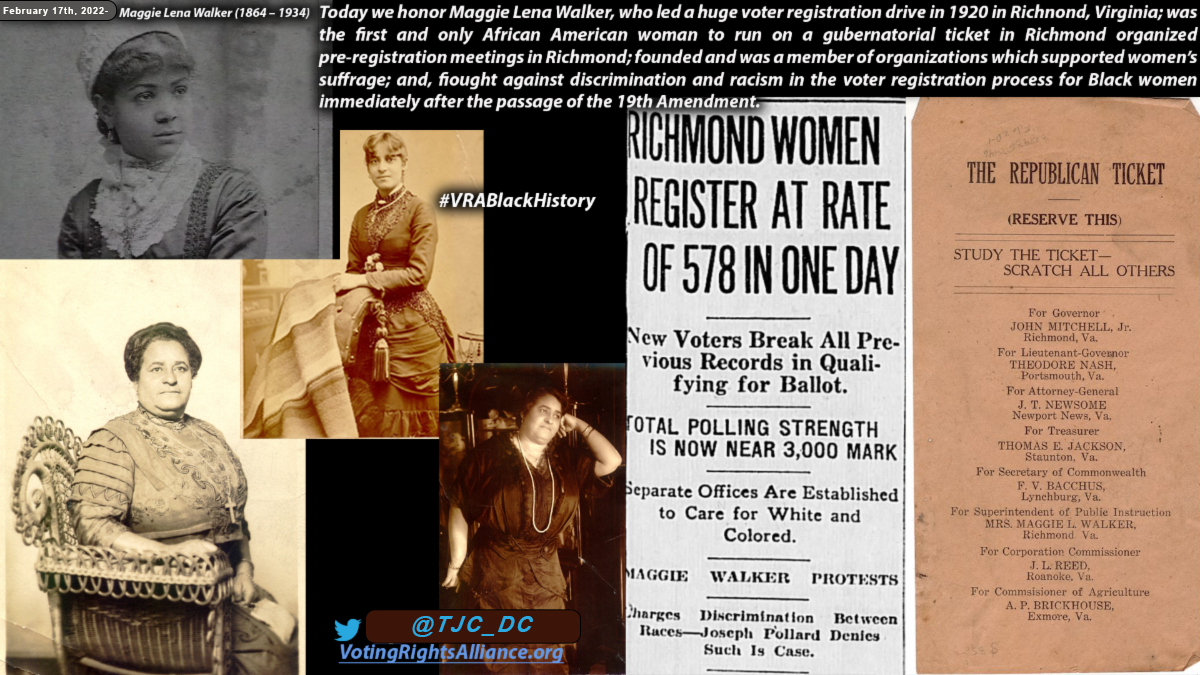
Being already registered herself, Maggie Walker still went to City Hall on September 20th or 21st with a goal of making sure women who were showing up were as well prepared as possible. Although there were no minutes from the pre-registration meetings Maggie attended, it seemed that one of the goals of those meetings were to spread information. Maggie went to City Hall to help guide the process. Her influence was so much that she raised enough of an issue to make it into the papers and even receive a subheadline “MAGGIE WALKER PROTESTS”. The results of her going to City Hall and advocating for Black women were chronicled by The Times-Dispatch:
|
|
What’s not reported in this article but is in her diaries is how Maggie helped Black women register for the next two days, and how when she sees the segregated process, she spends time not only preparing the women who show up for the registration process, but also going back and forth between the 4th Floor where the White women were being registered and the basement, where the Black women were being registered. She concluded White women were being registered at a faster rate than Black women were. After making the issue known, as we can see in the article above, she was told it had nothing to with race; but, the number of registrars. When presented with this explanation, she volunteers herself to be a registrar to make the process go faster, but they didn’t allow it. She continued keeping an eye out for discrimination, even after being denied the position of registrar. Although The Times-Dispatch covers the next two days of the surging voter registration efforts by women, no other article mentions Maggie Walker’s involvement or her concerns.
Starting September 20th, the numbers of women registered to vote In Richmond reached over 500 although when The News Leader wrote their article, the number of registrants on that day was only 276. Over 700 women were registered on September 21st. (Hewitt & Lebsock, 1993, pp. 83-84)
“…[T]he pace continued at [sic] from six to eight hundred a day, with as many as three hundred applicants still waiting in line at day’s end. On the final day, October 2, regsitrations [sic] at city hall topped a thousand.
The accelerated pace of registration was made possible in part by the appointment of three white women deputies to handle white applicants. After the deputies were sworn in, Maggie Walker pressed one official after another to have black deputies appointed as well. When Walker failed, the African American social worker and community organizaer [sic] Ora Brown Stokes took up the effort. With her compatriots in the Richmond Neighborhood Association, Stokes petitioned the registrar to appoint black deputies but to no avail. The resgitration [sic] line for blacks would continue to move more slowly than for whites, both because of the shortage of personnel and because black women’s applications were more frequently challenged. Consequently, black women were more likely than whites to find themselves still waiting when registration was shut down for the day. The registrar did extend the hours of business in the final two days of registration, a belated response to request from white women’s groups. When all the paperwork was complete, the total registration of the black women of Richmond was 2,410. The total for white women was 10,645.” (Hewitt & Lebsock, 1993, p. 83).
The Impact the Richmond Voter Registrations Had Statewide
The newspapers of Richmond repeatedly reported that Black women outnumbered White women in voter registration numbers, stoking racist fear and spreading disinformation such as White women being “kept out” (Hewitt & Lebsock, 1993, p. 84). In coordination with the newspapers’ reporting and further burrowing into Virginia’s White Supremacist narrative was the Democratic party, whose leaders “suddenly discovered the virtues of women suffrage” (Hewitt & Lebsock, 1993, p. 85).
“As the chairman of the Richmond City Democratic Committee phrased it, ‘It is the duty of every woman who regards the domination of the white race as essential to the welfare of the Southland to qualify for the ballot…’ A comparable call went out from Rorer James, chairman of the state central committee, who instructed the chairmen of all county and city committees to get white women registered in response to the ‘desperate efforts’ of the black women of Richmond to register. The officials of the party were assisted by the Virginia Association Opposed to Woman Suffrage, whose president called for conservative women to qualify ‘in view of the fact that colored women are registering in large numbers…” (Hewitt & Lebsock, 1993, p. 85)
The Democratic Party had opposed women’s suffrage, using racist narratives to justify their position. Now, afraid of losing the women constituents they had only alienated, they returned to such a racist narrative. “After registration was complete, some Democrats went further and tried to discipline the new voters by suggesting that women would not be able to vote in the 1921 Democratic primary unless they voted a straight ticket in November” (Hewitt & Lebsock, 1993, p. 85).
“Everywhere in Virginia, white women were able to register in greater numbers than black women, both absolutely and relatively. Male dominance proved almost as durable. Nowhere did women emerge as the majority of registered voters, even though women were a numerical majority in many Virginia cities…In most rural counties the proportion of black women registered was 5 percent or less of the black adult female population; the comparable figure for white women was anywhere from about 8 percent to 20 percent.” (Hewitt & Lebsock, 1993, p. 85)
“Of 260,000 Black Virginians over the age of twenty-one in 1920, less than 20,000 were eligible to vote in that year’s elections. Poll taxes and literacy tests disenfranchised many; white democratic election officials turned many others away from the polls; still others had given up their efforts to vote, realizing that even if they successfully cast their ballots, they were playing in ‘a political game which they stood no chance of winning’. The high proportion of female voters resulted from whites’ successful efforts to disenfranchise the majority of Black male voters, as well as the enthusiasm of women to exercise this new right…In Richmond, however, Black women soon found themselves facing the same obstacles to political rights as confronted Black men.” (Jacqueline, Cynthia, & Claudine, 2004, Endnote 15, p. 60) (citations omitted)
Maggie still voted in that Presidential election, and from Maggie’s 1918-1922 diaries, in addition to noting the election’s winners, her diary entry for November 2nd stated “Election Day – Holiday – 1st voting day for Women” (Maggie L. Walker National Historic Site, 2015, para. 2). “In the 1920 elections in Richmond, fully 80 percent of the eligible Black voters were women. The increased Black political strength represented by the female voters gave incentive to the growing movement for independent Black political action and led to the formation of the Virginia Lily-Black Republican Party” (Jacqueline, Cynthia, & Claudine, 2004, p. 60).
Maggie Walker's Historic Run on the Lily Black Ticket in 1921
Factors contributing to the forming of an independent Black political party were the history of racism and disenfranchisement from both parties in Virginia. The Republicans were trying to move away from the narrative of a party aligned with Black people, and so the party excluded Black voters from Virginia’s Republican Convention in 1920 and refused Black people as spectators at the 1921 convention. In addition, the party didn’t seat some Black delegates. (Library of Virginia, N.D., para 2) “The party's nominee for governor Henry W. Anderson was committed to promoting a ‘lily-white’ image” (Library of Virginia, N.D., para. 2). “Independent Black political parties developed in several southern states where the lily-white Republican faction has successfully purged Blacks from leadership positions in that party” (Jacqueline, Cynthia, & Claudine, 2004, Endnote 15, p. 60) (citations omitted).
In response to this “lily-white” ticket, John Mitchell Jr. led the way for Black people in Virginia to nominate their own candidate to the Republican ticket (Library of Virginia, N.D., para 3).
Not all black Virginians supported the ticket. P. B. Young, editor of the Norfolk Guide and Journal, refused the nomination for lieutenant governor, spoke out against the third party, and criticized his old rival, Mitchell, during the campaign. Young feared that an all-black ticket could result in as much racial strife as an all-white one. Young publicly supported Trinkle. As his candidacy was a largely symbolic move, Mitchell did little campaigning and finished a distant third in the election. Following the loss, Mitchell sent Trinkle a congratulatory telegram, and subsequently, Trinkle had a good working relationship with both Mitchell and Maggie Walker.” (Library of Virginia, N.D., para 3 - 4)
Maggie L. Walker was the only woman to receive a nomination from the Lily Black party. Although the Lily Black ticket was more of a protest than a serious bid, Maggie was very qualified for the position of state superintendent of public instruction, starting in her early childhood. Maggie “had joined the independent Order of Saint Luke at the age of fourteen, rose through the ranks to hold several important positions in the order, and, in 1895, [organized] the juvenile branch of the order” (Jacqueline, Cynthia, & Claudine, 2004, p. 49). Maggie and the women of the Order of Saint Luke “were role models for other Black women in their community activities as well as their occupations” (Jacqueline, Cynthia, & Claudine, 2004, p. 50). “The women of Saint Luke expanded the role of women in the community to the political sphere through their leadership in the 1904 streetcar boycott and through the St. Luke Herald’s pronouncements against segregation, lynching, and lack of equal education opportunities for Black children” (Jacqueline, Cynthia, & Claudine, 2004, p. 50).
“In addition to her Saint Luke activities, Walker was a founder or leading supporter of the Richmond Council of Colored Women, the Virginia State Federation of Colored Women, the National Association of Wage Earners, the International Council of Women of the Darker Races, the National Training School for Girls, and the Virginia Industrial School for Colored Girls. She also helped direct the National Association for the Advancement of Colored People, the Richmond Urban League, and the Negro Organization Society of Virginia.” (Jacqueline, Cynthia, & Claudine, 2004, p.49)
“As an advocate of African American women's rights, she served on the board of trustees for several women's groups…To assist race relations she helped to organize and served locally as vice president of the National Association for the Advancement of Colored People (NAACP) and was a member of the national NAACP board. She also served as a member of the Virginia Interracial Commission.” (Maggie L. Walker National Historical Site, 2019, Achievements section, para. 4)
“November 6, 1921 was two days before Virginia's Gubernatorial election, but voting fever had already gripped the capital city. That night, a mass meeting was held at Richmond's Moore St. Baptist Church (pictured) to rally voters in support of an all-Black ticket (known as the "Lily Black" ticket) which featured John Mitchell, Jr. for Governor, and Maggie L. Walker for Superintendent of Public Instruction, among others. Walker and Mitchell were two of the event's featured speakers, sharing stage space with devotionals and various musical selections.” (Maggie L. Walker National Historic Site, 2018, para. 1) “Walker was able to connect with prospective voters by tirelessly campaigning using her oratory eloquence across Virginia. While she did not win, she received 20,000 votes” (Maggie L. Walker National Historic Site, 2011). In comparison, Mitchell received 5,000 votes (Maggie L. Walker National Historic Site, 2013). “Though the ‘Lily Black’ ticket didn't win in 1921, it's hard not to think about the history they would have made if they had. Mitchell, for one, would have become the state's first African American Governor a full 70 years before Douglas Wilder. Walker, on the other hand. would have become the first African American woman elected to a statewide office, a feat that still has yet to occur in Virginia” (Maggie L. Walker National Historic Site, 2018, para. 2)!
|
|
Maggie Walker's Death: The Beginning of Her Legacy
Maggie Walker died in 1934 from complications associated with her diabetes. Up until her death, immediately after, and even today, her legacy inspires political action.
“[Maggie] developed type-2 diabetes by the mid 1920s and by the late 1920s, was confided to a wheel chair [due to an injury from a fall]. Again, Maggie Walker rose to meet the challenges of her life. She continued to work in a custom-designed wheelchair that was fitted with a writing desk. And, unlike other prominent figures who attempted to conceal their disabilities from the public, Walker purposefully allowed the full view of herself in a wheelchair to be photographed and distributed in print media, setting an admirable example for others with disabilities.
As she pushed doggedly on through every challenge — organizing the Consolidated Bank and Trust Company through a merger with two other banks after the financial crash in 1929 — Walker was coping with a diabetic sore on her leg that would not heal and was becoming infected with gangrene.” (Harris, J., N.D., Into the 20th Century section, para. 23-26)
A Times-Dispatch article about her death says she was “honored by white race”, and that in October 1934, Black people and all Black organizations nationwide during “Maggie L. Walker Month” with a thousand statuettes of her placed in homes, schools, and business (Jeannette’s take on life, 2016, Honored by white race section, para 1). Maggie’s work in establishing a thriving Black business community in Richmond has been credited with providing the initial infrastructure necessary for the Civil Rights Movement of the 1950-60’s.
|
|
Click the buttons below to share this article to your social networks: |
|
Did you miss any of the #VRABlackHistory series articles?
Don't forget to tell your friends!
|
|
References
Benjamin Anderson: a conversation with the Park Guide [Interview]. Maggie L. Walker National Historic Site. January 28, 2020.
MaggieWalkerNPS [YouTube channel). (2017, March 14). "Carry On: The life and legacy of Maggie Lena Walker" [YouTube video]. Maggie L. Walker National Historic Site (National Park Service). Retrieved from: https://www.youtube.com/watch?v=QR3CexPZXEk
MaggieWalkerNPS [YouTube channel). (2019, July 13). 1979 Maggie L. Walker National Historic Site - Deed Transfer [YouTube video]. Maggie L. Walker National Historic Site (National Park Service). Retrieved from: https://www.youtube.com/watch?v=8u6tFMhawmM
|
|
|
|
|
|
|