To opt out of these daily Black History emails from the Voting Rights Alliance,
please reply back to this email.
|
|
Mary McLeod Bethune (1875-1955) |
|
Click the buttons below to share this article to your social networks: |
|
The Transformative Justice Coalition and the Voting Rights Alliance, in honor of Black History Month, are reviving the daily special series devoted to sharing the legacies and stories of the sheroes, heroes, and events in the fight for Black suffrage. This series was created in 2017 and will add 9 NEW articles this year. In addition to these daily newsletters all February long, this series also incorporates daily social media posts; an interactive calendar; and, website blog posts to spread the word broadly.
We encourage everyone to share this series to your networks and on social media under the hashtag #VRABlackHistory. You can also tweet us @TJC_DC to share your own facts.
|
|
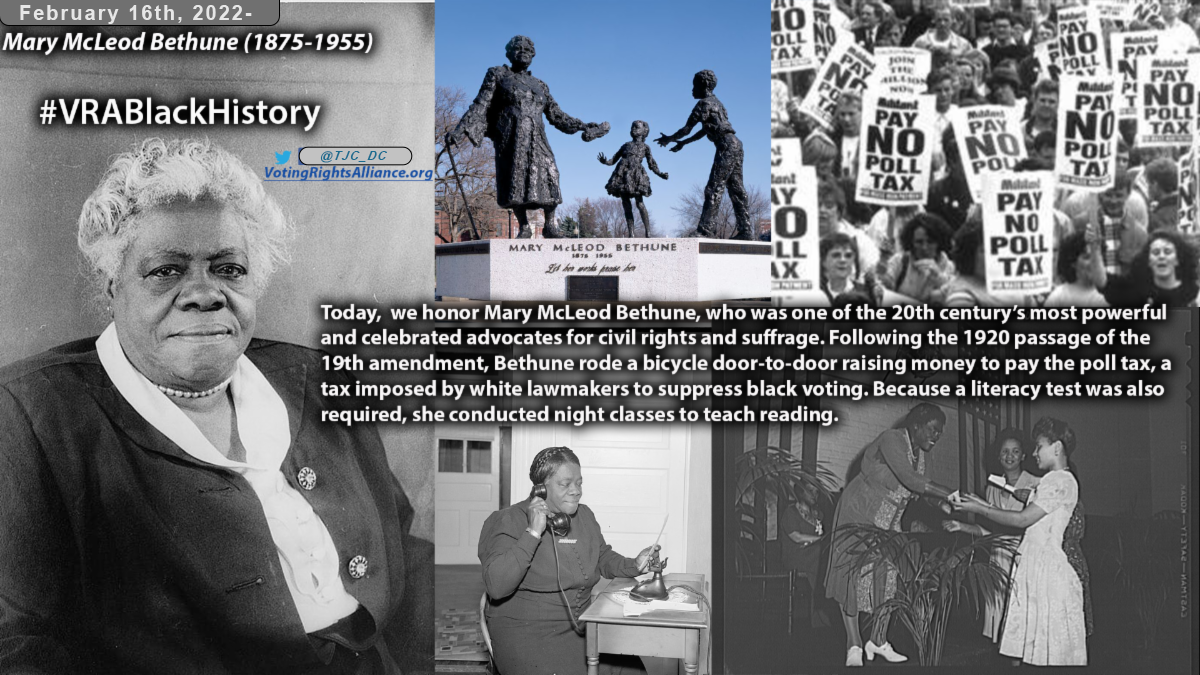
Today, February 16th, 2022, we honor Mary McLeod Bethune, who was "[o]ne of the 20th century’s most powerful and celebrated advocates for civil rights and suffrage" (Bennet, C. 2019).
Mary Jane Mcleod was born on a cotton far near Mayesville, South Carolina. She "was the fifteenth of seventeen children of former slaves, Samuel and Patsy McIntosh McLeod. Driven by an early personal belief in the power of education, Bethune secured scholarships to Scotia Seminary in North Carolina and Moody Bible Institute in Chicago, where she was the only African-American student. Among her many pioneering educational strides, Bethune fulfilled a dream to open a school for African American girls in Florida in 1904."
"Bethune turned her sights toward women’s suffrage in the early 1900s, when there was little role for African-American women, especially in the South. In 1912, she joined the Equal Suffrage League, an offshoot of the National Association of Colored Women. In an era when even African-American men couldn’t vote because of Jim Crow laws, Bethune watched as white-dominated voting rights and suffrage organizations marched and protested nationwide.
Following the 1920 passage of the 19th amendment, Bethune rode a bicycle door-to-door raising money to pay the 'poll tax,' a tax imposed by white lawmakers to suppress black voting. Because a literacy test was also required, she conducted night classes to teach reading. When 80 members of the Ku Klux Klan threatened to burn her school, Bethune held an all-night school-front vigil with a groundskeeper and some of her students. The Klan backed down, and Bethune led a procession of 100 African Americans to the polls to vote for the first time in the Daytona mayoral election.
The story of her defiance of the KKK spread, and Bethune became a popular speaker for the rights of African Americans. Inspired by W.E.B. DuBois, she opened her school’s library to the public, providing the first free source of reading material for African Americans in Florida." (What Is A Vote Worth, 2019b)
|
|
Abolish Poll Taxes: 1940-48
Click here to view a photo album with short articles on the fight to abolish Poll taxes between 1940-48.
Read more
www.flickr.com
|
|
|
|
|
|
Click the video below to watch the 10-minute video "With $1.50 and Faith: Leadership and Legacy of Mary McLeod Bethune", by Maryah Burney. |
|
Click the video below to watch a 4-minute video of Jacqui Rossi exploring the life of Mary McLeod Bethune and her devotion to the education and advancement of African Americans on Biography's YouTube Channel: |
|
Click the video below to watch a 5-minute video of YouTuber Sensei Aishitemasu presenting a biography and other information about Mary Mcleod Bethune,as part of her "Hidden Figures" series:
|
|
Fun Facts:
- "Bethune was the first woman and the first African American to be honored with a statue in a public park in Washington" (Bennet, C. 2019).
Recommended Reading:
|
|
Did you miss any of the #VRABlackHistory series articles?
Don't forget to tell your friends!
|
|
Click the buttons below to share this article to your social networks: |
|
~References~
Harris & Ewing, photographer. (ca. 1938) Mary Bethune, Chief of the Negro Section NYA. , ca. 1938. [Photograph] Retrieved from the Library of Congress, https://www.loc.gov/item/2016873302/
Harris & Ewing, photographer. (ca. 1938) Mary Bethune, Chief of the Negro Section NYA. , ca. 1938. [Photograph] Retrieved from the Library of Congress, https://www.loc.gov/item/2016873302/
Highsmith, C. M., photographer. Mary McLeod Bethune Memorial, Washington, D.C. United States Washington D.C, None. [Between 1980 and 2006] [Photograph] Retrieved from the Library of Congress, https://www.loc.gov/item/2011630730/
Smith, R., photographer. (1943) Washington, D.C. Mrs. Mary McLeod Bethune, President of the National Council of Negro women, presenting certificates to hostesses for USO duty, at the Phyllis Wheatley YWCA on Rhode Island Avenue. Facing the camera is Miss Dorothy Height, Director of the YWCA. , 1943. July. [Photograph] Retrieved from the Library of Congress, https://www.loc.gov/item/2017859744/
|
|
|
|
|
|
|