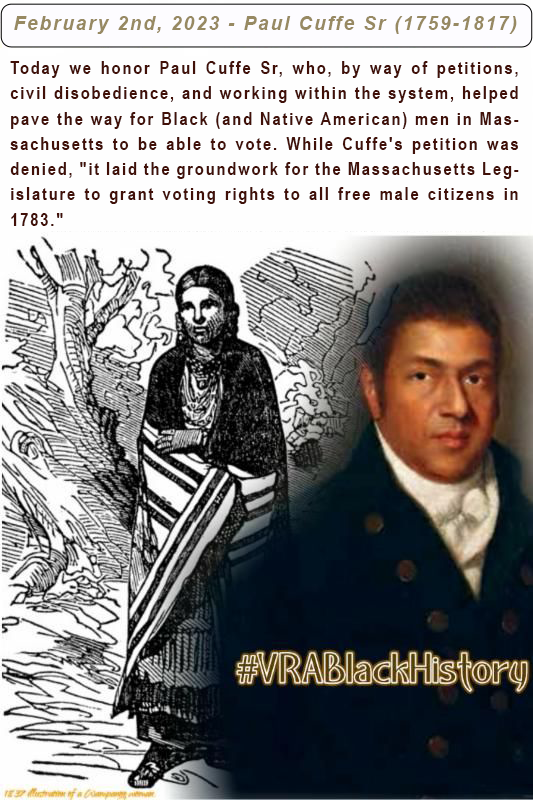
Paul Cuffe Sr. (1759-1817)
| |
Please email ccobb@tjcoalition.org to unsubscribe specifically from this daily February series. Thanks. | |
Click the buttons below to share this article to your social networks: | |
|
The Transformative Justice Coalition and the Voting Rights Alliance, in honor of Black History Month, are reviving the daily special series devoted to sharing the legacies and stories of the sheroes, heroes, and events in the fight for Black suffrage. This series was created in 2017 and will add several NEW articles this year. In addition to these daily newsletters all February long, this series also incorporates daily social media posts; an interactive calendar; and, website blog posts to spread the word broadly.
Feel free to publish on your social media outlets, with credit given to the Transformative Justice Coalition.
In light of the recent attempts to ban Black History, we are even more pleased to share these stories this year. We encourage everyone in the 18 states that are banning Black History to share these stories broadly!
We encourage everyone to share this series to your networks and on social media under the hashtag #VRABlackHistory. You can also tweet us @TJC_DC to share your own facts.
Others can sign up for the daily articles at VotingRightsAlliance.org.
This article is written by Caitlyn Cobb. All the sources are linked throughout the article in green.
| |
|
Today we honor Paul Cuffe Sr, who, by way of petitions, civil disobedience, and working within the system, helped pave the way for Black (and Native American) men in Massachusetts to be able to vote. While Cuffe's petition was denied, "it laid the groundwork for the Massachusetts Legislature to grant voting rights to all free male citizens in 1783."
Background
Paul Cuffe was born in Cuttyhunk Island, Massachusetts. Sources cite to his birth being in the year 1759; yet, his actual birth date is unknown (although some sources cite his birth date as January 17, 1759). The failure to keep genealogical records of Black families was a common problem because enslaved Africans were considered chattel property. Paul Cuffe’s father, Kofi (also known as Cuffe Slocum), was a slave who was captured at the age of 10 from the Ashanti Empire in West Africa and eventually earned his freedom (though some reports say that Kofi Slocum was freed by his owner, who couldn’t reconcile slavery with his religious beliefs). Paul Cuffe’s mother, Ruth Moses, was a Wampanoag Indian. Paul “was raised at a unique confluence of cultures—the growing African diaspora, the surviving members of the native Wampanoag people, and the religious influence of English colonists.”
Paul Cuffe was the youngest of 10 children (though some sources say he was the 7th youngest and some sources say there was only 7 or 9 children), and although all 10 children went on to become successful, Paul was the star of the family. Paul refused to keep his father’s previous master’s last name of “Slocum”, and changed it instead to his father’s first name, “changing Kofi, an Ashanti word meaning ‘born on a Friday,’ to Cuffee (though often spelled with just one ‘e’).” Paul’s father was a landowner and was literate. Paul could read and write as well.
Petitioning and Tax Evasion
It was during the Revolution Era, when Cuffe was in his 20’s, that he began his life of activism. “In 1780, both local and state legislation levied heavy taxes against land owned by African Americans, including Cuffe's family farm on Cuttyhunk.” He petitioned the government to either give Blacks and Native Americans the right to vote or cease to tax them, throwing the new America’s own logic back at them: “if England had no right to tax the colonies without representation, what right did America have to tax citizens who were not allowed to vote?” His petition was simple, but powerful. Below is “a transcript of the petition submitted to the Masschusetts [sic] legislature”.
| |
"by Paul Cuffe
To the
Honorable Council and House of Representatives, in General Court assembled, for
the State of the Massachusetts Bay, in New England:
The
petition of several poor negroes and mulattoes, who are inhabitants of the town
of Dartmouth, humbly showeth,—
That we
being chiefly of the African extract, and by reason of long bondage and hard
slavery, we have been deprived of enjoying the profits of our labor or the
advantage of inheriting estates from our parents, as our neighbors the white
people do, having some of us not long enjoyed our own freedom; yet of late,
contrary to the invariable custom and practice of the country, we have been,
and now are, taxed both in our polls and that small pittance of estate which,
through much hard labor and industry, we have got together to sustain ourselves
and families withall. We apprehend it, therefore, to be hard usage, and will
doubtless (if continued) reduce us to a state of beggary, whereby we shall
become a burthen to others, if not timely prevented by the interposition of
your justice and your power.
Your
petitioners further show, that we apprehend ourselves to be aggrieved, in that,
while we are not allowed the privilege of freemen of the State, having no vote
or influence in the election of those that tax us, yet many of our colour (as
is well known) have cheerfully entered the field of battle in the defence [sic]
of the common cause, and that (as we conceive) against a similar exertion of
power (in regard to taxation), too well known to need a recital in this place.
We most
humbly request, therefore, that you would take our unhappy case into your
serious consideration, and, in your wisdom and power, grant us relief from
taxation, while under our present depressed circumstances; and your poor
petitioners, as in duty bound, shall ever pray, &c.
| | |
|
|
John Cuffe,
Adventur Child,
Paul Cuffe,
Samuel Gray, X his mark.
Pero Howland, X his mark.
Pero Russell, X his mark.
Pero Coggeshall.
| |
|
Dated at Dartmouth, the 10th of February, 1780.
Memorandum in the hand-writing of John Cuffe:—
This is the copy of the petition which we did deliver unto the Honorable Council and House, for relief from taxation in the days of our distress. But we received none. JOHN CUFFE."
(emphasis in original)
The Petition's Outcome
Unfortunately, Cuffe's petition was denied; however "it laid the groundwork for the Massachusetts Legislature to grant voting rights to all free male citizens in 1783."
| |
Other Fun Facts
- Paul Coffee became a very wealthy individual, and even owned a fleet. “In 1815 Cuffe led 38 African American colonists to Sierra Leone. The colonists established new homes and integrated into the small community of former English residents and refugees from Nova Scotia.” This feat cost him $5,000.
| |
Click the buttons below to share this article to your social networks: | | | | |