|
This article was authored by Caitlyn Cobb. All the sources are linked throughout the article in green.
View as Webpage
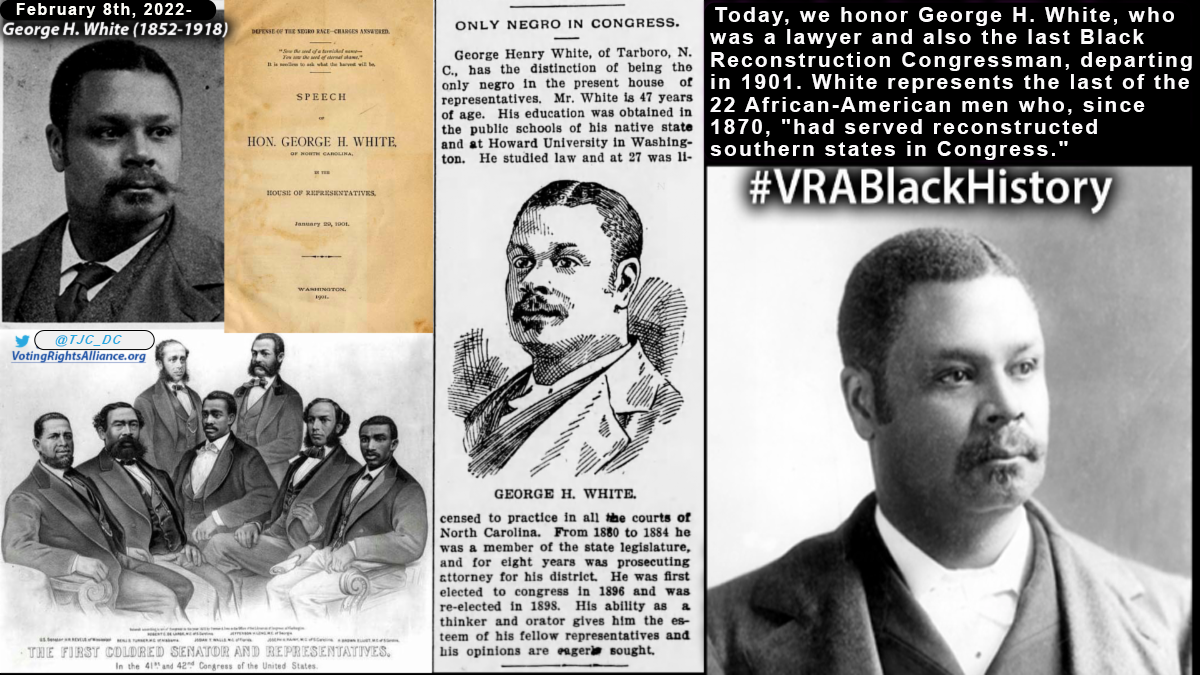
Today, February 8th, 2022, we honor George H. White, who was a lawyer and a Republican African-American Congressman from North Carolina’s Second Congressional District (1899-1901). The Black massacres of the 1860's- 1880's were over voting. While many more massacres occurred after 1880's, the extreme concentration of Black massacres during this time period were specifically targeted against Black men exerting their right to vote under 15th amendment. Despite the horror that yesterday's article showed, I purposefully have inserted this article after it to provide a contrast: that even when everything seems hopeless, progress still finds a way to rise as a phoenix.
"Facing overwhelming odds in the wake of the further disfranchisement of North Carolina blacks, he declined to run for re-election in 1900." White was part of the 56th Congress of the United States and was the last African-American member of Congress since Reconstruction, and there wouldn't be another African-American Congressperson until 28 years later in 1928. White would also be the last African-American Congressman "elected from North Carolina until the 1990s".
White represents the last of the 22 African-American men who, since 1870, "had served reconstructed southern states in Congress." While he was last; he certainly was not least, and it is our pleasure to lift up and honor a man who so earnestly loved the law, his country, and his race.
"In January 1901, at the beginning of a new century, George H. White was ending his term as a Congressman from North Carolina’s Second Congressional District. Realizing that he was bringing to a close a thirty two year period when nearly forty Southern African Americans sat in Congress, White used the occasion of his farewell address to remind that body and the nation of the reason for his defeat and the elimination of black representation in the nation’s capital. He also predicted that African Americans would return to Congress. His prediction became a reality when in 1928, Oscar DePriest was elected to represent a Chicago congressional district."
What made White's farewell address even more commendable was that it wasn't supposed to even be a farewell address. White was on the House floor "considering the bill (H. R. 13801) [that would make] appropriations for the Department of Agriculture for the fiscal year ending June 30, 1902". White says in this speech that, because he had been denied the chance a couple days earlier to speak, he had taken this chance while he was on the House floor and had the attention of all the Congressmen to divert from the subject of the bill- leaving the bill to be discussed by more knowledgeable agriculturists- and instead use his five minutes to "enter a plea for the colored man, the colored woman, the colored boy, and the colored girl of this country."
White covered many issues in his speech, including:
- The racism displayed by the 56th Congress;
- The attempts of several Congressmen to repeal the 14th and 15th Amendments;
- The voter suppression tactics used against African Americans;
- The hierarchy, destructive nature, and hypocrisy of White Supremacy;
- The statistics of how African-Americans were doing in 1901 compared to 30 years before;
- The state of poverty that African-American families still faced; and,
- The two bills he had proposed in the first session of Congress, and descriptions and arguments for them both (these two bills were one regarding the Freedmen's Savings and Trust Company and one regarding his anti-lynching bill).
White's impromptu farewell address took up "four pages of the Congressional Record " (emphasis in original), at the end of which the record says there was loud applause.
|