Please email ccobb@tjcoalition.org to unsubscribe specifically from this daily February series. Thanks

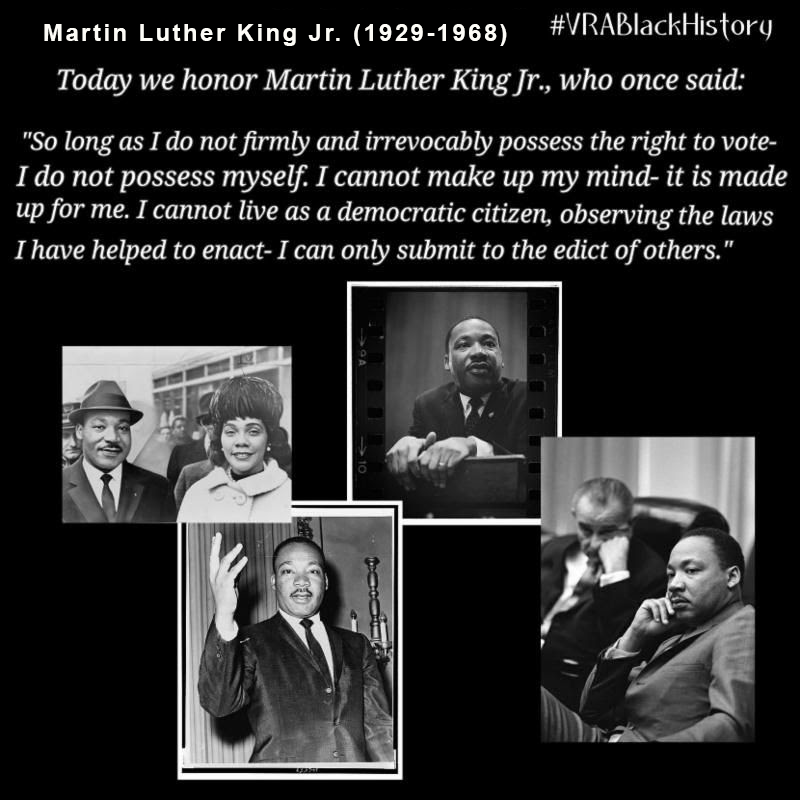
Martin Luther King Jr.  (1929-1968)
Click the buttons below to share this article to your social networks:
Facebook  Twitter  Instagram  Linkedin  

The Transformative Justice Coalition and the Voting Rights Alliance, in honor of Black History Month, are reviving the daily special series devoted to sharing the legacies and stories of the sheroes, heroes, and events in the fight for Black suffrage. This series was created in 2017 and will add several NEW articles this year. In addition to these daily newsletters all February long, this series also incorporates daily social media posts; an interactive calendar; and, website blog posts to spread the word broadly.


Feel free to publish on your social media outlets, with credit given to the Transformative Justice Coalition.


In light of the recent attempts to ban Black History, we are even more pleased to share these stories this year. We encourage everyone in the 18 states that are banning Black History to share these stories broadly!


We encourage everyone to share this series to your networks and on social media under the hashtag #VRABlackHistory. You can also tweet us @TJC_DC to share your own facts.


Others can sign up for the daily articles or view more Black History articles at VotingRightsAlliance.org. 


This article was authored by Caitlyn Cobb. You can also watch Caitlyn read this article on video via Facebook Live and Periscope, as a part of the 2018 #VRABlackHistoryLIVE series. View past article-readings by searching the #VRABlackHistoryLIVE.

Watch Caitlyn read this article via Facebook Live

Do you want to make a difference like those honored during this series?

In-Person Houston 2023 Gen Z and Millennial Votes Matter Training Application - The Voting Rights Alliance

The Transformative Justice Coalition (TJC) is hosting a non-partisan interactive in-person Gen Z and Millennial Votes Matter Leadership Training Event to be held March 29-April 2, 2023. This is a paid training opportunity with a $500 stipend and round-trip all expenses paid, including meals and ground transportation to Houston, Texas, for the entire event.

Click Here to Learn More and Appply

View as Webpage


All the sources are linked throughout the article in green. 


Today, we honor Martin Luther King Jr., who "was a Baptist minister and social activist who played a key role in the American civil rights movement from the mid-1950s until his assassination in 1968. Inspired by advocates of nonviolence such as Mahatma Gandhi, King sought equality for African Americans, the economically disadvantaged and victims of injustice through peaceful protest." Arrested for his involvement in the Birmingham campaign of 1963 (in which activists used a boycott, sit-ins, and marches to protest segregation, unfair hiring practices, and other injustices), on April 12th, King penned the civil rights manifesto known as the "Letter from Birmingham Jail", an eloquent defense of civil disobedience addressed to a group of white clergymen who had criticized his tactics. King was the driving force behind watershed events such as the Montgomery Bus Boycott, the March on Washington, and the Selma-to-Montgomery marches which helped bring about the Civil Rights Act of 1964 and the Voting Rights Act of 1965. "King was awarded the Nobel Peace Prize in 1964 and is remembered each year on Martin Luther King Jr. Day, a U.S. federal holiday since 1986.” 

Click Here to view the source and Learn More about Martin Luther King Jr. and his life and legacy for Black suffrage
Fun Facts


  • “After graduating in 1948, King entered Crozer Theological Seminary in Pennsylvania, where he earned a Bachelor of Divinity degree, won a prestigious fellowship and was elected president of his predominantly white senior class.”

  • The Montgomery bus boycott lasted 381 days, with Martin Luther King Jr. chosen “as the protests’ leader and official spokesman”.

  • “During a month-long trip to India in 1959, he had the opportunity to meet family members and followers of Gandhi, the man he described in his autobiography as “the guiding light of our technique of nonviolent social change.”

  • “The final section of Martin Luther King Jr.’s eloquent and iconic “I Have a Dream” speech is believed to have been largely improvised.”

“In 1996, Congress authorized Martin Luther King, Jr.’s fraternity, Alpha Phi Alpha, to establish a Memorial to him in Washington, D.C.” “The Martin Luther King, Jr. Memorial is located in West Potomac Park at 1964 Independence Avenue, S.W., referencing the year the Civil Rights Act Of 1964 became law. The memorial’s official dedication date is August 28, 2011, the 48th anniversary of the March on Washington for Jobs and Freedom.” “This memorial is the first African American honored with a memorial on the National Mall and the fourth non-president to be remembered in such a way. Martin Luther King, Jr.’s message is universal: a non-violent philosophy striving for freedom, justice, and equality.”


Recommended Reading:


Click on the video to watch as Coretta Scott King discusses the night of January 27, 1956, when her husband was just 27 years old, and received a threatening phone call that would cause his life to change forever.
Click the buttons below to share this article to your social networks:
Facebook  Twitter  Instagram  Linkedin  
~Sources~ 


Picture Credits: