Governor Lamont Signs Executive Order 3ExecOrder3
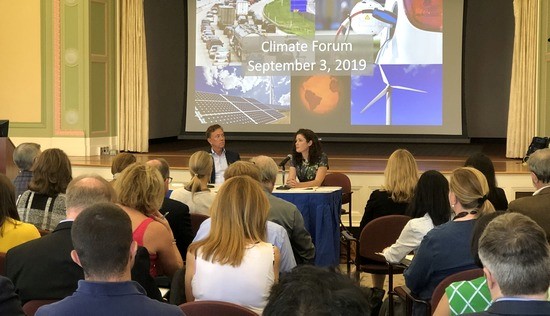
On September 3, 2019, at a Climate Forum held at DEEP, Governor Ned Lamont signed Executive Order 3 , strengthening Connecticut's efforts to mitigate climate change by expanding the responsibilities of the Governor's Council on Climate Change (GC3) and directing the DEEP to evaluate pathways to transition to a 100 percent clean energy grid by 2040.  Some key highlights of the Executive Order include:
  • Creating mechanisms to evaluate what the state is doing to enact the recommendations of our state climate mitigation plan - Building a Low Carbon Future for Connecticut:  Achieving a 45% GHG Reduction by 2030;
  • Developing a Climate Adaptation Strategy by 2020;
  • Expanding the makeup of the GC3 to include membership that will ensure equity and environmental justice; 
  • Directing DEEP to evaluate pathways to transition to 100 percent clean energy by 2040.
A Notice of Request for Public Input on Executive Order 3 has been released.  Members of the public are invited to submit comments  that will help inform the approach of the Governor's Council on Climate Change.  Please see the notice for more information.  Submit comments to DEEP.Climate.Change@ct.gov by November 8, 2019 at 5:00 PM EST. 
 
Governor Ned Lamont and DEEP Commissioner Katie Dykes at September 3, 2019 Climate Forum 

Toxics, Floods & Climate Risk:  Resources for BusinessToxics

Connecticut has experienced several powerful storms in recent years that resulted in local flood damage in cities and towns throughout the state.  Experts predict heavy rain events will increase in the future and statistics gathered by the Federal Emergency Management Agency (FEMA) show that 40% of businesses affected by a natural disaster, such as flooding, never reopen.  Businesses that have hazardous materials, chemicals or waste on-site, including retail shops that sell chemical products, run the risk of breached containment that can cause pollution, endanger workers and destroy property and assets.  The DEEP Pollution Prevention program has two new guidance documents that address preparedness for The Resilient 21st Century Business:  


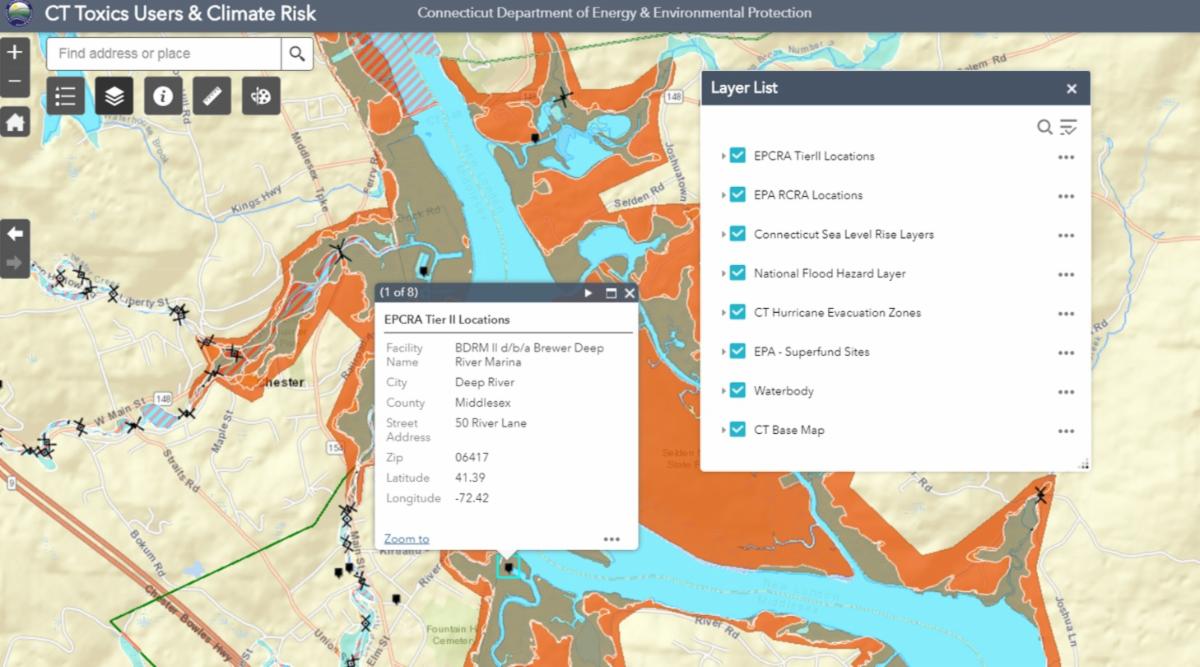
The DEEP Pollution Prevention program has also developed the CT Toxics Users & Climate Risk public viewer.  This is a tool for businesses, especially those that store hazardous chemicals, materials and/or wastes on site to assess the vulnerability of their location to climate-related natural hazards.  It was created so that facilities could assess their risk and implement best management practices to prevent damage or contamination from toxic on-site materials in the event of a natural hazard.  It will also assist EPCRA-regulated facilities with compliance with CGS 22a-610(e) requirements regarding updating hazard mitigation plans and applicable evacuation plans.  Local and state emergency preparedness and response planners will also find this tool useful.  Businesses and local entities can use the map to gauge their proximity to other facilities managing toxic materials that may impact normal operations, if flooding affects those facilities.  The viewer has several layers, including the FEMA flood hazard zones, hurricane evacuation areas, facilities that are EPCRA Tier 2 filers, RCRA hazardous waste generators, storage/disposal facilities, and Toxic Release Inventory reporters.  A layer with sea level rise will be added in the future.  Begin using the viewer by selecting the layers you wish to see and then typing in an address.  The results will show which, if any, flood zones intersect the property, along with facilities.


Additional information on chemical management and climate resilience for businesses as well as local and regional natural hazard mitigation planning is available on the DEEP Pollution Prevention webpage.

Updated FEMA Technical BulletinsTechBulletins
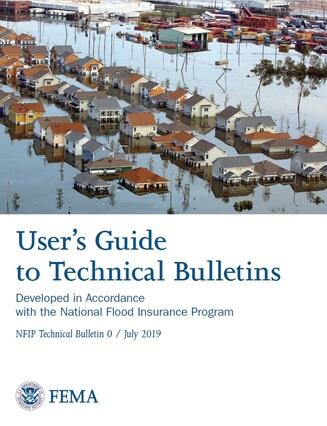
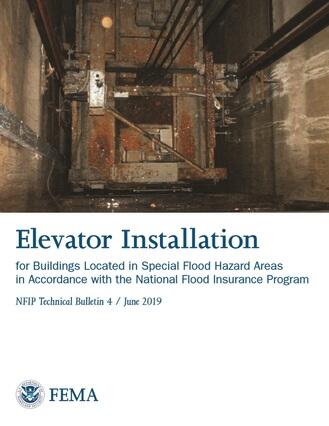
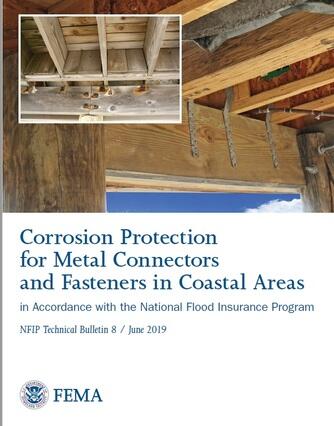
In August 2019, three updated National Flood Insurance Program (NFIP) Technical Bulletins (TBs) were released by the Federal Emergency Management Agency (FEMA).  TBs  provide guidance for complying with the NFIP building performance requirements.  The changes made to these bulletins are outlined in this fact sheet.  The bulletins help State and local officials interpret the NFIP regulations and are also useful resources for homeowners, insurance agents, building professionals and designers.  The updated TBs include:


Embracing RetreatRetreat

Read these two recent articles from The New York Times highlighting government embracing the concept of retreat in Nashville, Kentucky and Canada. 

NFIP Updates and InformationNFIPUpdateInfo
NFIP Reauthorization
In order for the National Flood Insurance Program (NFIP) to continue to operate, the program is required to be reauthorized by Congress.  On September 27, 2019, after many short term authorizations occurring since 2017, the President signed legislation passed by Congress authorizing the NFIP until November 21, 2019.  Congress has remained deadlocked on moving forward with a number of bills proposing long-term reform of the NFIP. 


Flood Insurance Changes

This short video explains the insurance changes to the NFIP that became effective on October 1, 2019.  These changes include the requirement for National Producer Numbers, specific rating guidelines, and the Community Rating System Eligible Communities List.  FEMA also announced changes scheduled to go into effect on April 1, 2020 and January 1, 2021, including updated premium rates and flood-proofing guidance for non-residential buildings.  These program changes may be subject to future update or modification due to Risk Rating 2.0, a new flood insurance rating system currently under development by FEMA.  Risk Rating 2.0 will fundamentally change how FEMA rates a property's flood risk and prices insurance for a structure.  The new rates for all single-family homes will go into effect on October 1, 2020. 


NFIP Financial Statement 

Financial information for the NFIP can be found in The Watermark newsletter, with the most recent third quarter 2019 edition published on October 15, 2019.


Office of the Insurance Advocate
The 2018 Annual Report of the Office of the Insurance Advocate was released in March 2019.  The report identifies trends affecting policyholders and includes recommendations to address those issues.  Four issues were identified in the 2018 report: 
  • Confusion regarding premium increases;
  • Confusion regarding condominium coverage;
  • Claim impacts when assuming a non-primary residents; and
  • Lack of refunds for prior policy terms after a letter of map amendment (LOMA) is issued. 

Flood Risk Communication Video SeriesFloodRiskVideo

FEMA has produced a series of eight Flood Risk Communication Videos.  Each video is approximately three minutes in length and is geared toward educating residents on various aspects of the National Flood Insurance Programs (NFIP).  Video topics include:

  • Introduction to the NFIP
  • Flood Insurance
  • Flood Risk Basics
  • Introduction to RiskMAP
  • Collecting Data To Create Flood Maps
  • Providing Input as the Flood Map is Developed
  • We have a Flood Map, Now What?
  • Mitigation
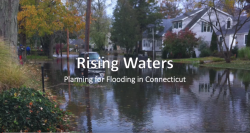
Rising Waters:  Planning for Flooding in ConnecticutRisingWaters

A new educational video entitled Rising Waters:  Planning for Flooding in Connecticut is now available.  This 15 minute video highlights flooding scenarios within our state along with the social and economic impacts of flooding, and opportunities for mitigation.  The video aims to increase the knowledge base of municipal officials to make informed decisions and effective choices supporting resilience.  The general public and other stakeholders will also find the video valuable.  


Connecticut Sea Grant utilized USDA National Institute of Food and Agriculture (NIFA) funds, which has a resilience component, to hire UCONN student Sarah Schechter to prepare the video.  Ms. Schechter coordinated with DEEP and municipal staff to gather information, pictures, content, resources and narration.  The video will be posted on Adapt CT this autumn and more videos are planned for the future.  This video is modeled after the PREP-RI video series funded by Rhode Island Sea Grant.     

Training OpportunitiesTrainings
WEBINARS

NFIP-related training webinars are available through STARR, a FEMA contractor.  Below is a list of upcoming webinars.  To register, go to the NFIP training website  and  click on the "Upcoming" tab. When asked during registration what FEMA Region you are in, please reply "1".


  • November 7, 2019, 1:00pm - Elevation Certificates
  • November 14, 2019, 1:00pm - Tools for Determining Base Flood Elevation
  • November 19, 2019, 1:00pm - CRS:  Introduction to CRS
  • November 20, 2019, 1:00pm - CRS:  CRS and Coastal Hazards
  • November 21, 2019, 12:00pm - Floodplain Development Permit Review
  • November 21, 2019, 1:30pm - Inspecting Floodplain Development
  • December 17, 2019, 1:00pm - CRS:  Natural Floodplain Functions and CRS
  • December 18, 2019, 1:00pm - CRS:  Preparing an Annual Recertification
  • December 19, 2019, 1:00pm - Elevation Certificates

V IDEOS

This  15 minute educational video highlights flooding scenarios within our state along with the social and economic impacts of flooding, and opportunities for mitigation.  The video aims to increase the knowledge base of municipal officials to make informed decisions and effective choices supporting resilience.  The general public and other stakeholders will also find the video valuable. 

H2O Partners offers short training videos on the following topics:
  • Demonstrating the Elevation Certificate
  • How the NFIP Works for the Floodplain Professional
  • Effects of Flood Map Changes
  • Role of the Elevation Certificate in Floodplain Management
   
 
NFIP TRAINING WORKSHOP & CERTIFIED FLOODPLAIN MANAGER (CFM) EXAM 
   
December 9-12, 2019:   L0273 Managing Floodplain Development Through the National Flood Insurance Program (NFIP), 4 Day Workshop, Fort Trumbull State Park, New London, CT, Cost $45, for more information and registration materials:  www.ctfloods.org/events
 
December 13, 2019:  Certified Floodplain Manager (CFM) Exam, Fort Trumbull State Park, New London, CT, 9:00am to 12:00pm, for more information and registration:  www.floods.org


CONFERENCES

October 30, 2019:  Connecticut Association of Flood Managers (CAFM) 6th Annual Conference, Water's Edge Resort, Westbrook, CT, www.ctfloods.org/events.

November 12, 2019:  Resilient Connecticut Climate Adaptation Summit, Fairfield University, Fairfield, CT, free parking and lunch included,  https://circa.uconn.edu/nov2019summit/

November 20-22, 2019:   Federal Alliance for Safe Homes (FLASH) National Disaster Resilience Conference , Clearwater Beach, FL,  www.flash.org.

November 23, 2019:  Connecticut Association of Conservation and Inland Wetlands Commissions (CACIWC) 42nd Annual Meeting and Environmental Conference, Cromwell, CT, www.caciwc.org.

April 28-30, 2020:  Global Resilience Summit - ResCon International Annual Conference, New Orleans, LA, www.resconnola.com.

June 7-11, 2020:  Association of State Floodplain Managers (ASFPM) Annual Conference, Fort Worth, TX, www.floods.org.


FEMA EMERGENCY MANAGEMENT INSTITUTE

The Emergency Management Institute (EMI) is located at the Federal Emergency Management Agency (FEMA) National Emergency Training Center (NETC) in Emmitsburg, Maryland.  EMI serves as the national center for emergency management training of federal, state and local government officials.  Tuition, housing, and all books and materials are provided at no cost.  Participants are responsible for the cost of a meal pass (approximately $120/week).  Below is a select list of floodplain management classes offered into September 2020.  A full list of training classes can be found at the EMI website.  
 

E172  HAZUS-MH for Flood - December 2-5, 2019, July 27-30, 2020
E174  HAZUS-MH for Earthquake and Tsunami - August 10-13, 2020
E177  Advanced HAZUS - March 23-26, 2020
E179  Application of HAZUS-MH for Disaster Operations - April 14-17, July 20-23, August 31-September 3, 2020
E190  ArcGIS for Emergency Managers -  January 13-16, May 11-14, 2020
E212  Unified Hazard Mitigation Assistance Program: Developing Quality Application Elements - June 22-25, 2020
E213 Hazard Mitigation Assistance Program: Application Review and Eval. - July 20-21, 2020 
E214  Unified Hazard Mitigation Assistance Program:  Project Implementation and Programmatic Closeout - July 22-23, 2020
E246  Advanced Building Science - March 30-April 2, 2020
E273  Managing Floodplain Development through the NFIP - December 2-5, 2019, May 4-7, 2020, August 31-September 3, 2020
E276  Benefit-Cost Analysis:  Entry Level  - May 27-28, 2020, July 27-28, 2020
E278  Community Rating System (CRS) -  Feb. 3-6, 2020, April 20-23, 2020, July 27-30, 2020
E279  Retrofitting Floodprone Residential Buildings - May 11-14, 2020
E282  Advanced Floodplain Management Concepts II - March 16-19, 2020
E284  Advanced Floodplain Management Concepts III - July 6-9, 2020
E312  Fundamentals of Building Science -    August 31-September 3, 2020, Sept. 14-17, 2020
E313  Basic HAZUS-MH -  March 2-5, April 6-9, June 8-11, July 13-16, August 17-20, 2020
E317  Comprehensive Data Management for HAZUS-MH - June 15-18, 2020, Sept. 21-24, 2020 
E386  Residential Coastal Construction -  September 21-24, 2020
 

EMI also offers free Independent Study courses on various aspects of the NFIP aimed at  community officials, surveyors, insurance agents, and claims adjusters.  These web-based courses are free and can be taken at your own pace. Below is a sample of courses available.  Independent study courses are also available for other topics in emergency management, hazard mitigation planning, disaster response and dam safety.    

IS-10.a     Animals in Disasters:  Awareness & Preparedness
IS-11.a     Animals in Disasters:  Community Planning
IS-30a      Mitigation eGrants for the Subgrant Applicant
IS-42       Social Media in Emergency Management
IS-111.a   Livestock in Disasters
IS-212.b   Introduction to Unified Hazard Mitigation Assistance (HMA)
IS-276      Benefit-Cost Analysis (BCA) Fundamentals
IS-277      Benefit-Cost Analysis (BCA):  Entry Level
IS-279.a   Introduction to Retrofitting Flood-prone Residential Structures
IS-284      Using the Substantial Damage Estimator 2.0 Tool
IS-366.a   Planning for the Needs of Children in Disasters
IS-386      Introduction to Residential Coastal Construction
IS-393.a   Introduction to Hazard Mitigation
IS-394.a   Protecting Your Home or Small Business From Disaster
IS-552      The Public Works Role in Emergency Management 
IS-554      Emergency Planning for Public Works
IS-556      Damage Assessment for Public Works
IS-558      Public Works and Disaster Recovery
IS-559      Local Damage Assessment
IS-634      Introduction to FEMA's Public Assistance Program
IS-1100.a  Increased Cost of Compliance
IS-1101     Basic Agent Tutorial
IS-1102     Theory of Elevation Rating
IS-1103     Elevation Certificate for Surveyors
IS-1104     NFIP Claims Review for Adjusters
IS-1105     EC Made Easy:  Elevation Certificate Overview
IS-1106     FEMA Mapping Changes
IS-1107     Adjuster Customer Service
IS-1108     Insuring Condominiums
IS-1109     Understanding Basement Coverage
IS-1110.a  Writing Commercial Exposures
IS-1111     Introduction to Commercial Claims
IS-1112     Introduction to Flood Claims
IS-1113     Coastal Barrier Resources Act
IS-1120     Letters of Map Revision
IS-2001     Threat and Hazard Identification Risk Assessment (THIRA)
Visit the DEEP website at www.ct.gov/deep.  Published by the Connecticut Department of Energy and Environmental Protection, Bureau of Water Protection and Land Reuse, Land and Water Resources Division.  Editor:  Diane Ifkovic, State National Flood Insurance Program (NFIP) Coordinator, email:  diane.ifkovic@ct.gov.
CT Department of Energy & Environmental Protection
The Connecticut Department of Energy & Environmental Protection is an Affirmative Action and Equal Opportunity Employer that is committed to complying with the requirements of the Americans with Disabilities Act (ADA).  Please contact us at (860) 418-5910 or deep.accommodations@ct.gov if you; have a disability and need a communication aid or service; have limited proficiency in English and may need information in another language; or if you wish to file an ADA or Title VI discrimination complaint.