|
|
New Climate Change Video Released by Adapt CT |
A video entitled Rising Waters: Planning for Flooding in Connecticut was released in 2019 and outlines the social and economic impacts of flooding in our state. Another video on legal issues and flood resilience titled Drowning in Liability: Reducing Municipal Impacts through Planning and Zoning for Climate Change is currently in production and scheduled to be released in 2021.
The purpose of these online video modules is to increase the knowledge base of inland and coastal municipal officials by providing current information and resources on subjects related to climate resilience. Through these short videos, local decision makers will learn information in order to make informed decisions and effective choices supporting resilience at the local level. The general public and other stakeholders will also find the videos valuable.
This Connecticut video series was developed with funding and resources from the USDA National Institute of Food and Agriculture, UCONN Extension, Connecticut Sea Grant and UCONN Center for Land Use Education and Research (CLEAR). The concept for these videos is modeled after the PREP-RI video series funded by Rhode Island Sea Grant. |
BRIC & FMA Applications due November 30 in FEMA GO
|
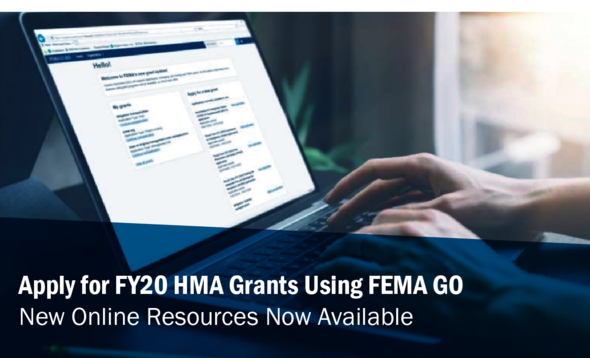
BRIC is a new program that replaces the existing Pre-Disaster Mitigation (PDM) grant program. The BRIC program aims to categorically shift the federal focus away from reactive disaster spending and toward research-supported, proactive investment in community resilience. This year, nationwide, there is $500 million available for BRIC and $160 million available for FMA.
Connecticut BRIC and FMA grant applications must be submitted in FEMA GO by 3:00pm on November 30, 2020.
|
New Agricultural and Accessory Structures Publication
|
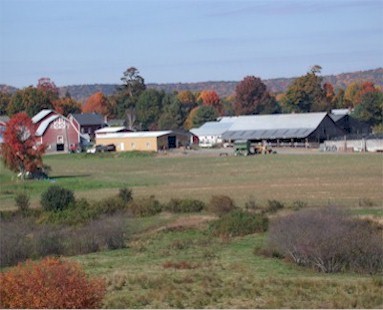
Earlier this year, in February 2020, FEMA issued a policy document entitled Floodplain Management Requirements for Agricultural Structures and Accessory Structures, FEMA Policy # 104-008-03. The purpose of this policy is to acknowledge the unique characteristics and uses of agricultural and accessory structures within the SFHA to ensure sound development and promote public health, safety, and welfare. As defined in the policy, an agricultural structure is a structure used exclusively in connection with the production, harvesting, storage, raising, or drying of agricultural commodities and livestock. Further, an accessory structure refers to a structure that is on the same parcel of property as a principal structure and the use of which is incidental to the use of the principal structure, such as a detached garage, carport, or storage shed.
The new bulletin provides further guidance on the policy document, clarifies the definition of agricultural structures and accessory structures, and establishes a clear, consistent process for ensuring compliance with National Flood Insurance Program (NFIP) design and performance standards for those structures located within the SFHA. The policy and bulletin should be used as a reference for floodplain managers and those involved in regulating, planning, designing, and constructing agricultural structures and accessory structures in SFHAs.
|
| Mitigate Your Risk with the FEMA Mobile App |
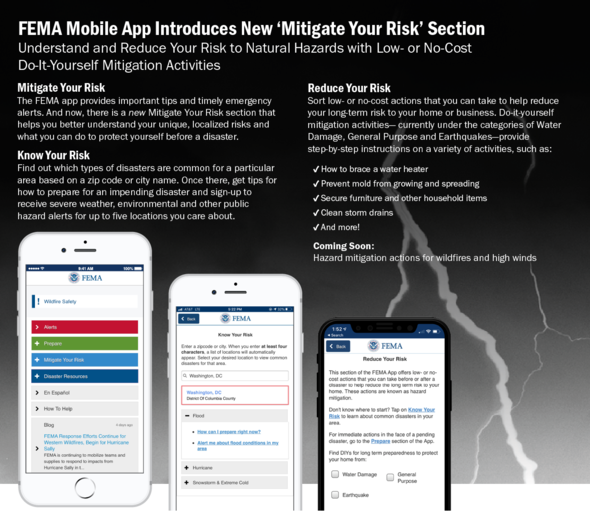
FEMA's Mobile App has introduced a new "Mitigate Your Risk" section, featuring no-cost or low cost do-it-yourself mitigation activities that can save property owners money and mitigate risk. The FEMA Mobile App also features real-time weather alerts in your area from the National Weather Service, location of open emergency shelters and disaster recovery centers in your area, customizable emergency checklists, emergency safety tips for over twenty types of disasters, and apply for disaster assistance or start a flood insurance claim online. The FEMA Mobile App can be downloaded from Google Play Store or the Apple App Store.
|
| Living Shorelines in Connecticut |
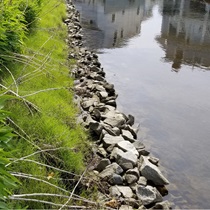
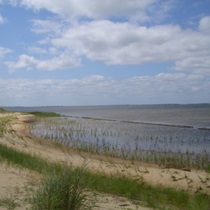
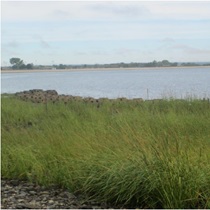
Living shorelines are a low-impact, "soft" approach to the traditional "hard" shoreline protection that integrates natural coastal features. Connecticut General Statutes Section 22a-363h passed in 2012 enabled the Department of Energy and Environmental Protection (DEEP) to establish and provide technical support for a pilot program to encourage implementation of living shorelines with the principal function of maintaining or restoring coastal resources and habitat as innovative, low-impact approaches to shoreline protection and adaptation to sea level rise.
DEEP has developed a story map to learn more about the living shoreline projects that the agency has advanced since this pilot program was initiated to demonstrate some of the different living shorelines techniques. These projects are located at Stratford Point, Stratford; Long Wharf Park and East Shore Park, New Haven; Three Mile River, Old Lyme; Hepburn Dune, Borough of Fenwick, Old Saybrook; and Dodge Paddock and Beal Preserve, Stonington.
|
| NOAA Sea Level Rise Viewer Updated |
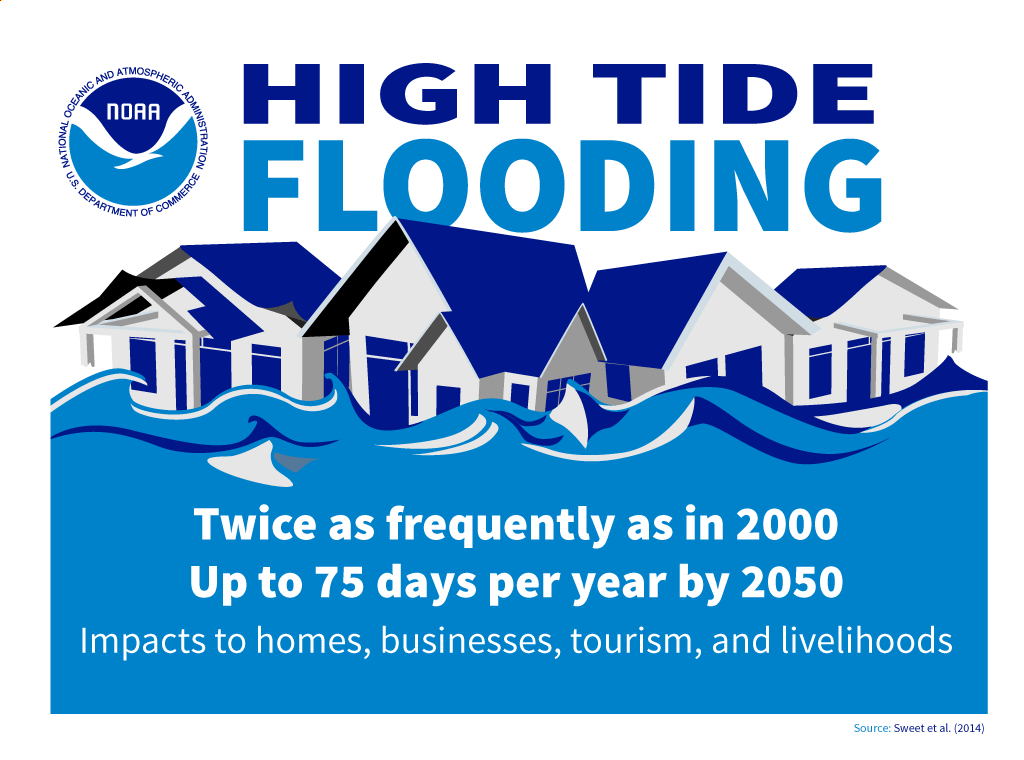
In July 2020, the National Oceanic and Atmospheric Administration (NOAA) Sea Level Rise Viewer was updated to include high resolution images and new high tide flooding data. Use this tool with its new and improved features to illustrate simulations of sea level rise, tidal marsh migration scenarios, and vulnerable locations in your community.
|
NFIP Reauthorized until September 30, 2021
|
 In order for the National Flood Insurance Program (NFIP) to continue to operate, the program is required to be reauthorized by Congress. On September 30, 2020, after many short term authorizations occurring since 2017, the President signed legislation passed by Congress authorizing the NFIP until September 30, 2021. Congress has remained deadlocked on moving forward with a number of bills proposing long-term reform of the NFIP. This one year extension allows flood insurance policies to be purchased and renewed.
Risk Rating 2.0, the new NFIP flood insurance risk rating system, has been delayed and is now scheduled to be implemented on October 1, 2021. Risk Rating 2.0 will fundamentally change how FEMA determines a property's flood risk and associated flood insurance premium.
In July 2020, FEMA released an updated NFIP Summary of Coverage brochure. This 8 page publication provides details on the definition of a flood, specifics on building and contents coverage, and outlines items which are not covered by a flood insurance policy. |
Training Opportunities
|
|
NFIP & CRS WEBINARS
NFIP-related training webinars are available through STARR, a FEMA contractor. Below is a list of upcoming webinars. To register, go to the NFIP training website and click on the "Upcoming" tab. When asked during registration what FEMA Region you are in, please reply "1".
- November 17, 2020, 1:00pm - CRS: Changes in CRS, 2021 Addendum to CRS Manual
- November 18, 2020, 1:00pm - CRS: Activity 370 Flood Insurance Promotion
- November 19, 2020, 1:00pm - Tools for Determining Base Flood Elevation (BFE)
- December 3, 2020, 12:00pm - Floodplain Development Permit Review
- December 3, 2020, 1;30pm - Inspecting Floodplain Development
- December 15, 2020, 1:00pm - CRS: Changes in CRS, 2021 Addendum to CRS Manual
- December 16, 2020, 1:00pm - CRS: CRS Credit for Conservation and Recovery of Threatened and Endangered Species
NATURAL HAZARDS CENTER WEBINARS
The Natural Hazards Center, in partnership with the Federal Emergency Management Agency, is pleased to present the
M
aking Mitigation Work Webinar Series
. These free one-hour webinars feature innovative speakers and highlight recent progress in mitigation policy, practice, and research. Past webinar recordings can also be accessed. Check back in 2021 for new webinars starting on February 9, 2021.
- November 10, 1:00pm - Advancing Racial & Social Equities through Mitigating Natural Hazards
- December 8, 2020, 1:00pm - Opportunities & Challenges Associated with Implementing Buyouts
ASSOCIATION OF STATE FLOODPLAIN MANAGERS (ASFPM)
The ASFPM Training and Knowledge Center offers webinars and an online university as a professional development resource for floodplain management professionals.
This 15 minute educational video from Adapt CT highlights flooding scenarios within our state along with the social and economic impacts of flooding, and opportunities for mitigation. The video aims to increase the knowledge base of municipal officials to make informed decisions and effective choices supporting resilience. The general public and other stakeholders will also find the video valuable.
This 13 minute educational video from Adapt CT highlights the effects of climate change in our state. The video aims to increase the knowledge base of municipal officials to make informed decisions and effective choices supporting resilience. The general public and other stakeholders will also find the video valuable.
This 5 minute video highlights how the U.S. Naval Submarine Base is an outstanding example of preparedness and shows some of the actions they have taken include elevating equipment and materials, using floodgates and having a plan of action in order to be more flood resistant. This 5 minute video highlights a local full-service marina and boat repair business which has implemented a variety of actions to protect the environment and be more flood resistant, including a daily walk-through and connecting with local emergency responders.
This 25 minute video will show how to make your business resilient to natural hazards, reduce property damage, environmental contamination and liability. This video will help businesses that use chemicals in their process, sell chemicals and store hazardous waste onsite, including retail stores and service providers. It offers steps businesses can take to reduce risks and keep your business operating, especially those in flood prone areas. This video is also available as a training course.
UCONN CENTER FOR LAND USE EDUCATION AND RESEARCH (CLEAR)
TRAINING FOR MUNICIPAL INLAND WETLAND AGENTS
RESTORATION WEBINAR SERIES
The Restoration Webinar Series, hosted by National Oceanic and Atmospheric Administration (NOAA) and U.S. Fish and Wildlife Service (FWS), is a venue for disseminating new approaches, best management practices and innovative restoration techniques to some of our nation's greatest restoration challenges. The series covers a broad spectrum of topics including implementing restoration projects, project monitoring and evaluation, permitting, and regional restoration planning.
NOAA DIGITAL COAST VIRTUAL LEARNING
CONFERENCES
June 27-30, 2021: National Flood Conference, Washington, DC.
FEMA EMERGENCY MANAGEMENT INSTITUTE
The Emergency Management Institute (EMI) is located at the Federal Emergency Management Agency (FEMA) National Emergency Training Center (NETC) in Emmitsburg, Maryland. EMI serves as the national center for emergency management training of federal, state and local government officials. Due to the COVID-19 pandemic, in-person training has been suspended until further notice. Please consult the EMI website for current status of when in person classes will resume.
EMI also offers free Independent Study courses on various aspects of the NFIP aimed at community officials, surveyors, insurance agents, and claims adjusters. These web-based courses are offered at no cost and can be taken at your own pace. Below is a sample of courses available. Independent study courses are also available for other topics in emergency management, hazard mitigation planning, disaster response and dam safety.
IS-10.a Animals in Disasters: Awareness & Preparedness
IS-11.a Animals in Disasters: Community Planning
IS-30.b Mitigation eGrants System for the Subgrant Applicant
IS-42 Social Media in Emergency Management
IS-111.a Livestock in Disasters
IS-212.b Introduction to Unified Hazard Mitigation Assistance (HMA)
IS-230.d Fundamentals of Emergency Management
IS-251.a Integrated Public Alert and Warning System (IPAWS) for Alerting Administrators
IS-271.a Anticipating Hazardous Weather and Community Risk
IS-273 How to Read a Flood Insurance Rate Map (FIRM)
IS-274 How to Read a Flood Insurance Study (FIS)
IS-276.a Benefit-Cost Analysis (BCA) Fundamentals
IS-277.a Benefit-Cost Analysis (BCA): Entry Level
IS-279.a Introduction to Retrofitting Flood-prone Residential Structures
IS-280 Overview: Engineering Principles & Practices for Retrofitting Flood-prone Residential Structures
IS-284.a Using the Substantial Damage Estimator 3.0 Tool
IS-285 Substantial Damage Estimator for the Floodplain Administrator
IS-318 Mitigation Planning for Local and Tribal Communities
IS-324.a Community Hurricane Preparedness
IS-366.a Planning for the Needs of Children in Disasters
IS-386 Introduction to Residential Coastal Construction
IS-393.a Introduction to Hazard Mitigation
IS-394.a Protecting Your Home or Small Business From Disaster
IS-552 The Public Works Role in Emergency Management
IS-554 Emergency Planning for Public Works
IS-556 Damage Assessment for Public Works
IS-558 Public Works and Disaster Recovery
IS-559 Local Damage Assessment
IS-632a Introduction to Debris Operations
IS-633 Debris Management Plan Development
IS-634 Introduction to FEMA's Public Assistance Program
IS-727 Floodplain Management and Protection of Wetlands
IS-922 Applications of GIS for Emergency Management
IS-1100.a Increased Cost of Compliance
IS-1101.b Basic Agent Tutorial
IS-1102 Theory of Elevation Rating
IS-1103.a Elevation Certificate for Surveyors
IS-1104 NFIP Claims Review for Adjusters
IS-1105.a EC Made Easy: Elevation Certificate Overview
IS-1106.a FEMA Mapping Changes
IS-1107 Adjuster Customer Service
IS-1108 Insuring Condominiums
IS-1109.a Understanding Basement Coverage
IS-1110.a Writing Commercial Exposures
IS-1111 Introduction to Commercial Claims
IS-1112 Introduction to Flood Claims
IS-1113 Coastal Barrier Resources Act
IS-1117 Severe Repetitive Loss for Agents
S-1119 Letters of Map Amendment (LOMA) & Letters of Map Revision Based on Fill (LOMR-F)
IS-1120 Letters of Map Revision (LOMR)
IS-2001 Threat and Hazard Identification Risk Assessment (THIRA)
IS-2901 Introduction to Community Lifelines
|
|
|
|
|
 The Connecticut Department of Energy & Environmental Protection is an Affirmative Action and Equal Opportunity Employer that is committed to complying with the requirements of the Americans with Disabilities Act (ADA). Please contact us at (860) 418-5910 or deep.accommodations@ct.gov if you; have a disability and need a communication aid or service; have limited proficiency in English and may need information in another language; or if you wish to file an ADA or Title VI discrimination complaint.
|
|
|