|
Stocks Down
The major U.S. stock indexes fell around 1% to 2% as shifting narratives about AI prospects and technology stocks continued to drive the broader market. For the S&P 500, it was the fourth negative week out of the past five, although the previous declines were all less than 1%.
U.S. jobs growth exceeded expectations, helping to ease recent concerns about labor market weakness. The gain of 130,000 jobs in January was more than double the number that most economists had forecast and up from 48,000 in December. January’s unemployment rate slipped to 4.3% from 4.4% the previous month.
Friday’s Consumer Price Index report extended a recent trend of slightly cooler-than-expected inflation. CPI rose at an annual rate of 2.4% in January, down from 2.7% the previous month, and the lowest figure since May 2025. Economists had forecast inflation of 2.5% in the latest month.
A Japanese stock benchmark surged nearly 6% for the week to a record high following an election result that gave the ruling party of Prime Minister Sanae Takaichi a supermajority in the nation’s Lower House. Japan’s market has recently been lifted by prospects of higher fiscal spending, tax relief, and a more assertive economic growth agenda.
Prices of U.S. government bonds rose, sending yields lower, after softer-than-expected inflation data boosted investor optimism about the prospect of additional interest rate cuts in the coming months. The yield of the 10-year U.S. Treasury finished the week at a year-to-date low of around 4.05%, down from about 4.20% at the end of the previous week.
With earnings season nearly three-quarters completed as of Friday, overall earnings growth remained well above analysts’ expectations relative to forecasts before the start of the reporting period. S&P 500 companies’ earnings were expected to rise by an average of 13.2% versus a forecast for about 8.3% growth as of December 31, according to FactSet.
December sales at U.S. retailers were essentially unchanged relative to the previous month. The flat result from the peak month of the holiday shopping season was well below the expectations of most economists, who had projected a month-to-month sales increase of around 0.4%.
A report scheduled for release on Friday will show whether the U.S. economy’s recent rapid growth extended into last year’s fourth quarter. The government’s release of its initial GDP estimate follows the 4.4% annual growth rate recorded in the third quarter, which was the fastest in two years.
Source: John Hancock Investment Management
| | |
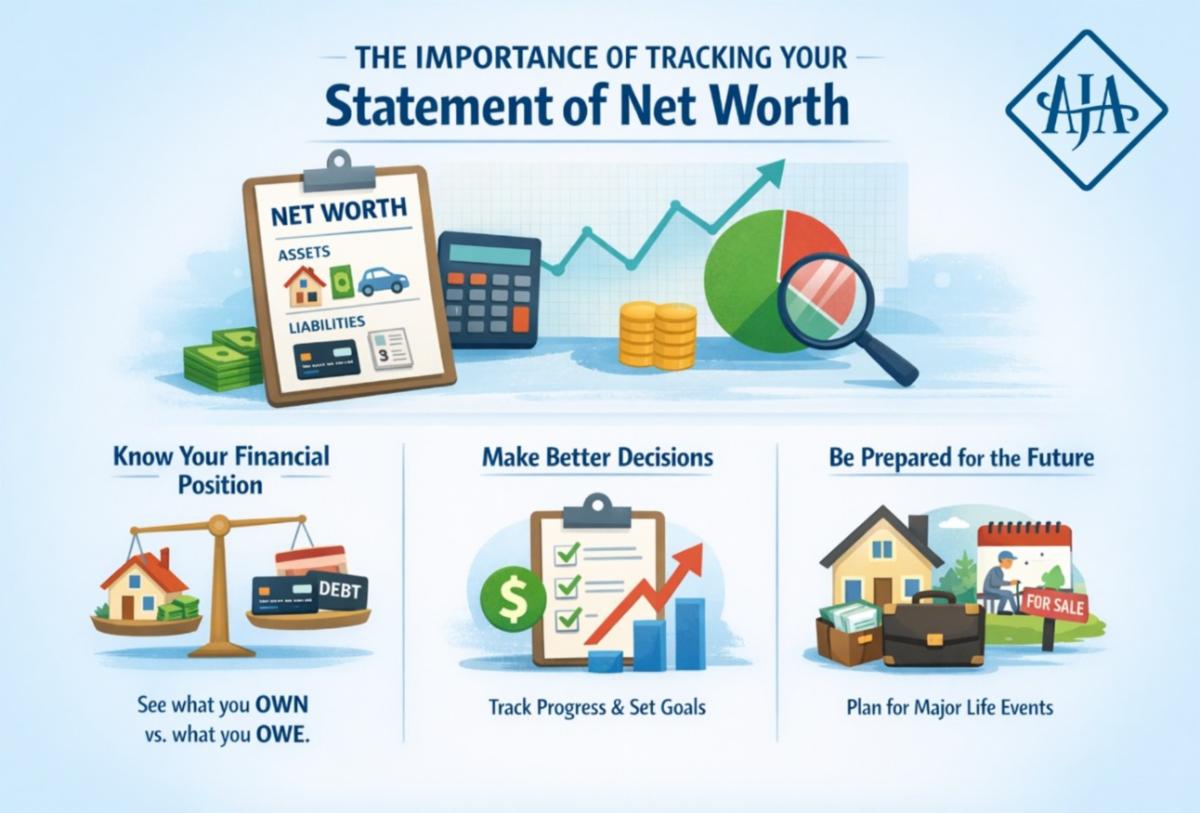
One item we regularly help clients with is to create a statement of net worth and track how it changes over time. This can be a very motivating way to see the financial progress you make over time.
Tracking your statement of net worth is important because it gives you a clear snapshot of where you stand financially at any moment. It shows what you own (assets like cash, investments, real estate) versus what you owe (debts like mortgages, loans, credit cards). Without tracking it, it’s easy to feel financially “fine” while quietly moving in the wrong direction.
It also helps you make smarter decisions with money. When you monitor changes over time, you can see whether paying down debt, saving more, or investing is actually improving your financial position. It turns vague goals like “build wealth” into measurable progress, which makes planning much more realistic.
Finally, tracking net worth keeps you prepared and in control, especially during major life events like retirement planning, buying a home, selling a business, or dealing with estate planning. It helps identify risks early, spot opportunities, and stay organized when financial decisions matter most.
| | America's Plumbing Problem | | |
The United States financial system is like the plumbing in your home. The water pressure needs to be just right to keep the system flowing smoothly. The Fed, which is the U.S. central bank, is the primary plumber responsible for maintaining the system.
The Fed adjusts interest rates
One tool the Fed uses to keep the financial system operating efficiently is the federal funds rate. When newscasters say the Fed raised or lowered rates, that’s often the rate they’re discussing. Many investors keep a close eye on Fed rate cuts and hikes because they can influence financial markets. For example:
- When the economy is overheating (water pressure is too high), the Fed can release the pressure by raising the federal funds rate. Higher rates make it more expensive to borrow, reducing the flow of money. This action can also put pressure on stock prices because higher borrowing costs can lead to lower profits, according to Mary Hall of Investopedia.
- When the economy is slowing or in recession (water pressure gets too low), the Fed can increase the pressure by lowering rates, causing money to flow more freely through the system. Rate cuts can boost stock prices because lower borrowing costs can lead to higher profits.
The Fed also buys bonds
Over the past few months, Wall Street’s attention has shifted from the federal funds rate to another tool the Fed relies on to keep money flowing through the system – the Fed’s balance sheet. That’s basically a list that includes everything the Fed owns, such as Treasury bonds and mortgage-backed securities.
- When the pressure in the financial system is low, the Fed pumps more money into the system by purchasing government bonds and securities. This process is known as quantitative easing or QE.
During the financial crisis, and again during the COVID-19 pandemic, the Fed bought a lot of government bonds to stabilize U.S. financial markets. Over the last two decades, its “balance sheet grew from about $800 billion to roughly $6.5 trillion—an increase from around 6 percent to 21 percent of GDP,” reported Burcu Duygan-Bump and R. Jay Kahn, writing in FEDS Notes.
- When pressure in the financial system is high, the Fed stops buying bonds and lets the ones it owns mature. As a result, the Fed’s balance sheet gets smaller. This process is called quantitative tightening or QT.
After the pandemic, as inflation rose well above the Fed’s target inflation rate, the central bank raised the federal funds rate to cool the economy. It also stopped buying bonds, shrinking its balance sheet from about $9 trillion to about $6.5 trillion.
The size of the Fed’s balance sheet affects long-term interest rates. A bigger balance sheet can keep long-term rates lower, encourage borrowing, and support stock prices. In contrast, a smaller balance sheet can push long-term rates higher, make borrowing more expensive, and put pressure on stock prices. In other words, the Fed’s balance sheet can influence mortgage rates, bond prices, and even the stock market.
A change of course in 2026
After years of shrinking its balance sheet, the Fed paused in December and began buying bonds again. Typically, it does this to stimulate economic growth, but the economy isn’t slowing. The Fed paused because of a different stress that was building in the financial system — falling bank reserves, according to Michael S. Derby of Reuters.
Over the next couple of weeks, we’ll explain the role of bank reserves in the financial system and how the selection of Kevin Warsh as the next Fed chair could affect the Fed’s balance sheet and financial markets.
| | |
AJ Advisors
www.ajadvice.com
|
|
|
Phone: (615) 709-8709
Fax: (615) 709-8709
| |
| |
John Stauffer, CFP®
Partner
| |
Andrew Quinn, CFP®
Partner
| | Past performance does not guarantee future results. Different types of investments involve varying degrees of risk, and there can be no assurance that the future performance of any specific investment, strategy, or product (including those recommended or undertaken by AJ Advisors, LLC), or any non-investment related content, made reference to directly or indirectly in this communication will be profitable, equal any indicated historical performance level(s), be suitable for your portfolio or individual circumstances, or prove successful. Due to various factors, including changing market conditions and/or applicable laws, the content may no longer be reflective of current opinions or positions. You should not assume that any discussion or information contained in this communication serves as the receipt of, or as a substitute for, personalized investment advice. To the extent that a reader has any questions regarding the applicability of any specific issue discussed above to their individual situation, they are encouraged to consult with the professional adviser of their choosing. AJ Advisors, LLC is neither a law firm nor a certified public accounting firm and no portion of the content herein should be construed as legal or accounting advice. If you are an AJ Advisors, LLC client, please remember to contact the firm, in writing, if there are any changes in your financial situation or investment objectives or if you wish to impose, add, or modify any reasonable restrictions on our investment advisory services. Until so notified, AJ Advisors, LLC will continue to rely on the most recent information provided. A copy of our current written disclosure statement discussing our advisory services and fees continues to remain available upon request. | | | | |