|
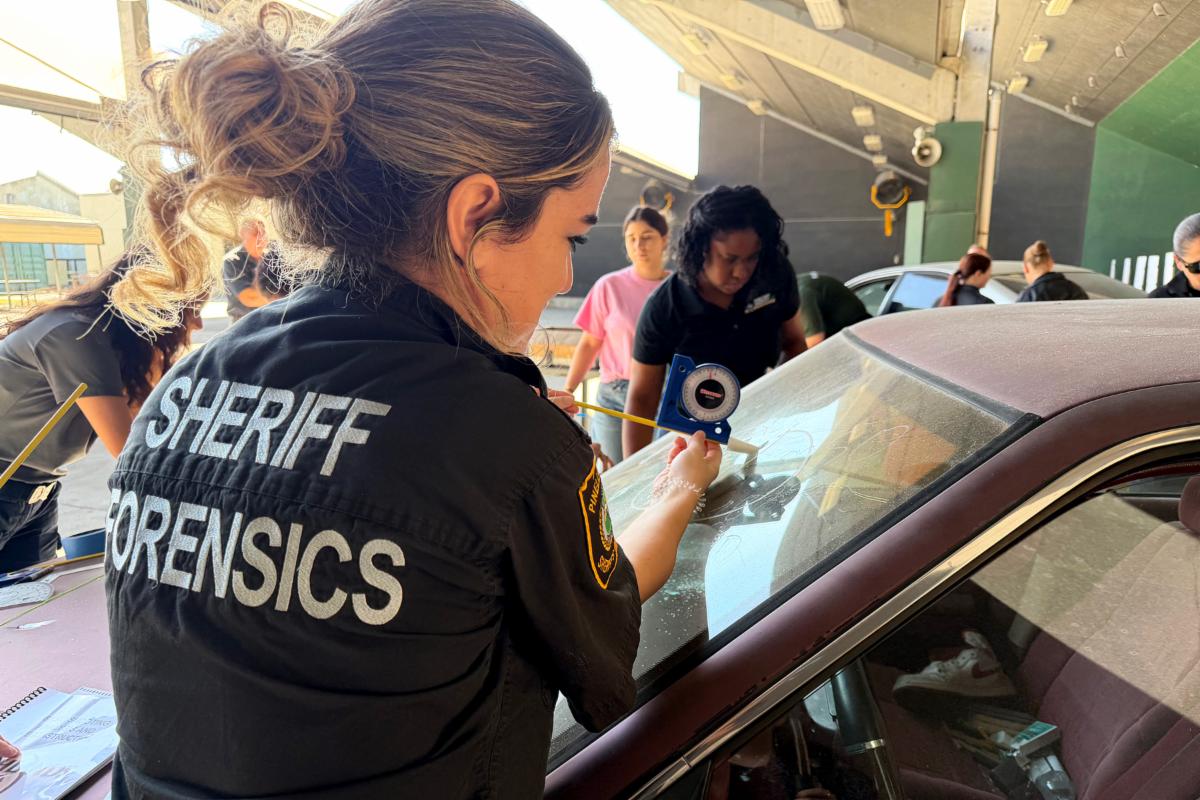
When you think of a bullet hole you probably picture exactly that: a round hole. But when a bullet strikes an object it won’t make that round hole unless it is shot at a precise 90 degree angle. Any change of angle will produce a different shape of hole, or no hole at all. The bullet may embed in something, or leave nothing but a glancing scuff mark, and a forensic scientist has to understand what these impact marks can tell them about a crime. At a recent class, members of the Pinellas County Sheriff’s Office (PCSO) Forensic Science Division learned about documenting and preserving shooting reconstruction evidence.
“The class took members through scenarios and examples of what the bullet does after it leaves the weapon, and what potential target interactions it may have,” said Forensic Science Supervisor Kristen Stropes. By recreating a variety of scenarios, they learned what to look for when a bullet strikes different surfaces. They examined marks on both the bullet and the surface it struck. “For instance if it struck concrete you could expect to see a defect where it breaks the concrete apart, and it would deform the bullet as well. But if it hits something like drywall it would most likely penetrate.”
The forensic scientists gathered at the PCSO firearms range and got the opportunity to see the “crime” occur before they investigated it. “They had a vehicle, a separate car hood and a car door, plywood boards, drywall boards, and cabinetry – all materials you would frequently find at a crime scene.” A firearms expert from the PCSO Training Division made the tricky shots so the class could study what happens when a bullet hits the materials from a variety of angles or ricochets off a surface. “Depending on what the surface is comprised of, it produces fairly predictable results.”
There are a couple of different things they can do with the evidence they find. If they have enough of the variables, they can calculate the full mathematical trajectory of the projectile. They can make these calculations whether the target was fixed or movable, though for a movable target they need to collect more information to create an accurate trajectory.
But even with only partial data they can use trajectory analysis to help solve a case. “If we don’t have all of the variables needed to create a true trajectory, we can insert a rod or use a laser for demonstrative purposes only, to provide a relative image of where a shooter may be positioned.” Dowel rods can be inserted into the bullet hole to show the angle at which the bullet struck, or a laser can trace the full path from the hole back to the general area where the shooter had been standing. Having that information can help corroborate or refute a suspect or witness statement. It can also help them collect evidence. In a recent case where the shooter had been positioned somewhere in a densely overgrown field, the science of bullet trajectory guided investigators to the place where they could find shell casings.
The trajectory information can be used in conjunction with the FARO 3D scanner to create a realistic three-dimensional image of the entire scene. That way, a detective or even a jury can walk through the virtual crime scene, viewing the trajectory from different angles in the context other objects and people who were present.
The training they received is based on firearms, but what if a more uncommon weapon is used? “If the victim is harpooned or hit with a slingshot we would have to do in-house experimentation to recreate the crime using the same exact weapon and ammunition,” Stropes said. Previous training examined the effects of bullets on the body, using a pig carcass purchased from a butcher as an analog for a human victim. After their analysis of the body, it was buried, and dug up again more than a year later so forensic scientists could practice recovering buried remains.
A forensic scientist looks at more than just the trajectory in a gunshot case. Directionality is also important. The shape of a bullet hole, defects in the surface, and the presence of residue can show which is the entry hole, and which is the exit hole. This can be especially important when a bullet penetrates or strikes multiple surfaces, such as if it passes through two walls. Forensic scientists can also estimate the distance from the muzzle to the target based on visible gunshot residue. All of this can help present a clear picture of where the shooter and target were positioned.
Of course, forensic scientists use many other methods to collect evidence at a crime scene involving a projectile. They can lift fingerprints at the scene, and even process pieces of evidence with the vacuum metal deposition chamber to reveal hidden prints. The areas they suspect someone touched can be swabbed for DNA. Other pieces of evidence can be processed with the MVAC, which can extract DNA from difficult surfaces. Shell casings left behind can be analyzed through NIBIN and matched with known crime guns. Using science and detailed analysis, PCSO’s skilled forensic scientists gather all the evidence to solve crimes.
|