The 3 Mindsets:
Awareness, Assessment, and Action
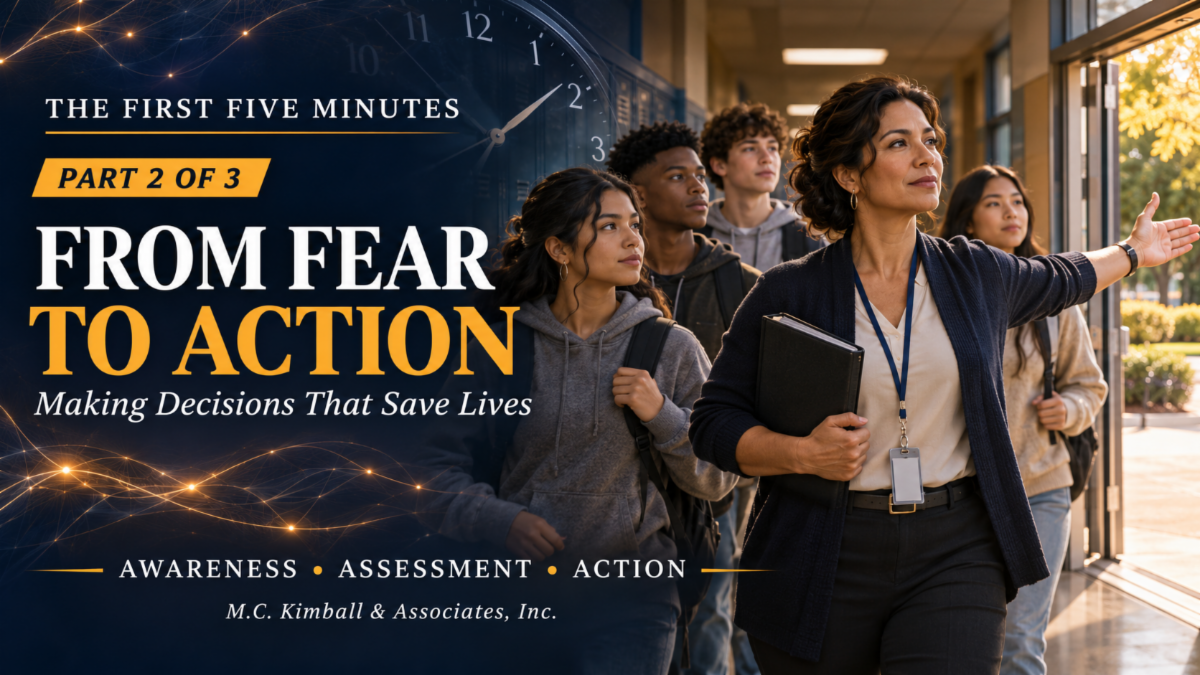
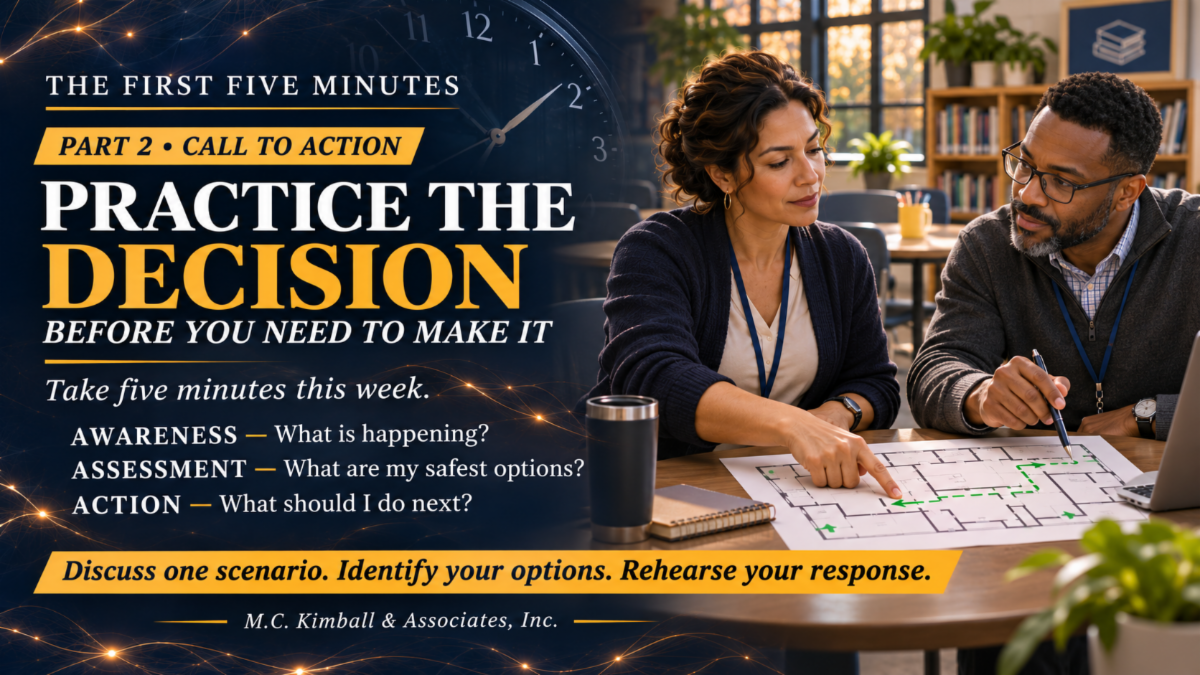
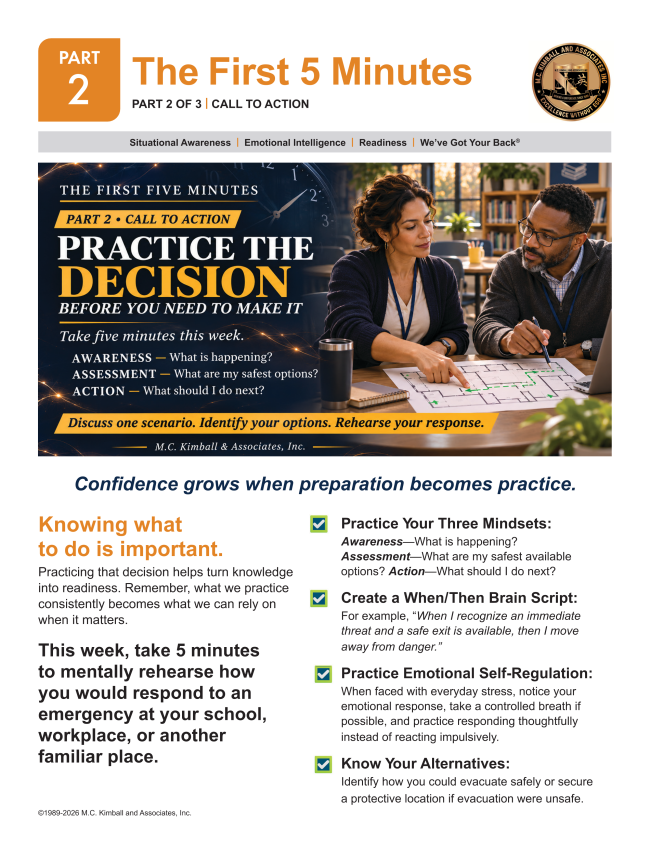
In our We’ve Got Your Back® (WGYB) student safety program, we use these three interconnected mindsets to help people navigate situations involving uncertainty and potential danger.
-
Awareness - What is happening?
-
Assessment - What does it mean?
-
Action - What should I do?
These mindsets provide a practical structure for decision-making.
- Awareness helps us recognize that something is happening.
- Assessment helps us evaluate the available information and identify our options.
- Action involves choosing and implementing the most appropriate response.
Importantly, this is not a slow, rigid, three-step process. During a rapidly evolving emergency, these mindsets may operate almost simultaneously. We must continue reassessing conditions because the safest option can change.
Your Brain Wants Certainty.
Survival May Require Action Before Certainty Arrives.
One challenge during a violent intruder event is the brain's tendency to interpret unfamiliar information through familiar experiences. (The Ostrich Paradox - Meyer and Kunreuther)
• A loud noise may be mistaken for construction.
• People running may initially be interpreted as students playing or employees reacting to a minor disturbance.
This process is sometimes associated with normalcy bias—the tendency to underestimate an unusual threat because it does not fit our expectations. However, not every hesitation is normalcy bias. Uncertainty, conflicting information, and automatic defensive responses can contribute.
The practical lesson remains important. We must train ourselves to recognize credible danger indicators and evaluate them promptly. This does not mean reacting recklessly to every unusual sound. It means understanding that waiting for absolute confirmation can create additional risk. It’s like training to maintain readiness for defensive driving.
The First Decision:
Can I Safely Move Away From the Threat?
When a safe route is available, evacuation can create distance between individuals and the source of danger.
Distance is often one of our most valuable protective resources. However, movement must be based on conditions. Running without assessing the environment can lead someone toward the threat, a bottleneck, or another hazardous area. This is where situational awareness becomes practical.
• Conscious Awareness helps us remain focused on the immediate problem.
• Sensory Awareness helps us recognize sounds, movement, and relevant changes.
• Spatial Awareness helps us identify exits and potential hazards.
• Informed Awareness allows us to apply knowledge of the building, emergency procedures, and available alternatives.
When evacuation is the safest option, move promptly, leave belongings behind, encourage others to follow when feasible, and continue toward a safer location. Once safe, notify emergency services and provide useful information if it is not already known.
The objective is not simply to run. It is to move away from danger with purpose. Remember to spread out and avoid bunching up at doors and chokepoints. Groups provide the assailant with targets of opportunity.
When Evacuation Is Unsafe:
Deny Access and Improve Protection
There may be circumstances in which leaving a room or building would increase exposure to danger. In those situations, securing the available space may provide the better protective option. Locking a door, using appropriate barricades when feasible, moving away from entrances, and staying outside direct lines of sight can create additional barriers between occupants and the threat.
Ensure that you are never huddled up in a corner and that you do not put yourself in a position of “Duck and Cover” under a table. Case studies and history teach us that duck and cover and huddling provide the shooter with targets of opportunity that they are searching for. These actions should be practiced as part of established emergency procedures.
There is a critical distinction between concealment and cover. The distinction is:
• Concealment helps prevent someone from being seen.
• Cover provides some degree of physical protection from gunfire or explosive devices.
A desk, curtain, or interior partition may conceal someone without providing meaningful ballistic protection. Some structural features offer greater protection as cover, but their effectiveness depends on materials and circumstances.
The goal is to use the best available protection while avoiding unnecessary exposure. Remember that no room, no lock, no barrier, or procedure can guarantee safety.
Emotional Intelligence During Lockdown: Controlling What We Can Control
Consider a classroom where several students are frightened. One student begins crying. Another wants to call a parent. Someone asks whether they should open the door to see what is happening. The teacher is also afraid. Emotional intelligence becomes essential.
The teacher cannot eliminate the danger or guarantee the outcome. But the teacher can influence how the group responds.
Using a steady voice, simple directions, and reassuring nonverbal communication may help students calm and focus on protective actions.
Simple direct phrases like:
• "Stay away from the door."
• "Keep your phones silent."
• "Follow my directions."
Provide clear, concise directions. These instructions are brief because complex communication is more difficult during extreme stress. They also demonstrate a principle of crisis leadership:
• People do not need perfect emotional composure from their leaders. They need clear, appropriate direction.
Can Breathing Help the Brain Function Under Stress?
Breathing is one of the few parts of the body's stress response we can consciously influence. When we become frightened, our breathing may become faster or shallower. Deliberately slowing our breathing can help regulate physiological arousal and support attentional control.
Some emergency-response training programs teach structured breathing techniques, including box breathing, which involves a repeated pattern of inhaling, holding, exhaling, and pausing. However, breathing techniques are not a substitute for immediate protective action. You need to move away from danger or secure a door; in other words, you need to act first.
When conditions permit, one or two controlled breaths and a simple internal cue can help you regain focus.
For example:In our third and final installment of our Science of Survival series, Train the Brain Before the Crisis, we will explore how neuroscience, emotional intelligence, realistic practice, and effective leadership help build lasting readiness, and why the best time to prepare for the first 5 minutes is long before they begin.
• "Focus."
• "Look for options."
• "Take the next step."
The purpose is not to make fear disappear.
It is to support functional thinking while fear is present.
|