Rehab Clinical Brief


Structured, Progressive Rehabilitation for PT and Veterinary Care Teams.


Carpus and Digit Rehabilitation

Three Priorities for Safe, Progressive Recovery

1


Begin with Low-Load Stability on Predictable Surfaces


Early carpal and digital rehabilitation should prioritize controlled, low-load stability work on firm, predictable surfaces. Begin with structured weight shifting and quiet stance control before introducing dynamic tasks. The goal is to restore joint tolerance and neuromuscular control without provoking inflammation. Stable surfaces reduce unwanted micro-movement and allow precise loading of healing structures.

2


Surface Selection Changes Everything


Surface instability has an outsized impact on the carpus and digits. Excessive motion, soft footing, or unstable equipment can quickly exacerbate tendon, ligament, or joint irritation in this region. Progression should be deliberate and minimal, with surface challenge introduced only after consistent pain-free tolerance on firm ground. In carpal and digital cases, too much movement too soon often delays recovery.

3


Restore Toe Strength and Proprioception Early


Digital flexor weakness can impair sensory feedback and paw placement early in recovery. Targeted toe activation, paw targeting, and slow, precise drills help restore both strength and proprioceptive accuracy. Emphasize controlled placement and accuracy over speed or repetition volume. Early restoration of distal control improves limb stability and reduces compensatory loading proximally.

Looking for more information?


Evidence Update


Carpal Ligament Instability


A retrospective review of 14 dogs with ligamentous carpal instability demonstrated significant improvements in alignment and lameness following brace application. Eleven dogs returned to normal function, and 11 of 12 resumed agility competition.


Pre-treatment assessment revealed increased valgus and varus angulation with reduced flexion compared to the contralateral limb. After bracing and long-term monitoring, alignment normalized and no measurable inter-limb differences remained. Median lameness scores improved from 3 pre-treatment to 0 at brace removal and follow-up.


Clinical Relevance


Carpal bracing appears to provide meaningful mechanical stabilization, supporting functional recovery and return to athletic activity in dogs with ligamentous carpal instability.


Tomlinson, J. E., & Manfredi, J. M. (2014). Evaluation of application of a carpal brace as a treatment for carpal ligament instability in dogs: 14 cases (2008–2011). Journal of the American Veterinary Medical Association, 244(4), 438–443.


Resources Built for Clinical Precision


Treatment Protocols


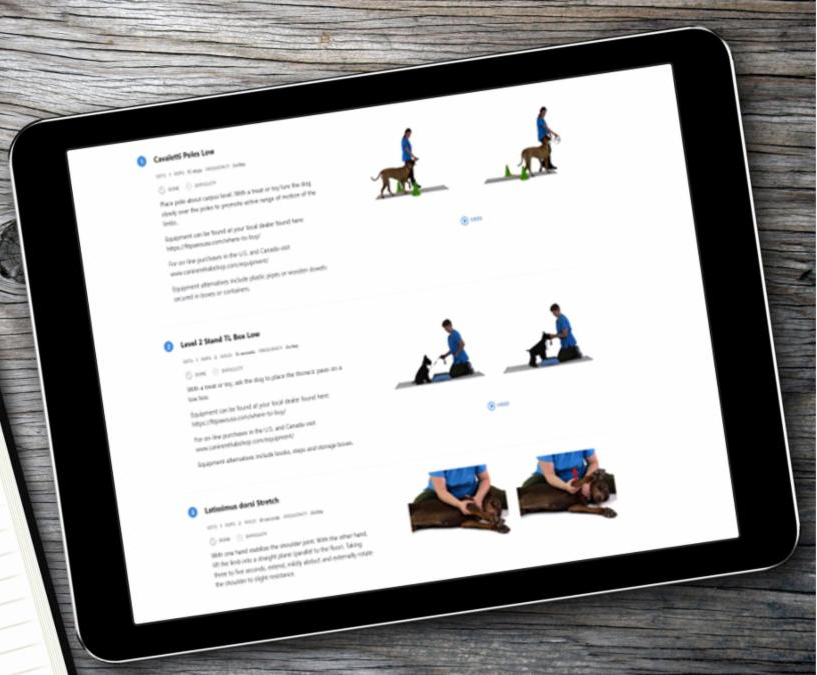
Structured, diagnosis-specific clinical pathways designed to guide evaluation, progression, and decision-making.


Explore Clinical Protocols

undefined

Home Program Templates


Pre-populated, structured programs built for clarity, compliance, and safe progression.


Start Your Free Trial for Access


Practice with Clarity.

Treat with Confidence.

Relax into the SaFi integrated ecosystem of education, execution, and client communication.


LEARN


Understand rehabilitation concepts with clarify and confidence.


Foundation Learning

DO


Apply clinical reasoning through structured treatment planning.


Clinical Protocols

EDUCATE


Educate clients with clear and consistent home programs.


GoGoCharlie(TM)


About the Creator


Sasha Foster is an internationally recognized animal physical therapist, author, and educator. Sasha brings together deep clinical expertise and a talent for simplifying complex rehabilitation concepts—so every therapist, client, and patient feels confident and safe.


GoGoCharlie is proudly powered by Wibbi.

Delivering a seamless, secure platform for professionals who need fast, professional home-program tools.

Platform Support and Infrastructure Provided by Wibbi

hello@gogocharlie.com

+1 866-301-3439


EXPLORE: About the Content Creator/GoGoCharlie/Heal Up Pup

Collaborations and speaking engagements: submit here.


Sasha Foster™ Educational Products

Evidence-informed. Human-centered. Clinically grounded.