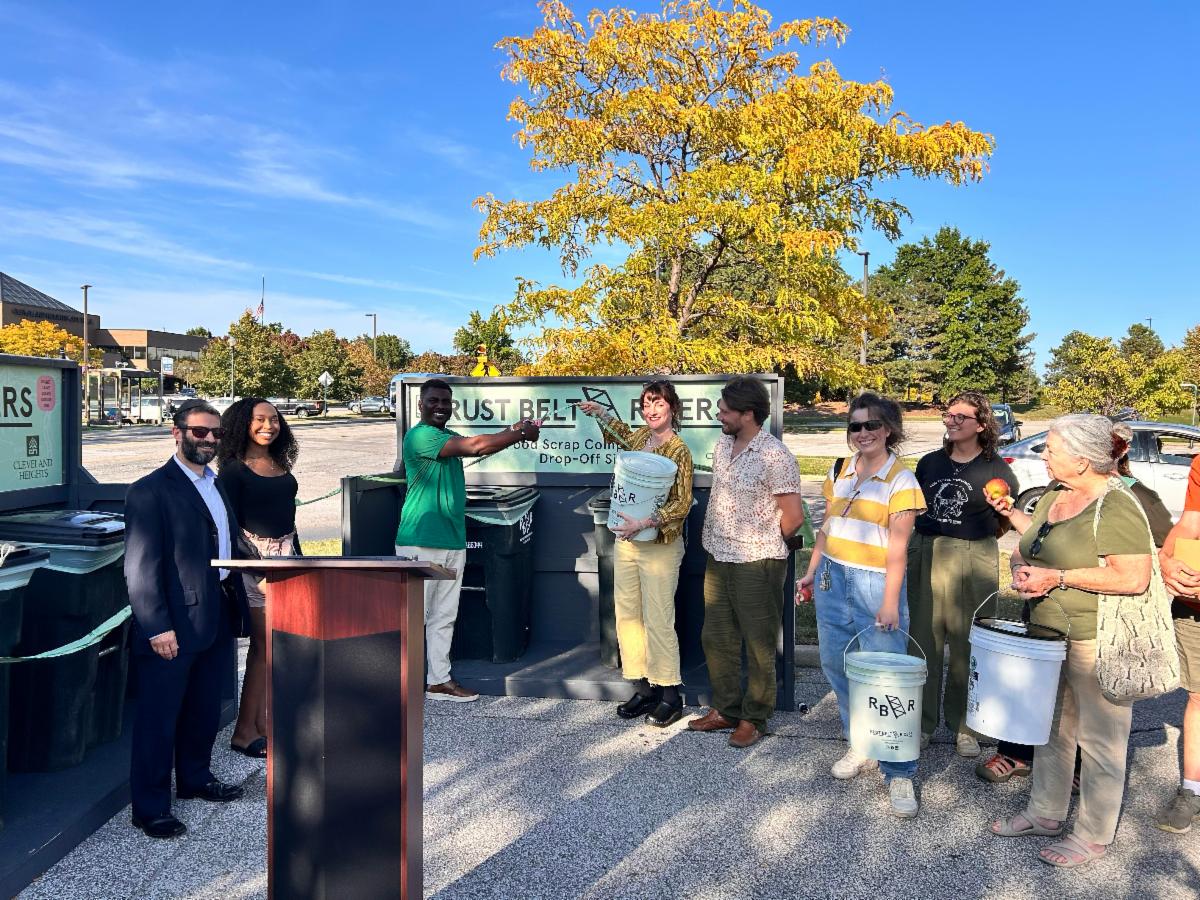
City launches municipal compost pilot program
When Cleveland Heights launched its Climate Action and Resiliency Plan in December 2024, it identified 28 strategies and 155 actions across seven sectors—Buildings, Energy, Transportation, Waste, and more—to reduce the city’s carbon emissions. Known as the Climate Forward Plan, it was advanced under Mayor Kahlil Seren’s administration, which set clear goals, championed broad community input, and initiated key actions for implementation.
One of those actions is cutting food waste, a significant source of methane as it decomposes. The municipal compost program launching this week is a concrete step toward that goal—reducing emissions, diverting solid waste from landfills, and creating a valuable soil amendment in the process.
“It takes a village to achieve any climate action. When everybody sees themselves in the Climate Forward plan, together we will achieve our carbon reduction and resilience goals.”
—Cleveland Heights Climate Action & Resilience Coordinator, Andy Boateng
The Details
The City of Cleveland Heights is partnering with Rust Belt Riders, a local composting company, to launch a municipal compost pilot program. A composting station has been installed at the Dave’s Severance store parking lot for residents new to composting to drop off food scraps—including meat, bones, and pizza boxes—along with other approved materials [for a list of compostable items, click here]. The City is covering the monthly cost for 300–400 residents to participate; residents are encouraged to use a reusable bucket with a lid for collecting and transporting food waste. [More details here].
Why it matters
- The Climate Forward Plan was developed with extensive community input and is now being implemented under Mayor Seren’s leadership, with early actions—including this compost pilot—focused on measurable, near-term impact.
- The Plan’s Materials & Waste sector calls for expanding local composting to reduce organics and food waste in landfills—exactly what this pilot is designed to do.
- Solid waste accounts for about 4% of Cleveland Heights’ total carbon emissions, making it the City’s fourth-largest emissions source; reducing organics in the trash stream lowers methane generation.
- Cleveland Heights has set two clear targets: reduce emissions 30% by 2030 and achieve carbon neutrality by 2050. The compost program is one of several implementation steps—alongside energy-efficiency upgrades and dedicated staffing for climate work—moving the City toward those goals.
Mayor Seren’s administration has emphasized turning plan commitments into action. This pilot is a practical start that lets residents participate directly in the City’s climate goals—one bucket at a time.
|