January 23rd, 2026 | Volume 57, Number 3 | | |
TCC/TAC of the Mobile MPO will meet on Wednesday, January 28th, 2026 at 10:00am at the GM&O Building at 110 Beauregard St, Mobile, AL 36602.
Mobile MPO Policy Board will meet on Wednesday, February 11th, 2026, at 10:00am at the GM&O Building at 110 Beauregard St, Mobile, AL 36602.
Public Notice: HERE
| | |
Recent Scheduling Changes This Week for Mobile MPO
The target start date or project engineers estimated amount has changed for the following:
Project : 100079629 ( CN )
Federal aid number : BR I065
County : BALDWIN
Project Description : BRIDGE REHABILITATION ON I-65 ON THE GENERAL W.K. WILSON JR. BRIDGE (BIN NOS. 12321 AND 12322)
Old Target start date : July 31, 2026
New Target start date : January 29, 2027
Project : 100069499 ( RW )
Federal aid number : STPMB 4919 (251)
County : MOBILE
Project Description : ADDITIONAL LANES ON CR-41 (CELESTE ROAD) FROM FOREST AVENUE TO SHELL STREET
Old Target start date : April 01, 2026
New Target start date : May 01, 2026
Project : 100079490 ( CN )
Federal aid number : NH 0158
County : MOBILE
Project Description : REPLACEMENT OF BRIDGE CONTAINMENT SYSTEM ON SR-158 EASTBOUND BRIDGE OVER BIG CREEK (BIN # 018683)
Old Target start date : May 29, 2026
New Target start date : September 25, 2026
Project : 100080796 ( CN )
Federal aid number : STPAA 0188
County : MOBILE
Project Description : INSTALL LEFT TURN LANE ON SR-188 AT I-10 EB ON RAMP IN THE CITY OF GRANDBAY
Old Target start date : May 29, 2026
New Target start date : September 25, 2026
Project : 100080777 ( UT )
Federal aid number : NH I065 (536)
County : MOBILE
Project Description : ADDITIONAL LANES AND BRIDGE REPLACEMENT ON I-65 FROM SR-158 TO CR-41 (CELESTE RD) (BIN 009267,009268)
Old Target start date : February 01, 2026
New Target start date : March 01, 2026
| | |
Baldwin County Transit Need and Demand Analysis
Background
Baldwin County provides transit services through the Baldwin Regional Area Transit Service (BRATS). This service is a demand response transit service providing trips to residents who schedule on their website, over the phone, or through the BRATS app. Service is provided Monday through Friday 7 a.m. to 5 p.m. and fares start at $2 per ride for the first 5 miles and then 50 cents per additional 5 miles. Rides can be booked 7 days in advance, but availability is dependent on ride volume.
In the sections below the terms ‘need’ and ‘demand’ are used frequently. Please consider ‘need’ to mean the universe of all trips, many of which are completed using any means available, including rides provided by other people and services. ‘Demand’ is meant to illustrate a number of trips required by persons in need that could be facilitated through a public transportation service specifically.
Note: The methodologies and calculations utilized here are greatly simplified for the purposes of brevity in this memo. Please review the full text of TCRP 161 for complete details on the factors, calculations, and concepts utilized in this document.
Service Need
Applying publicly available research from Transit Cooperative Research Program (TCRP) Report 161 – ‘Methods for Forecasting Demand and Quantifying Need for Rural Passenger Transportation: Final Workbook’[1], it is possible to estimate the number of residents that require public transportation services, and the General Public Demand on the transit system. This data is generated by evaluating data from the American Community Survey (ACS) including household size by vehicles available, poverty status in the previous 12 months, those 60 years old and older, and those with ambulatory or independent living disabilities[2].
In Baldwin County, there were 2,039 total households without a vehicle, and an estimated 3,405 individuals living in those households. There were also 24,819 persons reported as living below the poverty level at some point within the previous 12 months.
The data also accounted for 70,201 individuals aged 60 or older and 11,906 individuals with ambulatory or independent living disabilities.
As a result of these calculations, it was estimated that in 2023 there were a total of 28,224 individuals in need of passenger transportation services. Compared to a total county population in 2023 of 239,945, this represents 11.76% of Baldwin County’s population that is likely to require some form of passenger transportation service.
Mobility Gap
Going further, TCRP 161 provides a method for estimating a ‘mobility gap’ or a number of trips per day or per year, that are not taken by households due to mobility challenges. For Baldwin County this is estimated for 2023 to be 2,855 trips per day. Over the course of a year (300 days) the annual trip need is estimated to be 856,380. (Note that this is a total universe of trips needed, where many are filled by other services, friends, family, etc.) TCRP 161 states that on average approximately 20% of these trip needs were met by public transportation services at the time of publishing in 2013.
Trip Demand
To estimate the rural public transportation demand, TCRP 161 recommends factors that apply to the values retrieved for the population over 60, those age 18-64 with mobility limitations, and households with no vehicles available. Utilizing these factors as illustrated in the table below, it is estimated that Baldwin County has a general public demand of approximately 219,572 trips per year. These are defined as trips not related to any other social service or public programming and would be trips eligible for reporting to the Rural NTD if provided.
Baldwin County Totals
Estimated Demand - Trips | Persons | Factor*
Age 60+ 70,201 2.2
Mobility Limited Age 18-64 11,906 5.21
Household with No Vehicle Available 2,039 1.52
Estimated Trip Demand (Sum) 219,572
*These factors are utilized as recommended in TCRP 161.
To calculate the estimated annual demand on rural transportation services, the annual mobility gap found above as well as the reported revenue miles for Baldwin County (851,744 in 2023) are utilized. The calculation from page 24 of TCRP 161 yields a result of 98,925 trips. It is noted here that there were a total of 100,167 boardings in Baldwin County during 2023 which yields a value greater than the expected demand.
Conclusion
In conclusion, this information highlights three critical points. First: BRATS appears to be meeting a large portion of the county's transit requirements, demonstrating the effectiveness of the existing system, second: while BRATS is exceeding the demand for those that need transit services, they are currently meeting less than half of the estimated general public demand, suggesting there could be potential to expand services in order to meet these needs; and lastly: further research is needed to understand who is utilizing these services in Baldwin County. Additional research could include daily trip and route density, as well as direct rider surveys. These are important in identifying true use of the system and to prioritize high demand destinations for those using the service most frequently. Broad community outreach can help identify potential riders with demonstrated transportation needs that are not accessing available services. This information could be used to modify service offerings to attract new users, helping to address the unmet estimated general public demand for transit in the county.
Whether the goal is to maintain current service levels or expand to better serve the community, this data provides a compelling foundation for future planning, funding requests, and service enhancements. Understanding the levels of need and demand can help not only improve access to essential services for vulnerable populations but also contribute to the creation of a more equitable and efficient transportation system for all residents of Baldwin County.
[1]Methods for Forecasting Demand and Quantifying Need for Rural Passenger Transportation: Final Workbook (2013) http://nap.nationalacademies.org/22619.
[2] TCRP 161 only calls for the use of independent living disabilities, NADO RF staff included ambulatory disabilities in this calculation as well.
| |
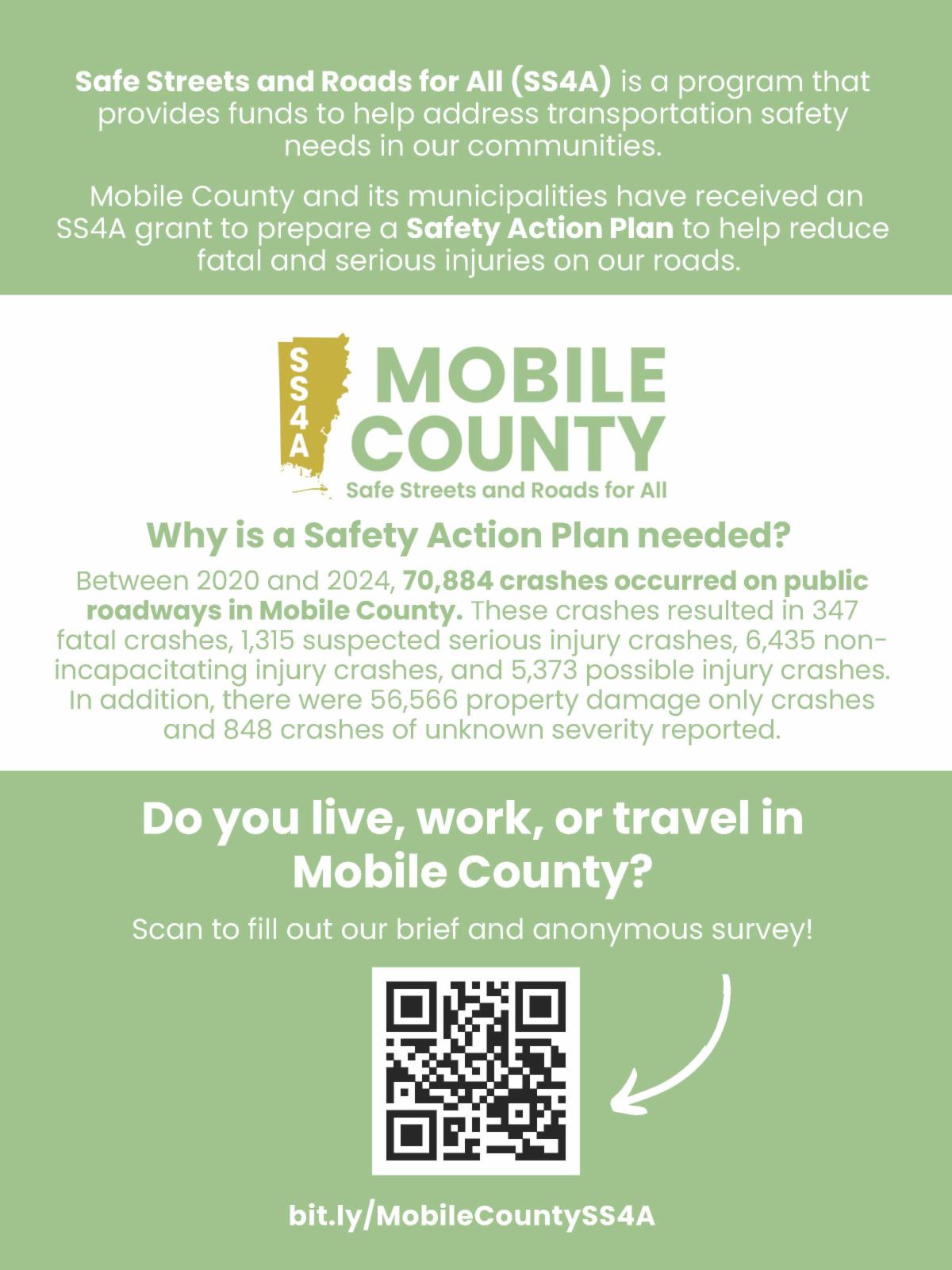
Mobile Countywide Safe Streets and Roads for All Grant
| | |
Project Letting January 30th, 2026
BALDWIN COUNTY
STPAA-HSIP-0287(503) , BALDWIN COUNTY
for constructing the Planning, Resurfacing, Traffic Signal Backplate Upgrades, and Traffic Stripe on SR-287 from the intersection of East 3rd Street to the junction of SR-59 in Bay Minette. Length 1.925 mi.
The Bracket Estimate on this project is from $1,028,628 to $1,257,212.
ESCAMBIA COUNTY
None at this time
MOBILE COUNTY
STPAA-HSIP-0193(511) , MOBILE COUNTY
for constructing the Safety Widening, Planning, Resurfacing, and Traffic Stripe on the SR-193 Service Roads from Rabbit Creek to the I-10 Interchange northeast of Theodore. Length 1.929 mi. The Bracket Estimate on this project is from $788,366 to $963,559.
| | |
Seagrass restoration bill passes AL House
BY GRANT McLAUGHLIN 1/22/2026
A Mobile County lawmaker has now had two bills focusing on the Alabama coast sail through the state House of Representatives as of the end of the chamber’s business for the week.
On Thursday, House lawmakers nearly unanimously approved House Bill 38, which if passed by the Senate and approved by Gov. Kay Ivey, would establish a task force commission to study how to restore seagrass and sea oats to Mobile Bay and the coast’s beaches.
The House voted 102-0 in favor of the legislation, with two representatives voting absent.
Before its passage, bill sponsor and House Rep. Chip Brown, R-Hollinger’s Island, told his fellow members the legislation will help to address a “90 percent” loss in Mobile Bay’s sea grass population.
“We’ve had 90 percent of our seagrass eliminated by thin layer placement and other dredge activities,” Brown said.
Brown’s words on the floor alluded to another bill awaiting further action in the House, which would, if passed, curtail the U.S. Army Corps of Engineers from depositing dredge material collected from maintenance work on the Port of Mobile’s shipping channel back into the bay. The practice is known as “mud dumping” by its critics.
Click HERE to read more.
| |
Congress advances transportation funding bill
The legislation largely maintains funding for public transportation and passenger rail but slashes a program to add intercity passenger trains.
Dan Zukowski Jan. 22, 2026
U.S. House and Senate appropriators agreed Tuesday on bipartisan legislation to fund transportation through the remainder of fiscal year 2026, which ends Sept. 30.
The bill “provides the overwhelming majority of public transit and passenger rail investments” funded by the Infrastructure Investment and Jobs Act, according to the American Public Transportation Association.
The House is expected to vote on the measure this week, and the Senate next week, to prevent a partial federal government shutdown on Jan. 30.
Follow this LINK for the full story.
| |
House & Senate Introduce Bipartisan Transit-Oriented Development Bill
NARC 1/22/2026
Last week, the House and Senate introduced the bipartisan Build Housing, Unlock Benefits and Services (Build HUBS) Act to streamline transit-oriented development. Introduced by Senators John Curtis (R-UT) and Lisa Blunt Rochester (D-DE) and Representatives Mike Lawler (R-NY) and Laura Friedman (D-CA), the Build HUBS Act makes several changes to the Transportation Infrastructure and Finance and Innovation (TIFIA) and Railroad Rehabilitation and Improvement Financing (RRIF) programs. Among the reforms, the bill extends TIFIA and RRIF for five years, streamlines environmental review and project financing, and prioritizes development that includes attainable housing.
| | |
Public Comment Period for Alabama Coastal Area Management Program (ACAMP) 2026-2030 Section 309 Enhancement Strategy
The Alabama Department of Conservation and Natural Resources (ADCNR), State Lands Division, Coastal Section is making available for public review and comment the draft Alabama Coastal Area Management Program (ACAMP) 2026-2030 Section 309 Enhancement Strategy. The ACAMP serves as Alabama’s implementation of the Coastal Zone Management Act in partnership with the National Oceanic and Atmospheric Administration (NOAA).
Your input is important in helping to inform development of the final ACAMP 2026-2030 Section 309 Enhancement Strategy to be approved by NOAA. Development of this strategy will allow the ACAMP to receive additional funding through NOAA to address a priority enhancement area over a five-year period.
The public review and comment period opened January 13, 2026, and will close on February 12, 2026. The draft strategy is available for download at:
Alabama Coastal Area Management Program | Outdoor Alabama
Comments can be submitted by email to dcnr.coastal@dcnr.alabama.gov through February 12th, 2026. Please sure to use “Draft 309 Strategy” in the subject line of your email when submitting comments. We appreciate your time in assisting the ACAMP in its efforts to secure additional funding to support coastal Alabama.
| | |
Governor Ivey announces ATRIP-II awards for 2026
ALDOT News 1/21/2026
Governor Kay Ivey and the Alabama Department of Transportation (ALDOT) on Wednesday announced that more than $40 million in state transportation funding is being awarded to cities and counties for various road and bridge projects. This announcement comes the week after Governor Ivey touted in her state of the state address the tremendous progress being made by Rebuild Alabama.
“Since 2019, Alabama generated more than $2 billion, paving the way for 500 vital road and bridge projects in all 67 counties. None of these projects would have happened without the passage of Rebuild Alabama,” said Governor Ivey during her state of the state address.
The funding is made available through the Alabama Transportation Rehabilitation and Improvement Program-II (ATRIP-II), a program created by the Rebuild Alabama Act. The Rebuild Alabama Act requires ATRIP-II to be an annual program setting aside a minimum of $30 million off the top of ALDOT’s share of new gas tax revenue for projects of local interest on the state highway system.
Governor Ivey has awarded $40 million in ATRIP-II grants to local governments in each of the last five years, exceeding the $30 million minimum required by the Rebuild Alabama Act.
There were 25 projects selected for funding for a total of just over $40 million in state transportation funding. Of those awarded projects, 20 were from cities and counties putting forward more than $11 million in local funds. Under the ATRIP-II program, there is no requirement that local governments put up matching funds to be eligible. The state has now awarded more than $260 million in state transportation funds under ATRIP-II since the program’s creation in 2019.
“Rebuild Alabama continues making generational transportation improvements a reality. I am proud to award funds towards these 25 projects. Our success with Rebuild Alabama will only continue,” said Governor Ivey.
The projects were selected by the ATRIP-II Committee created by the Rebuild Alabama Act. It is anticipated that a number of projects will be under contract during the 2026 fiscal year. All projects are required to move forward within two years of the awarding of funds.
A list of this year’s selected projects in our region is below.
County | City | Project Description | ATRIP-II Award | Local Funds | Total
Baldwin Daphne Adding southbound right $1,176,806.80 $253,896.22 $1,430,703.02
turn lane and extending
northbound left turn lane
on SR-181 at Corte Road
Baldwin Foley Intersection improvements $2,000,000.00 $950,000.00 $2,950,000.00
on Foley Beach Express (SR-161)
at Miflin Road (CR-20), including
turn lanes and signal upgrades
Escambia Atmore Installation of traffic signal $914,000.00 $113,400.00 $1,027,400.00
on SR-21 at Wal-Mart
Mobile Creola Access management on US-43 $778,976.00 $1,875,000.00 $2,653,976.00
from Jackson Road to 0.25
miles north of Jackson Road,
including median crossover
removal and new traffic signal
Mobile Satsuma Add right turn lane and $2,000,000.00 $482,891.89 $2,482,891.89
acceleration lane on
Pennsylvania Avenue, from
Old Highway 43 onto US-43
northbound
| | |
Britt secures dredge project funds for Mobile Bay
BY GRANT McLAUGHLIN Jan 22, 2026
U.S. Sen. Katie Britt has secured more than $20 million for Mobile and Baldwin counties through federal appropriations passed by Congress, some of which has now been made a focal point in an ongoing debate about how maintenance dredge material is disposed of in Mobile Bay.
On Wednesday, Britt’s office announced millions in federal appropriations for sediment studies in Mobile Bay, funds for several projects that utilize dredge material collected during U.S. Army Corps of Engineers work to maintain shipping channels in the bay, and more.
“There are several critical Alabama Gulf priorities I was proud to champion and secure in the recent package of funding bills passed by Congress,” Britt said in a press release issued Wednesday. “From strengthening our inland waterway infrastructure and Mobile Harbor, to supporting our hardworking law enforcement, to providing funding for our incredible higher education institutions, to upgrading water infrastructure, this key funding reflects the promise I made to return your hard-earned taxpayer dollars home to Alabama as a member of the Appropriations Committee.”
In total, $13.5 million will go toward understanding sediment buildup in Mobile Bay, environmental studies, beneficial use of USACE dredge material and for the creation of sites for new projects.
Specifically, Britt secured:
- $5 million for the Town of Dauphin Island to use dredged material from the Mobile Ship Channel to protect and restore the West End of Dauphin Island.
- $3.254 million for Mobile Harbor for the creation of a beneficial use site.
- $750,000 for an environmental investigation of the Mobile Harbor Ship Channel.
- $1.066 million for additional maintenance dredging of the Gulf Intercoastal Waterway.
- $4 million for additional maintenance dredging of Mobile Harbor.
- $500,000 for Alabama Port Authority for a study to understand sediment buildup in recent years that has impacted the Port of Mobile.
Click HERE for the rest of the story.
| |
Corps of Engineers defends so-called ‘mud dumping’ in Mobile Bay
By Margaret Kates Jan. 22, 2026
The U.S. Army Corps of Engineers, responsible for maintaining the channel that brings ships into the Port of Mobile, is defending its practice of depositing dredged sediment back into the bay - a practice called “thin layer placement,” or sometimes, “mud dumping.”
“Thin-layer placement is not ‘mud dumping,’” said Brigadier General Zachary Miller, who commands the Corps’ South Atlantic Division. “It is a measured, monitored, and science-based sediment management practice designed to mirror natural sediment processes that have shaped Mobile Bay over thousands of years.”
In an open letter, Miller said that it’s not true that the practice is the main driver of oyster and seagrass decline in the bay. Thin layer placement involves depositing dredged sediment in open-water locations throughout the bay, which environmental advocates say increases the cloudiness of the water and jeopardizes marine species.
Click HERE to read the full article.
| | MOBILE OPENS TRANSIT SURVEY, MAYOR WANTS TROLLEYS: | | |
The City of Mobile’s staff have been working with the city’s transit provider, Via, to evaluate and improve Mobile’s current services since September. “For Mobile to reach its full potential, we need a system that meets the needs of residents who depend on public transportation and provides convenient, appealing options for anyone traversing our city,” said Mayor Spiro Cheriogotis. A survey is currently collecting feedback from riders who use the Wave and asks what Mobilians want to see in their public transportation system. Additionally, AL.com recently published an interview with Cheriogotis, in which he says, “Trolleys are coming. As much as I’d like to buy a pile of them right now, we want to be cost effective and make sure this solution works. I will trust the experts. I will trust [Via’s] expertise without letting go of my ultimate vision.”
Click HERE to complete the survey.
| | |
Funding opportunities from the U.S. Department of Transportation (USDOT) open now:
-
USDOT Releases FY 2026 Better Utilizing Investments to Leverage Development (BUILD) Grant NOFO: BUILD grants fund projects that will have a significant local or regional impact and improve transportation infrastructure. Note that this NOFO may be revised soon, so prospective applicants might want to continue preparing materials but not submit applications right away.
- Deadline: February 24, 2026.
-
USDOT Reconnecting Communities Institute Technical Assistance: The Reconnecting Communities Institute provides direct technical assistance to communities that are working to expand economic opportunity and mobility through transportation reconnection projects. To request support, apply using this form.
USDOT Competitive Grants Dashboard
The DOT Competitive Grants Dashboard provides communities with an overview of competitive grant opportunities that can help meet their transportation infrastructure needs. Designed with all communities in mind, the Dashboard identifies grant programs with rural and Tribal set-asides or match waivers available. The Dashboard also includes Federal grant programs outside of DOT that may be of particular interest to rural communities. The Dashboard is updated weekly.
Additional Resource:
The DOT Navigator is a resource to help communities understand the best ways to identify grant funding that supports the delivery of transformative infrastructure projects and services.
| | |
AARP is accepting applications for the 2026 funding cycle that:
- Deliver tangible improvements to communities, such as new crosswalks, benches, bike lanes, housing designs, and public space enhancements.
- Leverage additional support from public, private, and philanthropic sources
- Help communities overcome policy barriers and implement lasting change
- Foster new collaborations and increase community engagement
2026 AARP Community Challenge Timeline
-
January 27: Question & Answer Webinar, 2 pm ET | 11 am PT
-
(Attendance is optional. A link to the webinar recording will be posted here after the event.) Register Today!
-
March 4: Application Deadline, 5 pm ET | 2 pm PT
-
See a Sample Application | Submit an Application
-
May: Applicants will be notified of their status by email
-
June 24: The grantees are announced— and the project work begins!
-
December 15: Project completion deadline
-
December 31: Deadline for after-action reports
More information about the opportunity can be found HERE
| | |
Better Utilizing Investments to Leverage Development (BUILD) Grant Program FY 2026 Funding Opportunity
For more information, click HERE.
| |
Dauphin Island’s Legend of ‘The Goat Tree’
by: Akievia McFarland
DAUPHIN ISLAND, Ala. (WKRG) — A town that’s rich in history and nature, Dauphin Island has myths and old tales, but few are as popular as the story of the Goat Tree.
The Goat Tree is a historical part of Dauphin Island. As legend has it, it used to serve as shelter for the island’s wild goats that would climb the tree at night to stay protected from the alligators that roamed below.
The tale is a favorite of locals.
Click HERE to read more!
| | | | |