|
What’s not to like about HMG’s plan for 159 new mental-health centres?
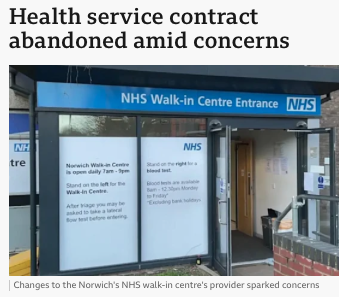
One hundred will be community walk-in centres, offering help without a referral.
Fifty-nine will be mental-health emergency departments, intended to keep people in-crisis out of noisy, crowded A&Es.
Excellent.
A conventional A&E is exactly the wrong place for someone frightened, distressed, suicidal or psychotic.
A calmer setting, staffed by people who understand mental illness, should be safer, faster and more humane.
HMG is putting £343m into the scheme… £187m for community centres and £156m for emergency departments.
We know quite a lot about the buildings. Fifty-seven will be new-builds. Another 102 will be conversions of existing sites.
Spread across 159 projects, averages a little over £2m a site.
Enough perhaps to refurbish a vacant shop, convert NHS space or build a therapeutic suite, but…
… capital builds buildings. It doesn’t staff them.
Which brings us to the obvious question… staffing.
The new SoS, Yvette Cooper, pointed to 8,500 additional mental-health workers recruited since June 2024.
Then she said…
‘… staff would have to work differently, and teams work more closely together.’
Work differently?
Two words doing the work of a whole workforce plan.
Extra staff are real, but they’re not spare.
They came into MH services already carrying substantial workforce shortages. They represented badly needed reinforcement, not a new reservoir of spare capacity, for an extra service, already...
...struggling with rising demand.
The RCN says only 12% of surveyed community mental-health nurses believe they have enough time to care properly for patients.
One in seven consultant psychiatrist posts is vacant. More than a quarter are either empty or covered by locums.
There’s no slack, and there is the extraordinary contradiction...
... in the same week ministers announced new places for mental-health staff to work, we learned many of the organisations employing them expect to employ fewer.
A survey of 37 mental-health providers found 57% expect to reduce clinical staffing this year, 59% expect vacancy freezes and 68% anticipate reducing or closing some services.
New front doors. Fewer people behind them.
Against that background, ‘work differently’ sounds less like innovation and more like a euphemism for doing more with the same people...
... or fewer.
Of course services can work better.
-
Shared records could stop patients repeating their story to every new professional.
-
AI could reduce note-taking, form-filling and duplicated administration.
-
Peer-support workers, charities, housing advisers and employment services can help with problems that do not require a psychiatrist or nurse.
-
Better-organised teams could reduce hand-offs, repeated assessments and people bouncing between services.
All worthwhile, but…
…none of it creates a psychiatrist, psychologist or mental-health nurse.
Neither does it remove the need for skilled assessment, continuity, trust and therapeutic conversation.
Mental-health care is particularly resistant to the factory version of productivity. It can’t simply be turned into shorter appointments, more contacts and faster throughput.
The conversation is not preparation for the treatment… it is the treatment.
Carl Rogers taught us that, in mental-health care, the relationship is part of the therapy. That takes time and that means people...
... people with the with the time.
You can't industrialise empathy. You can't put trust on a productivity trajectory, and...
... there comes a point when making an appointment shorter does not make it more efficient. It simply makes it worse.
Productivity matters. Bad IT, duplicated assessments and unnecessary administration waste scarce clinical time, but…
… the measure can’t simply be, how quickly someone moves through the service.
It must be whether they recover, remain safe, avoid another crisis and don’t come back through the emergency door.
Open-access centres will not simply redistribute existing demand...
... by removing referrals and thresholds they will uncover need currently hidden in waiting lists, GP surgeries, families and people’s homes.
That’s part of their purpose. It also means more work.
If trusts staff the new centres by transferring people from existing community teams, the government will have created an attractive new front door by taking staff from the rooms behind it.
Which leaves a curious imbalance in this announcement.
We know where the buildings will be.
We know which will be new-builds and which will be conversions.
We know the capital allocation.
What we don’t know is …
…who is going to work in them.
Nor do we have a recurrent staffing allocation, a safe staffing model nor an explanation of which existing work will stop if staff are transferred.
Those are not implementation details. They determine whether the policy works.
Yvette Cooper arrived at Health with a reputation for seriousness, experience and mastering the detail. Many of us thought; at last, someone sensible…
… which is why her; staff will ‘work differently’ is such a disappointing answer.
This is too important a policy to be balanced on two words.
In mental-health care, time is not the overhead.
Time is the treatment.
|