|
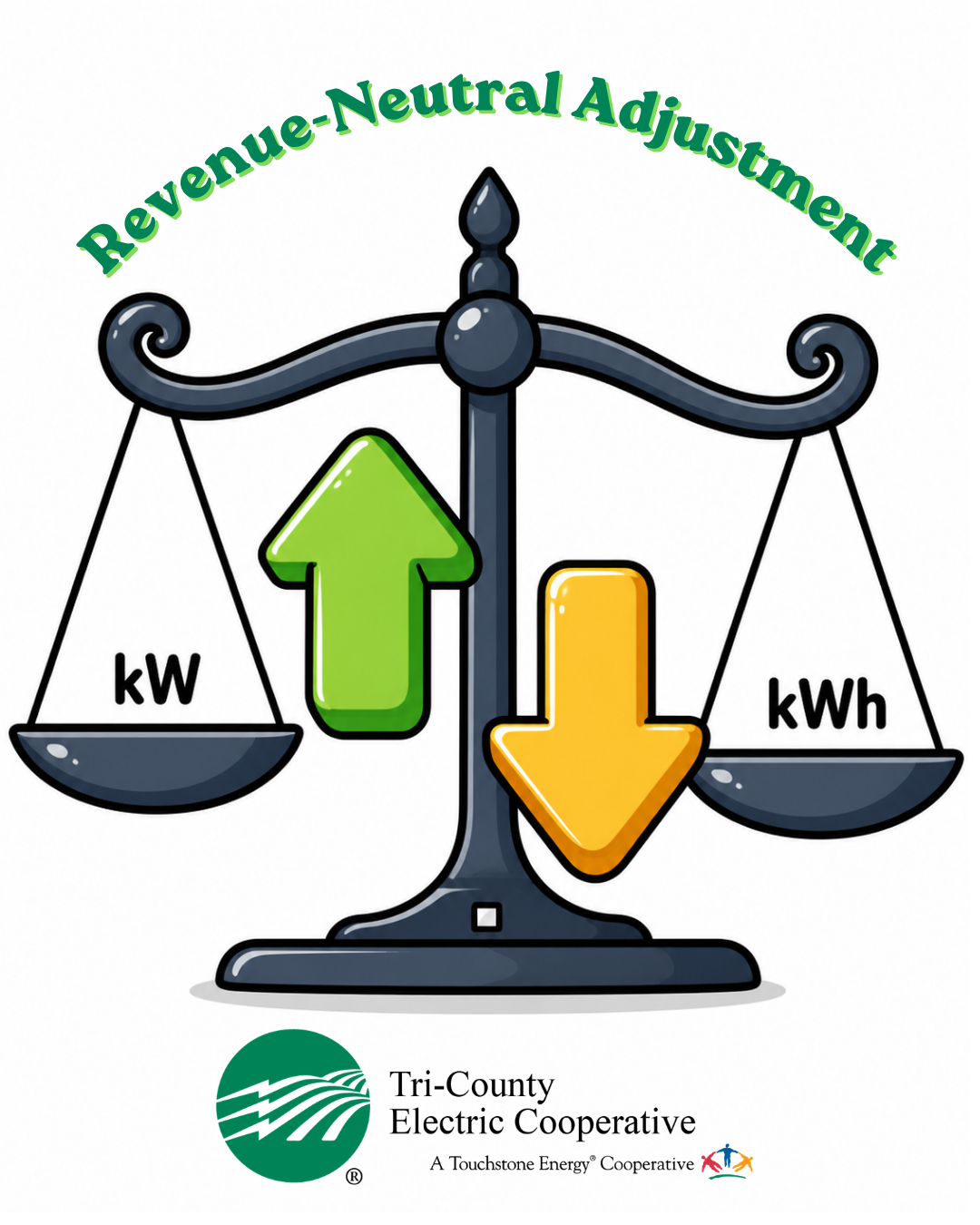
You probably saw this headline and thought, “what is a revenue-neutral rate adjustment?” In simplest terms it means a rate re-structure without changing the bottom line. Think of it as balancing the weight on a scale rather than adding or removing weight. The good news is that it’s much simpler than it sounds and for some, it can lead to a decrease in their monthly bill!
So how will that work with my bill? You’ll notice on your October bill for your September usage that the kW rates went up while the kWh rates went down. The kW rate will increase to $6 while the kWh rate will decrease from $0.13185 to $0.10064. The numbers are carefully balanced so that, in the end, the total revenue stays relatively the same. It’s not about bringing in more money, it’s about adjusting how costs are are collected. High demand users may see an increase while high kWh users may see a decrease.
There are a few reasons for this change, and one of the biggest comes down to how energy use actually works. A portion of your bill, kilowatt-hours (kWh), is heavily influenced by things we can’t control, like the weather. When temperatures are extreme, we use more energy to heat or cool our homes. But during mild winters and summers, energy use naturally drops. That can create challenges when it comes to covering the fixed costs of delivering reliable power.
That’s where demand, or kilowatts (kW), comes in. Demand reflects the amount of power being used at a given moment. Demand has always made up a significant portion of the cost we pay to supply electricity. Unlike the weather, demand is something members can manage. By spreading out when and how electricity is used, like avoiding running multiple large appliances at the same time, members can have more control over this part of their bill.
The revenue-neutral adjustment helps balance those two pieces, kW and kWh. It ensures that even during milder seasons, when overall energy use is lower, we’re still able to cover the costs of maintaining a safe and reliable system. At the same time, it gives members more opportunity to take control of their usage and potentially lower their bill through smart energy habits.
The bottom line? A revenue-neutral adjustment isn’t a rate increase for everyone; it’s a rebalancing. While individual bills may look a little different, the overall goal is to create a system that’s fair, sustainable, and better aligned with how energy is used today. Simple things like running appliances at different times of day, or spacing out when you use high-energy equipment can help lower your demand. By being mindful of when you use electricity, not just how much, you can take control of your energy use and potentially lower your monthly bill.
|