Made in NC Showcased ADF-Commissioned World Premieres
by Five Amazing Choreographers -- and Their Troupes
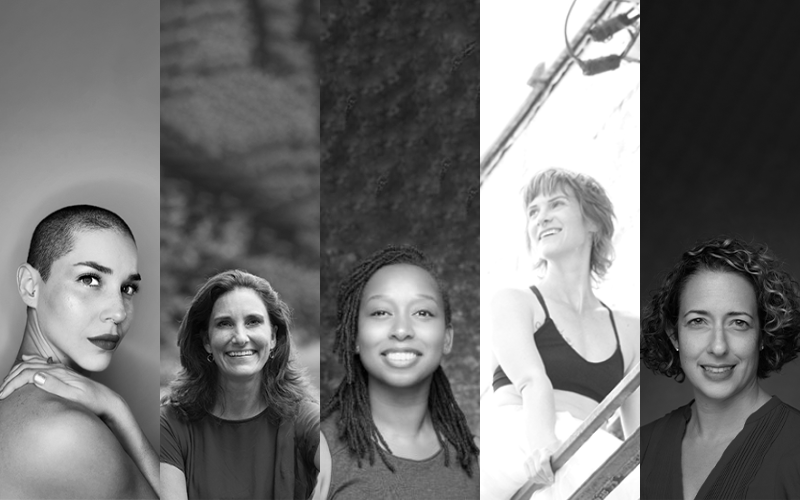
Made in NC includes ADF-commissioned world premieres by (from left) Nicole Vaughan-Diaz, Michelle Pearson, Kristin Taylor Duncan,
Renay Aumiller, and Caroline Calouche at 7:30 p.m. Saturday, June 17th, in Duke University's R.J. Reynolds Industries Theater
Asheville, Raleigh, Durham, Charlotte and Elon are five thriving locations for dance in North Carolina. This is the second year that the
American Dance Festival has commissioned world-premiere works by North Carolina artists
for a special evening called Made in NC.
On Saturday, June 17th, the large crowd in the lobby of Duke University's
R.J. Reynolds Industries Theater was filled not only
with ADF regulars, but friends and family whom I suspect may be first-timers at ADF. And after such a wonderful evening, I feel confident
that they'l be back for more!
It was joyful, and appropriate, to see that the 90th anniversary
ADF playbill cover art was by Alex Katz, the beloved local artist known for his
hundreds of dance paintings since the 1960's. This year's playbill is filled with many scannable QR codes, for additional information and
last-minute updates, which I found especially helpful for Made in NC, which contained only scant information in its printed program.
It always grounds me to see ADF's executive director Jodee Nimerichter
make the curtain speech. This is ADF's 90th anniversary season, which she calls the season of "celebrating dance and community." She
also gave a big thank-you to the Mary Duke Biddle Foundation and its executive director,
Mimi O'Brien, specifically for their support of Made in NC.
the light beyond the forest

Kristin Taylor Duncan (photo by Bill Russ)
The first piece of the evening was the light beyond the forest, created by choreographer
Kristin Taylor Duncan, in collaboration with the dancers of the
KT COLLECTIVE.
KT COLLECTIVE is a project-based dance company, based in Durham; and Duncan is its artistic director. "Project-based" is when troupes
are commissioned to create works that pair with visual arts, events, and celebrations, such as KTC's work for the
N.C. Museum of Art, called Not Myself in response to two artists from the 30 Americans
exhibit. Another more recent project-based commission was to create a piece for the Civil Rights mural, Continuing to Tell, located in
downtown Durham.
When the lights come up on the light beyond the forest, performers Alexandra Burchette, Malanah Hobgood,
Jasmine Powell, and Megan Ross begin the dance in four corners of the stage over a dark background. There is
a woodsy feel, because the costumes are in autumnal shades of golds, maroons, and browns. The first musical piece is highly percussive, as the
dancers begin to display their individual dance vocabularies -- evoking the idea of individual creatures in a forest. This is followed by some
short and expressive solos and duets.
Because KTC has worked with response-to-visual-art pieces, an especially powerful moment happens when a leafy sculpture enters from above and
the music changes from mostly percussion into a piano. The last movement features a percussive jazz-like track that fits beautifully with a
joyful and evocative finale, performed by all four of these very expressive dancers.
The Space Between Us

Nicole Vaughan-Diaz (photo by NVD)
The Space Between Us was created by choreographer Nicole Vaughan-Diaz,
the artistic director of the NVD Project in Asheville. The first thing that we heard at the top of this duet
was a voice that says "I choose to begin at this very second." Lights come up on two dancers --
Kendall Teague and
Nicole Vaughan-Diaz -- sitting across from each other at a table.
A scratchy phonograph recording of Bessie Smith, singing
"Nobody Knows You When You're Down and Out,"
begins to play. We immediately realize that this is a dance about a relationship over time -- and exploration of relationships when hardship arises.
In the playbill, Vaughan-Diaz quotes M. Esther Harding, "Conflict is the
beginning of consciousness." With only a small table and two chairs, these two performers explore what seems to be every permutation of space,
and every permutation of a relationship: survival, admiration, revulsion, collision, leaving, and coming back. These dancers' movements are sharp
then smooth, expected and unexpected, together then apart -- displaying the couples' artistry and strength in every moment. The placement of the
table often represents the passage of time. Of course, there needs to be a moment with the couple is not a couple. Vaughan-Diaz places the solos
center-stage, while the person not dancing carries the burden of a furniture piece (or pieces) in a walk that encircles the soloist from afar.
In the program notes, Vaughan-Diaz proposes a toast: "Here's to the effort of staying ... for ourselves and for each other."
Pushing Through the Cracks

Caroline Calouche (photo by Tom Topinka)
This dance features an unusual collection of performers. Caroline Calouche is
known for blending circus arts and traditional dance in her choreography. Her group, CC&Co, is a community-based nonprofit, dedicated to
inspiring people of diverse backgrounds to experience the world from an artistic perspective through performance and education. CC&Co is a
resident company at the Blumenthal Performing Arts Center in Charlotte.
The troupe of four enters in black sweats and knit caps and performs to a hip-hop-style
music track. Then a large metal hoop is brought on, soliciting a reaction from the crowd, because we know something fun and unusual is in store.
Michelle Mazzarella sheds her sweats to reveal a sparkly circus acrobat leotard,
and proceeds to defy physics with her hoop.
Second soloist Jaala McCall's story begins in a "ballet class," where we hear a
voiceover narration of her thoughts and misgivings about how she's coping with the structured lesson. Feeling the need to break out and do her own
wonderful thing, but feeling obligated to fit in, was the theme of her dance-as-commentary. The inside jokes in her performance resonated especially
-- audiences' giggles -- most likely from modern dancers who started their journey with ballet.
Tennessee native Molly Graves defied stereotypes and gravity in her
aerial rope routine to her own voiceover that talks about what it means to be "feminine." Molly has trained with professional coaches
from Cirque du Soleil, Ringling Brothers, and
École nationale de cirque. Then all four dancers meet up for a finale with a reveal,
including Caroline Calouche herself as part of the team for curtain call.
The Dwelling Place

Renay Aumiller (photo by Jen Guy Metcalf)
Renay Aumiller is an associate professor of dance at
Elon University, specializing in contemporary dance technique and the process of choreography.
The Dwelling Place is a performance piece that integrates ideologies and practices from
Adrienne Maree Brown's
Emergent Strategy: Shaping Change, Changing Worlds (AK Press 2017)
into a choreographic process to explore inclusion and belonging. To quote from Brown's book: "Together we must move like waves. Have you
observed the ocean? The waves are not the same over and over -- each one is unique and responsive. The goal is not to repeat each other's motion,
but to respond in whatever way feels right in your body. The waves we create are both continuous and a one-time occurrence. We must notice what
it takes to respond well. How it feels to be in a body, in a whole -- separate, aligned, cohesive. Critically connected."
Aumiller credits her performers Anna Martz, Dylan Parton, Izzy Piccirilli,
Sarah Quinn, Maya Simmons, and Kayla Spalding with Movement/Invention, which makes perfect sense
for a piece about cooperation and connection. The Dwelling Place is performed in a large shadow box that contains an all-white room,
designed and constructed by Charles Johnson and Greg Thom. The performers begin as observers, standing downstage
of the box. Then each dancer makes the decision to step up into the room. There they examine, experiment and explore individually and collaboratively.
Composer Clay Stevenson's music drives the movement, at times very precisely, and other times in a more abstract way. The dancers explore spatial relationships with the room and with each other by climbing the walls, hanging upside down, walking on each other, lifting each other, and finally by making the place cozy by adding greenery. The final pose has four of the dancers on the roof looking down at the final two, who are still working out some issues. The Dwelling Place is an example of good storytelling in dance, and shows impressive work by these talented young women.
Thirst

Michelle Pearson (photo by Zoe Litaker)
I had the opportunity to speak briefly with Michelle Pearson, the
artistic director of Raleigh's Black Box Dance Theatre in the lobby before the show. The world
premiere of her extremely personal piece, Thirst, brought out a large group of friends and family to support her. She talked about how her
family had recently experienced loss and grief -- she herself had to postpone grief in order to do eulogies -- and her observations of how those
around her experience grief, often by hiding it instead of letting it happen.
Pearson's mentor, choreographer Liz Lerman's question: "Does dance matter?" influenced her decision
to create a dance based on personal experience. In her playbill notes, Pearson says, "Thirst invites the audience into a space of
longing and of loss. A space that unapologetically refuses to let go of those things that the soul needs."
Pearson has a behind-the-scenes video on YouTube, that shows the dancers in rehearsal and also expands
her explanation of the piece.
Also influencing the piece was Pearson's time leading workshops and dances with the theme of resiliency: "Resiliency. We all want to feel
better. We want to get over things. We want to thrive and do well. And I want that too. What happens before that? What happens if we're not
thriving? Is that a place where we can be, and stay, and experience as a human being -- and honor that place as well?"
Why was the dance called Thirst? Pearson cites a Greek word,
dipsao: to painfully feel want of, and eagerly long for,
those things of which the soul thirsts.
She goes onto say, "This work Thirst is not about getting over something. So, I decided to be in a human artistic
place of suffering and allow the dancers and the artists to bring that into a space together. To move it, to be moved by it."
The dance begins against a black backdrop and a heartbeat-like percussive soundtrack. Early in the piece, we hear the voice of Pearson's
92-year-old grandmother comment about the loss of a loved one, "You lose them over and over. You don't just lose someone once."
Pearson uses repeating themes in her large and diverse troupe of extraordinary dancers: embraces, sobs, stillness, and willing the body to be
still but fighting the "pulse" of grief running through it. Sheer curtains enter, creating a veil with some dancers behind the sheer
and others in front, while we hear repeated vocal phrases, timed to a beat.
The last portion of the dance becomes more ritualistic, as dancers add large colorful skirts and the lighting changes to a rich gold. The colors
evoke the ancient idea of embracing grief and making it part of a ritual, creating a dance that's good for the soul.
Wrapup:
I had a short interaction with a person reviewing for another publication, who told me that she had specifically asked to review Made in NC,
to which I replied, "So did I!" Why? Because there is so much great work going on all over this state. But it's not always possible for
Asheville audiences to attend ADF, or Triangle audiences to drive to Charlotte.
So, this Made in NC showcase is important, not only as a way to help the choreographers and dance studios by providing an international
venue, but to give ADF audiences a chance to see what's going on statewide. And after seeing the five amazing troupes, the audience has built a
connection to these choreographers and dancers -- ready to seek them out, get on their mailing lists, support them monetarily, and make the drive
to see them again. And this critic is very ready for year number three of Made in NC in 2024, which, judging by the size of the 2023 crowd,
definitely has a fan base.

Made in NC featured ADF-commissioned world premieres by (clockwise, from lower left) Michelle
Pearson,
Renay Aumiller, Nicole Vaughan-Diaz, Caroline Calouche, and Kristin Taylor Duncan
MADE IN NC (In Person June 17th),
five ADF-commissioned world premieres by
Renay Aumiller,
Caroline Calouche,
Michelle Pearson,
Kristin Taylor Duncan, and
Nicole Vaughan-Diaz
(American Dance Festival in the
R.J. Reynolds Industries Theater on
Duke University's West Campus in Durham).
DIGITAL PROGRAM: https://audienceaccess.co/show/RFEIE-7931.
ADF VIDEOS: https://www.youtube.com/user/AmerDanceFest.
PRESENTER:
https://americandancefestival.org/,
https://www.facebook.com/AmerDanceFest/,
https://www.instagram.com/amerdancefest/,
https://twitter.com/AmerDanceFest,
https://en.wikipedia.org/wiki/American_Dance_Festival, and
https://www.youtube.com/user/AmerDanceFest.
2023 SEASON: https://americandancefestival.org/2023-performances/.
CALENDAR: https://americandancefestival.org/season/.
NEWS RELEASE: https://americandancefestival.org/2023/03/01/2023-season/.
VENUE: https://americandancefestival.org/venues/.
INFORMATION: 919-684-6402 or adf@americandancefestival.org.
PLEASE DONATE TO: American Dance Festival.
Nancy Jokovich's Triangle Review Review Permalink.
[RUN HAS CONCLUDED.]

