In Burning Coal's Copenhagen, a Consummate Trio
of Actors Interact with Spinetingling Intensity
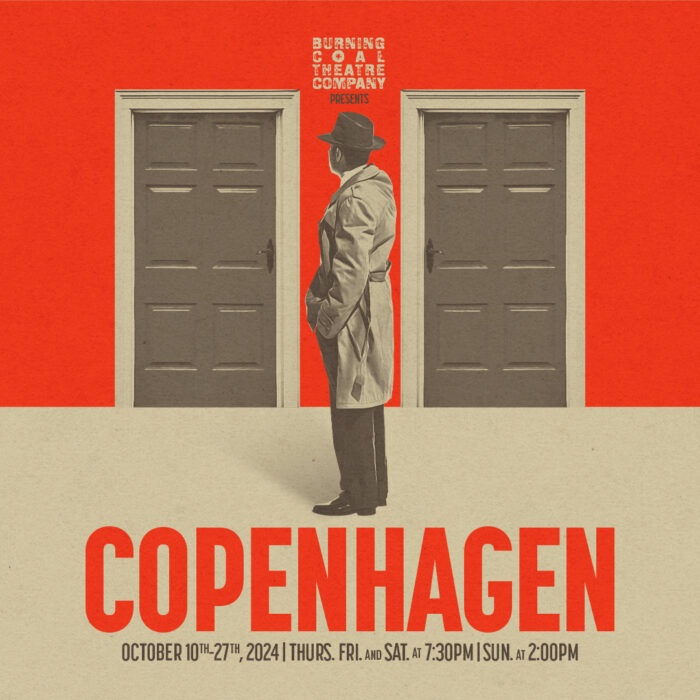
The Burning Coal Theatre Company production of Michael Frayn's Copenhagen offers the rare opportunity to be a "fly on the wall" during a probing and memorable conversation that takes place in "the afterlife." The conversation in question concerns (and reenacts) a visit that takes place in 1941, and it is between Werner Heisenberg, Niels Bohr, and Margrethe Bohr. Margrethe Bohr was Niels Bohr's wife; Werner Heisenberg and Niels Bohr, both quantum physicists, were "players" in the "game" of development of the atom bomb.
Enlisting the talents of actors Lynda Clark, Ian Finley, and Brian Linden, director Jerome Davis makes sure that this conversation is both engaging and accessible. Playing original music composed by Christian L. Stahr, violist Lauren Hess heightens, punctuates, and seasons the action at key moments -- sometimes with just few notes, at other times with longer pieces. (The music often suggests a "shifting of the gears.")
Significant Facts:
-
Heisenberg was German. The Bohrs were Danish.
-
Germany had invaded Denmark in 1940, and the 1941 visit takes place at the home of the Bohrs in the Danish capital during the World War II German occupation.
-
Heisenberg had been a student and assistant of Bohr's in the 1920s, prior to accepting a position at a university in Germany.
The goal of Heisenberg's 1941 visit to the Bohrs has never been clear. Was it merely social, or was it to enlist Niels Bohr's aid in Germany's atom bomb project? Was it to probe for possible information about the progress of the Allies' nuclear program?
Even though this beyond-the-grave conversation seems to center on establishing the correct answer, the ensuing discussion touches on several questions concerning such subjects as morality, loyalty, friendship, and patriotism. We also get verbal snapshots of some of the starker realities of war, and we witness the characters' probings into the questions of the responsibilities of both individuals and nations.
The Tech:
Technical director/master electrician Barry Jaked heads up a competent team.
For this theater-in-the-round production, scenery designer Xiang Li has created a round platform and has fittingly dressed it so as to suggest the layout of the inside of an atom, a look that will have thematic ramifications throughout. Set pieces consist of three matching living room chairs and a small serving cart on which a single prop has been placed.
Lighting designer Matthew Popowich has arranged for some spectacular effects. Costume designer Matt Snellgrove has supplied the "look" of northern Europeans in 1941. And the sound design, by Juan Isler, supplies both earthly and ethereal sound effects.
And a well-deserved tip of the hat to dialects coach Natalie Blackman -- Margrethe and Niels Bohr sound quite Danish, and Werner Heisenberg definitely sounds German. Kudos also to the three actors for sustaining the two different accents throughout the play.
The Play:
Copenhagen is quite "dialogue driven," but this production is never "static." Nor is it ever "overly busy" with "unmotivated" motion. And although the subject matter is very serious and intense, there are plenty of laugh-out-loud moments.
Percussive sound effects herald the entrance of the violist who glides across the platform and takes her position a few feet beyond its edge.
With near robotic motion, the Bohrs enter next, establish their positions on the platform, and begin a conversation. Heisenberg enters soon thereafter and hovers at the edge of the platform, speaking in soliloquy. (Significantly, Heisenberg cannot hear the Bohrs' dialogue, and they cannot hear him.) We are, thus, prepared for the interaction that begins once Heisenberg enters the Bohrs' "space."
As the characters question themselves and each other, delving into the evidence that might supply the sought-after answers, we see that these are, indeed, scientists, forming and testing theories. The recurring term "another draft" reinforces this impression as we imagine them preparing to publish the findings of this research.
The Acting:
This cast is a consummate trio of actors. They transition nicely between their discussions (that are set in the after-the-fact in the afterlife) and the "reenactments" of the scene set in 1941. Their interactions reach a spine-tingly intensity at times.
Ian Finley's Heisenberg is well-intentioned, optimistic, and apprehensive at the same time. The character's posture and movements at the very beginning were so thoroughly "German" that I imagined him, for a brief moment, "goose-stepping." Even though this Heisenberg is interesting and likeable throughout, Finley is at his best as the character emerges from every facade and bares his soul.
Lynda Clark's Margrethe and Brian Linden's Niels have a comfortable chemistry between them and two quite individual reactions to Heisenberg in both realities.
Clark's Margrethe is ever-ready to defend her husband, but just as prone to unmask any of his pretensions and to enlighten him. She is quite entertaining in a segment in which her gestures and actions ridicule and mock the other two. Clark's "asides" are often directed to a single audience member, thereby further endearing the character to the audience. Watch, also, for the character to appear quite worn out and somewhat defeated at the top of the second act.
Linden creates a Niels that is glad to see his old friend and former student but also apprehensive with respect to "where this is going" -- again in both realities. He's especially sympathetic when the subject of the death of one of his sons (by drowning) becomes an issue. And Linden's performance shines during a segment with the references to uncertainty while skiing and again when the characters act out the metaphor of "life" within the atom.
Nice Touches:
-
The various effects achieved by Lauren Hess on viola.
-
The sound effects and the stylized entrance at the top of the show.
-
Heisenberg entering from the audience.
-
Heisenberg "playing" a Bach fugue on an "air keyboard."
-
The details involved to make "Another draft" (which seem very much like an actual restart of the scene).
-
The parable of living inside the atom and the ensuing blocking.
-
Recurring references to Elsinore.
Memorable Lines:
-
"Everyone understands 'uncertainty' -- or thinks they do."
-
"I don't think anyone discovered a way to use theoretical physics to kill people."
-
"... sew a yellow star on my ski jacket."
-
"I thought I had a straight; I misread the cards."
-
"Schrödinger's wretched cat."
-
"Every dark corner [in Elsinore] reminds us of the darkness of the human soul."
-
"... as if the streets had been fouled by the hounds of hell."
-
"It's not a plan. It's a hope."
-
"Because it had been done? Or because it wasn't you who did it?"
-
"That 'excellent Danish' that you heard was my first attempt at English."
-
"Einstein! I'm the Pope. He's God!"
-
"Explain it to me? You couldn't explain it to each other!"
-
"Swerve left, swerve right, or think about it and die."
-
"... a more efficient machine for killing men, women, and children."
-
"Because they were Jews!"
The Bottom Line:
This show is quite interesting, informative, and entertaining. And I do recommend it. At the same time, I highly recommend accessing the show's online digital program in advance.
Page 22 supplies a "Time Line of the Development of Quantam Mechanics," which -- while interesting and informative in itself -- serves to put the show in context, thereby increasing understanding and appreciation.
Page 23 explains "Quantum Concepts Mentioned in Copenhagen," which -- again -- are an invaluable aid toward maximum enjoyment of the show. Be sure, also, to peruse the "Artistic Director's Notes" on page 2.
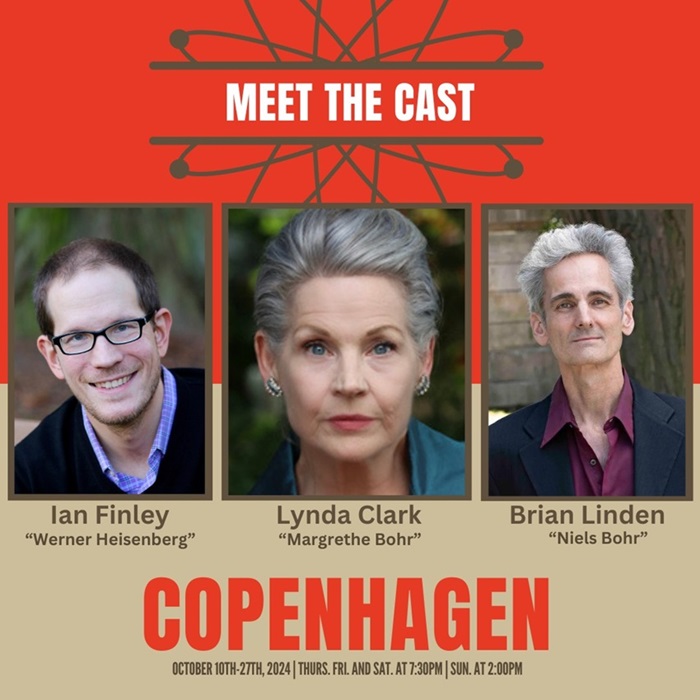
Michael Frayn's
COPENHAGEN
(In Person at 7:30 p.m. Thursday-Saturday and 2 p.m. Sunday,
Oct. 12, 13, 17-20, and 24-27), directed by
Jerome Davis
and starring
Ian Finley
as German physicist and philosopher
Werner Heisenberg (1901-76),
Brian Linden
as Danish physicist
Niels Bohr (1885-1962), and
Lynda Clark
as Danish editor
Margrethe Bohr (1890-1984)
(Burning Coal Theatre Company in the
Murphey School Auditorium in Raleigh).
DIGITAL PROGRAM:
https://burningcoal.org/wp-content/uploads/2024/10/COPENHAGEN-Digital-Program.pdf.
BURNING COAL VIDEOS:
https://www.youtube.com/channel/UC3qVv6iWGS3yQtVoFH5_XNQ.
PRESENTER:
https://burningcoal.org/,
https://www.facebook.com/burningcoaltheatrecompany,
https://www.instagram.com/burningcoaltc/,
https://twitter.com/burningcoaltc, and
https://www.youtube.com/channel/UC3qVv6iWGS3yQtVoFH5_XNQ.
PODCASTS:
https://burningcoal.podbean.com/.
2024-25 MAINSTAGE SEASON:
https://burningcoal.org/now-playing/season-28/.
VENUE:
https://burningcoal.org/plan-your-visit/ and
https://burningcoal.org/history-of-the-murphey-school/.
DIRECTIONS/PARKING:
https://burningcoal.org/plan-your-visit/.
ACCESSIBILITY:
https://burningcoal.org/accessibility/.
COPENHAGEN (1998 West End and 2000 Broadway play):
https://www.penguinrandomhouse.com/books/55922/copenhagen-by-michael-frayn/,
https://www.ibdb.com/broadway-show/copenhagen-10290, and
https://en.wikipedia.org/wiki/Copenhagen_(play).
THE SCRIPT (excerpts): https://books.google.com/books.
MICHAEL FRAYN (London, England-born playwright and screenwriter):
https://literature.britishcouncil.org/writer/michael-frayn,
https://www.ibdb.com/broadway-cast-staff/michael-frayn-7726,
https://www.imdb.com/name/nm0292450/,
https://www.britannica.com/biography/Michael-Frayn, and
https://en.wikipedia.org/wiki/Michael_Frayn.
NOTE:
There will be a FREE post-show discussion, presented by
Carolina Public Humanities, following the show's
2 p.m.
Sunday, Oct. 20th, performance.
TICKETS: $30 ($5 students 18 and under, $20 college students and
educators and active-duty military personnel, and $25 seniors 65+),
plus taxes and fees. Click
here
to buy tickets.
INFORMATION: 919-834-4001 or
info@burningcoal.org.
PLEASE DONATE TO:
Burning Coal Theatre
Company.

