Intergovernmental Collaboration Newsletter, Issue 1 |
|
Greetings!
Welcome to the Walking on Common Ground Newsletter! Intergovernmental collaboration is a key that can open the door to leveraging resources for increased public safety in Indian country and surrounding communities. This newsletter brings together stories, resources, and information on tribal-state collaboration, with a focus on court and law enforcement collaboration. Our hope is to inspire and encourage collaborations by highlighting the innovative work that is happening in many jurisdictions. We welcome feedback, suggestions, and any information to be included in future newsletters.
If you have information or an article that you would like to share for future newsletters, please contact Chia Halpern Beetso at Chia@TLPI.org.
|
|
In this issue:
-
Feature stories
-
Now What? Moving Forward after U.S. Supreme Court in Castro-Huerta
- 2022 Reauthorization of the Violence Against Women Act: Implications for Tribal Jurisdiction
- Intertribal Working Group (ITWG) on Special Tribal Criminal Jurisdiction Meetings
- United States v. Cooley and the Continuing Need for Tribal-State Inter-governmental Law Enforcement Agreements
- Cases before the United States Supreme Court
- Mary Smith will become the first female Native American president of the American Bar Association (ABA)
- 2023 American Bar Association (ABA) Thurgood Marshall Award Celebration Honoring Native American Rights Fund (NARF) Executive Director John E. Echohawk
- Over-Incarceration of Native Americans: Roots, Inequalities, and Solutions
- 2023 Tribal Healing to Wellness Court Enhancement Training
- New Intergovernmental Collaboration Resources
- Training and Technical Assistance Provider Profiles
- Bureau of Justice Assistance Funding Opportunities
- Bureau of Justice Assistance Call for Peer Reviewers
|
|
Now What? Moving Forward after U.S. Supreme Court in Castro-Huerta
By Jerry Gardner, Executive Director, Tribal Law and Policy Institute
|
|
On June 29, 2022, the United States Supreme Court in Oklahoma v. Castro-Huerta, 142 S. Ct. 2486 (2022) dramatically expanded the power of states to prosecute crimes committed by non-Indians against Indians in Indian country. The Court held that Congress did not intend through passage of the General Crimes Act, 18 USC §1152, to preclude state court jurisdiction over crimes committed by non-Indians against Indians in tribal communities and that state jurisdiction is intact, concurrent with federal jurisdiction, unless otherwise precluded by federal law. Ignoring nearly 200 years of existing law and policy, and violating treaties, this decision expands state power while undermining the hard-fought principle that tribes, as sovereign nations, have the inherent right to govern themselves and their own territory. Justice Gorsuch argued (page 12 of his dissent) on behalf of the four dissenting justices:
"Today the Court rules for Oklahoma. In doing so, the Court announces that, when it comes to crimes by non-Indians against tribal members within tribal reservations, Oklahoma may “exercise jurisdiction.” Ante, at 4. But this declaration comes as if by oracle, without any sense of the history recounted above and unattached to any colorable legal authority. Truly, a more ahistorical and mistaken statement of Indian law would be hard to fathom."
Potential Implications for Tribal Justice Systems
This decision has unsettled many because of the language in the majority opinion emphasizing that Indian reservations remain parts of states for purposes of jurisdictional analysis and the belief that the decision may portend further intrusions upon tribal sovereignty, as well as slowing down the momentum under the Violence Against Women Act to restore more inherent tribal jurisdiction over non-Indian perpetrators. This decision has tribal, state, and federal governments scrambling to understand what it means for their criminal justice systems and the potentially huge negative impacts and implications for the communities they serve, including: jurisdictional confusion for states, tribes, and the federal government around the authority to exercise criminal jurisdiction impacting both law enforcement and courts; funding shortages similar to Public Law 280 shortages; reduced ability to obtain guilty pleas in tribal court; under resourced and overburdened state law enforcement and court systems; and barriers to native victims in state system resulting in a dangerous under-reporting of crimes.
Many tribal advocates and legal scholars have pointed out that this decision does not legally affect tribal or federal criminal jurisdiction and that the potential impact will likely vary significantly from tribe to tribe and state to state. Some have argued that the decision should be limited only to the unique situation in the State of Oklahoma. Others have pointed out that this decision will substantially increase the importance of intergovernmental agreements between tribal and state governments to address the limitations on tribal jurisdiction over certain non-Indian defendants and the often passive role the federal governmental has historically played in the prosecution of crimes against native victims.
Whatever one’s perspective on the decision, it will certainly require more coordination between the federal, tribal, and state governments to prosecute these crimes. With the recent passage of the Violence Against Women Act and the expansion of jurisdiction over criminal behavior committed by non-Indians subject to inherent tribal jurisdiction there are going to be certain crimes which if committed by a non-Indian perpetrator on an Indian victim can potentially be subject to prosecution by three separate governments. While some have argued that the possibility of prosecution by three separate governments could result in more accountability for perpetrators of crime, Justice Gorsuch (page 34 of his dissent) cast doubt on that assumption:
"Whatever may have happened in the past, it seems the Court can imagine only a bright new day ahead. Moving forward, the Court cheerily promises, more prosecuting authorities can only “help.” Three sets of prosecutors— federal, tribal, and state—are sure to prove better than two. But again it’s not hard to imagine reasons why the Cherokee might see things differently. If more sets of prosecutors are always better, why not allow Texas to enforce its laws in California? Few sovereigns or their citizens would see that as an improvement. Yet it seems the Court cannot grasp why the Tribe may not.
The Court also neglects to consider actual experience with concurrent state jurisdiction on tribal lands. According to a group of former United States Attorneys, in practice concurrent jurisdiction has sometimes “create[d] a pass-the-buck dynamic . . . with the end result being fewer police and more crime.” Brief for Former United States Attorneys et al. as Amici Curiae 13; see also C. Goldberg, Public Law 280: The Limits of State Jurisdiction Over Reservation Indians, 22 UCLA L. Rev. 535, 552, and n. 92 (1975); Goldberg-Ambrose 1423."
Possible Congressional Action
Justice Gorsuch argues in his dissent that Public Law 280 should be amended to ensure that states, other than those six states with mandatory criminal jurisdiction under 18 U.S.C. 1162 (a), have no criminal jurisdiction in Indian country unless they have first obtained tribal consent to that state criminal jurisdiction and, where necessary, have amended their state constitutions or statutes to permit that jurisdiction, all in compliance with procedures outlined in 25 U.S.C § 1324. The following is suggested language that legal scholars have developed to implement Justice Gorsuch’s proposed amendment:
"Section 2 of Public Law 82-280, as amended and codified at 18 U.S.C. 1162, is hereby further amended by adding at the end thereof the following new subsection (e):
(e) Lack of State Jurisdiction Absent Tribal Consent.
Except as provided in subsection (a) of Title 18, Section 1162, a State lacks criminal jurisdiction over crimes by or against Indians in Indian Country, unless the State complies with the procedures to obtain tribal consent outlined in 25 U. S. C. § 1321, and, where necessary, amends its constitution or statutes pursuant to 25 U. S. C. § 1324."
Possible Practical Responses
Assuming the Castro-Huerta decision is not modified by Congress, federal, tribal, and now potentially also state governments need to coordinate to ensure that every perpetrator is prosecuted by at least one court with jurisdiction over an offense.
Initial responders to crime in tribal communities- tribal police, BIA police, victim advocates, medical providers etc.- need to know which jurisdiction is going to prosecute the crime to ensure that evidence is obtained and preserved in accordance with that law’s jurisdiction. If, for example, a state judge issues a search warrant for a home on a reservation occupied by an Indian victim and non-Indian perpetrator of crime and proof of other crimes is found, will that warrant stand in a tribal court or federal prosecution of the Indian occupant of the home? What if a Tribal Court issues a warrant for a non-Indian’s home on the reservation that discloses proof of other violations of state or federal law, but not necessarily tribal law?
Even though the United States Supreme Court has held that separate sovereigns may prosecute the same crime and not run afoul of the constitutional double jeopardy bar, that does not mean that federal, state and tribal prosecuting agencies do not have administrative policies relevant to the prosecution of crimes already prosecuted by a separate sovereign. For example, the Department of Justice has initiated a policy known as the Petite Policy. The Petite Policy is not a law but rather an internal federal prosecutorial guideline that implies federal prosecutions will not be initiated for federal crimes arising from the same act underlying a state prosecution unless 1) there is a compelling federal interest and 2) an Assistant Attorney General approves of the federal prosecution. States may have similar administrative policies that affect state prosecutions for crimes prosecuted by another jurisdiction. Tribes may want to evaluate various prosecutorial policies and determine whether to initiate similar policies for tribal prosecutions regarding crimes previously prosecuted by another sovereign.
Communication, collaboration and cooperation between states and tribes have never been more critical. The solution is clear – inter-governmental agreements on law enforcement authority and prosecution authority for these crimes. Fortunately, there are already examples of such agreements in Public Law 280 states where some Tribes prosecute crimes in their communities even though Public Law 280 conveyed concurrent jurisdiction upon the states to prosecute those crimes. Intergovernmental agreements clearly define law enforcement authority and prosecution authority to respond to crimes in tribal communities and help victims of those crimes understand which jurisdiction will be assisting them in the prosecution of a crime.
Joint jurisdiction courts are another possible practical response. Jurisdiction is exercised jointly when a tribal court judge and a state or federal court judge exercise their respective authority simultaneously, bringing together justice system partners to promote healing and protect public safety. Using innovative joint jurisdictional agreements, tribal, state, and federal jurisdictions bring together their strengths, reflect the unique circumstances of different tribal nations, and successfully address the challenges they face. For more information on joint jurisdiction courts please visit: www.WalkingOnCommonGround.org where you can find the TLPI Publication on Joint Jurisdiction Courts and other resources.
Justice Department Interim Guidance
Prior to Castro-Huerta, the Department and our Tribal, state, and local partners had understood that, absent specific authorization from Congress or state statutory authority, 18 U.S.C. § 1152 [General Crimes Act] provided exclusive federal criminal jurisdiction over certain offenses committed by or against Indians in Indian country. While Castro-Huerta altered that understanding, the holding does not alter federal jurisdiction to prosecute crimes in Indian country pursuant to 18 U.S.C. §§ 1152 and 1153 [Major Crimes Act]. Nor does the decision diminish the federal government’s trust responsibility to Tribes.
Consistent with the Deputy Attorney General’s July 13, 2022 directive, U.S. Attorneys should continue to prioritize bringing cases to promote public safety in Indian country, including to address violence against women, children, and families. As the Department evaluates the decision’s impact, USAOs should maintain pre-Castro-Huerta intake practices regarding crimes involving non-Indian defendants who commit crimes against Indians in Indian country. Additionally, USAOs should not alter referral practices without formal consultation with Tribes in their districts, bearing in mind the important principles of Tribal sovereignty, our government-to-government relationship, and the importance of partnership and open communication. If, after Tribal consultation, your office refers certain matters to state or local partners, you should maintain a list of all such cases.
Technical Assistance Available
The Tribal Judicial Institute at the University of North Dakota School of Law and the Western Community Policing Institute have a grant from the Bureau of Justice Assistance to work with law enforcement agencies to reach inter-governmental agreements that can aid in responding to the Castro-Huerta decision. The Tribal Law and Policy Institute has a grant from the Bureau of Justice Assistance to work with tribal and state court systems to reach inter-governmental agreements that can aid in responding to the Castro-Huerta decision.
For more information, see:
|
|
2022 Reauthorization of the Violence Against Women Act:
Implications for Tribal Jurisdiction
By Virginia Davis, Consultant, Tribal Law and Policy Institute
|
|
The Violence Against Women Act Reauthorization Act (VAWA 2022) was signed into law on March 15, 2022. The Act, which was included as a part of the Consolidated Appropriations Act (H.R. 2471), included a tribal title with significant provisions for tribal communities– including enhancements to tribal criminal jurisdiction over non-Indians. VAWA was first enacted in 1994 and has been reauthorized three times since—in 2000, 2005, and 2013. Each time VAWA has been reauthorized, it has included new provisions aimed at addressing the high rates of violence against Native women. The provisions included in VAWA 2022, which were championed by Senators Lisa Murkowski (R-AK) and Brian Schatz (D-HI), were the result of years of advocacy by victims and survivors across tribal communities, tribal leaders, and advocates. The Senate Committee on Indian Affairs has a provided an overview of the VAWA 2022 and a Section by Section Summary of VAWA 2022 Tribal Provisions. In addition the Inter-Tribal Working Group Summary of VAWA 2022 Tribal Provisions and the amendments to the law are helpful to review.
VAWA 2022 builds on the historic tribal jurisdiction provision in VAWA 2013 known as “special domestic violence criminal jurisdiction (SDVCJ).” SDVCJ recognized the inherent authority of tribal governments to prosecute certain crimes without regard to the race or Indian status of the offender. SDVCJ was enacted in response to the high rates of violence committed against Native women by non-Native men, and it created a framework for tribal prosecutions of non-Indians for the first time since the Supreme Court removed that authority in Oliphant v. Suquamish in 1978. SDVCJ, which is codified as part of the Indian Civil Rights Act at 25 USC 1301-1304, applied only to crimes of domestic violence, dating violence, and criminal protection order violations committed on tribal lands in certain circumstances. VAWA 2013 did not alter existing state or federal jurisdiction over crimes committed on tribal lands, and tribal governments that choose to exercise SDVCJ must comply with a number of procedural requirements such as providing an attorney to defendants who cannot afford one, including non-Indians in tribal jury pools, and ensuring that presiding judges are sufficiently law-trained. The due process protections that must be afforded to non-Indian defendants in tribal courts are codified at 25 USC 1304(d).
|
|
More than thirty tribal governments have implemented SDVCJ. The positive impacts of the law were documented by the National Congress of American Indians in a 2018 report that concluded that “[VAWA 2013] has fundamentally changed the landscape of tribal criminal jurisdiction … many communities have increased justice and safety for victims who had previously seen little of either.” The report also found, however, that tribal implementation of SDVCJ has “shown where the jurisdictional framework continues to leave victims—including children and law enforcement—vulnerable.” VAWA 2022 addresses many of these gaps.
VAWA 2022 builds on VAWA 2013’s tribal jurisdiction provision by including additional categories of criminal conduct that can be prosecuted in tribal courts against non-Indians. Specifically, Section 804 of VAWA 2022 will restore tribal jurisdiction over non-Indians for certain crimes involving violence against children, sexual violence, stalking, sex trafficking, obstruction of justice, and assaults against tribal justice personnel. These changes went into effect on October 1, 2022.
Under VAWA 2022, the framework for exercising tribal jurisdiction will largely be the same as it currently is under SDVCJ. The term “SDVCJ” itself will be replaced by the term “Special Tribal Criminal Jurisdiction” or “STCJ” to more accurately reflect that tribal jurisdiction is not limited only to domestic violence. Tribal governments will be able to choose whether to implement the law, and those who do will need to provide all the due process requirements of the existing federal law. In addition, tribal governments will have to provide notice in writing to defendants of their right to petition for a writ of habeas corpus in federal court.
VAWA 2022 also includes a pilot project for tribes in Alaska—the majority of whom were not reached by the VAWA 2013 provision. The law also clarifies that tribes in Maine are eligible to exercise criminal jurisdiction over non-Indians pursuant to VAWA—a point that has been the subject of confusion and disagreement. In addition to the tribal jurisdiction provisions, VAWA 2022 also establishes a reimbursement program that tribal governments will be able to access to cover some costs related to the investigation, prosecution, and incarceration of non-Indians in tribal courts. The law directs the Department of Justice to consult with tribal governments within 12 months to develop regulations for this reimbursement program.
|
|
Intertribal Working Group (ITWG) on Special Tribal Criminal Jurisdiction Meetings |
|
The ITWG held their 19th meeting on the Agua Caliente Reservation in Palm Springs, California from December 5-6, 2022. The ITWG is a voluntary working group of designated tribal representatives who may exchange views, information, and advice, peer-to-peer, about how tribes may best implement Special Tribal Criminal Jurisdiction (STCJ), combat violence in tribal communities, recognize victims’ rights and safety needs, and safeguard defendants’ rights. The next in person meeting is scheduled for June 13-14, 2023 at the Salt River Pima-Maricopa Indian Community, Scottsdale, Arizona.
If you would like to join the ITWG or would like more information about the ITWG please email Chia@TLPI.org.
|
|
United States v. Cooley and the Continuing Need for Tribal-State Inter-governmental Law Enforcement Agreements
By B. J. Jones, Executive Director, Tribal Judicial Institute
|
|
A recent U.S. Supreme Court decision in United States v. Cooley, 141 S. Ct. 1638 (2021) strongly affirmed the inherent rights of Indian tribes to protect the economic security and health and welfare of its members. It found that a Crow tribal police officer had the right to detain, and investigate the criminal activity of, a non-Indian located on the Crow Reservation. This decision reversed a federal court of appeals decision that had suppressed the evidence obtained as the result of the officer investigating a non-Indian whose vehicle was stopped along a federal highway on the Crow Reservation.
As the result of Cooley, some have questioned whether Indian tribes should continue to enter into inter-governmental law enforcement agreements such as cross-deputization agreements, which permit tribal officers to arrest non-Indians who violate state law in tribal communities. The agreements also permit state and county officers to arrest Indians for tribal law violations. If Indian tribes already have the inherent sovereign authority to investigate and detain non-Indian offenders, then why do they need agreements with states? Cooley involved a tribal police officer detaining and investigating a non-Indian involved in criminal activity prosecuted by the United States. The assumption is that the decision also dictates that tribal officers have the inherent authority to investigate and detain non-Indians for criminal activity that can be prosecuted by state authorities.
However, some states define law enforcement officers in very restrictive manners, oftentimes excluding tribal police unless deputized by the state or county. In such a jurisdiction it is unclear whether the actions of a non-deputized tribal officer against a non-Indian suspect in Indian country will be countenanced by a state court in a state criminal prosecution. Suppose, for example, tribal police obtain a search warrant from a tribal judge to enter into the room of non-Indian suspects at a tribal casino and find evidence of a burglary committed in a state jurisdiction. Will most state courts admit this evidence into the non-Indian’s trial if the tribal officers involved were not deputized by the county or state? Cooley would seem to indicate that the officers acted within the scope of their inherent authority, but what if the state in which this occurs does not include tribal officers within the definition of law enforcement officers?
Inter-governmental law enforcement agreements clear up the confusion about jurisdictional authority by clearly defining the authority of each law enforcement agency. On large reservations where many tribes have found it difficult to hire enough officers to patrol a large swath of land, inter-governmental agreements can increase the number of law enforcement and emergency personnel available to respond to crimes and accidents in tribal communities by including state and county officials. These officials have a contractual duty to report their findings to tribal courts and prosecutors, which then will determine whether tribal crimes have been committed. Although many are opposed to these agreements because of the impression they create that tribes are acceding their authority to non-Indian agencies, a strong inter-governmental agreement oftentimes results in mutual respect being created and public safety being enhanced.
The Bureau of Justice Assistance, recognizing the critical need for inter-governmental cooperation to ensure the safety of tribal communities, has a program to provide technical assistance to Indian tribes and adjoining jurisdictions who are looking to cooperate in the development of inter-governmental law enforcement agreements to overcome the obstacles pointed out by this short article. That project—Enhancing Tribal-Federal-State Local Intergovernmental Collaboration—is being administered jointly by the Tribal Judicial Institute (TJI) and the Western Community Policing Institute (WCPI) and can help jurisdictions facilitate discussions and action plans to overcome the jurisdictional barriers that oftentimes result in conflict rather than cooperation. TJI can be contacted through its director, BJ Jones, at b.jones@und.edu and WCPI can be contacted through Brian Kauffman at kauffmab@wou.edu.
|
|
Cases before the United States Supreme Court |
|
On November 9, 2022, the United States Supreme Court heard oral arguments in the case of Brackeen v. Haaland. The issues before the court were (1) whether the Indian Child Welfare Act of 1978’s placement preferences — which disfavor non-Indian adoptive families in child-placement proceedings involving an “Indian child” and thereby disadvantage those children — discriminate on the basis of race in violation of the U.S. Constitution; and (2) whether ICWA’s placement preferences exceed Congress’s Article I authority by invading the arena of child placement — the “virtually exclusive province of the States,” as stated in Sosna v. Iowa — and otherwise commandeering state courts and state agencies to carry out a federal child-placement program. Texas and the non-Indian individuals argue that Congress acted beyond its Indian Commerce Clause power in enacting ICWA, that ICWA creates a race based child custody system in violation of the Equal Protection Clause, and that ICWA violates the anti-commandeering doctrine. Texas also argues that ICWA’s implementing regulations violate the nondelegation doctrine by allowing individual tribes to alter the placement preferences enacted by Congress. The United States and the Four Tribes (Cherokee Nation, Oneida Nation, Quinault Indian Nation, and Morongo Band of Mission Indians) argue that Congress had the authority to enact ICWA, that ICWA does not violate the anticommandeering doctrine, that ICWA does not violate the Equal Protection Clause, and that Texas’ nondelegation challenge should be rejected. Numerous amicus briefs were filed on both sides, including a brief filed on behalf of 497 Indian Tribes and 62 Tribal and Indian Organizations in support of the United States and Four Tribes. The briefs and timeline can be found on SCOTUSblog. The oral argument and other information can be found on the NCAI/NARF Tribal Supreme Court Project website. The decision is expected to be handed down Summer 2023.
On March 20, 2023, the United States Supreme Court heard oral arguments in the case of Arizona v. Navajo Nation. The issues before the court were (1) whether the opinion of the U.S. Court of Appeals for the 9th Circuit, allowing the Navajo Nation to proceed with a claim to enjoin the secretary of the U.S. Department of the Interior to develop a plan to meet the Navajo Nation’s water needs and manage the mainstream of the Colorado River in the Lower Basin so as not to interfere with that plan, infringes upon the Supreme Court’s retained and exclusive jurisdiction over the allocation of water from the LBCR mainstream in Arizona v. California; and (2) whether the Navajo Nation can state a cognizable claim for breach of trust consistent with the Supreme Court’s holding in United States v. Jicarilla Apache Nation based solely on unquantified implied rights to water under the doctrine of Winters v. United States. The briefs and timeline can be found on SCOTUSblog. The oral argument and other information can be found on the NCAI/NARF Tribal Supreme Court Project website. The decision is expected to be handed down Summer 2023.
|
|
Mary Smith to become first female Native American President of the American Bar Association (ABA) in August 2023 |
|
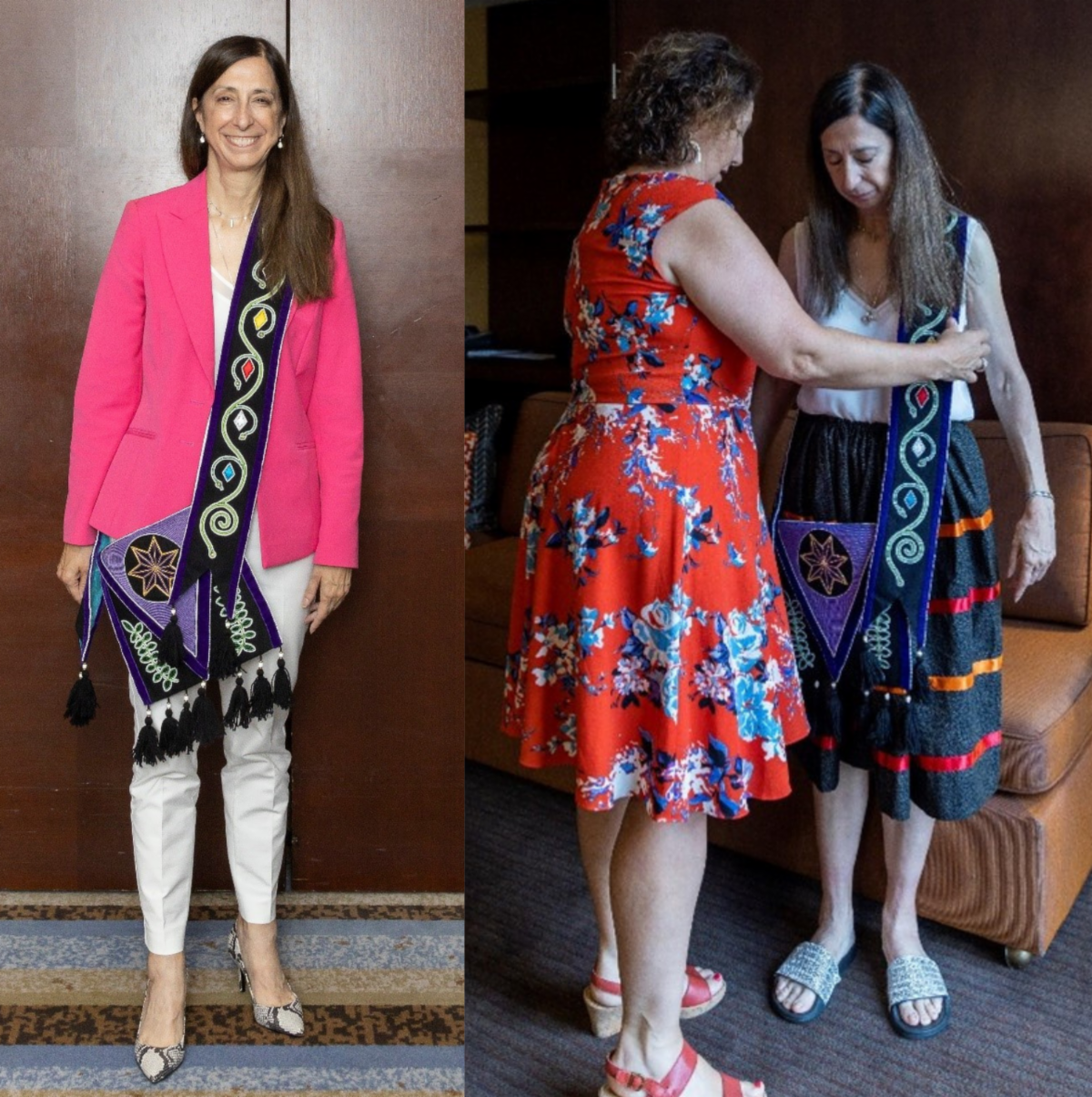
Left: American Bar Association (ABA) swearing in of Mary L Smith as President-Elect at the Hyatt Regency Chicago, August 9th, 2022. Right: Stacey Leeds and Mary Smith
©Sarah Matheson
|
|
A member of the Cherokee Nation, Smith was born in Chicago and received her J.D. from the University of Chicago Law School. She was on the ABA Board of Governors for seven years and served as ABA secretary from 2017-2020. Smith has served in the ABA House of Delegates and has worked with several sections, including the Commission on Women in the Profession, the Section of Litigation and the Section of Individual Rights and Responsibilities.
During her long legal career, Smith has served as general counsel at the Illinois Department of Insurance; counselor in the Civil Division at the U.S. Department of Justice, focusing on national security, consumer protection, constitutional issues and legislative matters; associate White House counsel to the president of the United States; and associate director of White House Policy Planning. She was also a partner at Schoeman Updike & Kaufman and an attorney at Skadden Arps. Smith is a past president of the National Native American Bar Association and past president and founder of the National Native American Bar Foundation.
|
|
2023 ABA Thurgood Marshall Award Celebration Honoring
Native American Rights Fund (NARF) Executive Director John E. Echohawk
|
|
Mr. Echohawk has long been a hero of the ABA Section of Civil Rights and Social Justice. Indeed, in 2006, the Section published a piece naming him as our Human Rights Hero in our Human Rights Magazine. He will receive the award on Saturday, August 5, 2023, during a dinner celebration at the 2023 ABA Annual Meeting.
Established by the Section of Civil Rights and Social Justice in 1992, the annual ABA Thurgood Marshall Award honors U.S. Supreme Court Justice Thurgood Marshall, who epitomized individual commitment, in word and action, to the cause of civil rights in this country. The award recognizes similar long-term contributions by other members of the legal profession to the advancement of civil rights, civil liberties, and human rights in the United States.
|
|
Over-Incarceration of Native Americans: Roots, Inequities, and Solutions
By Desiree L. Fox, Ph.D., Ciara D. Hansen, Ph.D., Ann M. Miller, J.D.
|
|
Native people are disproportionately incarcerated in the United States. Several factors contribute: a history of federal oppression and efforts to erode Native culture, a series of federal laws that rejected tribal justice systems in place long before European contact, historical trauma that has a lasting impact on the physical and mental well-being of Native people, a complicated jurisdictional structure that pulls Native people further into justice involvement, and a deficiency of representation for the accused in tribal courts. Although people accused of crime in tribal courts are afforded the right to counsel, tribal governments are not constitutionally required to provide appointed counsel for the indigent. As a result, there are uncounseled convictions in tribal courts used against Native people in state and federal systems.
|
|
2023 Tribal Healing to Wellness Court Enhancement Training
Celebrating 25 Years of Tribal Healing to Wellness Courts
|
|
September 12-14, 2023
Agua Caliente Band of Cahuilla Indians Reservation in Palm Springs, CA
This training is pending U.S. Department of Justice approval
|
|
The Tribal Law and Policy Institute (TLPI) looks forward to welcoming new and returning attendees in-person for the 13th Annual Tribal Healing to Wellness Court Enhancement Training (Wellness Court Training). This year’s Wellness Court Training will be held September 12-14, 2023 on the Agua Caliente Band of Cahuilla Indians Reservation in Palm Springs, California. The Wellness Court Training this year will focus on the theme: Celebrating 25 Years of Tribal Healing to Wellness Courts – highlighting the establishment of the first Tribal Healing to Wellness Courts in 1998.
The Wellness Court Training will be oriented around the Tribal Ten Key Components and the National Association of Drug Court Professionals (NADCP) National Drug Court Standards. This training is a unique opportunity to receive information on current drug court best practices, learn innovative approaches to substance abuse and treatment, and engage with other Healing to Wellness Courts practitioners from across the country.
This training focuses on tribal issues, including jurisdictional and legal issues unique to Indian country, the incorporation of custom and tradition into the phases, case management, treatment curriculums, tangential services, and the peer-to-peer sharing of successful Healing to Wellness Courts models in operation. Training topics will cover adult criminal, juvenile justice, family dependency, DWI/DUI, and veterans models.
|
|
New Intergovernmental Collaboration Resources |
|
The Tribal Law and Policy Institute is pleased to announce its updated resources:
|
|
Coming soon: Enhanced Tribal Authority Series: Tribal Criminal Jurisdiction over Non-Indians Violence Against Women Reauthorization Act of 2022
This publication provides general guidance to assist tribes in making an informed decision about whether to begin exercising criminal jurisdiction over non-Indians. It also provides information about resources available to tribes interested in exercising this jurisdiction, as well as the benefits and challenges of doing so. This publication is part of a two-part series on enhanced tribal authority, the other publication discusses Tribal Law and Order Act enhanced sentencing authority.
Coming soon: Enhanced Tribal Authority Series: Enhanced Sentencing Authority Tribal Law and Order Act
This companion publication provides an overview of enhanced sentencing authority, examines possible benefits and challenges of implementing that authority, provides a review of the Bureau of Prisons Pilot Project, provides examples of tribal code implementing provisions, and then provides additional enhanced sentencing authority resources. This publication is part of a two-part series on enhanced tribal authority, the other publication discusses Tribal Criminal Jurisdiction over non-Indians.
Tribal Provisions of the Violence Against Women Reauthorization Act (VAWA) 2022
Joint Jurisdiction Court Needs Assessment: Full Report and Summary Findings
Tribal, state, federal and local courts have overlapping jurisdictions and face common challenges and resource limitations. To address these concerns, several jurisdictions have come together in a joint jurisdictional model that acknowledges each other’s autonomy, while sharing resources for better outcomes for everyone. In September 2019, the Tribal Law and Policy Institute, in collaboration with the Bureau of Justice Assistance, disseminated a needs assessment survey to the joint jurisdiction courts known to be operational. TLPI gathered information on (1) the courts’ approach, design, and development; (2) the courts’ operations; (3) the court-connected services; (4) the court collaboration and coordination; (5) court record management and evaluation; and (6) techniques to sustain the courts. TLPI developed a full report of findings, as well as a summary report. The needs assessment survey responses showed that these courts share similar characteristics and face similar challenges. The full report provides details on the findings of the needs assessment survey, including an overview of the lessons learned, the effectiveness of joint jurisdiction courts, and the funding needed to support their implementation, sustainability, and growth.
|
|
This 2020 update of the directory includes a detailed listing of the 13 currently operational Tribal-State Court forums around the nation. These forums provide unique collaboration opportunities including: agreements on the transfer of jurisdiction, Indian Child Welfare Act education, tribal court directories, legislation on the enforcement of tribal court orders, judicial relationship building, and many more. (2020)
|
|
This policy brief provides an overview of the purpose and function of Tribal-State Court Forums and includes a detailed chart that provides an overview of key features of forums, such as membership attributes, information about authorizing documents and key accomplishments. (2020)
|
|
Coming soon: Meeting on Promising Strategies in Intergovernmental Collaboration Held
On July 26, 2021, the Tribal Law and Policy Institute, in collaboration with the Bureau of Justice Assistance, held the “Promising Strategies in Tribal-State-Local-Federal Intergovernmental Collaboration Virtual Meeting.” The panelists highlighted intergovernmental collaborations in child welfare, bail reform, family wellness courts and community wellness courts from Alaska, California, New York, and Maine. The meeting was well attended by invited stakeholders from various disciplines, including tribal and state courts and law enforcement. The Tribal Law and Policy Institute is drafting a short publication based on these and other intergovernmental collaborations that will be forthcoming.
The Tribal Law and Policy Institute is also drafting a short publication that will discuss what a Joint Jurisdictional Court is, the different models and approaches that exists, how a community can assess their readiness to implement a Joint Jurisdictional model, and will provide recommendations for design, development, and implementation of Joint Jurisdictional Court from a practical standpoint. The publication is forthcoming.
Check www.WalkingOnCommonGround.org for updates on the publication release and other intergovernmental collaboration news and events. Other TLPI publications that may be of interest can be found on home.TLPI.org.
|
|
Training and Technical Assistance Providers Profiles |
|
Walking on Common Ground is an on-going initiative to promote and facilitate tribal, state, and federal collaboration. The initial effort focused upon tribal, state, and federal court or justice system collaborations, but it now also includes tribal, state, and federal collaborations on a broader range of issues. The official statement of the Walking on Common Ground initiative (adopted by the 2005 Walking on Common Ground planning committee) is as follows: Tribal, federal, and state justice communities join together, in the spirit of mutual respect and cooperation, to promote and sustain collaboration, education, and a level of support to ensure equal access to justice.
Please submit any story or resource regarding tribal-state-federal collaborations to Chia@TLPI.org.
|
|
Tribal Law and Policy Institute provides training, technical assistance and resources to develop, promote and enhance intergovernmental collaborations, with a special focus on judicial collaborations, such as joint jurisdiction courts. This project includes the WalkingOnCommonGround.org website which serves as a resource on tribal-state-federal-local collaborations and contains a wealth of collaboration resources, including an interactive map with memorandums of agreement searchable by subject matter, and the TribalProtectionOrder.org website, which serves as an online resource on the drafting and enforcement of tribal protection orders.
This project – funded by a grant from the Bureau of Justice Assistance – includes providing training and technical assistance for Tribes implementing the Violence Against Native Women Act (VAWA) “Special Domestic Violence Criminal Jurisdiction” and/or the Tribal Law and Order Act “enhanced sentencing” provisions.
|
|
The Tribal Judicial Institute at the University of North Dakota School of Law has been providing technical assistance and training to tribal justice systems for over 30 years in a variety of areas. TJI has been involved in the Bureau of Justice Assistance’s Tribal Court Assistance Project since its inception and has also been involved in numerous projects designed to improve the collaboration between tribal and state systems to ensure public safety in tribal communities. Currently TJI and its collaborating partner, Western Community Policing Institute, are implementing a grant to improve the law enforcement collaboration amongst state, tribal and county law enforcement. Technical assistance under this project is available to any tribal or state jurisdiction looking to improve law enforcement relations to ensure safety for tribal and non-tribal communities. For more information, please visit the Tribal Judicial Institute website.
|
|
Western Community Policing Institute (WCPI) was established in 1996 as one of the national networks of Regional Community Policing Institutes (RCPI). WCPI provides innovative nationwide training and technical support on issues vital to community safety.
|
|
Bureau of Justice Assistance
Funding Opportunities
|
|
The Department of Justice, Bureau of Justice Assistance provides leadership and services in grant administration and criminal justice policy development to support local, state, and tribal law enforcement in achieving safer communities. BJA supports programs and initiatives in the areas of law enforcement, justice information sharing, countering terrorism, managing offenders, combating drug crime and abuse, adjudication, advancing tribal justice, crime prevention, protecting vulnerable populations, and capacity building.
Bureau of Justice Assistance offers funding through a variety of different programs. The website has current available opportunities, learn about funding webinars, apply to become a peer reviewer, find information about previously available solicitations, and see details of funding previously awarded.
Subscribe to receive news and information about new funding opportunities, tools and resources, and BJA programs and initiatives.
The Department of Justice, Tribal Justice Safety website provides information on funding opportunities specifically the Coordinated Tribal Assistance Solicitation and other information current activities.
|
|
Watch these webinar replays on BJA’s YouTube channel to learn how to successfully apply for BJA’s funding initiatives. Applicants will also learn about eligibility and budget requirements and other frequently asked questions related to BJA funding.
|
|
Bureau of Justice Assistance
Call for Peer Reviewers
|
|
The Bureau of Justice Assistance is looking for subject experts with diverse professional backgrounds across various criminal justice fields. Reviewers will participate remotely and will review 5-15 applications within a two-week period. If interested, please send an email with "Peer Reviewer Candidate Resume" in the subject line to BJAreviewer@ojp.usdoj.gov. A current resume/curriculum vitae and a valid e-mail address must both be included.
|
|
8229 Santa Monica Blvd., Suite 201
West Hollywood, CA 90046
(323) 650-5467
Tribal Justice Initiative
UND School of Law
215 Centennial Drive, Stop 9003
Grand Forks, N.D. 58202
(701) 777-2104
Western Community Policing Institute
Western Oregon University
345 Monmouth Ave. N.
Monmouth OR 97361
(503) 838-8000
|
|
This project was supported by Grant No. 2019-IC-BX-K005 (TLPI) and 2019-IC-BX-K006 (TJI) awarded by the Bureau of Justice Assistance. The Bureau of Justice Assistance is a component of the Office of Justice Programs, which also includes the Bureau of Justice Statistics, the National Institute of Justice, the Office of Juvenile and Delinquency Prevention, the Office for Victims of Crime, and the Office of Sex Offender Sentencing, Monitoring, Apprehending, Registering and Tracking. Points of view or opinions in this document are those of the author and do not necessarily represent the official position or policies of the U.S. Department of Justice.
|
|
|
|
|
|
|