Volume 6 | Issue 5 | May 2026 | | Cosmology of Light Newsletter | | |
Dear Friends,
It has been a joy to continue to work with Cosmology of Light over the past decade.
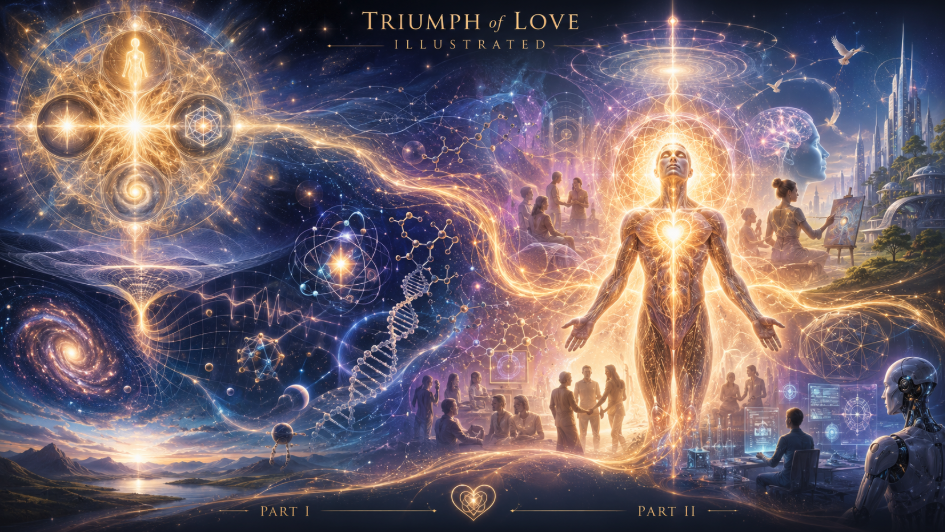
What began with a simple question — why does light travel at 186,000 miles per second in a vacuum? — gradually unfolded into a much larger exploration of being, becoming, life, intelligence, and human possibility. Over time, this inquiry became a body of work spanning multiple volumes and several interwoven series: first the mathematical foundations, then applications in fields such as quantum computing, genetics, artificial intelligence, and transhumanism, and then a fully illustrated rendering of the same cosmology through art, meditation, and also as mythological and symbolic form.
The illustrated series makes a dense and technical cosmology more contemplative, visual, and hopefully accessible. Through the collaboration of science, mathematics, philosophy, and art, the work asks not only how reality may be structured, but how human beings may more consciously participate in its unfolding.
This month, I am pleased to share that two books from Cosmology of Light, Triumph of Love Illustrated Part 1 & 2, have been selected into the Forbes Councils Executive Library. Together, they offer a two-part journey: first into the origins of Light, matter, life, and natural quantum computation and its output, genetics; and then into more sophisticated embodiments of consciousness and creativity, and the meaning of transhumanism in an AI-saturated age.
Best Wishes.
Pravir
| |
Triumph of Love Illustrated – Part I
A Mathematical Exploration of Being, Becoming, Life, and Transhumanism in a Cosmology of Light
| |
Triumph of Love Illustrated – Part I begins at the most fundamental level of the Cosmology of Light: the question of how the invisible becomes visible.
The book explores Light not only as a physical phenomenon, but as an infinitely fast medium whose four primary qualities — Presence, Power, Knowledge, and Harmony — cohere as Love. From this original coherence, Light slows to the speed of light, giving rise to the Big Bang and to the four macro parameters of space, time, energy, and gravity.
In this first part, the work traces the emergence of material and living layers from deeper structures of Light. One of the central archetypes introduced is EM-WAMP, the first material expression of these four qualities in physical form. Through this framework, matter is not treated as inert substance, but as a lawful expression of deeper relational and energetic dynamics.
A major theme of Part I is that genetic-type code may be understood as an outcome of persistent quantum computation in nature. In this view, nature is already computational, not in the narrow machine sense, but in the deeper sense of continuously integrating invisible potential into visible form.
This has important implications for how we think about artificial intelligence. Rather than placing machine intelligence at the center of the future, Part I argues for a more expansive understanding of intelligence rooted in consciousness, and its subsequent play as human consciousness, perception, creativity, relationship, and integrative potential. AI may be powerful, but it remains a derivative human intelligence. The deeper question is how human beings can awaken to the natural intelligence already operating through matter and life.
At its heart, this book presents Love as integrative coherence: the principle through which differentiated realities remain connected, meaningful, and capable of further becoming.
Part 1 as described in the Forbes Councils Executive Library
|
Triumph of Love Illustrated – Part II
From Quantum Seeds to Human Emergence in an AI-Saturated Age
| | |
Triumph of Love Illustrated – Part II continues the journey from the quantum and biological foundations of Part I into the specifically human threshold.
Where Part I explores the emergence of matter, life, and natural quantum computation, Part II turns toward consciousness, creativity, emotion, organization, constructive mutation, and the possibility of a deeper human future. It asks what becomes of humanity when technological intelligence grows rapidly, but the fuller dimensions of human intelligence remain only partially understood.
A central framework in this volume is FBLEE, the Four-Base-Logic-Encoding-Ecosystem. Through FBLEE, the book explores how life, creativity, and constructive transformation may arise through a quaternary logic that is deeper than binary computation. This allows the work to contrast two kinds of beings: derivative technological intelligence, or D-type beings, and human P-type beings, whose consciousness, feeling, relationship, creativity, and integrative awareness open possibilities that machines cannot simply replicate.
Part II also deepens the question of transhumanism. In much of contemporary discourse, transhumanism is framed as technological enhancement: more computing power, more data, more automation, more extension of human capability through machines. This book offers a different path. It suggests that meaningful transhumanism does not arise from replacing the human with the technological, but from integrating more deeply with the natural intelligence of Light, life, and consciousness.
In that sense, the future is not only about artificial intelligence. It is about whether human beings can cross a new evolutionary threshold consciously, creatively, and relationally.
Part II points toward what I describe as the Second Singularity: not a machine-dominated event, but a human-founded leap rooted in consciousness, Love, Light, and the deeper generative intelligence of nature.
Part 2 as described in the Forbes Councils Executive Library
| | | | |