|
22 September 2026
Welcome back to our National Maritime Historical Society members and friends who share a love for naval history!
| | |
Good Tidings! Today marks the 250th anniversary of John Paul Jones sailing Providence into Canso Bay, Nova Scotia, and attacking the British fishing fleet. Of course, we would not know about the Nova Scotia raid by the original Providence if there was not documentation. Much is being done to make these documents accessible. There will be a remarkable workshop titled Prize Papers of the American War of Independence at the British National Archives on 8–9 October. No need to book a flight to Heathrow! The first day of the workshop is online. A month later there will be a panel at the US Naval Institute exploring the wartime experiences of Bruce McCandless. Registration to attend the November 10 event in person closes this Friday. Details on both of these events are below!
This week we offer links to not one but TWO naval history newsletters: check out NHHC’s September edition of From the Quarterdeck and The Western Naval History Association Newsletter which covers more than just happenings on the West Coast!
Best wishes to the US Navy Memorial for a successful Lone Sailor Dinner tomorrow night — our lead Item of Immediate Interest.
For our Naval History Book Review, we thank Peter H. Hames for his review of a book edited by Steve Wills that examines our maritime infrastructure. For the “In Case You Missed It” feature, we offer the latest episode from Preble Hall discussing the state of the Marine Corps post-World War II.
| |
| |
Tuesday Tidings is compiled by Dr. David F. Winkler and Jessie Henderson as a benefit for members of the National Maritime Historical Society and friends of naval history.
As always, comments and naval history news items are welcome at nmhs@seahistory.org.
| | Tuesday Tidings is published by the National Maritime Historical Society with support from the US Naval Institute. Interested in joining USNI? Click on the USNI logo to become a member! | | |
ITEMS OF IMMEDIATE INTEREST | |
Wednesday, 23 September – US Navy Memorial Lone Sailor Dinner
National Building Museum, Washington, DC
Thursday, 24 September – World Ship Society Virtual Presentation
The Adriatic Affair: A Maritime Hit-and-Run Off the Coast of Nantucket
With SSHSA Board Member Jennifer Sellitti
6:30 PM (EDT)
Friday, 25 September – 108th Anniversary Commemoration of the Sinking of USCGC Tampa
USCG War Memorial, Arlington National Cemetery
10–10:30 AM (EDT)
Saturday, 26 September – Philadelphia Navy Yard Symposium
Battleship New Jersey, Camden, NJ
Sunday, 27 September – Tour of Philadelphia Naval Shipyard
Wednesday, 30 September – The 2026 Bernard Behrend Lecture
“Forged at Sea, Born in Philadelphia: The History and Horizons of Navy Medicine”
With Capt. Brian L. Feldman, MD, MPH (Deputy Chief, US Navy Medical Corps)
The College of Physicians of Philadelphia
6:00–7:30 PM (EDT)
Register here>>
Thursday, 8 October – The Prize Papers of the American War for Independence Workshop
National Archives, London
4:30 AM – 2 PM EDT
Wednesday, 14 October – Naval Order Speaker Series
US Pacific Basing Decisions Post-WWII
With Dr. Hal Friedman
8 PM (EDT) (Virtual)
Monday, 19 October – Naval Order New York Commandery Rear Adm. Samuel E. Morison Award for Naval Literature Festive Dinner
Honoring John U. Bacon
5:30 PM – 8:30 PM
| | An International Workshop on the UK Prize Papers and the American War of Independence: Wartime Lives, Capture, and Transnational Exchange | | |
This international workshop highlights the importance of the UK Prize Papers collection for research on the American War of Independence and offers new insights into lived experiences in war at sea and on land. Bringing together specialists on prize law, the American War of Independence and the Prize Papers, the workshop approaches the collection as a transnational archive of wartime capture and its afterlives. The workshop creates a forum for sustained international exchange and collaboration.
The year 2026 marks the 250th anniversary of both the Declaration of Independence of the United States of America in July and the opening of the British Vice-Admiralty Court in newly captured New York City in September 1776. Although exceptionally rich, the prize papers of this court have been largely inaccessible. The newly catalogued papers of the New York court (and its mother-court in London) provide new perspectives on the War of Independence at sea, and on lived experiences of the time, through the intercepted papers and letters found by the British on merchant and fighting ships.
Maritime warfare was central to the War of Independence. Controlling, disrupting, and capturing shipping was crucial to the war on both sides. America started privateering early, in 1775, and sought new (previously forbidden) trading partners. From 1778, French naval and privateering activity expanded the war against Britain, followed by Spain and the Netherlands. British naval forces and loyalist privateers sought to stop American and allied shipping, enforce their imperial authority, and weaken the Continental cause. The conflict eventually extended far beyond the North American seaboard.
An initial group of papers from 150 captured ships, American or supporting America, will be published online on 8 October in the Prize Papers Portal, the open-access online database of the Prize Papers Project. The Prize Papers Project, an international collaboration between the University of Oldenburg and The National Archives, UK, sorts, catalogues, and digitises the complete collection of the Prize Papers. The project is funded by the Göttingen Academy of Sciences and Humanities in Lower Saxony, Germany as part of the Academies Programme of the Union of the German Academies of Sciences and Humanities.
This first publication is only the beginning. Major bodies of captured material from American, French, Spanish, Dutch and recaptured British vessels will be published in the coming months and years, as more material is identified, catalogued, digitised, contextualised, researched, and made accessible.
The two-day international workshop, held on 8–9 October at The National Archives, UK and available both online and in person, will bring together specialists in prize law, the American War of Independence, and the Prize Papers from the United States, the United Kingdom, and across Europe. Participants will discuss the Prize Papers and foster sustained international exchange and collaboration.
The workshop is jointly organised by the Prize Papers Project (The National Archives, UK / University of Oldenburg, Germany), the German Maritime Museum Bremerhaven, and the German Historical Institute London. It takes place alongside Revolution 250: America’s Independence Story, The National Archives’ major 2026 exhibition marking the anniversary of American independence and drawing in part on the Prize Papers. The workshop is hosted by Nele Popp, Amanda Bevan, Randolph Cock, Oliver Finnegan and Lucas Haasis.
| | Deadline to Register for USNI McCandless Iron and Fire Program (In Person) This Friday | | |
Join the US Naval Institute on 10 November 2026 at 10:30 AM ET at the Jack C. Taylor Conference Center in Annapolis, MD for a look inside the new book Iron and Fire: The Pacific War Story of Destroyer Captain Bruce McCandless with Bruce McCandless III as he recounts the wartime experiences of his grandfather, Admiral Bruce McCandless.
Lieutenant Bruce McCandless was at Pearl Harbor on December 7, 1941, and fought aboard the heavy cruiser USS San Francisco (CA-38) through the brutal Guadalcanal campaign. Later promoted to captain, he commanded the destroyer USS Gregory (DD-802) during the final drive across the Pacific. Late in life, retiring as an admiral, he dictated his wartime memories to his daughter Sue; the manuscript was then set aside for many years. Iron and Fire draws on family letters, photographs, shipmates’ recollections, and stories passed down through generations to share his story.
Registration and other Information:
All in-person guests must register by 25 September 2026. Due to the requirements of the US Naval Academy and the timing of this event, in-person attendance is only open to US citizens.
The conference will take place at the US Naval Institute’s Jack C. Taylor Conference Center, which is located on the grounds of the US Naval Academy.
A limited amount of parking is available at the Jack C. Taylor Conference Center.
We welcome our audience in-person and via live-stream on the US Naval Institute’s YouTube Channel.
See more here>>
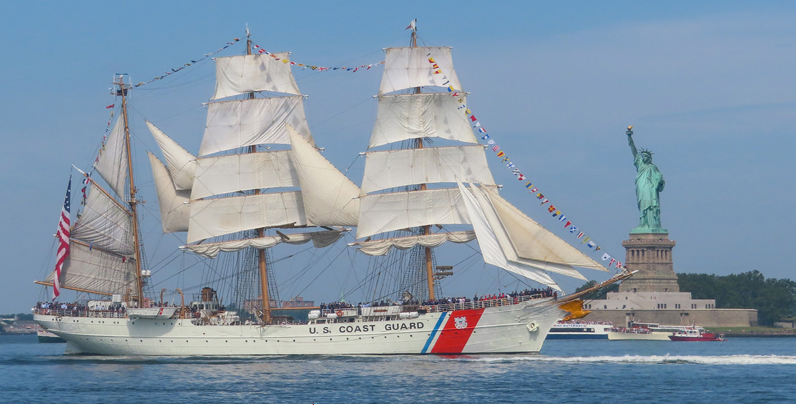
| | Forty-Fourth Salute to the US Coast Guard in New York | | |
Coast Guard Foundation
Join us in paying tribute to the Coast Guard Northeast District. Dinner, cocktails, award presentations, and more!
Thursday, 8 October 2026
The Lighthouse at Pier 61
At Chelsea Piers, 23rd Street, New York City
Cocktail Reception: 6:00 PM
Dinner and Program: 7:00 PM
Post-Dinner Reception to follow
Cocktail Attire
Reservations and Inquiries
Becky Ketterhagen, Coast Guard Foundation
850-457-1413 | bketterhagen@coastguardfoundation.org
Click here for details on sponsorships, tables, tickets, and to register online>>
Read more information here>>
| |
NAVAL HISTORY BOOK REVIEWS | | |
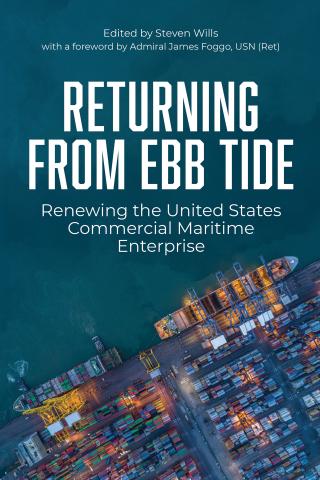
Returning from Ebb Tide: Renewing the United States Commercial Maritime Enterprise, edited by Steven Wills, PhD, Marine Corps University Press (2025)
PDF download, EPUB, and Audiobook are available at Returning from Ebb Tide>>
Reviewed by Peter H. Hames
| | |
The United States once possessed a commercial maritime enterprise capable of providing extraordinary strategic depth in time of war. Its merchant ships carried troops, fuel, food, ammunition, and other necessities across the world’s oceans; its shipyards could build vessels in enormous numbers; and its mariners provided the skilled personnel needed to operate them. Today, much of that capability has withered.
Returning from Ebb Tide: Renewing the United States Commercial Maritime Enterprise is a forceful examination of how America reached this point—and, more importantly, what might be done about it. The 310-page volume brings together essays from 13 contributors and includes a foreword by retired Admiral James G. Foggo, dean of the Center for Maritime Strategy.
The book’s central argument is straightforward but consequential: America’s commercial maritime capability has declined to a level that threatens national security. This is not simply a story about fewer US-flagged ships. It is the story of the erosion of an entire maritime enterprise—ships, shipyards, mariners, cargoes, ports, suppliers, training institutions, financing, and government policy. The authors argue that these elements cannot be considered independently because together they constitute the nation’s strategic maritime capacity.
The contributors identify several forces behind the decline. The post-Cold War “peace dividend” reduced the perceived need for maritime capacity. Changes in federal maritime policy weakened traditional forms of support for American commercial shipping. Globalization shifted cargoes toward foreign-flag and foreign-owned carriers, producing efficiencies and lower transportation costs while simultaneously reducing America’s control over strategically important transportation capacity. Meanwhile, the US commercial shipbuilding industry contracted, and the maritime labor force declined with it.
Admiral Foggo puts the issue starkly: the fleet that supported the Allies in two world wars and transported hundreds of thousands of troops and millions of pounds of equipment during Desert Shield and Desert Storm has become a “shadow of its former self.”
The historical perspective is particularly important. The United States did not build its wartime maritime capability overnight. It rested on a commercial ecosystem that existed before the emergency arose. Shipyards, marine engineers, equipment manufacturers, naval architects, seafarers, ports, shipowners, cargo interests, and government agencies all contributed to that capability.
The authors’ implicit question is therefore one that policymakers should be asking today: If the United States entered a major, prolonged war tomorrow, where would the ships, crews, shipyards, and logistics capacity come from? The answer is uncomfortable.
One of the strengths of the book is that it does not reduce the problem to the number of ships flying the US flag. Chapter 1, “Why a Standalone US Commercial Fleet?” and the subsequent chapters examine the commercial fleet in the context of strategy, sealift, logistics, energy, shipbuilding, and national security.
That broader perspective is essential. A merchant ship is not an isolated asset. It is the product of an industrial and human ecosystem. A ship requires a shipyard capable of constructing or repairing it. The shipyard requires skilled welders, pipefitters, electricians, engineers, naval architects, and other trades. The ship requires engines, generators, pumps, valves, electronics, steel, and thousands of other components. It requires trained officers and crews. Those mariners require training institutions and career opportunities. And the ships need cargoes, ports, terminals, financing, insurance, and a regulatory structure that allows the entire system to function.
Losing enough pieces of that system and merely ordering more ships will not restore the capability. That is perhaps the book’s most important lesson.
The volume is explicitly a call to action, and its recommendations range widely. I particularly appreciated its arguments for maintaining a viable standalone US commercial fleet and supporting the Jones Act; its proposal for a blue-water strategy built around new forms of multimodal transportation; its consideration of electric-drive commercial ships; and its call for a maritime innovation incubator.
The discussion of nuclear propulsion and small modular reactors is especially ambitious. The authors argue that the United States should be willing to make the government investments necessary to develop the technology and regulatory framework that could eventually make nuclear-powered commercial vessels practical. That proposal is certain to generate debate, but it deserves serious consideration rather than dismissal.
The book also correctly recognizes that technology alone will not solve the problem. Shipowners, ports, shippers, shipyards, the military, labor, and educational institutions must work together. The maritime enterprise is interconnected and rebuilding one component while allowing another to disappear will accomplish little.
The discussion of the US Transportation Command and its logistics responsibilities is another strength. It helps readers understand the relationship between commercial shipping and military power and why sealift is not simply a Navy problem. Likewise, John Konrad’s introduction to the Merchant Marine provides a useful entry point for readers who may know the Navy but have little familiarity with the people who actually move much of the world’s commerce.
The book’s treatment of mariner retention is also important. Rebuilding ships without rebuilding the workforce to operate them would leave the nation with an expensive collection of hulls rather than a functioning maritime capability.
The volume is not without shortcomings. Some of the figures and tables in Part II, The Elements of Strategic Sealift, are simply too small to read comfortably, particularly in the paperback edition. This is unfortunate because the data presented there are important to the book’s argument. I did find that the charts in the PDF version are capable of being enlarged.
I was disappointed that there is no index. A book intended to serve policymakers, researchers, maritime professionals, and students would benefit greatly from one. With eleven chapters covering history, policy, shipping, sealift, technology, labor, and strategy, an index would make the book considerably more useful as a reference.
The book has a list of “Select Abbreviations, Acronyms, and Terms” along with extensive footnotes and a bibliography. Readers interested in pursuing the subject further will find a substantial foundation for additional research.
Perhaps the most encouraging aspect of Returning from Ebb Tide is that some of the issues it raises are increasingly moving from the margins of national policy into the mainstream.
That change is visible in recent developments. In August 2026, the Maritime Administration announced $35.1 million in grants for 45 small shipyards across 24 states and the US Virgin Islands, supporting infrastructure improvements and workforce development.
Other initiatives involving nuclear-powered shipping and small modular reactors suggest that some of the technologies discussed in the book are also receiving increased attention. At the same time, the broader American shipbuilding debate increasingly recognizes that rebuilding capacity requires more than simply appropriating money for individual vessels. It requires rebuilding the industrial base and the workforce that make sustained production possible. Several major shipyards have announced apprenticeship programs offered in partnership with local junior colleges.
Returning from Ebb Tide is ultimately a warning, but it is not a hopeless one. The United States did not lose its commercial maritime capability because Americans suddenly forgot how to build ships or sail them. It was the result of decades of policy choices, economic decisions, changing strategic priorities, globalization, and institutional neglect. Reversing that decline will therefore require more than one new program or another round of shipbuilding appropriations. It will require rebuilding the maritime ecosystem.
That means ships, shipyards, suppliers, ports, cargoes, mariners, educators, financiers, technology developers, and government agencies working together toward a common strategic objective. It means recognizing that commercial maritime capability is not merely an economic sector. It is part of the nation's defense infrastructure and an element of national power.
The book’s message is therefore both simple and profound: a maritime nation cannot outsource the foundation of its maritime power indefinitely.
For anyone interested in American maritime policy, commercial shipping, sealift, shipbuilding, national security, or the future of the US Merchant Marine, Returning from Ebb Tide deserves serious attention. It is a useful diagnosis of a problem that has been developing for decades—and, perhaps more importantly, a call to begin rebuilding before the next major crisis demonstrates just how much capability has been lost.
Short bios of the fifteen contributors to Returning from Ebb Tide are included in “About the Authors.”
The reviewer, Peter H. Hames, graduated from the United States Merchant Marine Academy in 1965 with a BS in Marine Engineering, a US Coast Guard license as a Third Assistant Engineer, and an Ensign commission in the Navy Reserve. After sailing on Texaco oil tankers for three years, he transferred ashore and worked for Texaco Marine Department until retirement in 1995. He became a self-employed consultant working with a wide range of maritime companies to design, implement and maintain Quality, Safety, and Environmental Management Systems, retiring in 2019. He received an MS in Maritime and Naval Studies from SUNY Maritime College in 2024. Based on his master’s dissertation, he self-published I’ll Do It on My Own, the biography of the founder of the Houston Maritime Museum, which is available on Amazon.com.
| |
| NAVAL HISTORY BOOKS AVAILABLE FOR REVIEW | | Preble Hall Podcast Latest Episode | | |
EP268: Col Rod Andrew, USMCR-Ret, Marines Fight for Survival
13 September 2026
In this episode of Preble Hall, author Rod Andrew Jr. discusses his book The Marines’ Fight for Survival: War, Politics, and Institutional Crisis, 1945–1952 with Sondra Duplantis, the US Naval Academy Museum’s Education Specialist. Rod Andrew Jr. is professor of history and Alumni Master Teacher at Clemson University. The author of six books, he is a retired colonel in the US Marine Corps Reserve and former officer-in-charge, Field History Branch, US Marine Corps History Division.
Listen here>>
| | |
Call for Papers
Naval Dockyards Society 31st Annual (hybrid) Conference
Supplying and maintaining the Indo-Pacific Fleets in the Second World War
National Maritime Museum Greenwich
Saturday 20 March 2027
| | |
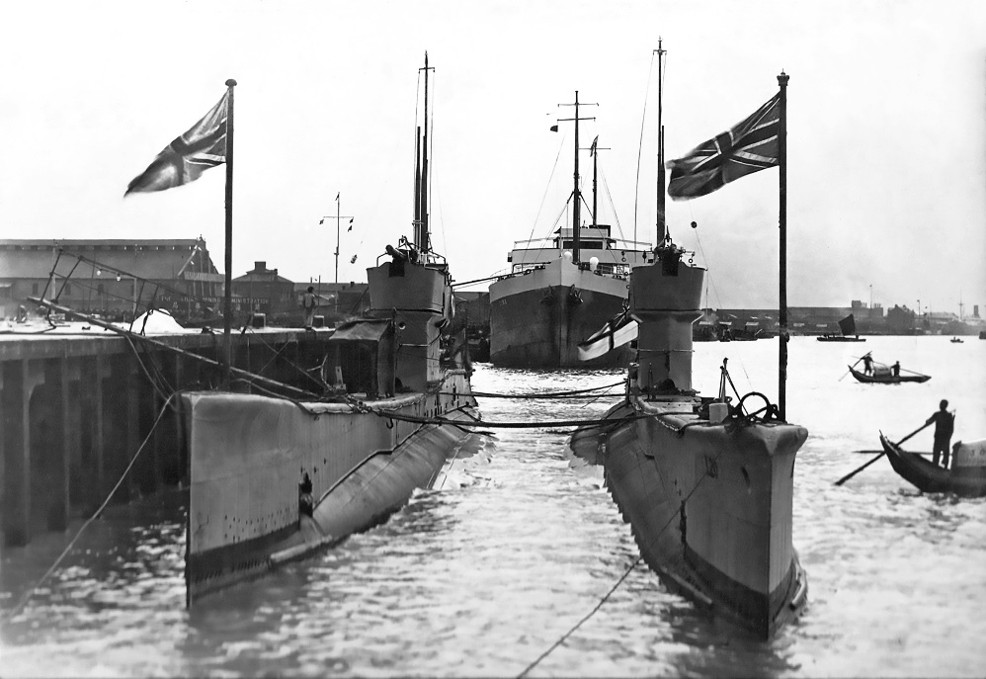
The NDS identifies July 1937 as the beginning of the Asia-Pacific War, December 1941 extending the Sino-Japanese war into a wider Indo-Pacific Ocean war involving Britain, the United States, Australia, the Netherlands and Norway, and critically embedding Royal Navy dockyards and logistical infrastructure. This interpretation challenges the narrative of the Pacific War as a solely American operation and emphasises British and Australian logistical transformation of base infrastructure around Sydney.
This conference highlights the indispensable contribution of merchant navies and their sailors and the global shore-based infrastructure to the Allied victory. All proposals relevant to the Conference theme will be considered, particularly including the following.
Conference proposals could address:
-
Evaluating the status of Singapore, Hong Kong, Trincomalee, Bombay, Colombo and other Indo-Pacific bases in 1937–41
- How the Sino-Japanese war 1937–41 affected British naval planning and logistics
- How the Royal Navy’s China Station was destabilised, 1937–42
- How Singapore Dockyard prepared for the possibility of Japanese war
- Appraising the scale and challenges of supplying ammunition, fuel, repair facilities and personnel to the Indo-Pacific Fleets in the Second World War
- Evaluating the effect of the collapse of Hong Kong and Singapore on the Indian Ocean infrastructure
- Assessing the effectiveness of Colombo, Trincomalee, Bombay and Simon’s Town in sustaining the Eastern Fleet following the collapse of Hong Kong and Singapore
- Assessing Dutch naval involvement, surface and submarine, at Colombo, Fremantle and Sydney
- Evaluating the role of international merchant navies and their sailors, such as those of the Netherlands and Norway
- How the Royal Navy was transformed from a fleet supported by imperial bases in Singapore, Hong Kong, and Ceylon into a fleet operating against Japan sustained from Australia
- Appraising the WW2 transformation of Sydney Harbour’s infrastructure and the role of Mobile Naval Air Bases (MONABs)
Dockyard Chronology
1937–39 China Station/Hong Kong/Singapore
Japan’s war against China creates an increasingly dangerous East Asian environment.
1940–41 Singapore becomes the great British strategic focus
The dockyard and naval base expand in anticipation of war with Japan.
7 December 1941 Japan attacks Pearl Harbour naval station and shipyard, followed by attacks on British, Dutch and Australian territories
Transforms the Sino-Japanese War into a multinational war involving the United States and the British Empire.
December 1941–February 1942 Singapore falls
Britain loses its great forward base.
April–May 1942 Ceylon is threatened
Eastern Fleet withdraws west.
1942 Kilindini becomes the emergency western base
Mombasa, in Kilindini Harbour in Kenya, supports the Eastern Fleet, East African communications, and Madagascar operations.
1943–44 Trincomalee is rebuilt/reopened as the principal Eastern Fleet base
The fleet gradually moves east again. Australian destroyers, for example, operate with the Eastern Fleet from Trincomalee in 1944.
Late 1944 British Pacific Fleet is created
Admiral Sir Bruce Fraser becomes Commander-in-Chief. Churchill informs Australian Prime Minister John Curtin in November 1944 that the fleet would be sent to the Pacific and maintained in Australia.
1945 Sydney/Australia becomes the logistical base for Britain’s war against Japan
The Royal Navy is now operating from Australia 4,000+ miles from Japan and roughly 16,000 miles from Britain’s supply sources, making the Fleet Train (Task Force 112) and Australian infrastructure critical.
If your proposal is accepted, you will present in-person or online. We shall refund UK/European travel fares to the conference (or travel from a UK airport to Greenwich), your fee, lunch, and contribute to accommodation, publish your paper in NDS Transactions (https://navaldockyards.org/transactions/) and give you a copy. Your talk will be c.35 minutes, the printed paper 6–10k words, due 30 June 2027.
Send your title, a 300-word synopsis and a 100-word biography by 16 October 2026 or earlier to Roger Bendall roger@rogerbendall.com and Dr Ann Coats avcoatsndschair@gmail.com N.B. The proposal should present original research.
Conference Page>>
Main Website>>
Facebook: NavalDockyardsSociety
| | |
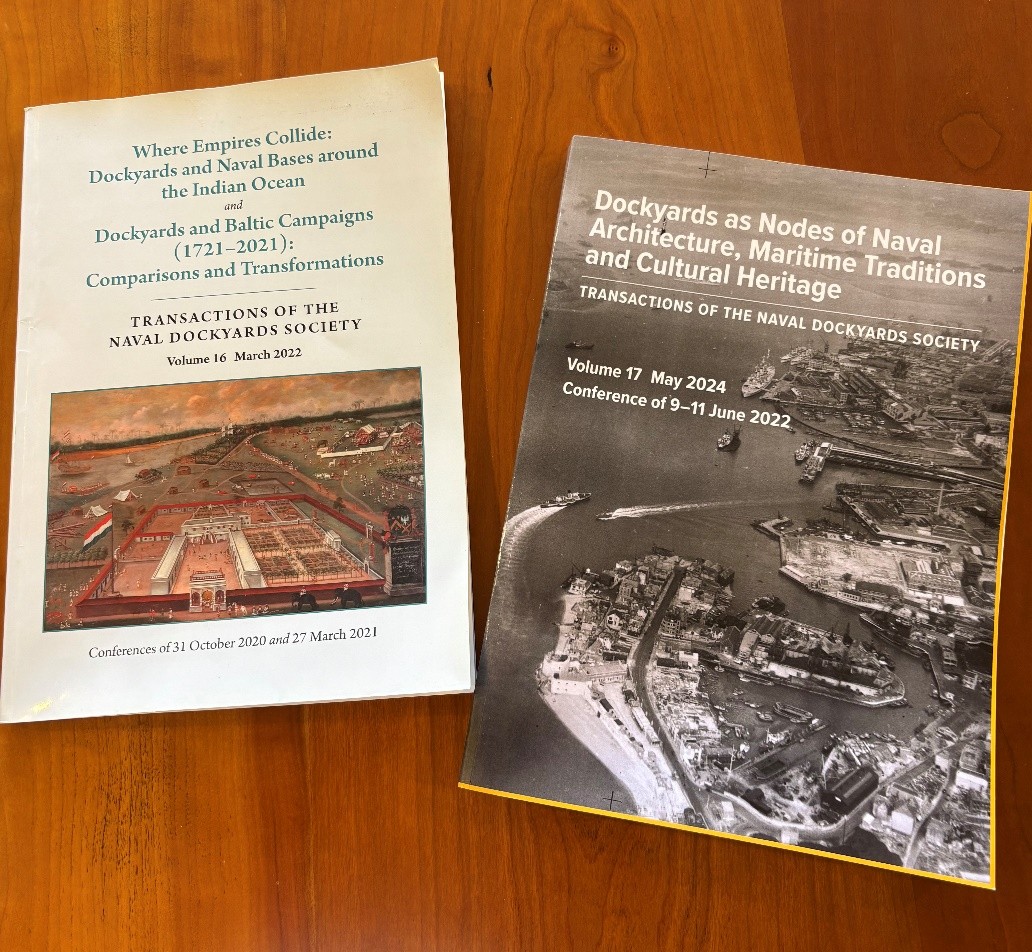
NDS Conference Transactions Journals
After each of our conferences all papers are published in the NDS Journal Transactions. This journal is a substantial and high quality hardcopy annual publication for members which features NDS themed conference papers, book reviews and additional articles. See the Transactions list and Author Index for details.
You can also buy papers from our past conferences on Amazon as either print on demand or Kindle editions. Transactions on Amazon
| | |
93rd Annual Meeting of the Society for Military History
11–14 March 2027, New Orleans, LA
Deadline for submissions: 10 October 2026
| | |
The Society for Military History is pleased to call for papers for its 93rd Annual Meeting, hosted at the Sheraton New Orleans Hotel.
The Society is also very happy to announce that due to a large donation from the late Graham K. Cosmas, we will waive the registration fees of all first-time attendees who are enrolled in a graduate program. One does NOT have to be on the program to receive this benefit. This fund is not unlimited and will be made available on a first-come, first-served basis during the early bird registration period only. Recipients will be designated as Cosmas Fellows in the program.
The Program Committee seeks to create a slate of panels that represent the breadth of expertise and interests, as well as the overall diversity of the Society’s wide-ranging membership. Proposals on all facets of military history (broadly defined) will be considered for inclusion. We encourage new and existing Society members, whether in academic institutions, the armed forces and governmental agencies, museums and archives, independent scholars, or employed internationally, to participate.
Priority will be given to complete panel or roundtable submissions that highlight the presentation of original research, new interpretations, topics of immediate interest to our membership, and cutting-edge trends and subject matter.
Types of Proposals and Requirements:
- Panel proposals must include: a panel title, paper titles, full names and professional affiliations of each participant, 300-word abstract summarizing the theme of the panel; 300-word abstracts for the three papers proposed; and a one-page professional curriculum vitae for each participant panelist. Standard panels consist of three papers and a chair, with an optional commentator.
- Roundtable proposals must include a title, full names and professional affiliations of each participant, a 300-word abstract summarizing the theme and questions; and a one-page professional curriculum vitae for each participant (including the moderator). Roundtables consist of a moderator and three or more expert participants. The moderator facilitates the discussion amongst the participants and audience. Roundtables are not the venues for individual presentations.
- Individual paper proposals will also be considered and must include a paper title, 300-word abstract of the paper, and one-page professional curriculum vitae. If accepted, individual papers will be assigned by the program committee to an appropriate panel. The denial rate for individual papers can be high. Applicants are encouraged to instead consider a poster (if material is suitable) or a “Lightning Talk”—both discussed below.
- Young Scholars Papers: B.A. and M.A. students are encouraged to submit individual paper proposals which must include a paper title, a 300-word abstract of the paper, and one-page professional curriculum vitae. If accepted, individual papers will be assigned by the program committee to an appropriate panel.
- Lightning Talks are 5-minute presentations in which the presenter summarizes their ongoing research; two sets of up to ten presentations each will be grouped with time reserved for Q&A and discussion. Proposals must include a paper title, 300-word abstract of the paper, and one-page professional curriculum vitae.
- Poster proposals allow military historians (especially, but not limited to, graduate students) to share their research through visual materials. Proposals should clearly explain (in no more than 300 words) the poster’s topics and arguments, as well as how the information will be presented visually and include a one-page curriculum vitae. This year we also especially encourage posters on the teaching of military history at all levels. The poster format is well suited to conveying information about teaching tools, tricks, and materials. In coordination with the SMH committee on teaching, and with the author’s permission, select posters may be displayed at an SMH table at conferences for educators (such as the National Council for History Education and the National Council for Social Studies).
- Volunteer Chairs. Those who wish to volunteer to serve as chairs should send a one-page professional curriculum vitae to the program committee chair at the email listed below.
Proposals will be judged according to the following criteria:
- Proposal (panels, roundtables, individual, young scholar, posters and lightning talks) explains the topic, research questions, methodologies, and historiographic significance in ways that specialists and non-specialists alike can understand. (5 points)
- Proposal (panels and roundtables) clearly articulates the rationale for bringing their specific set of papers or speakers together. (5 points)
- Proposal (panels and roundtables) reflects the SMH’s desire to sustain and expand the vibrancy and diversity of its membership. (5 points)
Appearance Limits:
You may only apply to appear as a speaker one time on the program unless invited to appear on a presidential, vice presidential, or SMH committee-sponsored panel. In addition, you may also serve as a panel chair or a roundtable moderator. It is the responsibility of the submitting organizer that all participants (speakers, chair, moderator, and commentator) adhere to this requirement. Submissions in violation of these limits will be required to adjust the proposal before it will be considered.
Submission Procedures and Deadline:
All submissions must be made via email to smhmeeting2027@gmail.com. One person will need to gather all required information for panel and roundtable submissions and provide the information preferably in a single combined document. For questions about the submission process, contact the Program Committee at smhmeeting2027@gmail.com.
Finally, we would like everyone to think carefully before applying on whether they will have the financial support to attend the conference. We require registration and membership to present at the conference. Additionally, you must attend the conference in person to present. Substitutes are not generally allowed. Moreover, due to the high cost of operating an online forum, SMH will not provide one. So please refrain from applying without some reasonable expectation of attending. Grad students applying for a travel grant (Weigley, Cosmas) should note their application in their conference proposal.
All proposals must be submitted by October 10, 2026. All accepted participants must be members of the Society for Military History by December 31, 2026, to be placed on the conference program. In addition, registration for the conference is required for participation.
| | Call for Papers: International Journal of Naval History | | UPCOMING NAVAL & MARITIME HISTORY GATHERINGS | | |
20–22 October 2026: UK Maritime Heritage Forum, Chatham Docks
22 October: NMHS Awards Dinner, New York
4 November 2026: US Naval Institute Annual History Conference, Annapolis, MD
4–7 November 2026: Naval Order Congress, Pensacola, FL
19–21 November 2026: North Carolina Maritime History Council Conference, New Bern, NC
24–26 November 2026: Portuguese Maritime Society 19th International Symposium, Lisbon
20–21 February 2027: Western Naval History Assn. Annual Conference, San Diego, CA
11–14 March 2027: 93rd Annual Meeting of the Society for Military History, New Orleans, LA
20 March 2027: Naval Dockyards Society Annual Conference, Greenwich, UK
28–30 April 2027: Council of American Maritime Museums Conference, Door County Maritime Museum, WI
| PREBLE HALL NAVAL HISTORY PODCAST | |
A naval history podcast from Preble Hall—the United States Naval Academy Museum in Annapolis, Maryland—featuring interviews with historians, practitioners, military personnel, and other experts on a variety of naval history topics from ancient history to more current events.
Click here for the latest episode: 268 — Col Rod Andrew, USMCR-Ret, Marines Fight for Survival>>
Click here for all Preble Hall Podcasts >>
|
DRACHINIFEL YOUTUBE CHANNEL
| WHAT’S GOING ON WITH SHIPPING? YOUTUBE CHANNEL | |
What’s Going on With Shipping examines headline topics and issues below the surface of the global maritime industry and aims to make the world of shipping readily understandable to all. Sal Mercogliano, the host, has degrees in Military and Naval History, Maritime History and Nautical Archaeology, and Marine Transportation. He is a former merchant mariner and teaches courses in maritime history, security and industry policy.
Click here for latest episode: Salvaging Starship 40: What SpaceX's New Footage Reveals>>
Click here for the YouTube channel>>
| SUPPORTING US NAVAL HISTORY & HERITAGE | |
Tuesday Tidings is free to all—but it exists because NMHS members keep our work moving forward. Membership supports research, publications, seminars, educator resources, and the community that shares these stories. If you enjoy reading Tuesday Tidings, becoming a member is the best way to sustain it. Thank you!
Click here to become a member of NMHS today >>
| | | | |