Tuesday Tidings is published by the National Maritime Historical Society with support from the US Naval Institute. Interested in joining USNI? Click on the USNI logo to become a member! | | | |
28 October 2025
Welcome back to our National Maritime Historical Society members and friends who share a love for naval history!
| | |
Congratulations to the 1805 Club, which hosted its inaugural conference last Friday in conjunction with its annual Trafalgar Dinner in the HMS Nelson Wardroom held on Saturday Evening in Portsmouth, UK. Look for a summation in next week’s Tidings.
In this week’s edition, we include a tribute to former Secretary of the Navy Bill Middendorf written by Todd Creekman. We also offer follow-up context for last week’s announcement at the Naval Order Congress of the Navy’s decision to withdraw from a land swap arrangement to procure a site for a new National Museum of the US Navy.
For Naval History Book Reviews, we again thank Dr. John Satterfield, who goes two for two with his review of Steven Dunn’s study of British coastal defense. Thanks for the multiple requests for recently received titles. Additional books have arrived for reviewer consideration!
| | |
Tuesday Tidings is compiled by Dr. David F. Winkler and Jessie Henderson as a benefit for members of the National Maritime Historical Society and friends of naval history.
As always, comments and naval history news items are welcome at nmhs@seahistory.org.
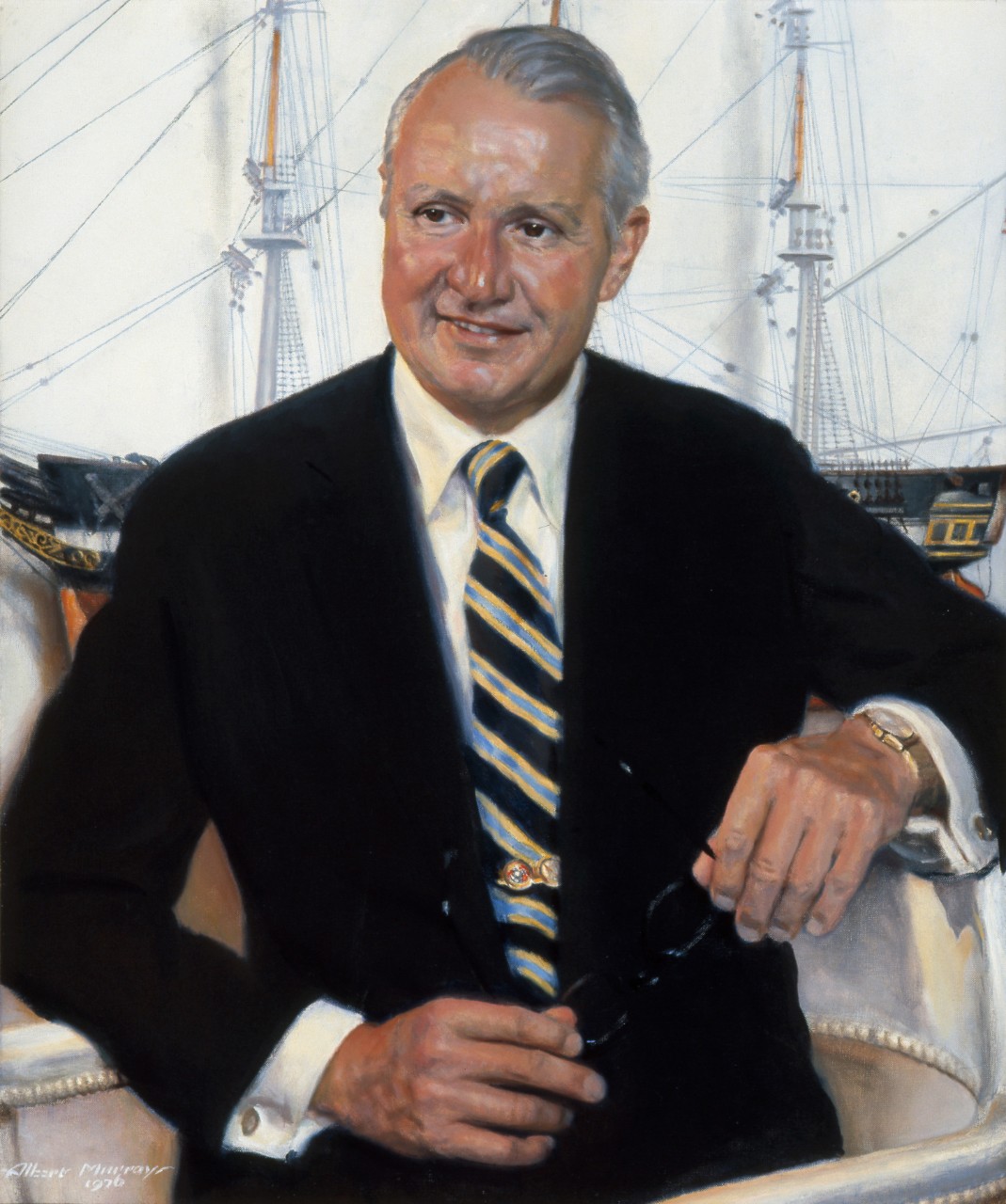
| | A Tribute to former Secretary of the Navy Bill Middendorf | | |
J. William Middendorf II, the 62nd secretary of the Navy under President Gerald Ford from 1974 to 1977, died this past Friday, 24 October, at the age of 101 in a Massachusetts hospital not far from his beloved Little Compton, Rhode Island, home.
Bill, as he was known to friends, business, and political associates, was born in September 1924 in Baltimore, MD. Starting his college years at Harvard, he transferred to the College of the Holy Cross in 1945 as part of the Navy’s V-12 college training program, received his bachelor of naval science degree and was promptly commissioned an ensign in the US Navy. He served aboard USS LCS(L)(3)-53 in the Pacific theater as engineer officer and navigator in the final months of World War II, including duty with his ship in China before returning home. He resumed his studies at Harvard, where he earned a bachelor of arts degree in 1947. Though he was awarded a master’s degree in business by New York University in 1948 and spent a number of years as a New York City investment banker, his love of the naval service and public service to the nation shaped his later career.
His New York Times obituary details a fascinating business, political, and government service career, punctuated by his musical composition and art talents, not to mention his rowing prowess well into his 90s.
For our purposes, it’s important to note that as secretary of the Navy, Middendorf was instrumental in sponsoring through Congress the Ohio-class submarine program and accompanying Trident missile system; the Aegis surveillance and surface-to-air-missile system; the F/A-18 Hornet carrier-based fighter-attack jet; and the CH-53E heavy-lift helicopter for the Marine Corps. He also is credited with helping create the Marine Corps Marathon, whose 50th- anniversary race was held 26 October, two days after he passed away.
His naval heritage predated his own World War II service; one of his ancestors chartered two merchant ships to the infant Continental Navy in December 1775, which became the schooner Wasp and sloop Hornet in the American Revolution.
He promoted the Navy’s and the nation’s proud bicentennial through the events of 1975 and 1976, culminating in the 4 July 1976 OpSail and International Naval Review in New York City. That same month he accompanied Queen Elizabeth II on a visit in Boston, Massachusetts, to the Navy’s frigate USS Constitution, still the world’s oldest commissioned warship afloat. He also directed the creation and use during the Navy’s bicentennial celebration of a “First Navy Jack,” flown by all commissioned Navy ships during that period and modeled on a Revolutionary War-era naval flag.
After his SecNav tour, preceded by appointment as ambassador to the Netherlands (1969–1973) and followed by ambassadorial appointments to the Organization of American States (OAS) (1981–1985) and the European Community (later the European Union or EU) (1985–1987), he settled into his elder statesman role and, among other jobs, took on a four-decade position as a director of the nonprofit Naval Historical Foundation. In that capacity he assisted Navy legends Admiral Jim Holloway and Admiral Bruce DeMars in preserving and promoting the Navy’s history and heritage across a wide range of programs.
His love of music and impressive composition skills resulted in not only eight symphonies—including The Holland, written while he served as ambassador to the Netherlands—but also many Navy marches, including the “Battle of Midway March,” performed annually at Battle of Midway commemoration events around the nation. His fondness for the US Navy Band resulted in sponsorship of the first prize for the ensemble’s annual Young Artist Solo Competition.
In 2022, then-SecNav Carlos Del Toro named the future guided missile destroyer DDG-138 USS J. William Middendorf, whose fabrication at Bath Iron Works, Bath, Maine, is set to begin next month. As one of his parting gestures, Middendorf designed elements of that future ship’s crest, for consideration by the future prospective commanding officer.
A memorial service for Bill Middendorf will be held on Saturday, 22 November at the United Congregational Church in Little Compton, RI, followed at a future date by interment at Arlington National Cemetery.
| | Permanent Home for Navy Museum Saga Continues | | |
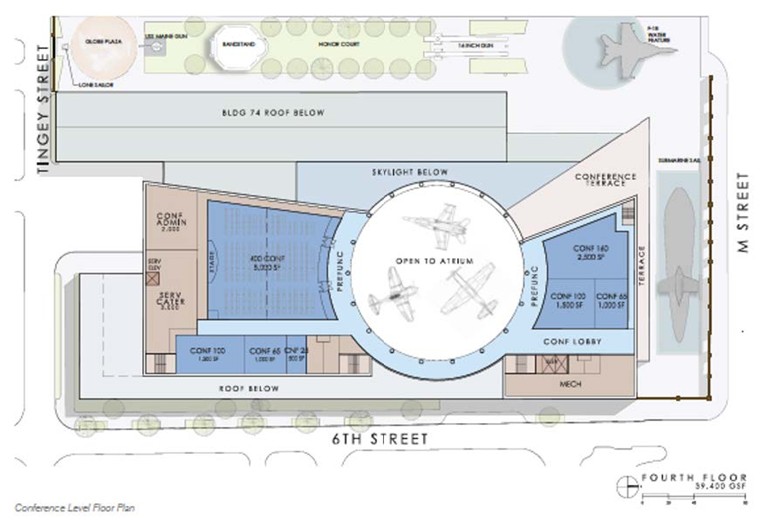
The recent disclosure that Secretary of the Navy John Phelan has opted to cancel the land swap arrangement that would have located the National Museum of the US Navy on a parcel of land along M St. SE adjacent to the western boundary of the Washington Navy Yard represents another milestone in the ongoing effort to find a permanent home for the Navy’s Flagship Museum. To provide some context for how we got here, the story begins nearly a century ago with an article in the Naval Institute’s Proceedings by Capt. Dudley W. Knox titled “Our Vanishing Naval History,” where he lamented how much naval history had been stashed away within the personal property of veterans and their heirs and called for a national collection effort. As a result, the Naval Historical Foundation (NHF) was formed in 1926 to take on that mission.
In addition to collecting personal papers and other historic artifacts, the NHF took on a museum advocacy mission as the Royal National Maritime Museum had recently opened in Greenwich and Americans who had the opportunity to visit the new facility returned with envy and desire to establish an American counterpart. Thus, the NHF lobbied the regents of the Smithsonian Institution to build an American maritime museum on the National Mall. The regents declined, and the onset of the Great Depression effectively ended any Smithsonian initiative.
However, with the election of Franklin D. Roosevelt, the NHF had a friend in the White House and interest was revived—this time for a Navy-only museum. Locations that were considered included a site astride the Smithsonian American Art Museum on the east end of the Mall, and sites that are now occupied by the National Museum of African American History and Culture close to the Washington Monument, and the United States Institute of Peace near the Old Naval Observatory. Architectural renderings of the proposed museum are still on display at the Naval History and Heritage Command (NHHC).
With America’s entry into World War II, President Roosevelt took an added interest in a naval museum, given the historical narrative that was being created on the world’s oceans. Roosevelt worked with Knox, by then a commodore, to create a museum complex centered on a tidal basin to be located where the Kennedy Center for the Performing Arts now stands. Within the basin, Roosevelt envisioned the “frigate” Constellation (later to be determined to be an 1850s sloop-of-war), the Hartford of Mobile Bay fame, the Olympia of Battle of Manila fame, and a World War I vintage destroyer. There would also be an indoor museum nearby. As plans were developed, Olympia was drydocked for hull work in the spring of 1945.
FDR’s museum vision died with him. His immediate successors expressed interest in a national museum that honored all services, which would never be built. Instead, the NHF arranged to open a display center in the carriage house of the former home of Stephen Decatur near the White House and the Truxtun-Decatur Naval Museum was a fixture on the nation’s capital landscape from 1950 through 1980.
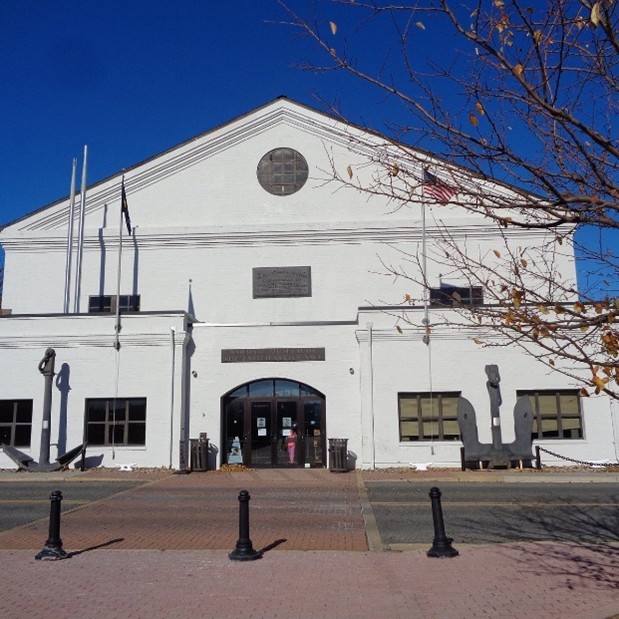
However, the Truxtun-Decatur Museum was not a final solution. Chief of Naval Operations Adm. Arleigh Burke toured overseas naval museums and came home determined to establish one at the Washington Navy Yard; he initiated the conversation about an industrial building that had once installed breeches on the naval guns produced at the yard’s Naval Gun Factory. Opened in 1963, the National Museum of the US Navy evolved over the next four decades to include a mast from USS Constitution, the submersible Trieste, and an extensive World War II section. Outside, a World War I-vintage railway gun from the Dahlgren Naval Support Facility was added and the Forrest Sherman-class destroyer Barry arrived to serve as a display ship in 1984.
| | The Navy Museum. Note the periscopes on the left-hand side. US Navy photograph. | | |
In the late 1990’s the NHF was approached by Milton Peterson, whose company intended to develop land on the East bank of the Potomac near the Woodrow Wilson Bridge (National Harbor), with an offer of free land to build a new museum. NHF President Adm. James L. Holloway III asked quizzically “Why would we want to build a new museum when we already have one here?” At the time, the museum was attracting some 900,000 visitors per year as between 40–50 buses would arrive on spring days to discharge their human cargo to tour the museum and Barry. With the museum’s popularity, the NHF agreed to take on a $15 million capital campaign to convert and fit out the nearby historic David Taylor Model Basin to a Cold War Gallery.
Unfortunately, the attacks of 11 September 2001 led to restricted public access to the Washington Navy Yard. Visitation tumbled, undercutting the NHF Cold War Gallery capital campaign. With the museum located in the middle of the Washington Navy Yard, access would be a constant thorn. Further undermining the fundraising effort was a competing National Navy Museum Foundation (NNMF) that had for its leadership the directors of PN Hoffman, a major DC developer, which had obtained the rights to remake the district’s Southwest waterfront and saw a navy museum on their property as a tourist draw. However, an NNMF meeting with Secretary of the Navy Donald Winter with the objective of obtaining tens of millions for fundraising seed money did not go well. Meanwhile another developer, Forest City, which had earned the rights to develop property that had once been part of the western portion of the Washington Navy Yard, made an offer to site the museum in a World War II vintage industrial building. The power plant along the waterfront on the Navy Yard’s western side was also offered for consideration.
With three sites to consider, the NHHC contracted with AECOM to provide consultation for a site recommendation. AECOM preferred the Forest City proposal, which offered a lease-to-own arrangement. Unfortunately, the lease-to-own option would not stand government scrutiny, as the Navy would be committing funds that had yet to be authorized by Congress. The Navy then sought to purchase the land outright. However, that ran into Congressional opposition. While this was occurring, the idea of repurposing the industrial building was set aside for building a museum from the ground up on nearby empty land.
| | A rendition of the new museum. Courtesy Navy Museum Development Foundation. | | Unable to purchase the desired property, the Navy entered into negotiations to conduct a land-swap arrangement that would provide the developer waterfront property on the Anacostia River near the 11 Street bridge. News of the pending deal was announced by NHHC Director Rear Adm. Sam Cox at the last annual meeting of the NHF in June 2022. Ironically, with the proposed land swap, the private development property line now came near the museum that was being closed in anticipation of new museum construction. Indeed, NHHC was directed to gut the Cold War Gallery of its exhibits (which the NHF had raised millions of dollars to fabricate) to enable the turnover of the historic building to the developer. Finally, last September with great fanfare, it was announced by then-Navy Secretary Carlos Del Toro that the land swap had been signed. As the saying goes: back to square one. | | NAVAL HISTORY BOOK REVIEWS | | |
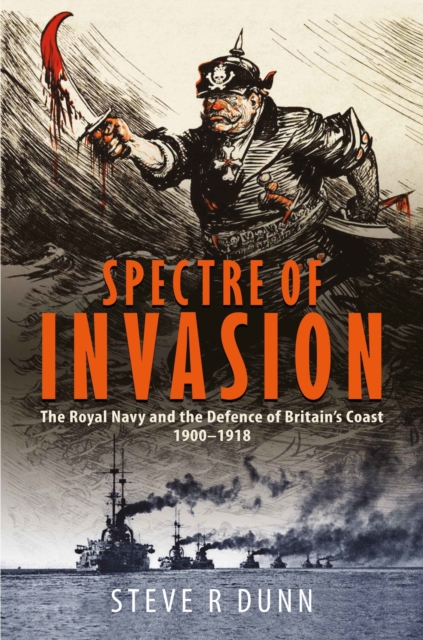
Spectre of Invasion: The Royal Navy and the Defence of Britain’s Coast 1900–1918 By Steve R. Dunn, Barnsley, UK: Seaforth Publishing (2025).
Reviewed by John R. Satterfield
| | |
The English Channel is only twenty miles wide at the Straits of Dover, so invasion, real and imagined, has figured strongly in Britain’s history. Roman occupation spanned four centuries, and Nordic raiders frequently attacked across the North Sea. The Norman conquest across the Channel in 1066 opened centuries of conflict with France. By the reign of Henry VIII in the mid-sixteenth century, Britain had established the Royal Navy to defend against seaborne assault. After the Restoration in 1660, the Royal Navy became a primary instrument of Empire. The Napoleonic Wars created acute public fears of cross-Channel attack, and the Royal Navy became the world’s largest in the nineteenth century, the globally predominant defender of the homeland and imperial territories and trade.
This history forms the framework of author Dunn’s study. His book recounts how imperial burdens, technological and scientific advancements, changing economic, social, and political environments, and evolving national beliefs and attitudes all contributed to the Royal Navy’s diminished effectiveness in the early twentieth century.
Dunn recounts the late Victorian-era government’s creation of coastal defense installations and improvements in the Royal Navy. Adm. Sir John Fisher’s appointment as First Sea Lord in 1904 accelerated naval modernization and reform. Fisher revolutionized naval strategy, planning, personnel and training policies, and shipbuilding. He eliminated obsolete ships while creating HMS Dreadnought, the paradigm of modern battleships, and fast, well-armed battlecruisers and smaller vessels. This avoided potential problems with the growing German threat and World War I. Still, expensive new ships, the advent of wireless communication, signals intelligence, submarines, and aircraft impaired Britain, portending the Empire’s collapse after World War II.
The popular press fomented much of Britain’s preoccupation with invasion. Speculative journalism and fiction excited public invasion fears, in turn developing interest in volunteerism that supported local coastal observation and defense organizations. Volunteer Training Corps units totaled, at peak, half a million men. The army grew to five million men with 2.7 million volunteer enlistments. The all-volunteer Territorial Force endured 600,000 casualties. The Royal Navy numbered more than 400,000 by war’s end, and Royal Navy coast watchers included 2,400 civilians and 1,700 Boy Scouts!
Britain still suffered attacks. German ships and submarines bombarded thirteen coastal ports and towns, shelling military targets and civilian areas, killing and injuring hundreds of civilians. More serious were 103 airborne attacks by Zeppelins and bombers over London and other cities, killing 1,114 and wounding 3,416. Thanks to Adm. Sir Percy Scott, who built up London’s non-existent anti-aircraft defenses in 1915, German losses were sufficient to curtail raids.
The invasion fear also had extensive negative repercussions. Continental warfare in static trench lines ground up tens of thousands of troops on both sides, many in massive offensive operations that often gained nothing. The British army needed reinforcements, but in 1917, only 100,000 soldiers were authorized despite a War Office request for 615,000. In 1918 1.5 million troops, including convalescents and trainees, were in England protecting the homeland.
The Defence of the Realm Act (DORA) was another damaging ramification of invasion worries. DORA imposed draconian regulations governing Britain under a “civil-military junta with little parliamentary involvement.” DORA curtailed personal liberties such as freedom of speech and movement, private property rights, and such trivial actions as flying kites, whistling for cabs, buying binoculars, or giving bread to horses or chickens. Many foreigners were subject to detention on suspicion of espionage. The government could take over any factory or land and fine or imprison any DORA violators. In addition, strict work rules led to industrial strikes and stoppages that reduced wartime production. Ordinary lives changed immensely and lost fundamental privileges.
The Royal Navy clustered its forces around Britain, using undefended ports for fleets to bring them within striking distance of enemy sorties from the North Sea. There was never, however, a decisive battle in Mahanian terms, raising questions about the Royal Navy’s effectiveness. Both belligerents attempted blockades, using mines, submarines, and surface attacks against merchant ships. Britain enjoyed greater success in breaking Germany’s efforts with technological and tactical innovations. Lack of food was a major factor in Germany’s military collapse in 1918 while transport of troops and materiel from America and other allied nations to Britain continued without major disruption.
From this broad strategic perspective, Dunn’s focused history argues that the Royal Navy was essential to victory in World War I, although Britain suffered significantly from the navy’s inadequate shield. Dunn’s volume is well worth reading, and concludes that today Britain’s maritime shield has vanished, with unprotected coasts and sixty-two Royal Navy ships, one quarter of the number of US Coast Guard cutters.
Steve Dunn is an author with a special interest in the Royal Navy of the late nineteenth century and the First World War. He has written biographies and narrative histories, most recently Blockade and Securing the Narrow Sea, both published by Seaforth. He lives in Worcestershire and southwest France.
Dr. Satterfield writes about and teaches military and naval history for the University of Maryland Global Campus.
| | NAVAL HISTORY BOOKS AVAILABLE FOR REVIEW | | |
Latest Podcast!
The Death of Nelson
In this commemorative episode of Mariner’s Mirror Podcast, Dr. Sam Willis marks the 220th anniversary of the Battle of Trafalgar by exploring the exact location and circumstances of Admiral Lord Nelson’s death aboard HMS Victory on the 21st of October 1805. Joined by Andrew Baines, curator of HMS Victory at the National Museum of the Royal Navy in Portsmouth, and Dr. Dan O’Brien, historian of undertakers and funerals in eighteenth-century England, the discussion unfolds on the very decks where history was made—the quarter deck where Nelson was shot, and the orlop deck where he died. This episode offers a poignant reflection on the emotional weight that the decks of HMS Victory still retain.
This is one of just two specials that have been additionally supported by the SNR’s Save The Victory Fund (STVF); the second will be available tomorrow in a back-to-back release for “Trafalgar Week.”
Listen here>>
| | Call for Applications: 2026 Summer Seminar in Military History | | |
Through the generous support of the John A. Adams ’71 Center for Military History and Strategic Analysis at the Virginia Military Institute, and the Society for Military History, the 2026 Summer Seminar in Military History will be held on the VMI campus in beautiful Lexington, Virginia, June 1–12, 2026.
This two-week in-residence experience draws on the long tradition of Summer Seminars. This year, the theme will be “Foundations of Military History.” Participants will engage with visiting scholars, VMI faculty, and the program director to develop core skills and concepts in the study of military history. Seminar Fellows will also interact with public historians and archivists and participate in a battlefield staff ride.
The seminar is open to advanced doctoral students (ABD at time of application) in history or a closely related field, early career scholars no more than five years beyond the conferral of their PhD, or scholars new to the discipline of military history (including public historians or historians employed in government positions).
Due to funding constraints, the seminar is only open to US citizens or permanent residents.
Summer Seminar Fellows will receive:
- lodging for the duration of the seminar
- select meals, including a welcome dinner, lunch each seminar day, and a closing banquet
- all reading materials
- a $1,300 stipend to help offset transportation costs to and from Lexington, Virginia, and other costs, such as evening meals, laundry, etc..
Seminar Fellows are encouraged to seek additional support from their home institutions to supplement travel and other costs.
Applications will be submitted via https://form.jotform.com/252778234204053. The application consists of a brief form, plus the following items to be uploaded:
- A two-page letter of interest, outlining the applicant’s motivation, qualifications, and goals for the seminar and their future career
- A CV/Resume
Doctoral students will include the name and contact information of their academic supervisor, who will submit a letter of reference.
Applications will be accepted through December 12, 2025. Applicants will be selected based on their potential contributions to the field of military history and on the contribution the program can make to their future teaching and research. Selected Fellows must be members in good standing of the Society for Military History. Click here for membership information.
Questions about the program can be sent to the Director, Dr. Adam Seipp (Professor of History, Texas A&M University), at aseipp@tamu.edu.
| | Grimsley Fellowship Announcement | | |
The Society for Military History (SMH) seeks a doctoral student in military history and who is a member in good standing in the SMH to fill its Mark Grimsley SMH Fellowship in Social Media. This position honors Dr. Mark Grimsley, Associate Professor of History at the Ohio State University, a widely published scholar and leading pioneer in military history social media and academic blogging. The Grimsley Fellow will serve a two-year term beginning January l, 2026, and receive a stipend of $2,000 per year from the SMH.
The Grimsley Fellow will join the SMH’s Social Media Committee and act primarily to maintain the SMH presence on X (formally known as Twitter), Instagram, and Bluesky. Among other duties, the Grimsley Fellow will focus on posting abridged versions of notices that appear on the SMH Facebook Group, Facebook Page, and the SMH web site.
Any student of military history currently enrolled in a doctoral program—who is also an SMH member—is eligible for the Grimsley Fellowship. Please submit your application electronically to the SMH Social Media Committee Chair, Dr. Brittany Huner, at brittanyhuner@my.unt.edu. Applicants must submit:
- A cover letter including the applicant’s experience managing social media with a statement describing how social media can benefit and be utilized by the SMH
- The applicant’s CV
- Written confirmation from the applicant’s adviser that he or she is a student in good standing in an accredited program.
The deadline for applications is 15 October 2023. The Grimsley Fellow will be chosen by a search committee composed of the SMH Social Media Committee. Contact Dr. Brittany Huner at: brittanyhuner@my.unt.edu with any questions.
| | |
Aftermath of the 1956 Suez crisis: Global Ramifications and Reflections
for Dockyards and Shipyards
Naval Dockyards Society 30th Annual Conference (hybrid)
National Maritime Museum Greenwich Saturday 28 March 2026
Sponsored by the Society for Nautical Research
| | |
Writing a decade after the Suez crisis, one contemporary politician dismissed the affair as merely “the dying convulsion of the British Empire.”* This view is still widely held today, but how authentic is that interpretation in hindsight?
How did the Suez crisis redefine Britain’s international identity and economic profile and its relationship with former colonies and ongoing allies? And how did it influence attitudes among Britain’s allies, including France and Israel, who had taken part, and the United States who had forced an early end to the action?
Critically, how did the Suez aftermath and its often bitter recriminations shape future British naval policy on home and overseas dockyards and shipyards and their communities?
Conference themes will include:
- Overview of how the Suez crisis shaped subsequent British and Allied naval strategy and deployment in the Cold War
- Political, local, social and economic effects of Suez on dockyards and shipyards globally
- Global strategic threats and opportunities arising from Suez
- Suez accelerated the global power shift from Britain to the United States—evidence?
If your proposal is accepted, you will present in-person or online. We shall refund UK/European travel fares to the conference (other overseas: travel from UK airport to Greenwich), your fee, and lunch, and contribute to accommodation, publish your paper and give you a journal volume. Your talk will be c.30 minutes, the printed paper 6–10k words, due 31 June 2026.
Send your title, a 300-word synopsis and a 100-word biography by 15 December 2025 or earlier to Roger Bendall roger@rogerbendall.com and Dr Ann Coats avcoatsndschair@gmail.com N.B. The proposal should present original research.
https://navaldockyards.org/conferences/ https://navaldockyards.org/ Facebook: NavalDockyardsSocietyhttps://www.facebook.com/groups/1443502952760615
* Nutting, Anthony. No End of a Lesson. Constable, 1967. p. 108. A noted Arabist, Nutting resigned as Under-Secretary of State for Foreign Affairs in protest at the invasion of Egypt.
| | |
Maritime Margins: Missing Voices, Overlooked Places, and New Perspectives
New Haven, Connecticut, 27–29 May 2026
| | |
The North American Society for Oceanic History invites you to its annual conference at the Canal Dock Boathouse and Hotel Marcel in New Haven, Connecticut, 27–29 May 2026. From the Black engineer William Lanson, who once made New Haven’s Long Wharf the longest structure of its kind in North America, to the birth of industrialized oystering in the waters between river, harbor, and Long Island Sound, New Haven sits at multiple margins of human and natural histories. The city is also the “cultural capital of Connecticut,” boasting renowned museums, research libraries, and some of the best “apizza” outside Naples.
All scholars of the history or archaeology of fresh and saltwater, maritime cultural landscapes, navies, maritime security and strategy, and maritime actors (including the natural environment itself) are encouraged to submit proposals. We particularly seek presentations that highlight historically marginalized people, places, and subjects, including papers that consider race, class, gender and imperial, colonial, and environmental histories.
The program committee invites panel proposals of at least three and no more than four papers. We also welcome roundtable and individual paper proposals. The committee will consider a limited number of remote presentations from international participants only on a case-by-case basis. Participants from the United States must present in-person.
Proposal submissions should be in single document (.doc or .docx) and include: A) panel or paper title; B) 150-200 word abstract for the full panel and for each paper submitted; C) phone number, address, affiliation, and email of presenter(s); and E) any special requests to include remote participation by international presenters or any physical or technical accommodations required beyond a basic projector, laptop, and screen. Conference registration is required for all participants.
Proposals should be submitted electronically to nasoh.conference@gmail.com by
2 February 2026. Contact Dr. Jason W. Smith at smithj131@southernct.edu for general questions about the conference.
Student Grants and Awards
All students applying to present are automatically considered for NASOH’s Chad Smith Travel Grants. Students are also encouraged to submit their paper to be considered for the Clark G. Reynolds Student Paper Award. Additional information on award guidelines can be found on the NASOH website.
| | Call for Papers: International Journal of Naval History | | |
With the November publication of Issue 18, Vol. 2 on the new International Journal of Naval History website, the editors are seeking submissions for three planned Issue 19 volumes in 2026. Submissions from graduate students working toward a doctoral degree are especially encouraged. For inquiries, please contact the managing editor at IJNH@seahistory.org. The journal also seeks book reviews; the book review editor can be contacted at IJNHReviews@seahistory.org. Submission guidelines can be found at
Submissions – International Journal of Naval History.
| | Brigadier General James L. Collins Jr. Book Prize in Military History | | |
The US Commission on Military History proudly announces the submission date for all books for consideration for the Brigadier General James L. Collins Book Prize in Military History. The prize entails a $2,000 award to the author, irrespective of nationality, of the best book written in English on any field of military history published during 2024. The Book Prize Committee, comprising USCMH members Dr. Edward J. Marolda, (Chair), Dr. Jeffrey Clark, and Dr. John Hosler, will review the submitted books and select the winner. Topics in all periods and all aspects of military history (including naval and air warfare) will be considered.
One copy of books for consideration by the Collins Prize Committee must be submitted to each of the following addresses:
Dr. Edward J. Marolda
15570 Golf Club Drive
Montclair, VA 22015
Dr. Jeffrey Clarke
1011 North Van Dorn Street
Alexandria, VA 22304
Dr. John Hosler
Command and General Staff College
Department of Military History
100 Stimson Avenue
Fort Leavenworth, KS 66027
Copies must be postmarked no later than 31 December 2025. Upon notification from the
selection committee, the Collins Prize will be presented at the USCMH Annual General Meeting
usually held in early November of the following year. For further information contact the Collins
Prize Committee Chair at: edwardmarolda@yahoo.com
| | UPCOMING NAVAL & MARITIME HISTORY GATHERINGS | | PREBLE HALL NAVAL HISTORY PODCAST | |
A naval history podcast from Preble Hall—the United States Naval Academy Museum in Annapolis, Maryland—featuring interviews with historians, practitioners, military personnel, and other experts on a variety of naval history topics from ancient history to more current events.
Click here for the latest episode: 252 - David Gendell - Battles at Annapolis>>
Click here for all Preble Hall Podcasts >>
|
DRACHINIFEL YOUTUBE CHANNEL
|
NAVY HISTORY MATTERS
Welcome to Navy History Matters, the Naval History and Heritage Command’s biweekly compilation of articles, commentaries, and blogs related to history and heritage. Every other week, they gather the top-interest items from a variety of media and social media sources that link to related content at NHHC’s website, your authoritative source for Navy history.
Click here for most recent article>>
| SUPPORTING US NAVAL HISTORY & HERITAGE | |
At NMHS, we preserve the stories of America’s sailors and the Navy that has safeguarded our nation for 250 years. With your support, and through publications like Tuesday Tidings, we keep naval history alive and accessible to all.
Click here to donate today >>
| | | | |