|
3 March 2026
Welcome back to our National Maritime Historical Society members and friends who share a love for naval history!
| | |
Huzzah to the Continental Navy and Marines! Today marks the 250th anniversary of the capture of New Providence in the Bahamas. (Spoiler alert: We gave it back!)
This week, we have the Naval History and Heritage Command do the heavy lifting with a link to their latest From the Quarterdeck. Also, in our “In Case You Missed It” section, we feature a summary of the recent Western Naval History Symposium conference and links to the various presentations. Three cheers to Sam Tangredi & Company for the quick turnaround. We have an update from Steve Myatt on his Brandywine project. Speaking of the Age of Sail, we have sad news to report, with the passing of former USS Constitution commanding officer Ty Martin.
For our review, we thank Dr. John Satterfield, who reviewed a biography on naval aviator Jimmy Thach! New titles from Casemate are en route!
| |
| |
Tuesday Tidings is compiled by Dr. David F. Winkler and Jessie Henderson as a benefit for members of the National Maritime Historical Society and friends of naval history.
As always, comments and naval history news items are welcome at nmhs@seahistory.org.
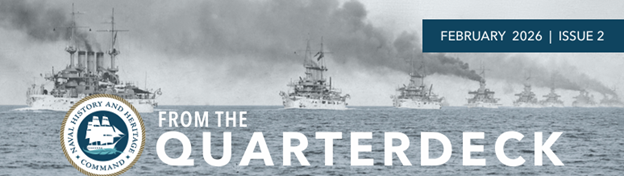
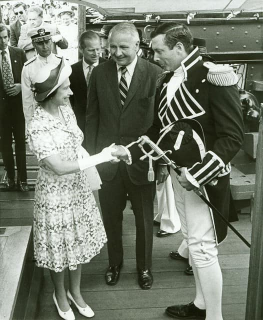
| | Tuesday Tidings is published by the National Maritime Historical Society with support from the US Naval Institute. Interested in joining USNI? Click on the USNI logo to become a member! | | | The Naval History and Heritage Command posted the second issue of its newsletter From The Quarterdeck, with front-page articles celebrating the fourth birthday of the command canine “Commander Bond” and the acquisition of a Great White Fleet collection. Of special note to readers of Tuesday Tidings is the publication of yet another NHHC monograph, titled Case Studies in Damage Control. Congratulations to Jon Middaugh and Tyler Pitrof, who wrote and edited chapters that discuss the loss of Panay in 1937, damage inflicted by Japanese Kamikazes, the Vietnam conflict Oriskany and Forrestal fires, Exocet missile strikes against British and US combatants in the 1980s, the Samuel P. Roberts mining, and the terrorist bombing of the Cole. | | Crossing the Bar: Commander Tyrone G. Martin – 58th Commanding Officer USS Constitution | | Commander Martin welcomes Queen Elizabeth II aboard USS Constitution with Secretary of the Navy J. William Middendorf looking on. (US Navy Photo) | | |
We were saddened to learn that Cdr. Tyrone Gabriel Martin passed away early last Thursday morning. He was 95. A native of Greenwich, CT, Martin attended the University of Rochester, where he earned his commission in 1952 through the Naval Reserve Officers Training Corps (NROTC) unit. He then had four tours of duty in the Western Pacific (WestPac), first in a radar picket destroyer at the end of the Korean War, followed by another WestPac destroyer, a tank landing ship (LST) assignment, and finally orders to the Third Marine Division as naval gunfire officer. After five years in East Asia, Martin spent time with the Atlantic Fleet, serving on two heavy cruisers and a destroyer, making a Mediterranean deployment on each. His first shore duty assignments were attendance at the Naval Intelligence School and the Office of Naval Intelligence (ONI). Beginning in 1962, he returned to the Pacific Fleet to serve with a cruiser-destroyer flotilla staff, then as executive officer and commanding officer of a destroyer, again making WestPac deployments. Following another tour in ONI, he commanded a destroyer and was chief staff officer of an amphibious squadron, both in the Pacific, and both with tours in East Asia.
When Martin took command of USS Constitution on 6 August 1974, the ship was beginning the second phase of a multi-year restoration. Finding that no one involved had any particular knowledge of the ship, he began his own research program. This culminated in recommendations to the Chief of Naval Operations (CNO) Adm. James Holloway III concerning the designation of an historically accurate War of 1812-era baseline as the foundation for the restoration, as well as a proposal on how restorations ought to proceed in the future. On 24 December 1975 Holloway made both recommendations policy. With the nation’s bicentennial, Constitution welcomed numerous VIPs, including Queen Elizabeth II and Prince Philip. On 10 July 10 1976, Constitution led a Tall Ships parade into Boston Harbor. For the ship’s efforts during the national bicentennial, Constitution received her first-ever unit commendation. When Martin retired in 1978, he became the first captain since Charles Stewart in 1815 to be decorated for his command tour.
After he retired, Martin wrote the award-winning book A Most Fortunate Ship, first published in 1980. He spent a year directing a whale research effort, then became an assistant headmaster at Boston Technical High School while founding a Navy Junior Reserve Officers’ Training Corps (NJROTC) unit that was rated among the top ten in the country. Leaving that program in 1989, he turned to writing five additional works about Constitution, and also authored a column in Naval History magazine for more than 10 years. Martin’s website about Constitution, called The Captain’s Clerk, was established in 1998. It is now a part of the Library of Congress permanent electronic archives. He has continued to make his research available to USS Constitution, Naval History & Heritage Command, and the USS Constitution Museum. In recognition of his efforts, the museum made him an Honorary Life Member and Distinguished Overseer, and presented him with the Samuel Eliot Morison Award. In 2019, Martin received the Dudley W. Knox Medal for Lifetime Achievement in Naval History from the Naval Historical Foundation.
| | Save The Date: Philly Shipyard Symposium! | | |
Join us on board Battleship New Jersey Museum & Memorial for a symposium on the 30th Anniversary of the closing of the Philadelphia Navy Yard, 225 years after its opening.
The symposium is set for Saturday, 26 September 2026, from 10:00 am–4:30 PM.
The symposium will focus on the history of the Yard, some of the ships built there, the closing of the yard, and more. Guests will be able to tour the battleship, and lunch is included. Keep an eye on BattleshipNewJersey.org for the tickets to drop later this year. Tuesday Tidings will post a Call for Papers next week.
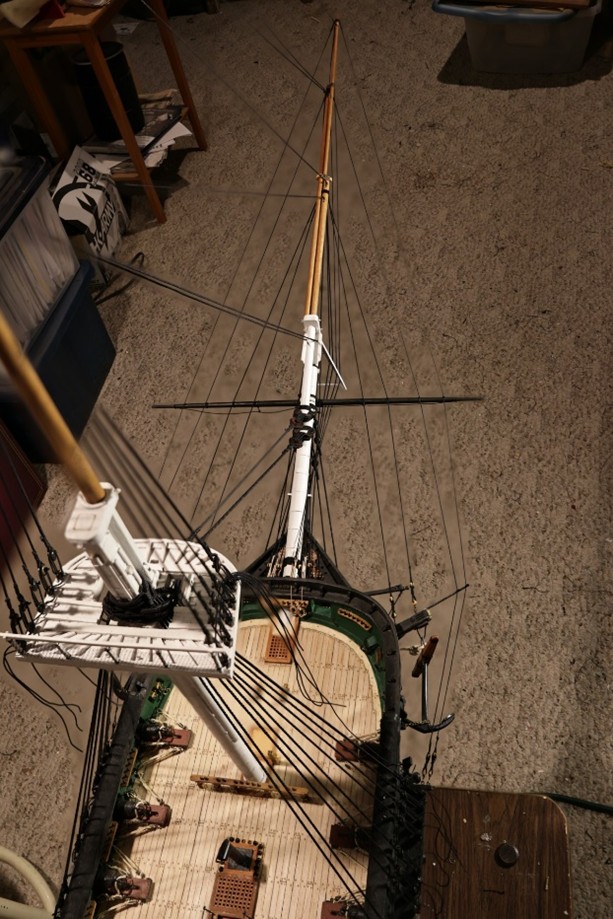
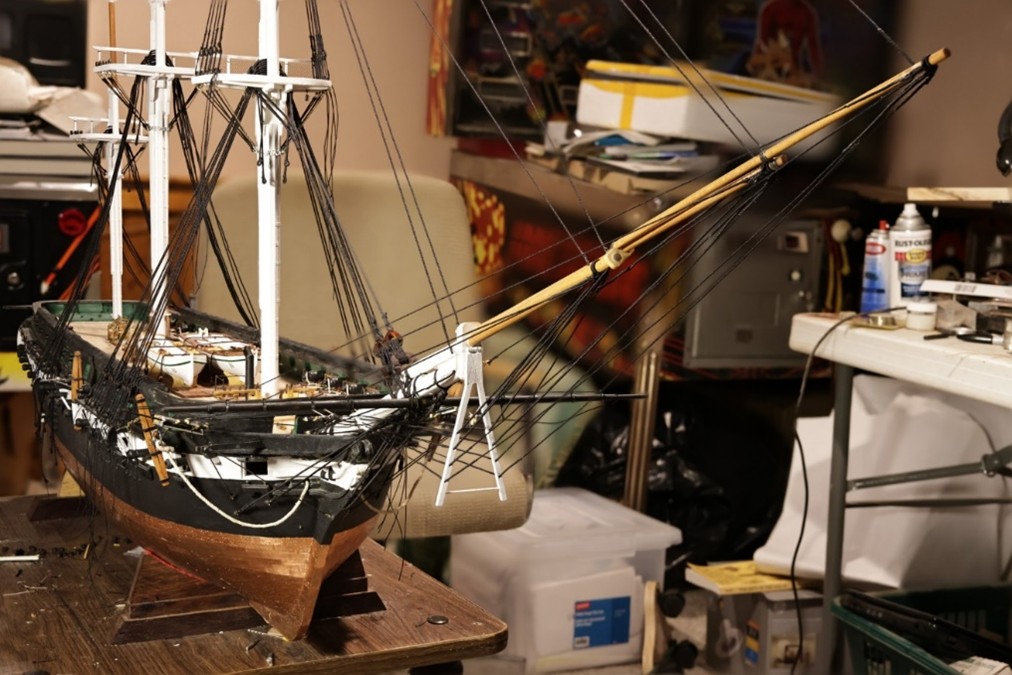
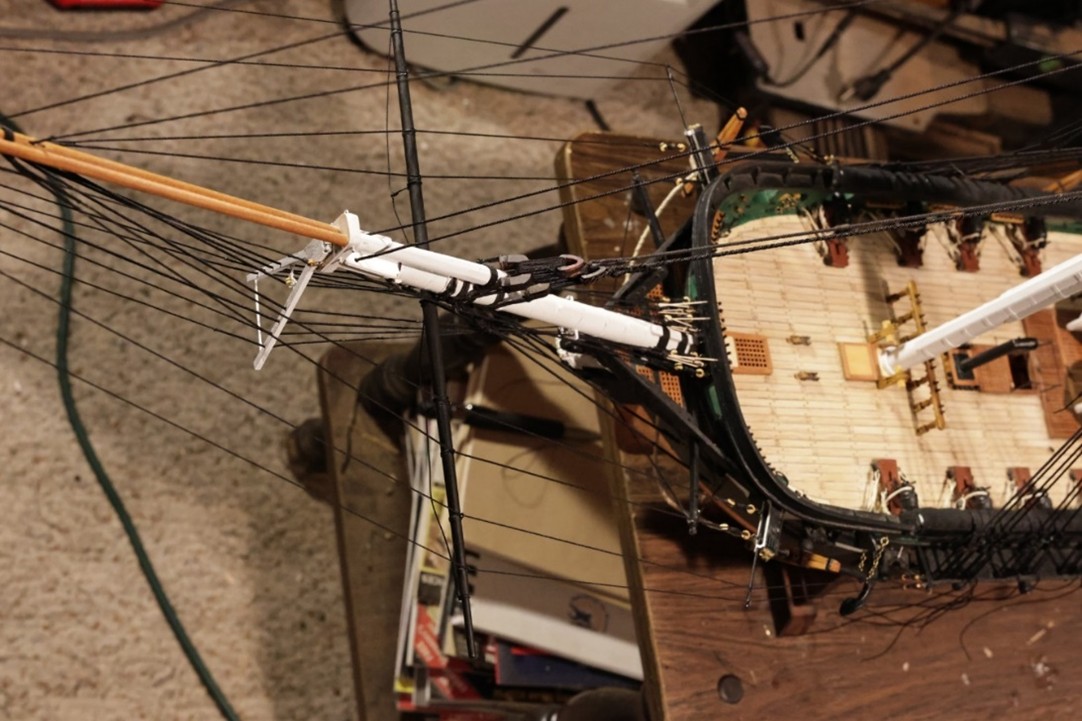
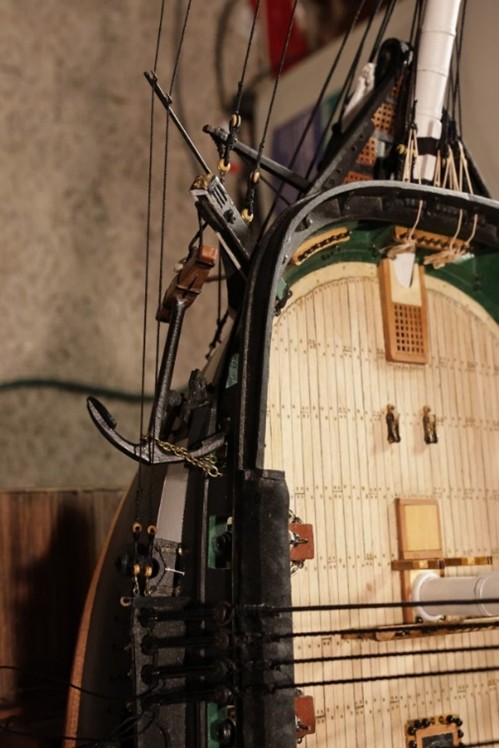
| | Steve Myatt reports the rigging of Brandywine proceeds from the bow to the stern, and he has about 90% of the bowsprit rigging in place. Here are his descriptions of each image: | |
| |  | So here you get a shot of the entire bowsprit assembly. You get to see the sizes of the jibboom, flying jibboom, and the jib-of-jibboom. Lots of stuff to note here. First notice that only the CENTER pin rail is being used by the head rigging. What about those pin rails on the left and right side of the bridal ports? So for centuries bowsprit and foremast stays were tied off to the knight heads of the ship. In the days of the Brandywine, the knight head beams no longer projected above the hull but they are still there providing lateral support to the bowsprit. The fore mast stays and the martingale stays will all tie off at the knight heads of the ship—which is why you see so much activity on either side of the hull next to the bowsprit. The outer pin rails are there to handle the sheet and clew lines of the jib, flying jib, etc. These lines come in from above and easily clear the monkey rail (funny how the flair of the forecastle bulkheads allow those rails to be reached from above) so you won't see holes drilled into the monkey rail to allow ropes to come in at a level angle and tie up to the pin rail. The center pin rail has those holes because the ropes DO come in at a level angle to tie-up. I’ll mention this here: I’ve seen other models that seem to get this wrong by using all the pin rails in the bow area as if they were servicing knight head ropes. In some cases you can't figure out how a crew member could ever pick his way through the forest of ropes to get to the head facilities. If done right, the model clearly shows how this works out for the crew.
Next item: the spritsail yard. By 1830 spritsails were a thing of the past. American naval ships did not carry them and as far as I could tell, this started happening after 1800. So why is there still a spritsail yard? The yard is now used as a spreader for the various guys that give lateral support to the bowsprit assembly. In a few short years, the spritsail yard will be dumped for dedicated spreaders that will attach to either side of the bowsprit. Finally, this picture shows those lateral guys pass through eyelets on top of the spritsail yard and tie off at the cat head and the fore channels. To get the flying jib and the jib-of-jibboom guys to clear the ground tackle, a thing called a "whisker" is attached to the cat head and the outer guys run through it. This is something I've never seen on a model, but it has to be out there somewhere. Anyway, the Brandywine carried the jib-of-jibboom and this requires the ship to have a set of whiskers. Notice also that the guys tie off using bulls eyes and lanyards. If the spritsail yard was carrying a sail, the guys would have tied off with tackles whose falls would go to those outer pin rails in the bow. But the Brandywine never carried a spritsail so the guys tie off with bulls eyes.
| | This image shows the whole ship from the tip of the jib-of-jibboom to the stern. You can get a feel for how the martingale stays and the foremast stays all tie off. | | This gives a better look at the dolphin striker and the guys. Notice how even with all that rigging, you could still easily go through the bridal port to use the head. | | |
This image gives a nice view of the whisker booms in action and how it allows the guys to clear the bower anchors. Final note here—you can kind of tell in this picture that the guy ropes are NOT all the same diameter in size. Rope sizes decrease as you go upward or outward in the rigging. This model, for instance, uses 5 different rope diameters to get the various foremast stays set up. There are three different guy sizes. This is not so hard to do when you have your own rope-walk and create all the ropes yourself.
Next for Myatt: The main mast rigging—shrouds and the stays.
| | NAVAL HISTORY BOOK REVIEWS | | |
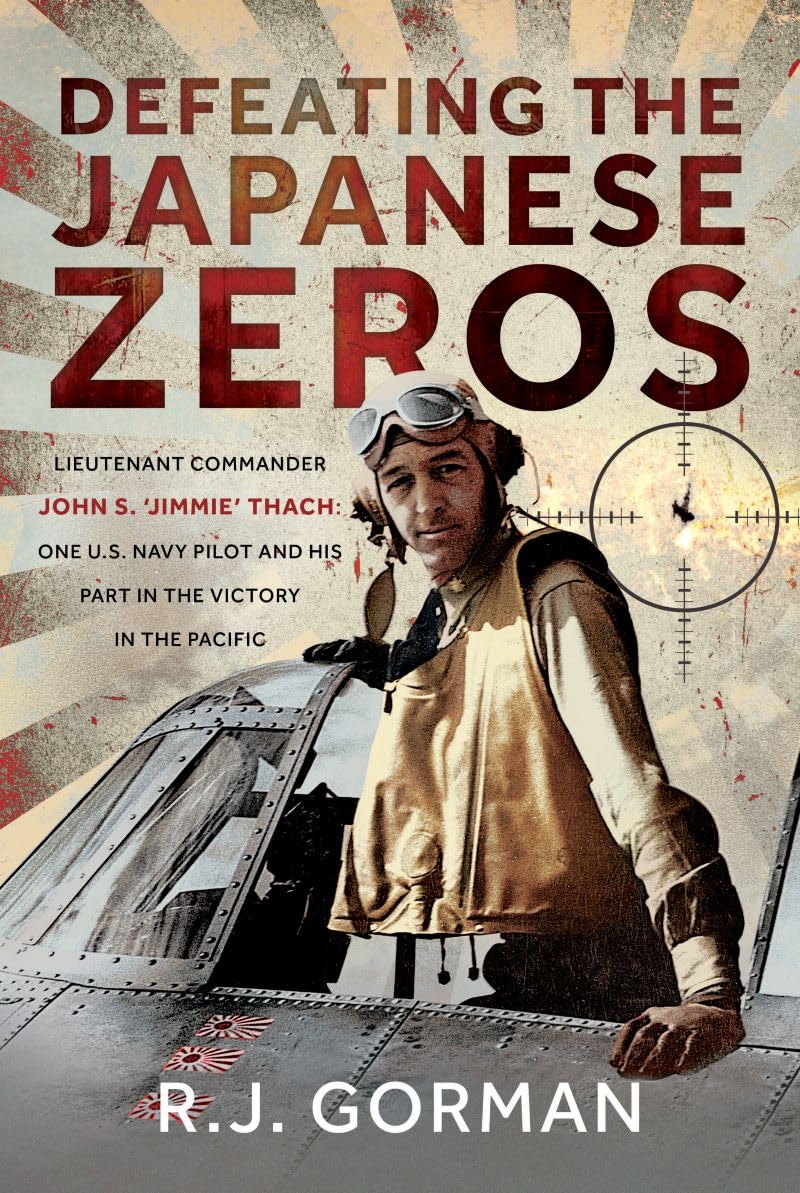
Defeating the Japanese Zeros: Lieutenant Commander John S. “Jimmie” Thach: One US Navy Pilot and His Part in the Victory in the Pacific by R. J. Gorman, Yorkshire - Philadelphia: Air World Books, (2025).
Reviewed by John R. Satterfield
| | |
John S. “Jimmie” Thach is among the many notable World War II leaders now unjustly relegated to obscurity. Author R. J. Gorman’s first book, Defeating the Japanese Zeros, describes Thach’s naval career and achievements and may help to rectify his diminished reputation.
Born in Arkansas in 1905, Thach graduated from the Naval Academy in 1927. His classmates nicknamed him Little Jimmie because his older brother James (Big Jimmie) preceded him at Annapolis, Class of 1923. He began a forty-year service career in battleships and earned his gold aviator wings in 1930. Thach was a talented flyer and spent a decade as a flight instructor, test pilot, and aerial gunnery expert. By 1940, he commanded Fighter Squadron Three (VF-3), flying Grumman F3F biplanes with their Felix the Cat emblems on the carrier Saratoga (CV 3). Thach trained his unit well; VF-3 was the Navy’s best shooting squadron, with half of its aviators earning the aerial gunnery “E” for marksmanship. Among his squadron members was Edward “Butch” O’Hare, the Navy’s first ace of the war and first naval aviator to receive the Medal of Honor for his defense of the carrier Lexington (CV 2) in early 1942.
Thach made his name as an aerial tactician. First, he created a maneuver he called beam defense, quickly renamed the “Thach Weave,” that enabled Grumman F4F Wildcat fighters to manage speedier, nimbler, and faster climbing Japanese Nakajima A6M Zero fighters more effectively. Thach saved many naval aviator lives and improved combat odds until the introduction of the more capable F-6F Hellcat fighter in 1943. Lieutenant Commander Thach and his squadron, flying from Yorktown (CV 5) proved his innovation during the Battle of Midway in mid-1942. His six-fighter group, escorting slow torpedo bombers, shot down four Zeros at the cost of one Wildcat. After promotion, Thach helped produce popular fighter training films with Walt Disney and returned to the war as operations officer for Admiral John McCain’s Fast Carrier Task Force (TF-38) in late 1944, devising a fighter surveillance and defense network that reduced kamikaze attacks. Thach’s contributions earned him a place at the Japanese surrender ceremony on Missouri (BB 63) in 1945. His decorations included two Navy Crosses, two Distinguished Service Medals, the Silver Star, two Legions of Merit, the Bronze Star, and other awards. He remained in the Navy, retiring as an admiral in 1967. He passed away in 1981, days before his 76th birthday.
Gorman’s book is not a comprehensive biography. It focuses on Thach’s leadership and tactical developments. He devotes several chapters to contextual background of the events that engendered the flyer’s tactical breakthroughs, details of the Japanese Zero’s design, performance and specifications, and Japanese strategic plans for Midway and other operations. Thach conceived his beam defense to remediate the Zero’s many performance advantages over the F4F Wildcat, and Gorman’s explanation of the tactic is nicely done.
The Zero was faster than the Wildcat, with an initial climb rate half again better. The Zero’s turn radius also was smaller, enabling the Japanese aircraft to get behind any pursuing Wildcat quickly. Using matchsticks on his kitchen table to represent aircraft positions, Thach explained his innovation where he abandoned the traditional three-plane triangular formation flying close-in, substituting two Wildcats flying side by side, far apart enough to see behind and around each other. If one wingman saw an enemy approaching the other Wildcat’s six o’clock position, he would instantly turn toward his companion, visually and instantly signaling danger so the threatened aircraft could turn toward his partner, enabling the wingman to fly into the nose of the adversary aircraft with guns blazing and forcing the attacker to break away. The Zero’s light weight, 1,200 pounds less than a Wildcat, sacrificed armor for the pilot and fuel tanks and limited ammunition for its two 20-mm cannons and light machine guns. The Wildcat could withstand more punishment, and its four .50-caliber machine guns were lethal against A6Ms. Thanks to Thach, Navy carrier fighters did surprisingly well against Zeros in the early Pacific War.
Naval aviation historians and World War II scholars may not find much new in author Gorman’s book, but Defeating the Japanese Zeros is a worthwhile and enjoyable introduction for general readers to the Navy’s significant role in World War II and to a naval aviator whose memory should enjoy a large and enduring popular legacy.
R.J. Gorman is a retired Arizona state prosecutor who took flying lessons from a US Navy pilot who flew in the Battle of Midway. This is his first book after extensive research on the battle.
Dr. Satterfield writes about and teaches military and naval history for the University of Maryland Global Campus.
| |
| NAVAL HISTORY BOOKS AVAILABLE FOR REVIEW | | |
he Western Naval History Association held its 8th Annual Symposium over the balmy weekend of 21/22 February on board the USS Midway on the San Diego waterfront. In accordance with its mission of promoting naval history to the broadest audience—from the mildly interested to world-class historians—the 2026 program included a range of topics from the US Marine Corps in the Gilded Age to a comparison between the threats presented by the old USSR navy up to the current PLA navy.
As in past years, the Symposium was well attended and was broadcast virtually. Hosted by the USS Midway Museum and moderated by WNHA president Captain Sam J. Tangredi (USN Ret), the program began with an examination of the Japanese mini-submarine attack on Pearl Harbor by Dave Miller, John Rodgaard, and Dr. Alan Zimm. Zimm followed this with an operational analysis of the Japanese air raid, depicting it as a sloppy affair and not a precision attack, as is commonly perceived. Terry McKearney discussed how to model naval battles, and the symposium’s participants broke into teams to analyze three famous naval battles according to McKearney’s methods. The day’s program continued with fascinating looks at the career of the Imperial Russian cruiser Askold by Stephen McLaughlin and the activities of ServRon 10 at Ulithi by Syndey Burks. Len Heinz finished the day with a discussion of the Spanish Civil War at Sea, a topic which was new information for many participants, and which provoked many questions
On Day Two of the Symposium, Evan Mawdsley joined the group virtually from Scotland, comparing the challenges to American supremacy at sea by first the Soviet and then the Chinese PLA Navy. Vincent O’Hara followed with a review of some of the major naval narratives of World War II. John Burtt then discussed the little-known New Georgia campaign of the Pacific War. Trent Hone spoke of the disasters that befell Allied shipping off the US coast in the months after Pearl Harbor, and then, in a change of pace, Lonnie Gill laid out a large-scale depiction of the 1915 Battle of the Dogger Bank using 1/2400 scale miniature ship models. The afternoon presentations were delivered by Hal Friedman, talking about the US Marines in the Gilded Age, Chris Langell on the US Atlantic Fleet before Pearl Harbor, and Jamie Orr on Alfred Thayer Mahan as a Prophet.
As in past years, major features of the event included the diversity of the program and the geniality of the participants. A much-commented-upon feature of this annual event is that it has exposed participants to many naval history topics they never would have explored on their own. The speakers at this year’s symposium included internationally respected academics, well-known naval history authors, naval professionals, and thinkers, including strong representation from the Naval War College and the editor of the Naval War College Review. Fifty people attended live, and more than a hundred attendedvirtually.
Dates for the 2027 symposium are set. It will be held once again on board the USS Midway, on 20 and 21 February.
To view the presentations, click HERE!
| | 2026 CNO Naval History Essay Contest | | |
NHHC announces the 2026 CNO Naval History Essay Contest, commemorating the enduring legacy of America’s Navy and the 250th anniversary of our Nation. As the Navy continues to operate at a strategic inflection point, this contest provides an opportunity to reflect on our history, deepen our understanding of the present, and strengthen the intellectual readiness required for the future fight. Participants are invited to submit their essays no later than 30 APR 26.
As we enter what may be the most consequential era in American sea power, the demands on our Fleet and our Sailors have never been greater. Great power competition, proliferating threats, rapid technological convergence, and an increasingly contested maritime domain require fresh thinking informed by historical experience. Across 250 years of American naval operations—from the age of sail to the nuclear era—our Navy has repeatedly adapted to strategic disruption, advanced technology, and global instability. Participants are encouraged to examine those historical touchpoints and derive insights that sharpen our understanding of how to generate, deploy, and fight a Fleet that is resilient, agile, globally present and combat credible. This contest is an opportunity to harness the intellectual capital of the Fleet and the Nation, leveraging history to strengthen the Foundry, the Fleet, and the way we Fight.
Areas of Historic Interest for the 2026 contest continue to highlight how lessons from the past can inform the Navy’s modernization and operational challenges. Submissions may explore:
- Historic Approaches to Defending the Rules-Based Maritime Order. From early American anti-piracy patrols to Cold War freedom-of-navigation operations, how has the Navy countered threats to maritime law and security, and what can these examples teach us as competitors increasingly challenge the global order?
- Historic Approaches to Technological Disruption and Warfighting Transformation. Examples might include the transition from sail to steam, the rise of naval aviation, or the advent of nuclear propulsion. How can these past transformations inform today’s integration of AI, autonomy, and distributed maritime operations?
- Historic Approaches to Maritime Competition. From great power rivalries in the 19th century to the Pacific campaigns of the 20th, how has the Navy adapted to long-term strategic competition, and what lessons should guide our approach to multi-domain rivalry today?
- America as a Maritime Nation. How has sea power shaped US national prosperity, deterrence, and the ability to project power far from home?
- The Enduring Impact of the American Sailor. For nearly 250 years, Sailors have delivered the ingenuity, grit, and courage that give the Navy its decisive edge. What historic examples best illuminate the Sailor as our main weapon system?
Our priorities are clear: Foundry, Fleet, and Fight. To deliver the world’s most powerful Fleet and be ready for the Fight, we must strengthen our most critical advantage—our people. The intent of this contest is to generate bold, actionable ideas that will sharpen our warfighting edge. The contest seeks to stimulate analysis that strengthens our ability to deliver peace through strength, calibrate our course, and transform how we solve the Navy’s toughest problems. As the Navy accelerates shipbuilding and repair, modernizes force-generation, and integrates cutting-edge technologies into a Future Fleet Design, understanding how previous generations confronted similar inflection points is essential. The contest invites authors from across the Fleet, the Joint Force, academia, and the maritime community to examine historic approaches to deterrence, warfighting, and sea power—and to connect those lessons directly to the Foundry, the Fleet, and the way we Fight today. The goal is clear: harness history to ensure that America’s Navy remains the most lethal, survivable, and globally capable maritime force in the world.
MIDSHIPMEN AND CADETS
Eligibility
(1) Navy, Marine Corps, Coast Guard, and Merchant Marine Academy midshipmen and cadets (Naval Academy, NROTC, Coast Guard Academy, Kings Point) and state maritime academy midshipmen.
Submission Guidelines
-
Word Count: 3,000 words maximum (excludes endnotes/footnotes).
- All entries must include either enumerated footnotes or enumerated endnotes; a bibliographic list of sources at the end of the essay is not permitted as a substitute for the footnotes or endnotes.
-
Submit essay by 30 April 2026 as a Word document online at: www.usni.org/cnonhessaycontestmidn-cadet
- Include word count on title page of essay but do not include author name(s) on title page or within the essay.
- Note: Essays must be the author's original work, neither previously published (online or in print) or currently under consideration for publication elsewhere, nor previously submitted to the CNO Naval History Essay Contest.
- Entrants may submit multiple essays, but the judging panel will select only one winning essay per entrant.
- The short biography should detail the author's eligibility for the contest.
Prizes
$4,000 — First Prize
$2,000 — Second Prize
$1,000 -- Third Prize
PROFESSIONAL HISTORIANS
Eligibility
(1) US and international professional historians, including history museum curators, archivists, history teachers/professors, PhDs, and published history authors.
(2) Authors of books on naval history (not including self-published works); or
(3) Civilians who have published articles in an established historical or naval journal or magazine.
Submission Guidelines
-
Word Count: 3,500 words maximum (excludes endnotes/footnotes).
- All entries must include either enumerated footnotes or enumerated endnotes; a bibliographic list of sources at the end of the essay is not permitted as a substitute for the footnotes or endnotes.
-
Submit essay by 30 April 2026 as a Word document online at: www.usni.org/cnonhessaycontestprofessional
- Include word count on title page of essay but do not include author name(s) on title page or within the essay.
- Note: Essays must be the author's original work, neither previously published (online or in print) or currently under consideration for publication elsewhere, nor previously submitted to the CNO Naval History Essay Contest.
- Entrants may submit multiple essays, but the judging panel will select only one winning essay per entrant.
- The short biography should detail the author's eligibility for the contest.
Prizes
$5,000 — First Prize
$2,500 — Second Prize
RISING HISTORIANS
Eligibility
Those that do not fall in the Professional Category and are either:
(1) Active duty, reserve, retired, and federal civilian personnel from the US Navy, Marine Corps, Coast Guard, and Merchant Marine; or
(2) Members of foreign militaries who have orders and are serving in an official billet in one of the above Services.
Submission Guidelines
-
Word Count: 3,000 words maximum (excludes endnotes/footnotes).
- All entries must include either enumerated footnotes or enumerated endnotes; a bibliographic list of sources at the end of the essay is not permitted as a substitute for the footnotes or endnotes.
-
Submit essay by 30 April 2026 as a Word document online at: www.usni.org/cnonhessaycontestrising
- Include word count on title page of essay but do not include author name(s) on title page or within the essay.
- Note: Essays must be the author's original work, neither previously published (online or in print) or currently under consideration for publication elsewhere, nor previously submitted to the CNO Naval History Essay Contest.
- Entrants may submit multiple essays, but the judging panel will select only one winning essay per entrant.
- Essays in the Rising Historian category may be co-authored, with both authors meeting the Rising Category qualifications.
- The short biography should detail the author's eligibility for the contest.
Prizes
$5,000 — First Prize
$2,500 — Second Prize
$1,500 -- Third Prize
In addition to the prize money winner will be offered:
- Invitational travel orders to the 2026 CNO Naval History Essay Contest Awards Reception (to be determined) to meet the CNO and potentially present their papers.
-
Winners will be published in Naval History magazine or Proceedings and online with the Naval History and Heritage Command (NHHC). Other essays may be published in Naval History or Proceedings and/or online by NHHC.
- Copper sheathing from USS CONSTITUTION (provided by NHHC)
- Recognition on NHHC's website.
- A one-year Naval Institute membership and a one-year subscription to Naval History magazine (courtesy of the Naval Institute).
Judging
Essays will be judged on the following criteria:
- Relevance to the topic: Applying lessons from naval history to establishing and maintaining maritime superiority in an era of great power competition;
- Readability;
- Thoroughness of research;
- Quality of insights based on historical events; and
- Uniqueness/novelty of ideas presented.
All essays are judged in the blind. A six-person panel will select the winning essays. We will notify you via email if your essay is selected for a prize or for publication.
Note: For non-winning essays, since we receive so many submissions (more than 100 per month!), notification of acceptance on one of our platforms may take 4-6 months.
For more details about the contest, please visit https://www.history.navy.mil/get-involved/essay-contest.html.
For questions, please contact Steve A. Hill, NHHC: email: Stephen.a.hill6.civ@us.navy.mil.
For advice and guidance on writing essays, please email: essayquestions@usni.org.
| | |
31st Conference for New Researchers
University of Southampton, 17—18 April 2026
Call for Papers
| | |
The British Commission for Maritime History (BCMH), in association with the University of Southampton, invites contributions to its thirty-first conference for new researchers. The University of Southampton provides an ideal setting with its focus on the maritime world—offering courses in marine biology, oceanography, maritime law, ship science, maritime archaeology and history. It is a delightful setting for this annual conference and provides a unique opportunity for new scholars to present their work in a historic setting.
The conference, which is supported by the Society for Nautical Research, helps emerging scholars who wish to share their work in a supportive environment and build relations with other maritime historians. We encourage applications from postgraduate students and warmly encourage participation by independent scholars. Contributions can address all aspects of maritime history in its broadest sense.
Those wishing to offer a paper should complete the online form available from
https://shorturl.at/inNoK
Please direct any queries to newresearchers@maritimehistory.org.uk
The deadline is 13 March 2026
Anyone interested in attending the conference without presenting a paper is also warmly invited to register an interest; further information will be sent to you and shared here in due course.
| | Call for Papers: International Journal of Naval History | | UPCOMING NAVAL & MARITIME HISTORY GATHERINGS | | |
26–29 March 2026: 92nd Annual Meeting of the Society for Military History, Arlington, VA
28 March 2026: Naval Dockyards Society Conference (hybrid), Greenwich, UK
17–18 April 2026: University of Southampton UK Conference for New Researchers sponsored by the British Maritime Commission
22–25 April 2026: Council of American Maritime Museums Annual Conference Mystic Seaport, CT.
14–15 May 2026: Society for the History of the Federal Government Annual Meeting, Washington, DC
27–31 May 2026: NASOH Annual Meeting, New Haven, Connecticut
25–27 June 2026 13th: Royal Canadian Navy History Conference In conjunction with the Canadian Nautical Research Society | CFB Esquimalt, British Columbia
Submit proposals and inquiries to: rcncrnsconference@gmail.com
| PREBLE HALL NAVAL HISTORY PODCAST | |
A naval history podcast from Preble Hall—the United States Naval Academy Museum in Annapolis, Maryland—featuring interviews with historians, practitioners, military personnel, and other experts on a variety of naval history topics from ancient history to more current events.
Click here for the latest episode: 258 - Tom Duffy - Tanker War in the Gulf>>
Click here for all Preble Hall Podcasts >>
|
DRACHINIFEL YOUTUBE CHANNEL
|
NAVY HISTORY MATTERS
Welcome to Navy History Matters, the Naval History and Heritage Command’s biweekly compilation of articles, commentaries, and blogs related to history and heritage. Every other week, they gather the top-interest items from a variety of media and social media sources that link to related content at NHHC’s website, your authoritative source for Navy history.
Click here for most recent article>>
| SUPPORTING US NAVAL HISTORY & HERITAGE | |
Tuesday Tidings is free to all—but it exists because NMHS members keep our work moving forward. Membership supports research, publications, seminars, educator resources, and the community that shares these stories. If you enjoy reading Tuesday Tidings, becoming a member is the best way to sustain it. Thank you!
Click here to become a member of NMHS today >>
| | | | |