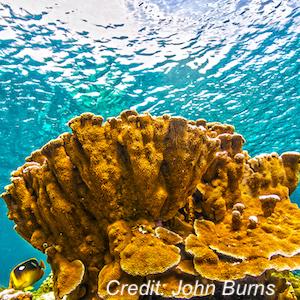
SOEST received a seven-year $50 million commitment from Dr. Priscilla Chan and Mark Zuckerberg that will support meaningful progress in restoring Hawaiʻi’s ocean health. This gift will fund research and programs that document changing ocean conditions, explore solutions to support healthier ocean ecosystems, enhance coastal resilience, and tackle challenges to marine organisms ranging from the tiniest corals to the largest predators. It will leverage efforts to grow community partnerships and support Indigenous resource management practices and training for the next generation of scientists and conservationists. |
|
|
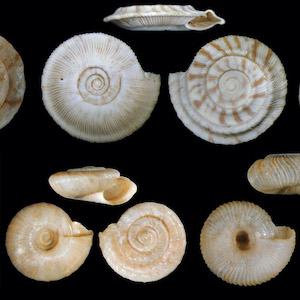
The history of life on Earth has been marked five times by events of mass biodiversity extinction caused by extreme natural phenomena. Many experts warn that a Sixth Mass Extinction crisis is underway, this time entirely caused by human activities. A comprehensive assessment led by Robert Cowie from SOEST’s Pacific Biosciences Research Center presented compelling evidence of this ongoing extinction event. To fight the crisis, it is essential to continue conservation efforts, cultivate a wonder for nature and, crucially, document biodiversity before it disappears.
|
|
|
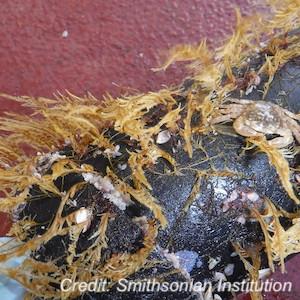
Coastal plants and animals have found a new way to survive in the open ocean—by colonizing plastic pollution. A new commentary published recently in Nature Communications reveals coastal species growing on trash hundreds of miles out to sea in the North Pacific Subtropical Gyre, more commonly known as the “Great Pacific Garbage Patch”. Researchers Nikolai Maximenko and Jan Hafner at SOEST’s International Pacific Research Center created models that could predict where plastic was most likely to pile up in the North Pacific Subtropical Gyre. The arrival of new coastal neighbors could disrupt open ocean ecosystems that have remained undisturbed for millennia.
|
|
|
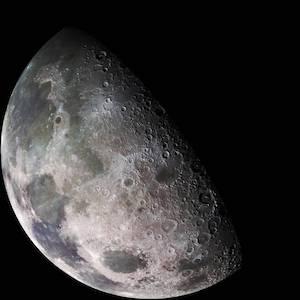
The first on-the-ground detection of water on the Moon’s surface was reported in a study published in Science Advances. Shuai Li, planetary geologist at the Hawai‘i Institute of Geophysics and Planetology, and co-authors analyzed spectrometer data from a lunar lander that visited the Moon in 2020. Understanding the concentrations and distributions of water on the Moon is critical to understanding its formation and evolution, and providing water resources for future human exploration. The new study provides the first in-situ measurements of water on the lunar surface and ground truths past observations from sensors orbiting the Moon.
|
|
|
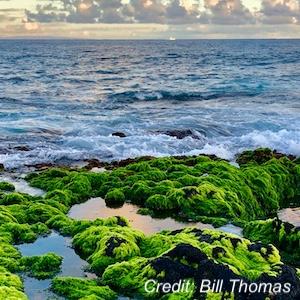
Native marine macroalgae, also known as limu, or seaweed, thrive in environments created by natural groundwater seeps—benefiting from the combined effects of enhanced nutrients despite lowered salinity levels, according to a review study led by Henrietta Dulai, SOEST Earth Sciences professor. In areas where the seeping groundwater is tainted by excess nitrogen typical of wastewater, the study found that invasive species typically flourish. These results point to the critical importance of sound land, water, and wastewater management policies and practices, especially in watersheds with urban development and conventional agriculture.
|
|
|
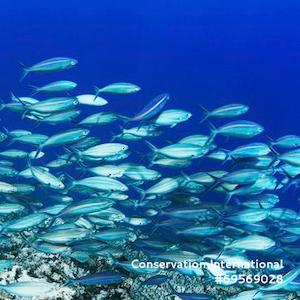
Recent breakthroughs in oceanography, genetics, ecology, fisheries biology, and social sciences now allow researchers to follow the entire life cycle of ocean fishes—when and where they are spawned, where they disperse and grow, and when and where they are captured, transported, and eaten. A recently published study led by University of Hawai‘i at Mānoa researchers indicates that the northern and southern portions of Hawai‘i Island are intricately linked by larval dispersal and catch distribution, a discovery that highlights the importance of an inclusive approach to management and conservation of coral reefs in the region.
|
|
|
Scientists have long been puzzled about how abundant populations of ocean microbes persists through relentless competition for scarce nutrients, such as nitrogen and iron. A new study published in Nature Ecology and Evolution by a collaborative group of researchers from 13 institutions, including SCOPE and the Department of Oceanography in SOEST, showed that the coexistence of diverse microbes in the open ocean is made possible by staggering the timing of nutrient uptake. Instead of having to compete with the entire community, microbes only compete with the organisms that share a specific “shift”.
|
|
|
To show your support for SOEST, consider donating to the SOEST Enrichment
Fund. Your contribution helps maintain and improve the quality of the educational and research capabilities at SOEST so as to serve better all of its constituent communities.
|
|
Know others interested in news from SOEST?
|
|
|
|
|
|
|