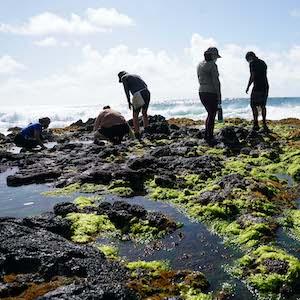
Hawaiʻi Sea Grant is leading a diverse group of organizations that has been awarded $68.5 million to build a more resilient future for Hawaiʻi. The project will build long-term climate resilience by restoring forest, watershed, coastal and marine ecosystems and through improved co-management and community governance of resources. Hawai‘i Sea Grant will work with two co-leads, Kuaʻāina Ulu ʻAuamo and the State of Hawaiʻi Department of Land and Natural Resources, and partners which span local and national non-profit organizations, collectives of Indigenous and local stewards, state and county government agencies, and academia. | |
|
Researchers at the Hawaiʻi Institute of Marine Biology (HIMB) showed that Marine Protected Areas (MPAs) are having a positive spillover effect, producing more “trophy-sized” fish just outside of the fully protected areas, and the effect is growing stronger over time. “Our study found that MPAs may take more than 20 years to show tangible spillover effects in the adjacent areas, which helps to set realistic expectations about the timeframe over which a marine reserve can be expected to have this type of effect on surrounding fisheries,” shared Simone Franceschini, lead author and postdoctoral researcher at HIMB. | |
|
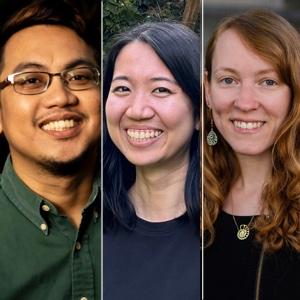
Andrian Gajigan, doctoral student in oceanography; Kacie Kajihara, a recent UH Mānoa botany graduate student who will soon start the Marine Biology Graduate Program; and Nicola Kriefall, postdoctoral researcher in the Pacific Biosciences Research Center were selected to be National Microbiome Data Collective Ambassadors of 2024. A highly competitive program through the Department of Energy and the Joint Genome Institute, the program trains and supports early career researchers motivated to engage with microbiome research communities, share knowledge, and commit to inclusion, diversity, equity, and accountability. | |
|
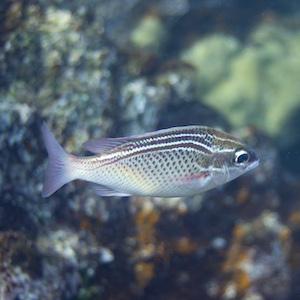
As Earth’s climate changes, scientific models predict that by 2050, body sizes of coral reef fishes could shrink by 14–39% due to elevated temperatures. However, researchers uncovered surprising survival tactics by coral reef fish in the Arabian Gulf, the warmest waters on Earth. Led by Jacob Johansen, associate research professor at the Hawaiʻi Institute of Marine Biology, and John Burt at New York University Abu Dhabi, they discovered adaptations in metabolism and swimming abilities that help fish survive the extreme heat. The fish demonstrated an unexpected capacity to maintain sufficient oxygen to fuel performance, even at elevated temperatures. | |
|
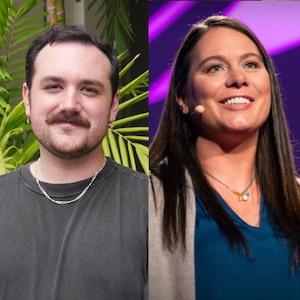
Oceanography graduate student Reece James and professor Angelicque White were selected by the Howard Hughes Medical Institute for the Gilliam Fellows Program, which recognizes science graduate student-adviser pairs for their outstanding research and commitment to advancing equity and inclusion in science. “Being selected for this program is validating and inspiring; a recognition of the work that myself and Dr. White have put forth to further the scientific community, and an opportunity to expand our understanding of how we can contribute to the ongoing advancement of diverse, equitable and inclusive life science research,” said James. | |
|
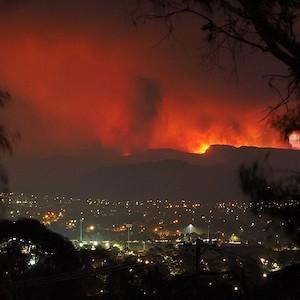
Smoke particles and dust from wildfires interact with clouds and impact weather and climate, affecting how clouds form, where and when it rains, and how air moves in the atmosphere. Supported by a Mid-Career Advancement award from the National Science Foundation, Jennifer Griswold, an associate professor and chair of the Department of Atmospheric Sciences, will strive to better understand these interactions and improve global climate models. Her efforts will aid scientists and policymakers in making smarter decisions to protect community health and prepare for future wildfires, and provide opportunities for students. | |
|
Community Connections Spotlight | |
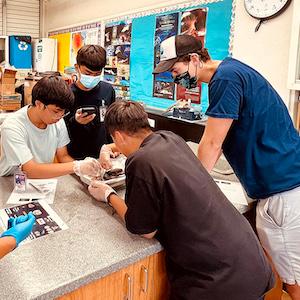
Blake Stoner-Osborne, an oceanography doctoral student in the Deep-Sea Fish Ecology Lab, balances his time between connecting with students and community members and conducting research to understand how islands alter the structure and function of open ocean food webs. Through a recent outreach and communications trainee program, he shared his knowledge, curiosity, and passion for deep-sea animals and ecology with hundreds of people. He offered workshops, hands-on activities, and presentations at the Hawai‘i STEM Conference, O‘ahu high schools, and the Waikiki Aquarium’s Mauka to Makai community event. | |
|
As a child, Makenna Kinsler became aware of the hardships in her island home when she walked through Kakaʻako with her mom to help the homeless. Now majoring in Global Environmental Science and Hawaiian studies at UH Mānoa, Kinsler is still impacted by that experience. Kinsler was selected for Miss Hawaiʻi Volunteer, a scholarship program that promotes community service, academic excellence, and leadership. Kinsler is determined to merge environmental science and Hawaiian studies in her future career as an urban planner to create communities that are sustainable, resilient and rooted in Hawaiian values. | |
|
To show your support for SOEST, consider donating to the SOEST Enrichment
Fund. Your contribution helps maintain and improve the quality of the educational and research capabilities at SOEST so as to serve better all of its constituent communities.
| | | | |