Welcome to the March Issue of Advanced Ceramics Insights

USACA made our first major push this month to build congressional and executive branch support for our primary policy and investment priorities for this year.


Our top two proposals for the annual appropriations cycle are for a new workforce initiative focused on advanced ceramics training and a new federal program dedicated to accelerating the development of transparent ceramics for advanced military sensors.


Both were the focus of a series of March meetings between USACA members and congressional offices and committee staff during our Spring Technical Meeting.


‘Workforce crisis’: The workforce pitch calls for $10 million under the Pentagon’s Industrial Base Analysis and Sustainment program to help address workforce development challenges “for what is no less than a ceramic engineering workforce crisis,” our appropriations proposal states. 


Known as the Advanced Ceramics Training Initiative for Operational Needs, or ACTION, the program would partner with universities to create regional training hubs with state-of-the- art equipment for advanced ceramics fabrication, integration, and testing, as well as scholarships for students to pursue ceramic engineering degrees. 


Taking action: “The shrinking workforce of ceramic engineers threatens the future of America’s war-fighting capabilities,” our proposal states. The ACTION effort “will help alleviate labor shortages in the advanced ceramics manufacturing industry. Over time, these efforts will ensure the continued production of war-fighting technologies that rely on advanced ceramics, as well as the uninterrupted support for research and development in this field.”


The training initiative, the proposal concludes, “will ensure a steady pipeline of skilled workers with the essential knowledge and expertise for war-fighting industry applications.”


Crystal clear vision: USACA’s other big push is for a $10 million investment in the Pentagon’s Manufacturing Science and Technology Program for “improved transparent ceramics windows” for electro-optical and infrared sensors. 


The specialized materials, designed to operate in harsh battlefield environments, are needed for the most advanced military radars, radio frequency antennas, and other high-tech battlefield sensors that the armed forces depend on. 


“Missile defense, precision weapons, ISR (intelligence, surveillance, and reconnaissance) platforms, and the emerging ‘Golden Dome’ layered defense system require durable EO/IR (electro-optical infrared) and RF (radio frequency) transparent ceramic windows capable of operating in extreme environments to protect on‑board seekers and sensors allowing them to 'see' targets in severe flight and re‑entry conditions,” the USACA funding proposal states.


Economic benefits: The initiative would also have a far reaching impact in building a more robust advanced ceramics industry for the future. 


“The investments in nanocrystalline transparent ceramics will strengthen U.S. economic security by establishing new domestic production capacity and expanding ceramic manufacturing operations in Massachusetts, Maryland, Kentucky, North Carolina, South Carolina, and Colorado," according to the USACA proposal.


USACA’s appropriations push for Fiscal Year 2027 will be a continuing focus of our interactions with Congress and the executive branch in the coming months.

MORE USACA NEWS

GIVE AND TAKE: Our Spring Technical Meeting also gave members the opportunity to hear from USACA leaders, including Executive Director Ken Wetzel and Technical Director Dr. Aisha Haynes.


They provided detailed updates to the membership on a range of developments that impact our industry, including provisions and investments contained in the recently approved National Defense Authorization Act and annual appropriations bills for executive branch agencies for Fiscal Year 2027 for the Departments of Energy and War, NASA, and more. 


Coming attractions: They also previewed the Trump administration’s forthcoming budget request for Fiscal Year 2027, which is expected to propose a record-breaking $1.5 trillion defense budget for a "Dream Military. Whether such an increase is politically viable remains an open question, but we expect to see boosts in the nuclear triad, AI, and autonomous systems.


Members also engaged directly with senior officials from the Departments of War and Energy. Special thanks for their presentations to Dr. Jorgen Rufner, Advanced Manufacturing Group Lead at DOE’s Idaho National Laboratory; Dr. Corson Cramer, a research and development associate at Oak Ridge National Laboratory, and Bethany Harrington, Director of Technology & Industrial Base Assessments at the Department of War. 


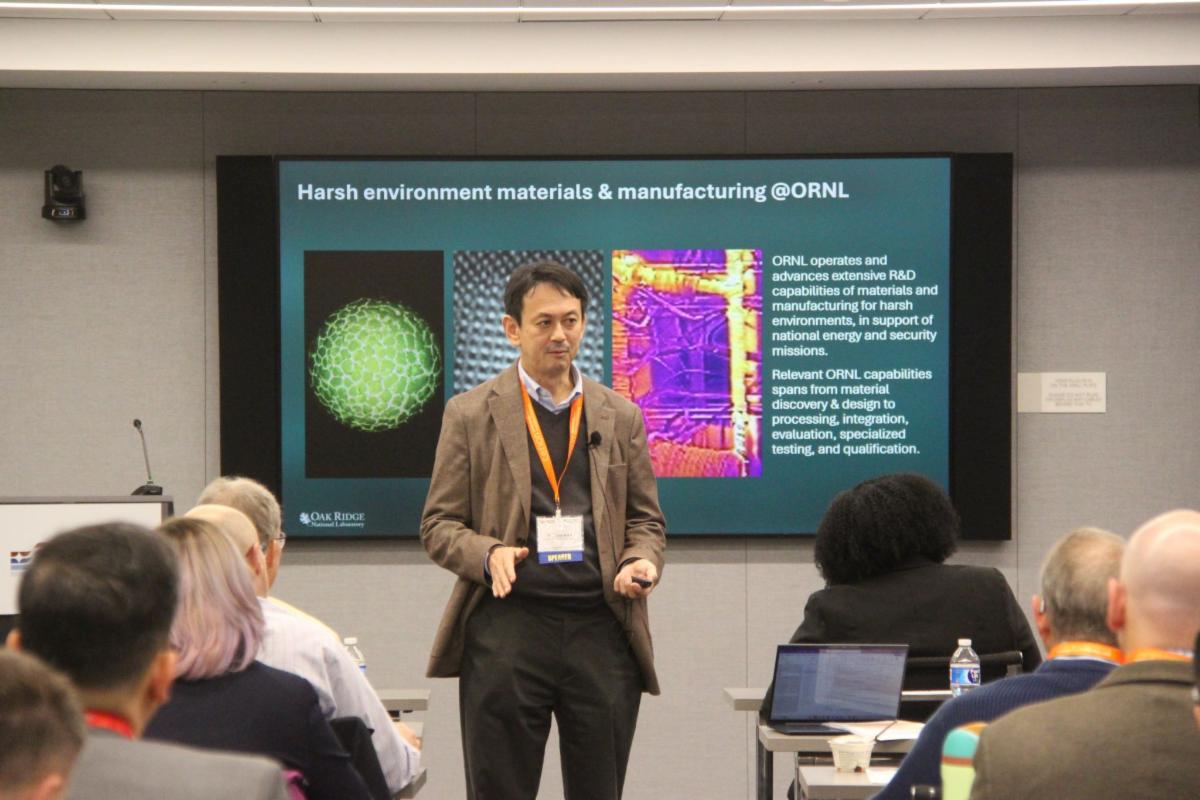
Harsh work: We kicked off the D.C. gathering with a special daylong workshop in partnership with Oak Ridge National Laboratory on “Next Generation Harsh Environment Materials and Manufacturing.” 


The event, which drew about 70 participants, was intended to help government technology leaders sharpen an evolving harsh materials roadmap. 


Special thanks to the government participants, including Dr. Yutai Kato, Director of the Materials Science and Technology Division at Oak Ridge; Dr. Victoria Blair, a Research Materials Engineer at the Army Research Laboratory and Senior Technical Advisor for the OUSW(R&E) Advanced Materials Office; and Dr. David E. Glass, a Senior Technologist at NASA Langley Research Center.


Industry input: The industry panel at the workshop featured Jeff Vervlied, Director of Sales and Business Development at Free Form Fibers LLC; Andy Thomas, Vice President for Research & Development at CoorsTek, Inc.; Landon Mertz, CEO of Cerion Nanomaterials; and Jared Weaver, a materials and manufacturing expert at GE Aerospace. 


Breakout sessions focused on aerospace, defense, energy, and nuclear applications. Said Wetzel: “These engagements were intended to give our government partners a USACA and industry perspective on the issues and opportunities. The breakout sessions were designed to compile industry perspectives to share with the government.”


What’s next: USACA will compile the proceedings, develop some recommendations, and leverage the workshop insights to strengthen our policy and investment plans, Wetzel said.


Thanks to the workshop sponsors: Lucideon, Free Form Fibers LLC, Cerion Nanomaterials, and Anton Paar USA.

TECHNOLOGY

BIG NEWS FOR SMALL BIZ: USACA was pleased to see a bipartisan compromise to reauthorize the Small Business Innovation Research (SBIR) and Small Business Technology Transfer programs (STTR) after a five-month lapse.


The Small Business Innovation and Economic Security Act passed the Senate and House after tough negotiations between Sen. Joni Ernst and Sen. Ed Markey on the Senate Small Business & Entrepreneurship Committee.


The two camps were able to narrow a series of divides on how to best modernize and expand the programs without losing the merit-based principles that have made them so effective in meeting government needs and fueling America's innovation pipeline. 


The bill reauthorizes the programs through 2031, giving small business innovators and research universities, including USACA members that participate in the competitive awards, much-needed stability. 


Breaking through: The new legislation strengthens safeguards to protect awardees from foreign adversaries, but it also requires that recipients be informed and have a chance to respond to government concerns and not simply be blacklisted. It also creates a “Strategic Breakthrough" program to propel the best ideas more quickly into real-world capabilities.


Under the new legislation, no small businesses can be automatically removed from the programs, as proposed under revenue caps contained in earlier versions of the legislation. That will ensure that experienced firms with a strong track record of meeting and exceeding government requirements can continue to compete, particularly to address the unique needs of the armed forces. 


The latest: House passes 5-year reauthorization to fund small business tech programs


And learn more about the new provisions.

EVENTS

REDUCE RISK, ACCELERATE DEPLOYMENT: The annual Ceramics Expo is set for May 4-6 in Cleveland. The industry gathering will focus on “Innovation, Performance & Manufacturing Breakthroughs” and “Strategy, Scale‑Up & Future Readiness.”


As a preview, organizers asked USACA’s Dr. Haynes to moderate a webinar on February 26 with Dr. William Carty, Chief Technology Officer of Materials Research Furnaces, and Dr. Carolyn Grimley, Manager of US Advanced Materials at Lucideon. The session explored how ceramic innovations are revolutionizing the design of spacecraft, hypersonic vehicles, nuclear systems, and advanced electronics.


‘Final properties’: It outlined “key considerations when designing ceramics for harsh environments, including how service conditions influence material selection, what factors most strongly impact ceramic performance, and how processing choices shape final properties,” according to the abstract.


The speakers also discussed practical considerations for design, processing, and testing and experimentation with the aim to “reduce risk and accelerate deployment of advanced ceramics for extreme applications.”


Check out the full upcoming Ceramics Expo agenda. 

READING ROOM

Fulbright Scholar finds warm welcome in new Clemson University Advanced Materials Innovation Complex

Have news to share with the USACA membership? We want to hear from you! Email Bryan Bender at bender@strategicmi.com or LB Fullerton at LB@strategicmi.com. And follow USACA on LinkedIn

LinkedIn  Web

Please Contact Us With Any Questions:


Ken Wetzel, ken@strategicmi.com

Aisha Haynes, aisha@strategicmi.com

LB Fullerton, lb@strategicmi.com