|
On the ground, it’s exciting to note that planting is officially underway in Louisiana and Texas. The Crop Progress report won’t be published until April 7th, so until then, on-the-ground information is putting expectations close to 20% planted, with it being slow in central Louisiana and normal in the Southern part of the state. Mississippi is expected to have some rice in the ground this week or next. At this stage, most states report crop expectations that are very similar to last year's, meaning a larger crop; we can only hope for stable climate conditions and an improved milling performance. In February at the USDA’s 101st Annual Agricultural Economic Outlook Forum analysts predicted a reduction in long-grain acres by several hundred thousand acres projecting 1.87 million total. Others say it will be a greater reduction based on a lack of financing for farmers, a seed shortage, low prices, and the overall condition of the farm economy. Rice imports are forecast to rise to a record 48.1 million cwt, up 1.1 million from the
previous year.
The USDA Colombia Grain and Feed Annual was just released and is of much interest to the US market because of the Colombian TRQ’s impact on research dollars, and the recent immigration stand-off that did lose us some business. In the country, milled rice production is forecast to drop by 4% because of low prices and farmers opting to plant other crops. Notable, Colombia currently has a national average yield of 44.07cwt/acre, compared to the US average of 76.49cwt/acre. Per capita, rice consumption is growing in Colombia, with statistics now showing per capita consumption as high as 101 pounds per year.
In regards to the Colombian TRQ, we feel the quote direct from the GAIN report is best: “The first 2025 COL-RICE was not fully subscribed. From the available quantity (998,040 MT MRE), 10336 MT MRE we allocated (10.5% of the total). [Colombian] Industry contacts attest there is sufficient rice in the local market from the main domestic harvest, along with competitive pricing. In addition, Post sources indicate that millers have critiqued US rice quality and prefer locally produced or CAN-origin rice due to specific quality characteristics. Two more COL-RICE auctions will take place in June and October 2025 for the remaining 41,963 MT MRE quota.”
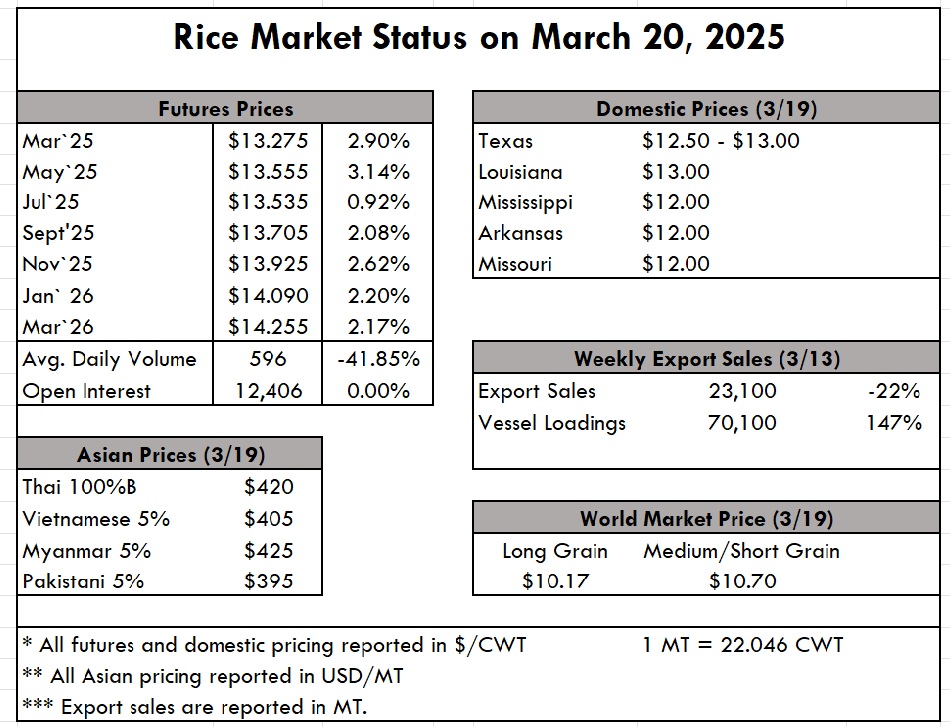
In Asia, pricing is dismal, to say the least. The unthinkable is upon us, where quotes
from Thailand and Vietnam are now as low as $405pmt, something that nobody was
hoping to see. These exporters are banding together trying to find a way to support
price, but with India’s enormous supply and average or large crops coming off again
this year, there is no respite in sight from the supply side of the equation. A surge in
demand would be helpful, given that current demand is weak at best; expect prices to break into the three-hundred range in the coming weeks.
The weekly USDA Export Sales report shows net sales of 23,100 MT this week, down 23% from the previous week and 73% from the prior 4-week average. Exports of 70,100 MT were up noticeably from the previous week and up 52% from the prior 4-week average. We don’t need any more political whiplash; therefore, patience is key in determining how the tariff war will play out. However, there is no sugar-coating the fact that the U.S. did miss out on Colombian TRQ business, and the very public fighting amongst key rice-trade partners isn’t helping business in the near term. One thing is for certain though: rice prices were in the doldrums before President Trump took office because India manipulated the global rice market through excessive subsidies and stockpiling/dumping schemes. Rice producers are left holding the bag for their communities and family farms, counting on a Farm Bill that needs to restore some sort of balance for domestic producers.
|