Today's quote is from an event back on the 14th of November. As you have seen, it deals with automobile production in North America. It is simply not possible to talk about that today, November 27, without some mention of yesterday's dramatic announcement from General Motors. The GM press release on the issue began smoothly enough:
"General Motors will accelerate its transformation to the future, building on the comprehensive strategy it laid out in 2015 to strengthen its core business, capitalize on the future of mobility and drive significant cost efficiencies."
The succeeding press reports were more brutal, with today's Wall Street Journal declaring
"GM to Close Plants, Cut Jobs."
The story explains that GM plans to reduce its workforce by roughly 14,800. Plants in Ohio, Michigan and Ontario will be affected. President Trump and Prime Minister Trudeau have both expressed their unhappiness with this turn of events to GM's CEO, Mary Barra. These GM decisions are likely to be discussed in future TTALK quotes, especially if they affect - and they are bound to affect - the debate over the proposed replacement for NAFTA, the United States-Mexico-Canada Agreement or USMCA. We mention them here because no discussion of automobile production in North America could ignore them. Still, it is worth bearing in mind that today's quote and the discussion below both took place well before GM made its now famous announcement.
That discussion occurred in the context of this year's Annual Canada-United States Law Institute Experts' Meeting. Organized by the Law School of Case Western Reserve in Cleveland, Ohio, and by Western Law in London, Ontario, the event was held at the Washington offices of Steptoe & Johnson. Terence Stewart, the Managing Partner at Stewart and Stewart was one of four speakers. The others were Kirsten Hillman, Deputy Ambassador at the Canadian Embassy in Washington, Lawrence Herman of Herman & Associates in Toronto, and Richard Cunningham of Steptoe & Johnson. As we listened to them, each speaker was supportive of the new USMCA agreement. But each approached the proposed new NAFTA differently.
Ms. Hillman spoke first. The link between trade agreements and trade balances was hardly her first or most important point but she did touch on it. She said, "Canada does not believe that the proper measure of the health and success of a trading relationship is measured by trade balances."
Mr. Stewart took the issue a step further with the following commentary on trade balances in the automotive sector.
MR. STEWART:
So the Administration has been fairly consistent with its basic philosophy. Ambassador Hillman indicates that she doesn't believe that a measure of a trade agreement is whether or not you're running a trade surplus or a trade deficit. Obviously, that's where this administration has started from, and they have been very clear about that from the beginning. And so, the countries that they have had concerns with are all countries, quote unquote, with which we have significant trade deficits, particularly in goods.
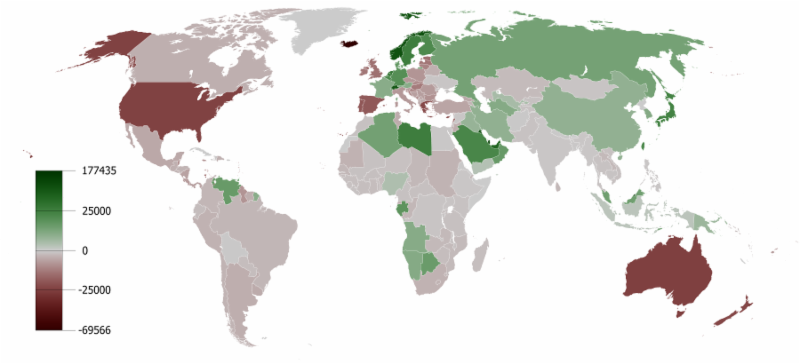
We obviously have a trade surplus with Canada when you add services in, but we have a very large trade deficit with Mexico under any analysis. And if you're going to look at that, if that is your concern, then you really have no choice but to look at the auto sector because [in] the auto sector, globally, we run something like $180 billion deficit.
Now, one of the premises that a lot of economists and a lot commentators, and many people in the auto industry itself, have had to say about the trade deficit in autos is that it is not surprising because it basically flows from producers looking to maximize their efficiency and by moving labor intensive parts of the job offshore to lower expense areas.
Presentations that were made to Commerce and the ITC have basically taken the position that there are three areas of major production: Europe, North America, and Asia, primarily focused around Japan but also including China.
Well the fascinating thing about that premise is that, if you look at Europe, and you look at Germany, which, obviously, would be the center, sure there has been some fragmentation and some outsourcing to lower cost countries, but Germany runs an increasing trade surplus over the last two and a half decades, with every part of the world and in total, in autos.
If you look at Japan, yes, they have outsourced certain parts of their production to other parts of Asia, but the reality is that the trade surplus that Japan runs in the auto sector has grown in most parts of the world and is flat in one or two segments. So, the United States is singular in its inability to have integrated with its neighbors in using low-cost labor in a way that improves its overall performance from a trade balance point of view. The overall trade balance in autos has dramatically worsened over the last 25 years.
So, for an administration concerned about that fact, adding things that have proven to be somewhat controversial and certainly unpopular amongst many in terms of the rules of origin is not surprising, as it is an effort to try to address what they perceive as a core problem. Whether that problem could be addressed through policy changes in other areas, obviously, is an area that many people would say "could be, should be," but trying to deal with it through the trade agreement is kind of an interesting idea.
So, what I see in the USMCA from the U.S. perspective is that, underlying a concern about reciprocity, you have an administration that has used, in many cases, very harsh rhetoric but has an objective of improving in trade liberalization with major trading partners that they believe are on the same page in terms of the economic system and ... the USMCA reflects that.
They have dealt with [a] perceived lack of reciprocity in key areas, such as autos, in a way that is reflected in that agreement in terms of higher content within NAFTA, high percentage of steel and aluminum that are used within NAFTA, produced within NAFTA, and some percentage of labor that is at a $16-an-hour rate. It goes up to 40-45 percent over time.
|