UT Energy Bulletin | July 2026 | | | | | |
OpenMinds NextGen Bootcamp Hosted at UT Austin
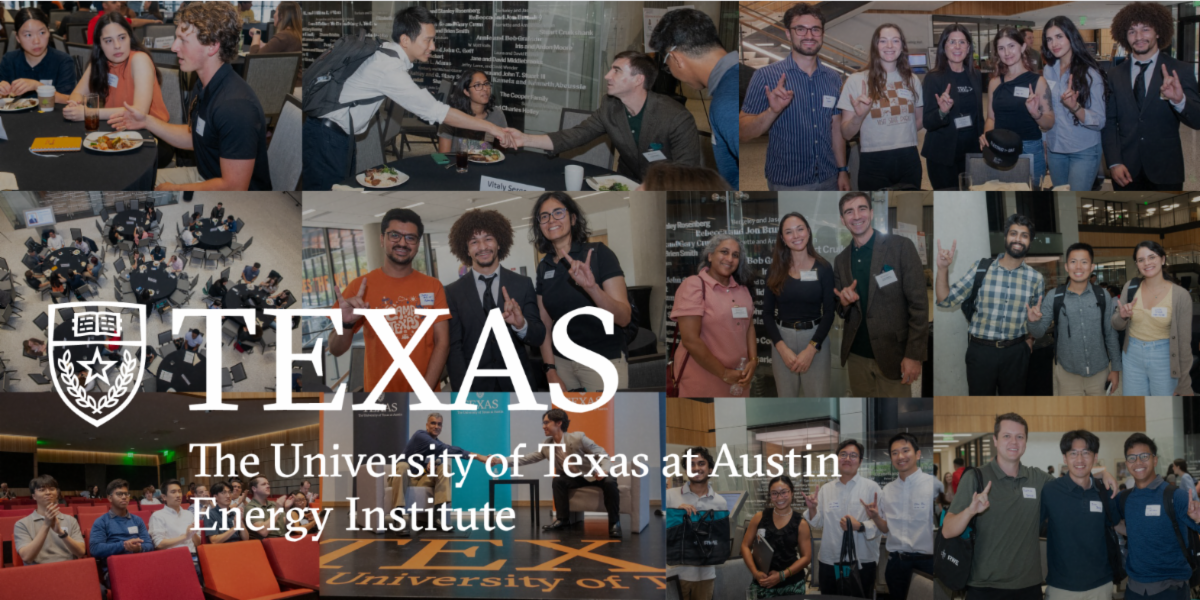
The University of Texas at Austin is helping shape the next generation of energy leaders through its partnership with the OpenMinds NextGen program. Students from universities across the country gathered in Austin in June for the 2026 OpenMinds NextGen Boot Camp to tackle the dual challenge of meeting growing energy demand while reducing emissions. Through discussions with energy startup founders, visits to technology demonstration sites, and more, participants explored innovative solutions and built connections with peers and energy leaders committed to a future of clean, abundant energy for all.
Learn More
| | | |
Energy Institute Journalism Fellow Brandon Mulder Reports on Texas Pipeline Boom
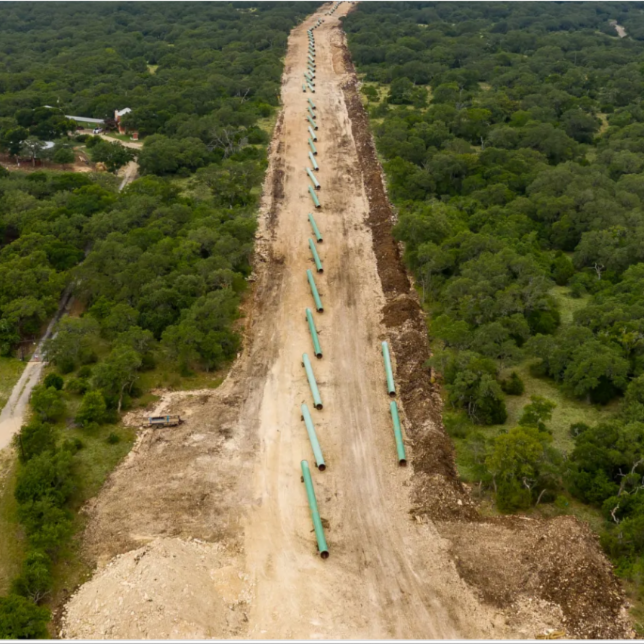
Texas is undergoing a rapid pipeline expansion as global energy markets tighten and domestic demand for oil and gas surges. Record production in the Permian Basin, coupled with the explosive growth of AI data centers, is driving companies to build new routes to move fuel efficiently across the state. Brandon Mulder’s new reporting in The Texas Tribune and Texas Monthly investigates the rush to increase capacity and the increased tension between landowners and pipeline developers that can result.
Read More Here and Here
| | | | |
UT Austin Researchers Create Jacket That Pulls Water From Air
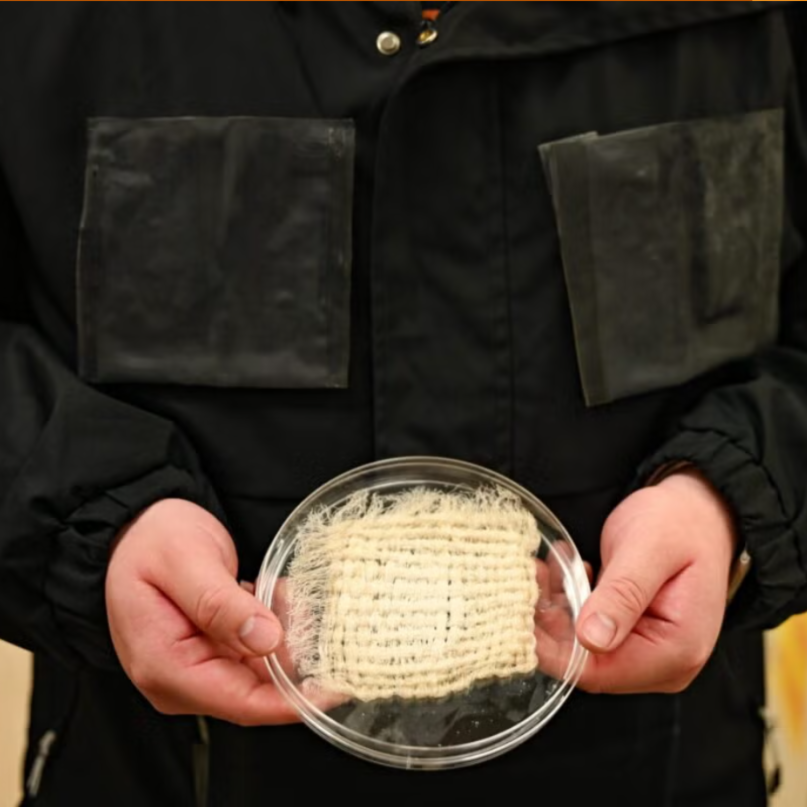
UT Austin engineers created a wearable jacket that can produce nearly a liter of drinking water per day using a moisture‑absorbing textile that pulls moisture from the air. The technology is promising for applications in outdoor activities, remote field operations, disaster response, and water access in remote or arid regions, and the team has applied for a patent via UT’s Discovery to Impact.
Read More
| | | | |
UT Austin Selected to Drive Semiconductor Workforce Development Effort
UT Austin’s Texas Institute for Electronics will lead the southern node of the National Network for Microelectronics Education, a consortium designed to address the workforce challenges facing the semiconductor industry as it rapidly expands. The program will connect students, veterans, and career‑changers to training for semiconductor careers, positioning Texas and the region for long‑term economic growth.
Read More
| | | | |
Navigating the Ethical Pitfalls of the Global AI Arms Race
EI Assistant Director Carey King is among the UT Austin faculty and researchers featured in a new documentary on artificial intelligence produced by the Ethics Unwrapped team at the McCombs School of Business. The film explores AI's benefits and challenges, including how social media algorithms can shape the information people see and influence public discourse. The film is the first installment of a series to be released in July and August 2026.
Watch the Docuseries
| | | | |
Mapping Underground Repositories to Optimize Domestic Fuel Reserves
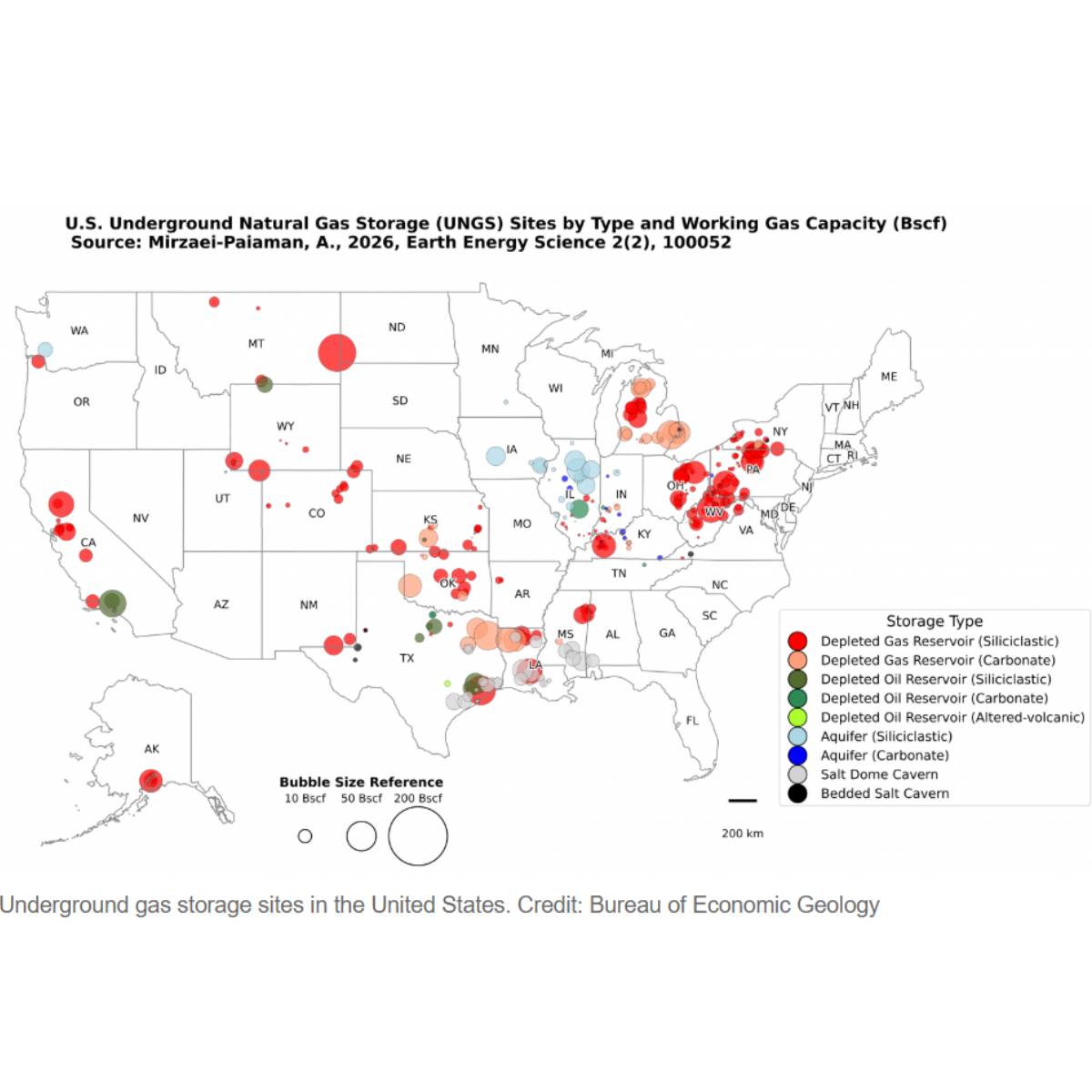
Scientists at UT Austin’s Bureau of Economic Geology have compiled a comprehensive database that maps underground gas storage facilities across the country. Led by research assistant professor Abouzar Mirzaei Paiaman, the integrated resource expands on limited federal datasets to help energy companies screen and identify ideal subterranean candidates for supply expansion. The framework will be crucial for companies planning the future deployment of emerging hydrogen and carbon sequestration technologies.
| | | | |
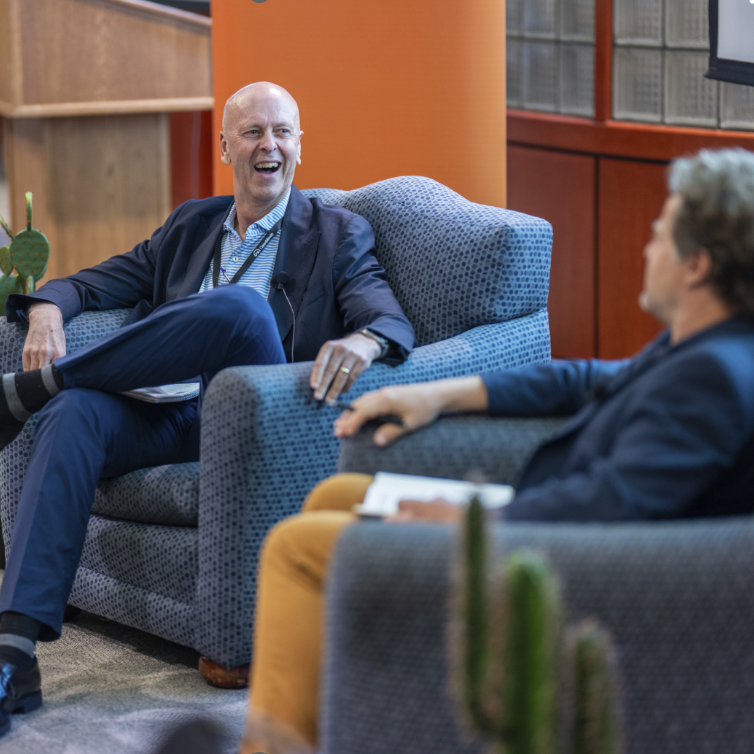
David Baldwin Reflects on Leadership and the Future of Energy, Between Two Cacti
On this episode of Between Two Cacti, David Baldwin reflects on the future of energy, discussing how industry leaders can balance growing energy needs, sustainability goals, and long-term economic growth. He examines the challenges facing the sector and the importance of collaboration among investors, innovators, and policymakers. The discussion provides a thoughtful look at what it will take to solve both climate and energy goals and how to build teams that can address that challenge.
Listen Here
| | | | |
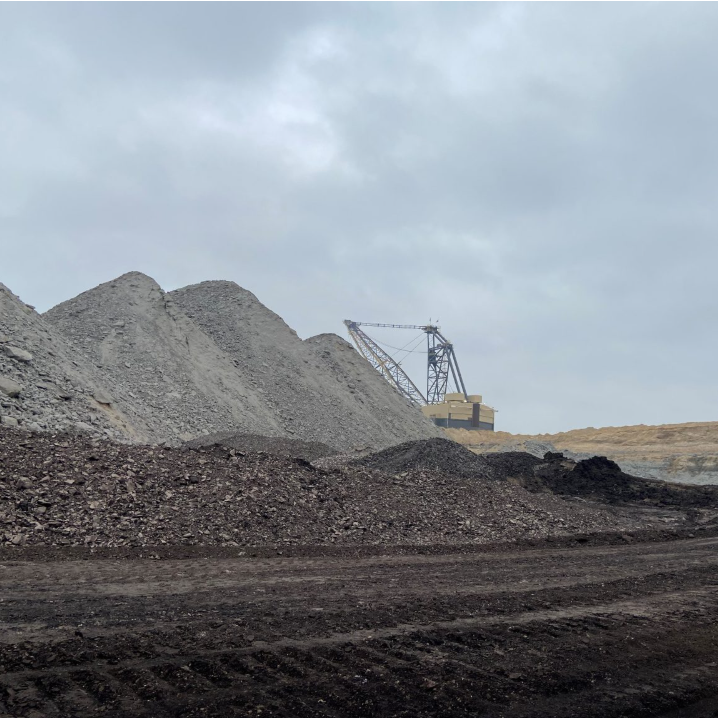
UT Researchers Find Billions in Critical Minerals in Gulf Coast Coal
UT researchers found that Gulf Coast coal and coal ash contain rare earth elements and other critical minerals that could be worth over $180 billion. While the concentrations are too low to justify standalone mining, the study suggests recovery could be economically viable as a byproduct for industries already processing these materials, offering a potential domestic source for minerals vital to clean‑energy technologies.
Read More
| | | | |
Startup Founded at UT Pinpoints Solution to Common Landscape Challenges
UT‑founded startup Pinpoint Irrigation is building a low‑cost robotic sprinkler system that cuts water waste and enhances leak detection. The team is supported by UT innovation programs and has partnered with Cockrell School researchers on developing new acoustic‑signal technology that uses sound waves to transmit data underground. The technology promises to help utilities detect leaks faster and monitor water systems more efficiently.
Read More
| | Energy Institute Advisory Board Chair Marilu Hastings Begins New Chapter | |
The Energy Institute congratulates Advisory Board Chair Marilu Hastings as she begins an exciting new chapter in her career.
Marilu is the founder of The Meridian House, a strategic advisory platform focused on infrastructure governance, regional development, and institutional strategy. For more than three decades, her work has centered on the societal, philanthropic, and institutional dynamics that increasingly shape large-scale infrastructure systems across energy, water, industrial development, and emerging technology sectors. She will continue to serve as Executive Chair of the Permian Energy Development Lab (PEDL).
After 15 years with the Cynthia and George Mitchell Foundation (CGMF) and 30 years working with the Mitchell family across HARC and CGMF, Marilu is excited about her next endeavor. She is especially enthusiastic to continue serving as Chair of the Energy Institute Advisory Board and remain an important partner to the Energy Institute and PEDL.
Marilu says, "One of the most rewarding aspects of my career has been bringing together people, ideas, and organizations to tackle complex energy and sustainability challenges. I am grateful for the opportunity to continue working alongside the Energy Institute community and look forward to advancing innovative solutions through Meridian House, PEDL, and the Advisory Board."
The Energy Institute is grateful for Marilu's continued leadership and looks forward to our ongoing collaboration.
| |
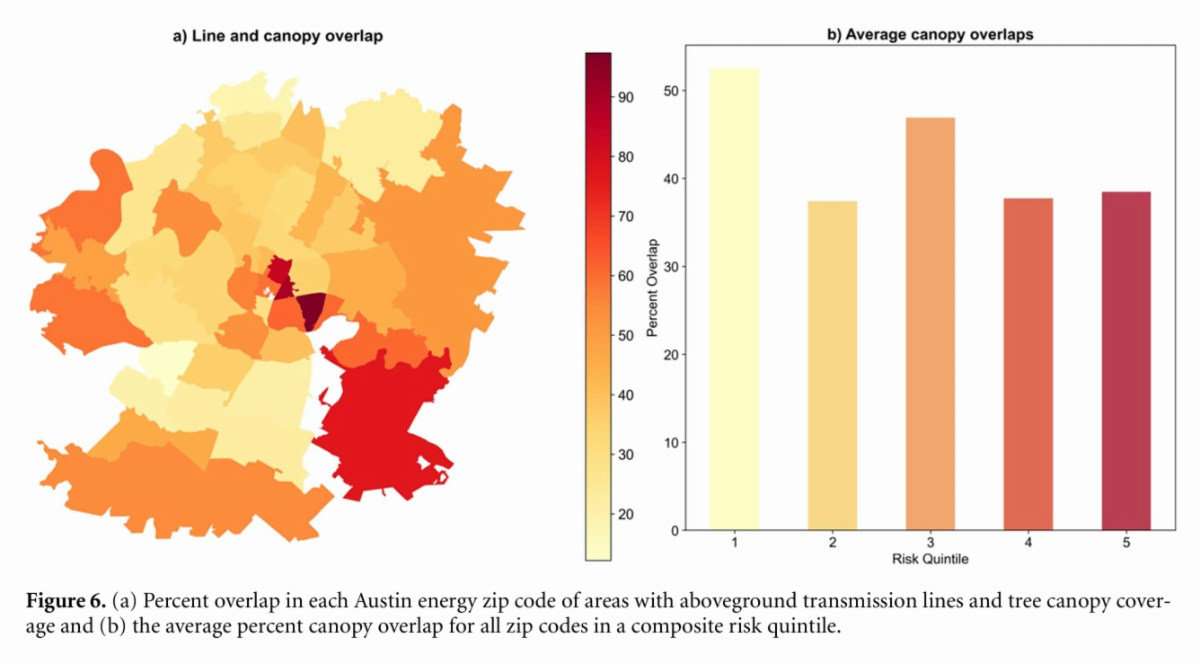
Data-Driven Framework to Promote Equitable Utility Upgrades in Vulnerable Areas
Researchers developed a composite risk and resilience score combining social vulnerability, social capital, climate hazards, and outage data to assess community-level resilience. Case studies in Washington and Texas show that socioeconomic disadvantage, weak social networks, and higher outage exposure cluster geographically, underscoring inequities in grid resilience. The framework offers utilities a practical tool for targeting investments that strengthen vulnerable communities.
|
| | |
Center for Electromechanics | Webber Energy Group
Michael Lewis, Emily Beagle, and Austin Mabrey gave Nick Kwek of BBC Tech Now a tour of UT Austin's hydrogen research facilities, showcasing the university's innovation in hydrogen vehicles and grid technologies to support a future hydrogen economy.
| | |
Energy Institute
Jorge Piñon was featured on BNN Bloomberg to discuss the impact of political and economic uncertainty on Cuba's mining industry, following the announcement by nickel and cobalt refiner Sherritt International Corporation that it might be forced to suspend operations in Cuba due to U.S. sanctions.
| |
LBJ School of Public Affairs
Robert Paterson was quoted by KERA News, noting that local moratoriums on data‑center development are unlikely to continue after Hill County faced a $100 million lawsuit.
Paterson was also quoted in The Texas Tribune discussing the ban on data centers passed in San Marcos. He explained that cities with home‑rule authority could theoretically uphold such a ban if it aligns with the city’s comprehensive plan.
Steven Pedigo co-authored an opinion piece in The Dallas Morning News arguing that Texas must give growing communities more authority on how their land is used, as the rapid expansion of data centers strains local resources and limits opportunities for higher‑value economic development.
| | |
School of Law
Chris Kulander is quoted in The Texas Tribune explaining how a 2004 Texas Supreme Court ruling made it easier for pipeline companies to meet the “bona fide offer” requirement in eminent domain cases, which in turn affects how landowners negotiate compensation.
| |
Bureau of Economic Geology
Katherine Romanak and Susan Hovorka fielded questions at a community meeting about CO₂ storage projects, as reported by East Texas Banner. Romanak’s analysis of roughly 800 wells provides data to evaluate groundwater safety, and Hovorka drew on her own research into subsurface geologic sequestration of CO2 to respond to safety concerns.
| |
Cockrell School of Engineering | Hildebrand Department of Petroleum and Geosystems Engineering
Hugh Daigle was quoted in an ABC News story examining recent declines in gasoline prices. Daigle explained that continued positive developments in U.S.–Iran negotiations could further ease global oil market pressures, leading to declines in consumer fuel prices.
Daigle also participated in a podcast by Marketplace on how the ongoing drawdown of U.S. crude oil reserves represents a slow‑moving supply challenge that could drive significant price increases as inventories approach minimum operating levels.
| |
Cockrell School of Engineering | Department of Civil, Architectural and Environmental Engineering
Kara Kockelman commented on Waymo’s pilot program to share road condition data with the City of Austin in Spectrum News 1, explaining how the vehicles’ inertial movement sensors can identify road damage.
She also commented on the new Texas law tightening rules for autonomous vehicle companies, as reported in CBS Austin. Kockelman noted that the legislation aims to strengthen safety oversight and ensure clearer accountability.
Kockelman's previous comments to Texas Monthly about driver assistance technology and safety were cited in an article published following a recent fatal Tesla crash in Katy.
| |
Cockrell School of Engineering | College of Liberal Arts
In a recent opinion piece for The Daily Texan, chemical engineering student Luke Stark draws on insights from fellow students and Professor Jules Elkins to highlight the negative effects of recent campus construction and argue that future projects should better account for noise, energy, and sustainability impacts.
| |
Webber Energy Group
Joshua Rhodes was quoted in E&E News explaining that a massive new wave of data centers, known as "Batch Zero," will likely be approved for grid interconnection before the state can pass any official guardrail regulations in 2027; at the same time, uncertainty around how much total new load will actually be connected is slowing regulatory approval processes, as quoted by The Wall Street Journal.
| |
Cockrell School of Engineering | Walker Department of Mechanical Engineering
Michael Webber appeared on Horizons for PBS News to discuss growing public concern over the environmental and community impacts of AI data centers. He emphasized the validity of the concerns as well as ways that data center development could be done “right” and benefit rather than harm communities.
Webber was also cited in a Fast Company story about Buc‑ee’s national expansion, noting that the chain keeps fuel prices low by selling gasoline at high volume while earning stronger margins on in‑store merchandise and food.
He also participated in Texas Public Radio’s podcast The Source, where he discussed the global clean‑energy race and the progress, challenges, and opportunities in advancing sustainable energy innovation in the United States.
Webber also co-authored a piece in Fortune India arguing that India is poised to replace China as the defining force of global energy markets.
| |
Cockrell School of Engineering | Center for Electromechanics
Robert Hebner commented in Yale Engineering on a recent breakthrough in transformer insulation. The enhanced nanotechnology design significantly improves thermal stability and durability compared to conventional materials.
| | | | |
Profitability and Sustainability in the Energy Industry
Start date: August 20, 2026
The University of Texas at Austin
| | | | | |
Managing the Energy Transition
Start date: September 1, 2026
The University of Texas at Austin
| | | |
Register Now: KBH Energy Center Symposium 2026
September 11, 2026
The University of Texas at Austin
| | | | |
Save the Date: EnergizeUT
September 22, 2026
The University of Texas at Austin
| | | | |
Save The Date: Global Solar Power & Energy Storage Forum
October 7, 2026
The University of Texas at Austin
| | | | |
Save The Date:
Hydrogen Day 2026
October 8-9, 2026
The University of Texas at Austin
| | | | | |
Register Now:
EEMDL 2026 Annual Event
October 13-15, 2026
The University of Texas at Austin
Register Now
| | | | | |
Register Now:
ASES Solar 2026 Conference
October 19-21, 2026
Palmer Events Center | Austin, TX
Register Now
| | | | |
Save The Date:
UT Energy Week 2027
April 5-9, 2027
The University of Texas at Austin
| | Thank you to our partners and sponsors for supporting the UT Energy Institute | |
| | | |