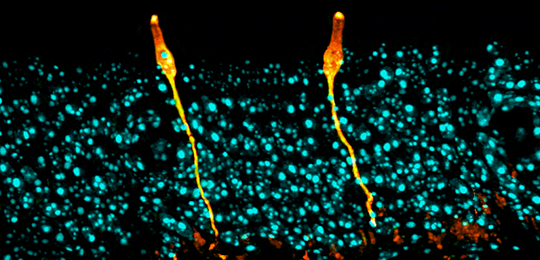
Although scientists have known for decades that a defective CFTR gene causes cystic fibrosis, the specific cells responsible for making CFTR were unknown until a recent study led by HSCI Principal Faculty member Jayaraj Rajagopal.
What they did: The researchers used single-cell sequencing technology to measure gene expression in the mouse airway, building a detailed catalog of many different cell types.
What they found: They identified a new and rare cell type where CFTR gene expression was concentrated, which they named the ionocyte.
Why it matters:Armed with this new understanding of normal lung biology and lung diseases, researchers can focus their efforts and accelerate progress in fighting cystic fibrosis.
Left to right: Richard Smith, Maria Lehtinen, Christopher Walsh.
What they did: The researchers analyzed the genomes of families affected by polymicrogyria -- a condition where the folds on the brain's surface are smaller and more numerous than usual -- in the brain region responsible for language.
What they found: Affected individuals had mutations in the gene SCN3A. When tested in an animal model, mutated SCN3A caused abnormal brain development.
Why it matters:The results open new avenues of investigation for understanding speech development in the fetal brain.