|
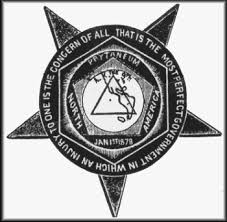 | |
Knights of Labor
|
|
|
|
|
|
|
|
|
Union Logos
by
Saul Schniderman
Unions, like other social justice organizations, use logos and other cultural symbols to express identity and solidarity. On the other side corporate capitalism likes to "brand" products or services in an attempt to beat the competition and increase market share.
When Spain's soccer team competed against Portugal, the Spanish players wore uniforms with the Adidas symbol; the Portuguese team sported the Nike "swoosh."
How does the American labor movement make use of cultural symbols and logos to get its message across? Given that, in the United States, we are a minority movement -- with around 10 percent membership -- and that only a small number of people actively participate in unions or have union experiences, do workers in America relate to any symbol that they recognize
as "theirs?"
Elise Bryant, a labor educator and director of the Labor Heritage Foundation teaches a class in which she asks the students to draw a symbol on the blackboard expressing "what is the union?" When union members and activists participate in the class they usually draw pictures of a heart, two hands grasping in solidarity, the scales of justice, or stick figures reaching for the stars. When she gives the same exercise to people who have never experienced unionism, her students draw dollar signs, picket signs, and fists that are fighting each other.
Could it be that union folks and the other 90% of the country have different images of what a union is and what it means to be part of one?
In 1994 I participated in the Labor Culture Tour of Sweden, along with fifteen artists and cultural workers. We were advised to bring buttons, bumper stickers, pins and t-shirts to give as gifts to our Swedish trade union hosts. I called my union - AFSCME - and the Union Label and Trades Dept. of the AFL-CIO and I packed my suitcase full of all sorts of union kicknacks.
Well, our Swedish hosts were very impressed with the American stickers, buttons, etc. "Your labor movement is so exciting," they told us, "with such colorful artifacts!" It turns out that in Sweden, where - during the 1990s - about 85 percent of the working class was organized into unions, there are little if any of these items present in the society. When everyone is in a union, why print up a bumper sticker? It's a majority movement with only about 10-20 percent of the workers unorganized, the opposite of the United States. In Sweden almost everyone, it seems, joins a union. It's a nation of "members" - union, political party, religious, youth organization, study circle, etc.
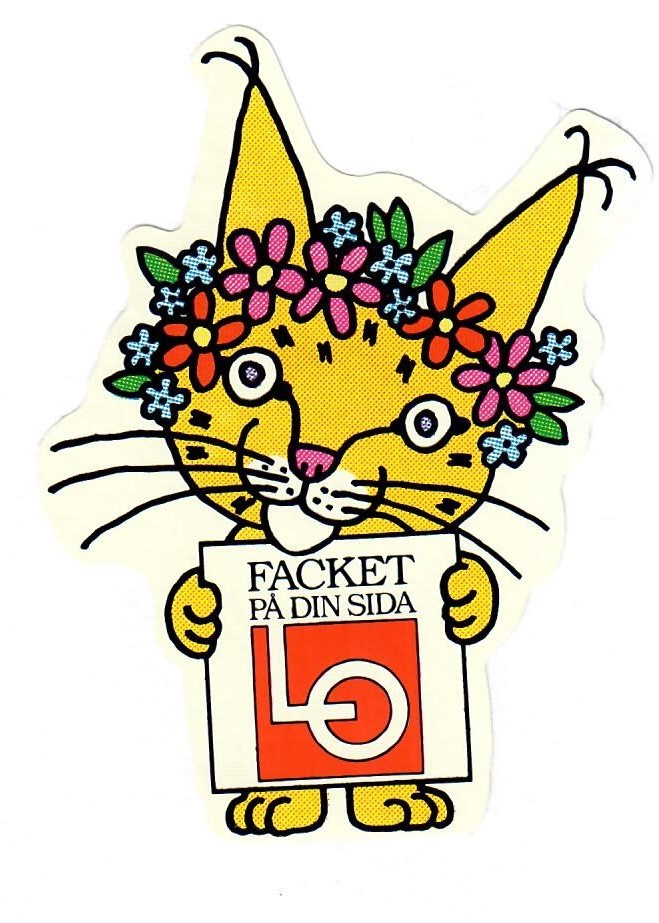
The Swedes did have one cultural logo that I must tell you about. Our tour was sponsored by Sweden's blue-collar union federation known as the LO. The symbol for the LO is a cat or a lynx - one that is found in the Swedish countryside. The name of this animal is pronounced, in Swedish, as "locat." And so the labor federation adopted the "LO Kat" as its mascot. In fact, our tour leader, Lars Petterson, called us, affectionately, the LO Kats from America.
Now, the reader who is familiar with America's blue collar unions - UAW, the Building Trades, Steelworkers, Teamsters, etc. - may have an image of the LO Kat as being strong, stealth, or panther-like. Quite the opposite. The Swedish LO Kat is a smiling, friendly cat, more like our "Morris the Cat" in the old commercials. In fact, there is a childish quality to the feline symbol, which was present on the carrying bags they presented to us as gifts. The LO Kat is cute and fluffy -- not at all like our images of tough blue collar workers.
When we visited the Swedish National Zoo, we saw that the LO had sponsored the lion and tiger exhibits (naturally). The walls were adorned with murals of LO Kats and baby Lo Kats, LO Kats on roller skates and LO Kats having fun on playground equipment. Swedes who visit the zoo associate the cat exhibits with the LO Kat, the symbol of the union.
The cat murals were very family-friendly; this was a unique and completely different cultural experience for the Americans on the tour.
I asked Lars, our tour guide, why the LO adopted this symbol and he told me that the union wanted to revitalize itself and its image. They wanted something that young people could relate to, something popular. The idea for the LO Kat originated with a woman who was on the national executive board of the organization, he said.
As we build our labor movement, let us not forget the power and influence of logos and cultural symbols. Bring back the old icons and create some new ones.
In America we are an emblematic movement, and for good reason.
(Saul Schniderman is the former president of the Library of Congress Professional Guild, AFSCME Local 2910, the chair of the Labor Heritage Foundation and the editor of Fridays Labor Folklore.)
|
|