|
Council of Producers & Distributors of Agrotechnology
Terry Kippley, CPDA
| | |
With Washington reopening after the record shutdown, CPDA is focused on driving real outcomes that matter to farmers and our member companies working every day to support them.
EPA’s pesticide registration backlog represents roughly half a billion dollars in delayed product reviews for CPDA member companies. We are working with EPA and Congress to reduce that backlog so safe, reliable products reach the field faster. CPDA continues pressing for the staffing, funding, and process improvements needed to restore predictable review timelines and ensure farmers have timely access to the tools they need to grow safe, affordable food.
Beyond Washington, CPDA is helping shape practical solutions from new ESA compliance resources for farmers to California’s pilot program aimed at reducing registration delays. Together, these efforts demonstrate how we connect policy to business outcomes for our members and the growers they serve.
| | |
CPDA, CropLife America, and the Agricultural Retailers Association released new Endangered Species Act (ESA) educational tools for farmers, retailers, and applicators.
The materials include an ESA 101 presentation and short videos on using EPA’s Bulletins Live! Two and PALM tools.
Resources are available at cpda.com/services/esa-mitigation.
CPDA Member Impact
This collaboration elevates the role of adjuvants and drift-reduction technologies as part of practical ESA compliance. It helps farmers meet new label requirements while positioning our members’ products as essential tools for keeping acres productive.
| | Adapting to ESA Video Series | | |
After 43 days, the government is back open following Senate and House approval of a bipartisan funding package.
The agreement provides full-year funding for USDA, FDA, VA, Military Construction, and Congress while extending all other agencies, including EPA, under a continuing resolution through January 30.
For agriculture, the deal includes:
• A one-year Farm Bill extension through 2026
• Restoration of USDA’s $30 billion Commodity Credit Corporation authority
• Full-year funding for USDA and FDA operations
EPA remains under a short-term CR, with appropriators eyeing December action to complete the remaining FY2026 bills before funding expires at the end of January.
| | |
EPA Administrator Lee Zeldin marked 300 days in office highlighting progress on core priorities, including a reduction of more than 5,200 submissions in the pesticide registration backlog.
CPDA Member Impact
CPDA continues to advocate for the needed resources at EPA. Each product cleared from the backlog helps get safe, effective tools in the hands of farmers sooner, while providing the predictability and transparency our member companies need to plan and serve growers effectively.
| | Farmer Assistance on Deck | |
Agriculture Secretary Brooke Rollins said last month that an assistance package for farmers hurt by export losses would come once the shutdown ended. With USDA staff back to work, attention now turns to how quickly the department moves.
In September, the administration shifted $13 billion to USDA for an aid program, and lawmakers say the package is ready. House Agriculture Chair GT Thompson expects an announcement soon, calling it the first tranche of support similar to the Market Facilitation Program.
How much USDA will spend remains unclear. The U.S.–China trade deal eased some tensions, but exports remain weak. Senator John Hoeven has said this will not be a one-shot deal, and Senator Chuck Grassley expects Congress may need to add funding if resources run short.
| | CA DPR Expedited Review Pilot—Deadline, 12/1 | |
CPDA convened member companies and CPDA State Affairs Advisor Emily Saad to coordinate engagement with the California Department of Pesticide Regulation (DPR) following release of California Notice 2025-12. The notice launches a six-month pilot to expedite certain amendment and notification actions through the CalPEST system, an early step toward addressing DPR’s longstanding registration backlog.
While narrow in scope, the pilot signals DPR’s willingness to respond to industry input and creates an opportunity for CPDA to advance broader process improvements for post-patent and adjuvant products. Members emphasized priorities such as developing CPDA recommendations for DPR based on lessons from EPA’s process improvements, emphasizing the role of adjuvants in ESA mitigation and sustainable pest management, and addressing unclear adjuvant data requirements that contribute to registration delays. The group also underscored the need for greater transparency within DPR’s Registration Branch and improved staff training on adjuvant issues.
CPDA Member Impact
The pilot hopefully creates a path toward more predictable registration timelines and improved competitiveness in one of the most complex regulatory markets in the country. For farmers, quicker turnaround times at DPR mean better access to the inputs they rely on.
Registrants may submit information by December 1 to determine eligibility for expedited review. For more information see: California Notice 2025-12
| | EPA Clarifies Fluorinated Carbon Policy | |
EPA published a new webpage outlining how the agency reviews pesticides containing fluorinated carbons. The site clarifies that all such products are evaluated under the same FIFRA standards as other pesticides and that the presence of a fluorinated carbon does not automatically classify a product as PFAS.
EPA emphasizes that each active ingredient is reviewed on a case-by-case basis, considering toxicity, persistence, and exposure data. The agency also notes that some fluorinated chemistries may provide benefits for specialty and minor crops and are registered in several other countries.
The clarification helps frame how EPA is approaching fluorinated carbon chemistry as PFAS policy evolves. CPDA will continue monitoring this issue.
Pesticides Containing a Fluorinated Carbon
| | CropLife Magazine Highlights CPDA | |
CropLife Magazine’s feature, “The Coming of ESA: What it Means for Crop Protection,” recognized CPDA’s leadership with CropLife America and the Agricultural Retailers Association in advancing practical ESA implementation.
By shaping how adjuvants are recognized in ESA mitigation, CPDA is helping members capture new commercial opportunities and ensuring farmers retain access to effective crop-protection tools.
| CropLife Magazine also featured “Collaboration in Action for ESA Compliance,” recognizing CPDA’s partnership with CropLife America and the Agricultural Retailers Association to make Endangered Species Act compliance easier for growers. CropLife Magazine is helping spread the word about practical tools like ESA 101 and video guides, resources designed to help you make decisions with confidence. | | Spanish Label Translation | The EPA recently provided answers to questions that CPDA posed in September regarding the content of the Spanish Translation Guide for Pesticide Labeling (STGPL). | | On Nov. 17 EPA and the Army Corps of Engineers released a proposed rule to update the definition of “waters of the United States” (WOTUS) under the Clean Water Act. This can have a significant, hopefully positive effect on the language of your pesticide labels, as well as how pesticides can be used on farmland. The proposed rule will be published soon for a 45-day public comment period. We welcome your input now on comments that CPDA should submit. | | Anticipating an early renewal of PRIA 6 in 2026, the PRIA Coalition has kicked off an effort over the next few months to explore the consolidation of the more than 225 PRIA codes for regulatory actions written into the law. Some of the codes are never used, some may be duplicative, and there is certainly confusion in selecting the right code. EPA cites frequent miscoding of regulatory submissions, particularly those related to substantially similar products, as a primary rationale for consolidating the long list. We welcome your input and examples of coding problems to help guide these efforts. | | PRIA Coalition Meets with RD Leadership | | The PRIA Coalition team working on revision of PRN 98-1 (self-certification of product chemistry data) had a productive meeting with RD leadership this week. It appears the Agency is favorably disposed to changes that CPDA has championed – a self-certification statement that is less “punitive”; reducing the rate of calling in the self-certified data; digitizing forms and the submission process; etc. The Agency anticipates a proposal for public comment in mid FY2026 (say, around April). Contact Ray McAllister for more information. | | |
With the shutdown over, agencies are returning to normal operations. USDA’s restored funding and CCC authority set the stage for new farm-aid announcements, while EPA’s short-term CR keeps pressure on appropriators to complete fiscal year 2026 bills before January 30.
CPDA is Your Voice on Capitol Hill
CPDA remains engaged in Washington and the states to ensure members’ voices continue shaping the policies that help farmers and our industry succeed.
| | Upcoming Webinar:
Earn 1 IPM CEU Credit, Adjuvants & Insecticides | | |
Season 4 of our successful webinar series, in partnership with the Agricultural Retailers Association (ARA) is back for another 5-part series discussing topics from biologicals and insecticides to tuning up your tank mix.
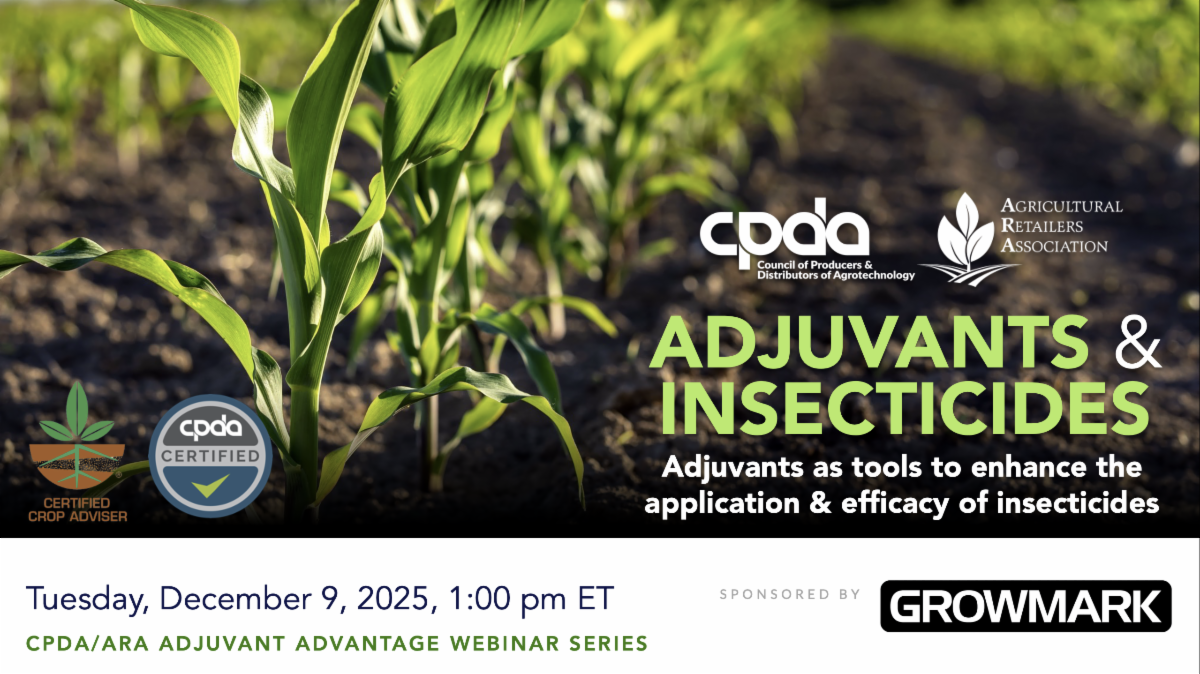
Tuesday, December 9, 2025, 1:00 pm ET
Adjuvants & Insecticides: ESA Strategies Update
This webinar discusses adjuvants as tools to improve the application and effectiveness of insecticides.
Certified Crop Advisers attending this webinar will earn one Certified Crop Adviser (CCA) program IPM CEU.
| | Stay Informed with CPDA's Weekly Policy Update | | |
Each week, CPDA Vice President of Government Relations Andrew Walmsley breaks down the latest developments in Washington and what they mean for the crop protection and ag technology sectors in Insider Ag Policy, a concise, no-spin briefing followed by hundreds of policymakers, industry leaders, and association partners.
This week’s edition covers the government shutdown ending with a bipartisan funding deal that includes a one-year Farm Bill extension, restored USDA authority for farm aid, full-year funding for USDA and FDA, and short-term EPA funding. Lawmakers now face completing the remaining appropriations before January 30th and preparing new farmer assistance programs.
Read the latest edition
If you’d like these updates delivered directly to your inbox, click Subscribe on LinkedIn to join more than 750 readers who already follow Insider Ag Policy.
| | | December 2–4, 2025 | ARA Conference & Expo
Salt Lake City, UT | | December 9, 2025 | Season IV: Adjuvant Advantage for the Sales Agronomist
Webinar Topic: Adjuvants and Insecticides (ESA Strategies update) | | December 9, 2025 | CPDA State & Federal Regulatory Update
Contact Andrew Walmsley for invitation | | January 7, 2026 | Season IV: Adjuvant Advantage for the Sales Agronomist
Webinar Topic: Tune up your Tank Mix: How to optimize pesticide performance with adjuvants | | January 28, 2026 | Season IV: Adjuvant Advantage for the Sales Agronomist
Webinar Topic: Drift Reduction Adjuvant and effective nozzle selection | | February 11, 2026 | Season IV: Adjuvant Advantage for the Sales Agronomist
Webinar Topic: ESA Technical Field Guide – How to Comply | | March 3–5, 2026 | CPDA DC Fly-In
Washington, D.C. | | April 27–29, 2026 | CPDA Adjuvants, Inerts & Crop Protection Conference
Austin, TX | | September 28–30, 2026 | CPDA Annual Meeting
Dallas, TX | | | | | |