|
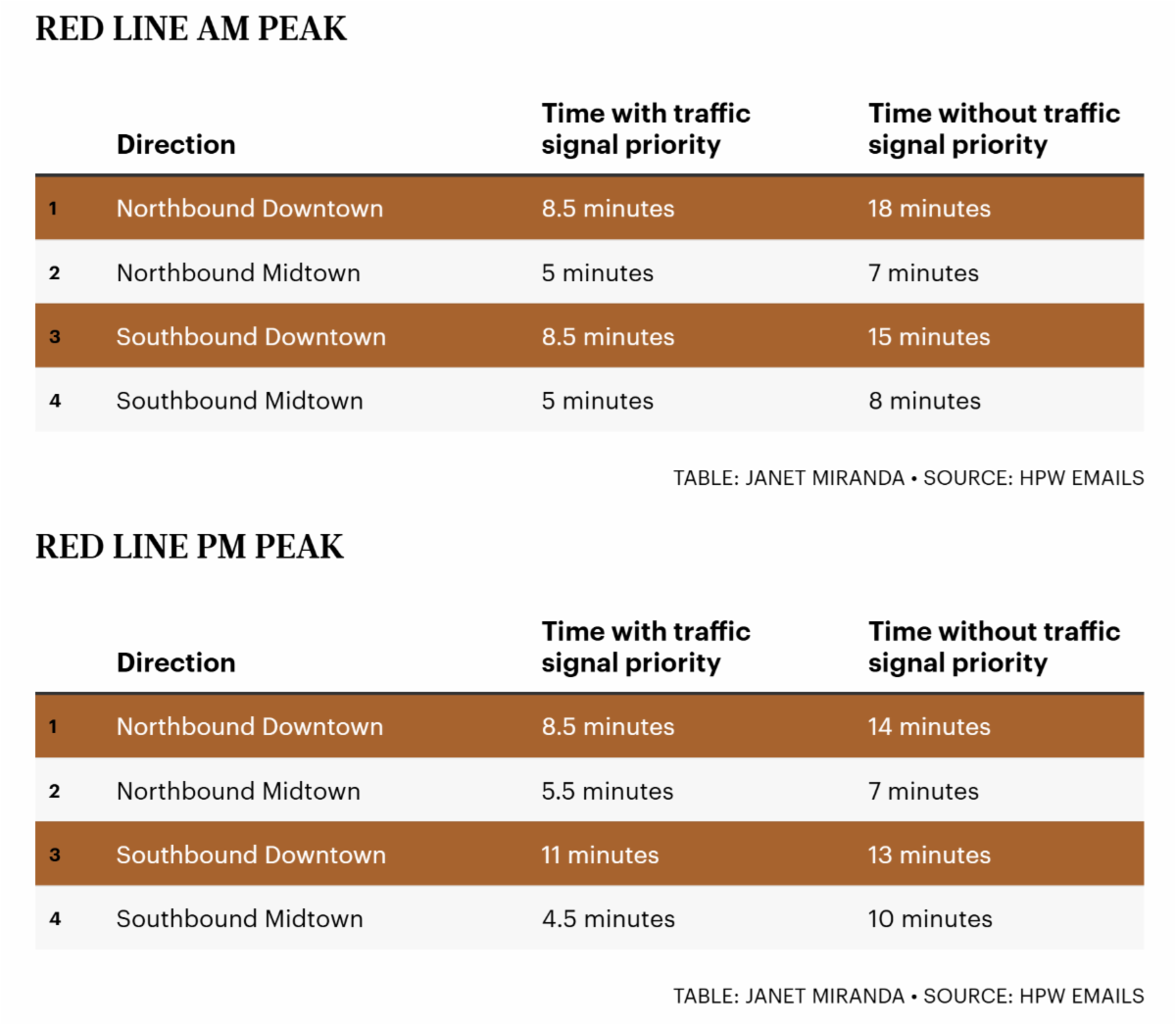
You may have seen some coverage in the Houston Chronicle and Houston Business Journal about a controversy that arose over the effect of changes to the timing of downtown traffic lights on Metro’s Red light rail line. The narrative that emerged from this reporting was that Mayor Whitmire had capriciously ordered that Red Line trains not be given priority in the timing sequence without any input from traffic engineers and was then forced to reverse his decision.
Having observed the Red Line’s operation since its inception in 2004 and having lived through several previous timing resets of the downtown grid, I found this narrative incredulous. So, I spent some time tracking down exactly what had happened, which turned out to be far different from the papers’ narrative.
Traffic signal timing plans must be updated over time because traffic volumes, travel patterns, and transit operations inevitably change. As a result, standard traffic-engineering practice is to retime signals every 3 to 5 years, or sooner in areas experiencing significant operational changes.
However, the last time the City retimed the signals downtown was in 2012. As a result, the timing had progressively deteriorated, leading to delays and numerous complaints from downtown commuters and business interests. In particular, Houston First raised concerns about the effect of crosstown traffic on the GRB Convention Center complex. In September 2023, the City Council, at the request of the Public Works Department, appropriated about $1.5 million to begin a major resynchronization. In July 2025, the City Council added $300,000 more to the project. Over that time, the City held meetings with downtown stakeholders on the retiming project.
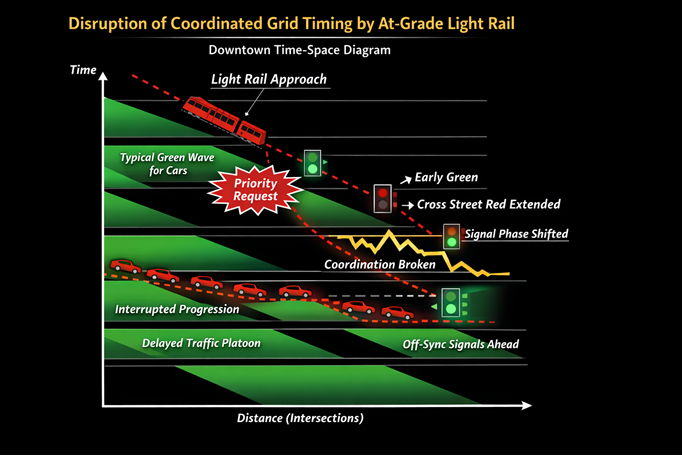
Any resynchronization of a grid is an exercise in balancing conflicting traffic flows. The idea is to “platoon” vehicles to move in a synchronized pattern, so they avoid each other at intersections and move through the grid with as few stops as possible. If the grid only has vehicular traffic, such synchronization is relatively straightforward. However, the introduction of at-grade light rail in downtown Houston greatly complicated the task of synchronizing the downtown signal grid. This is primarily because a platoon of vehicles moves through the grid largely without stopping, while trains must stop at their stations.
|