Native Plant Walk with Cathryn Pugh

Friday, May 17, 2024 5:30 - 7:00 PM

Saturday, May 18, 2024 9:00 - 10:30 AM 

Cathryn (Cat) Pugh, a PSU Extension educator, along with her team, will guide two consecutive native plant walks at ChicoryLane, one in the evening and another the next morning. They will focus on diverse native flora from the over 300 native trees, shrubs, herbaceous plants, and grasses catalogued at ChicoryLane. Both walks will use the mowed paths through varied natural, but scenic, terrains. Participants are welcome to join one or both walks and repeat walkers will no doubt see different wildlife and notice different plants on each.

Free event, Restroom available. Rain or shine except in a deluge.

Pre-registration through Penn State University encouraged.

Register Here

We will explore native varieties of TREES,

SHRUBS, PLANTS, & VINES

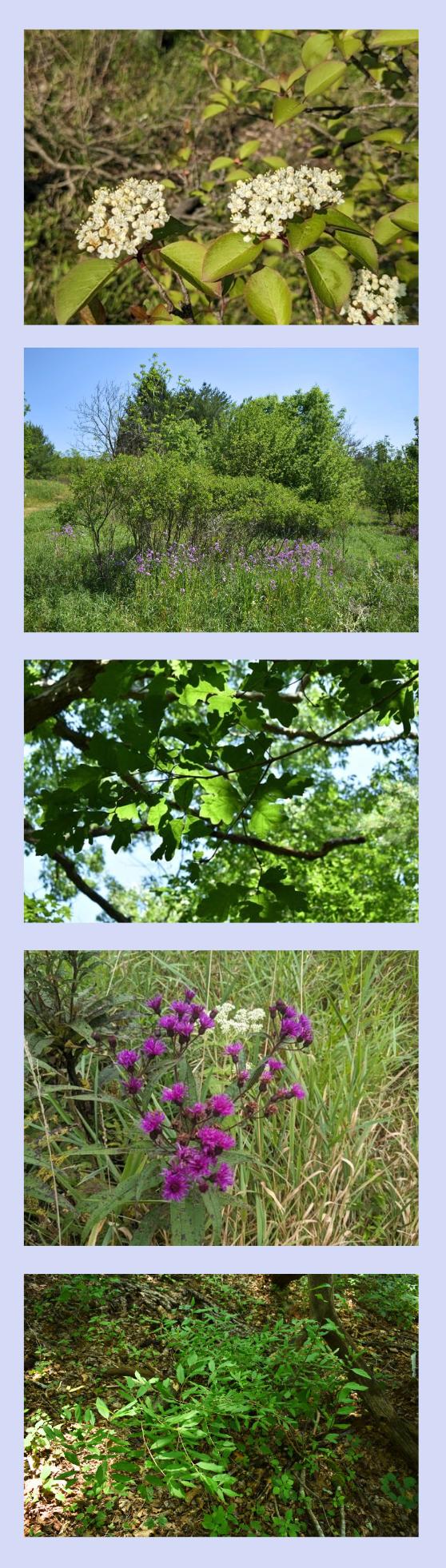
  • Viburnum are one of the most beneficial species of native shrubs for birds and other wildlife. In Doug Tallamy's list of beneficial ecological functions of native plants, Viburna check 9 of 11 categories. ChicoryLane has four varieties, which will be noted, including Cranberry (Viburnum trilobum), Nannyberry (V. lentago), Arrowwood (V. dentatum), and Blackhaw (V. prunifolium) shown.
  • Native Dogwood are another excellent species for wildlife, the shrub varieties also checking 9 of Tallamy's 11 functions. Five varieties can be seen at ChicoryLane, including Silky (Cornus amomum), Gray (C. racemosa) shown, Redstem (C. sericea), Alternate-leaf (C. alternifolia), and Flowering (C. floridia).
  • Oak Trees are great for so many forms of wildlife - supplying not just acorns but also caterpillars, a valuable a source of food for hatchling birds. White Oak, shown.
  • Herbaceous. With the declining population of Monarch butterflies, Milkweed are especially important. ChicoryLane includes both Common (Asclepias syriaca) shown, and Swamp (A. incarnata). Also seen in abundance in August is NY Ironweed (Vernonia noveboracensis) shown, particularly important for bees.
  • Invasives (avoid). When working with native species, it is important to distinguish them from some nonnatives that can become invasive. Oriental bittersweet (Celastrus orbiculatus), unlike its American counterpart (C. scandens), is an invasive vine, killing trees it climbs in tight encircling tendrils. Other common invasives we will point out include Autumn Olive (Elaeagnus umbellata) shown, Multiflora Rose (Rosa multiflora), and Tartarian Honeysuckle (Lonicera tatarica).

All images from the ChicoryLane collection

"Walking Willow" at ChicoryLane in Summer

Website

ChicoryLane is an ecological reserve near Spring Mills, protected by a Conservation Easement held by Clearwater Conservancy. It is 68 acres of very diverse lands that we are actively enhancing ecologically.


The landscape is natural, but scenic. It includes wetlands and meadows, several streams, remnant and successional forests, and a grassland. This diversity of habitats is especially inviting to birds and butterflies. A system of mowed trails makes most of it accessible to walkers.


We hold outdoor events throughout the year. If you do NOT wish to receive future announcements, please select unsubscribe, shown below.