|
Will you sign the Early Day Motion (EDM), tabled by Apsana Begum MP, calling for an end to public contracts with companies supplying Israel with technology used in its crimes against Palestinians, such as Cisco Systems, Oracle and Palantir.
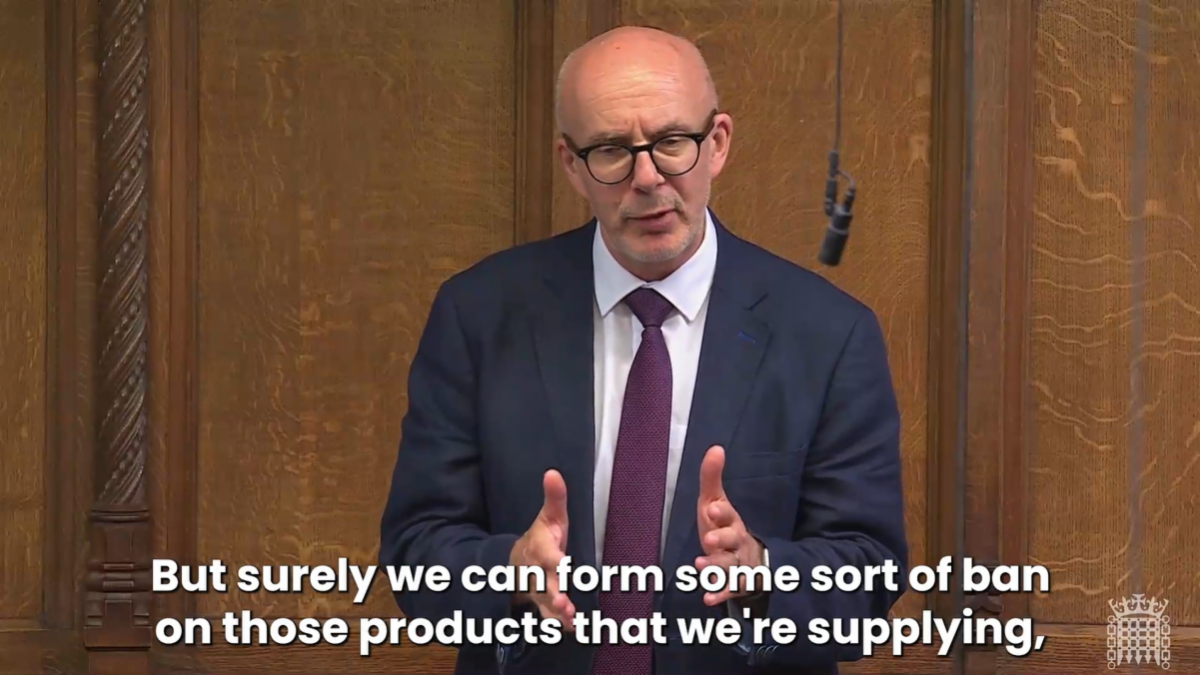
Although I no longer sign EDMs, as I do not believe they are an effective parliamentary mechanism for change, I have recently written to the Minister of State for Defence Readiness & Industry, to question the UK Government’s licensing scheme. You can read that letter here.
As I have mentioned in previous updates, I have continued to hold the UK Government to account on the legal, trading and military relationships it holds with the Israeli Government.
This Labour Government has taken stringent measures to penalise and deter the Israeli Government in its efforts to destroy the Palestinian way of life (e.g. sanctions and suspensions to free trade agreements). But it must go further and faster. Therefore, I will consider the position put forward in the EDM in my discussions with Government ministers.
Will you call on the UK Government to act to end Israel’s detention of Gazan medic and hospital director Dr Hussam Abu Safiya?
In December 2024, Dr Hussam Abu Safiya was detained in Gaza and taken to Sde Teiman military detention centre and later transferred to Ofer Prison.
Since then, his lawyer states that he has been tortured by the Israeli military and refused medical treatment and access to legal support. I remain concerned about his ongoing detention, as well as the detention of many other medical professionals from Gaza. It is worrying to read the recent reports from the United Nations, which you can read here, that he has been subjected to severe torture.
I know the Minister has raised the case with both the Israeli Ambassador to the UK and the Israeli Deputy Foreign Minister. Israel must clarify the reasons for his detention, as well as those for the detention of paediatrician Mohammed Hamouda and all the other health workers detained in Gaza. They must also allow the International Committee of the Red Cross unfettered and immediate access to detention facilities.
Gazan civilians must be protected and able to access effective healthcare. I am very concerned about the impact of the conflict on Gaza’s healthcare system and medical staff. It is unacceptable that many medical facilities are no longer in use or are inaccessible to humanitarian workers.
The UK will continue to support the provision of essential healthcare to civilians in Gaza, despite the clear efforts of Netanyahu’s government to destroy health infrastructure that Palestinians so dearly rely on. This includes support to UK-Med for operating its field hospitals and to the Egyptian Ministry of Health to support medically evacuated Palestinians from Gaza.
Will you call on the UK Government to suspend all UK export licences that facilitate Britain’s complicity in the Gaza genocide?
As I mentioned in my answer to FAQ #1 I have, and will continue to, press this Government to review its trading relationships with the Israeli Government. As I did during my time on the Department for Business & Trade Select Committee (find out more here) and in my ongoing engagements with Ministers in the DBT and the FCDO, I will continue to do so.
Since October last year, over 900 Palestinians in Gaza have been killed. 1.9 million Palestinians also remain displaced and dependent on humanitarian aid; families are without shelter and there is a public health crisis in Gaza. Yet the amount of aid entering Gaza is down, with barely half the level of the 4200 trucks promised in the peace plan entering. This is only worsened by Israel’s registration law (which is restricting the operation of international NGOs) and the closure of key crossings.
Whilst I recognise the genocidal actions of Netanyahu’s Israeli Government against the people of Palestine, and it is clear and obvious effort to obliterate Palestinians from Palestine, it is not for the UK Government to determine genocide. This is the responsibility of a competent court. At this stage, no competent court has made a final determination, although some courts have made provisional findings, I know that the UK will abide by these. The Government takes its commitments under international law, including the Genocide Convention, extremely seriously.
Why did the UK Government bar Hasan Piker and Cenk Uygur from entering the UK?
I understand that Cenk Uygur, the host of the Young Turks online political talk show, and Hasan Piker, who runs his own streaming channel, were both due to appear at SXSW London. However, the Home Office decided to cancel their electronic travel authorisations because their presence in the UK ‘may not be conducive to the public good’.
Free speech and the right to protest are fundamental to our democracy. I fully support both, and I share the Government’s commitment to ensuring people are free to gather and express their views. However, everyone deserves to be treated with dignity and respect, and no one should intimidate or infringe upon the freedoms of others.
Free speech in this country has deep historical roots but was not enshrined in UK law until the Human Rights Act in 1998. Article 10 of the Human Rights Act states that everyone has the right to freedom of expression, but that this may be subject to conditions in the interests of national security, public safety, for the prevention of disorder or crime, or to protect the rights of others.
Between 1 January 2024 and 11 June 2026, I am aware that 2,640 people have been refused an Electronic Travel Authorisation on the basis that their presence in the United Kingdom is not conducive to the public good.
Although the Home Office does not comment on cases in such instances, I understand that Hasan and Cenk had made pro-Hamas comments and antisemitic remarks.
It is important that all communities can live free from fear and harassment, and I am concerned about any antisemitic actions which target the Jewish community here in the UK. Antisemitism has no place in our society, and that extremism must be taken seriously.
I am glad the Government remains committed to carefully considering how best to protect individuals and communities from hate, while balancing the need to protect the fundamental right to free speech.
|