| | |
Former CLBB Research Associate Receives Equal Justice Works
Equal Justice Works and CLBB | 2025
Former CLBB Summer Research Associate Rohan Kandeshwarath was awarded a prestigious Equal Justice Works two-year fellowship, selecting CLBB as his host organization. Rohan, who earned his JD degree in June from the University of Michigan Law School, is one of 60 recent law school graduates who have been selected by Equal Justice Works to work in public interest law. His portfolio will include working on the Emerging Adult Program with the Suffolk County District Attorney’s Office and on the CLBB amicus brief team. The fellowship, which is supported by 92 law firms and other donors, will begin in late September 2025.
| | | | |
U.S. Court of Appeals Cites CLBB’s Amicus Brief in Cintron v. Bibeault Decision, Recognizing Harm from Solitary Confinement
U.S. Court of Appeals | August 5, 2025
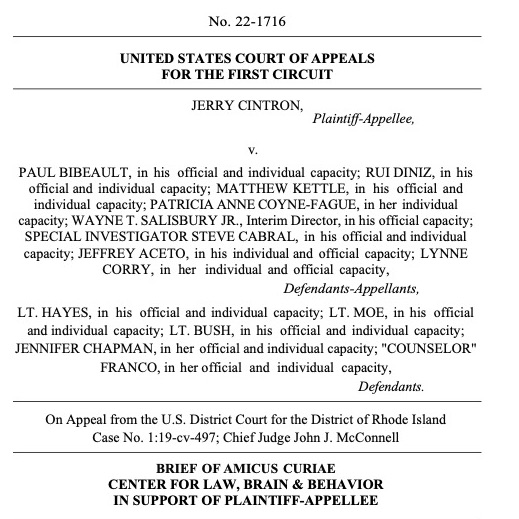
While serving a ten-year sentence in Rhode Island Department of Corrections (RIDOC) custody, Jerry Cintron suffered an overdose and was charged with drug trafficking. RIDOC officials sanctioned him with a total of 450 days in solitary confinement. During this period, Cintron experienced severe mental and physical deterioration, including significant weight loss, sleeplessness, self-injurious behavior, and psychiatric symptoms. RIDOC refused his pleas to end solitary confinement.
Cintron filed a lawsuit in the US District Court of Rhode Island, alleging violations of his Eighth Amendment rights (cruel and unusual punishment). When the Court upheld Cintron’s claim, the court officials appealed. The United States Court of Appeals for the First Circuit reviewed the case and ruled in Cintron’s favor and denied qualified immunity for the three prison officials. CLBB’s brief provided evidence of the deleterious cognitive, sensory, and sleep effects of prolonged solitary confinement, and was specifically cited in the Court’s ruling.
| | | | |
CLBB Executive Director Gives Pressentation at National Indian Country Conference on Trauma and Healing
2025 Indian Country Conference | August 13–15, 2025
The 2025 Indian Country Conference for federal district court staff covering tribal communities in jurisdictions across the United States was held in Missoula, MT, on August 13–15. CLBB Executive Director Robert Kinscherff, JD, PhD, gave a presentation on the science of adversity and resilience, historical and complex trauma, and ways in which Western and Indigenous views of well-being, harm, and healing can be integrated in trauma-informed practices. Subsequent speakers built upon these foundational presentations with discussions of culturally informed probation practices, the epidemic of missing Indigenous women and children, Indigenous healing practices, and vicarious trauma.
| | | | |
Adapting to Change: Forensic Resentencing Evaluations Post-Monschke, Mattis, and Other State Case Law
American Academy of Forensic Psychology | August 2025
At the American Academy of Forensic Psychology's 4th Annual Meeting in Washington DC, CLBB NeuroLaw Library Director Stephanie Tabashneck, PsyD, JD, co-presented the session Adapting to Change: Forensic Resentencing Evaluations Post-Monschke, Mattis, and Other State Case Law. The session examined the evolving role of forensic resentencing evaluations, with emphasis on landmark case decisions recognizing that defendants aged 18 to 21 exhibit developmental immaturity similar to younger adolescents and challenging rigid age cut-offs in sentencing. The workshop explored how forensic evaluators can best assess functional maturity and integrate developmental science into sentencing and resentencing evaluations, particularly in cases involving lengthy sentences.
| | | | |
Jennifer Jones Austin on Fighting Poverty and its Impact on Communities of Color
City & State New York | September 16, 2025
In an interview with City & State New York, Jennifer Jones Austin, JD, CEO of the Federation of Protestant Welfare Agencies discussed how FPWA is reframing the fight against poverty by shifting the focus from mere subsistence to true economic security for communities of color. She explained that FPWA is advocating for policies based on the real cost of living in New York City—not just survival-level thresholds—and leveraging those metrics to drive change in areas such as workforce development, housing, childcare, pay equity, and other critical supports, so that families can plan for stable, long-term futures.
| | | | |
Constitution Day Reminds Us to Protect Our Judges and Their Independence
The Baltimore Sun | September 17, 2025
In a guest opinion commentary, Federal Judge Andre M. Davis (ret.) called for fierce protection of judicial independence on Constitution Day, warning that attacks on judges threaten not just the courts but democratic trust itself. He argues that courts must remain free from partisan pressure and public intimidation so they can uphold constitutional guarantees, especially for those historically marginalized. Davis underscored the idea that safeguarding judges’ impartiality is essential to ensuring justice is accessible to all, not just a privileged few.
| | | | |
To Restore America, Start with Honor
Bloomberg | July 3, 2025
In an opinion piece, Anne-Marie Slaughter, President & CEO, New America, examined the erosion of the United States' moral compass. Drawing from her book The Idea That Is America, Slaughter argues that the nation's foundational values of honor, integrity, and respect for others have been undermined by political polarization and a decline in civic trust. She called for a collective effort to rebuild these values through public service, ethical leadership, and a renewed commitment to the common good.
| | | | |
Health Disparities in Neurology
Nature Reviews Neurology | September 10, 2025
Altaf Saadi, MD, MSc, Massachusetts General Hospital, co-authored a review that examined how structural, institutional, and individual factors drive preventable disparities in neurological care and outcomes worldwide. The article highlighted the growing burden of neurological disorders alongside persistent inequities, calling for systemic strategies to address social determinants of health, expand access, diversify the neurology workforce, adapt diagnostic tools, and track progress with equity-focused metrics.
| | | | |
Interplay of Genetic Predisposition, Plasma Metabolome, and Mediterranean Diet in Dementia Risk and Cognitive Function
Nature Medicine | August 25, 2025
Olivia Okereke, MD, MS, Massachusetts General Hospital, and colleagues examined how genetic risk (especially APOE4, a high-risk Alzheimer’s gene), blood chemistry, and adherence to the Mediterranean diet interact to influence dementia risk and cognitive function. The research found that individuals who carry APOE4 benefit even more from following a Mediterranean-style diet rich in fruits, vegetables, fish, and healthy fats. The study also identified specific molecules in the blood that may explain why this diet is protective and could help doctors identify high-risk individuals earlier, offering new directions for precision prevention of Alzheimer’s and related dementias
| | | | |
Contra-hedonic Functions of Self-Destructive Behaviors in Adolescents
PsyArXiv Preprints | September 1 2025
Leah Somerville, PhD, Harvard University, and colleagues published a preprint examining how adolescents' emotional experiences differ from those of children and adults. Their study suggests that during adolescence, individuals may experience a wider range of emotions simultaneously, which can make it more challenging to identify and label their feelings accurately. This developmental shift may contribute to the emotional intensity often associated with adolescence and has implications for understanding mental health during this critical period.
| | |
Neurolaw Bootcamp
CLBB, Dana Foundation, and NJAM | August 29, 2025
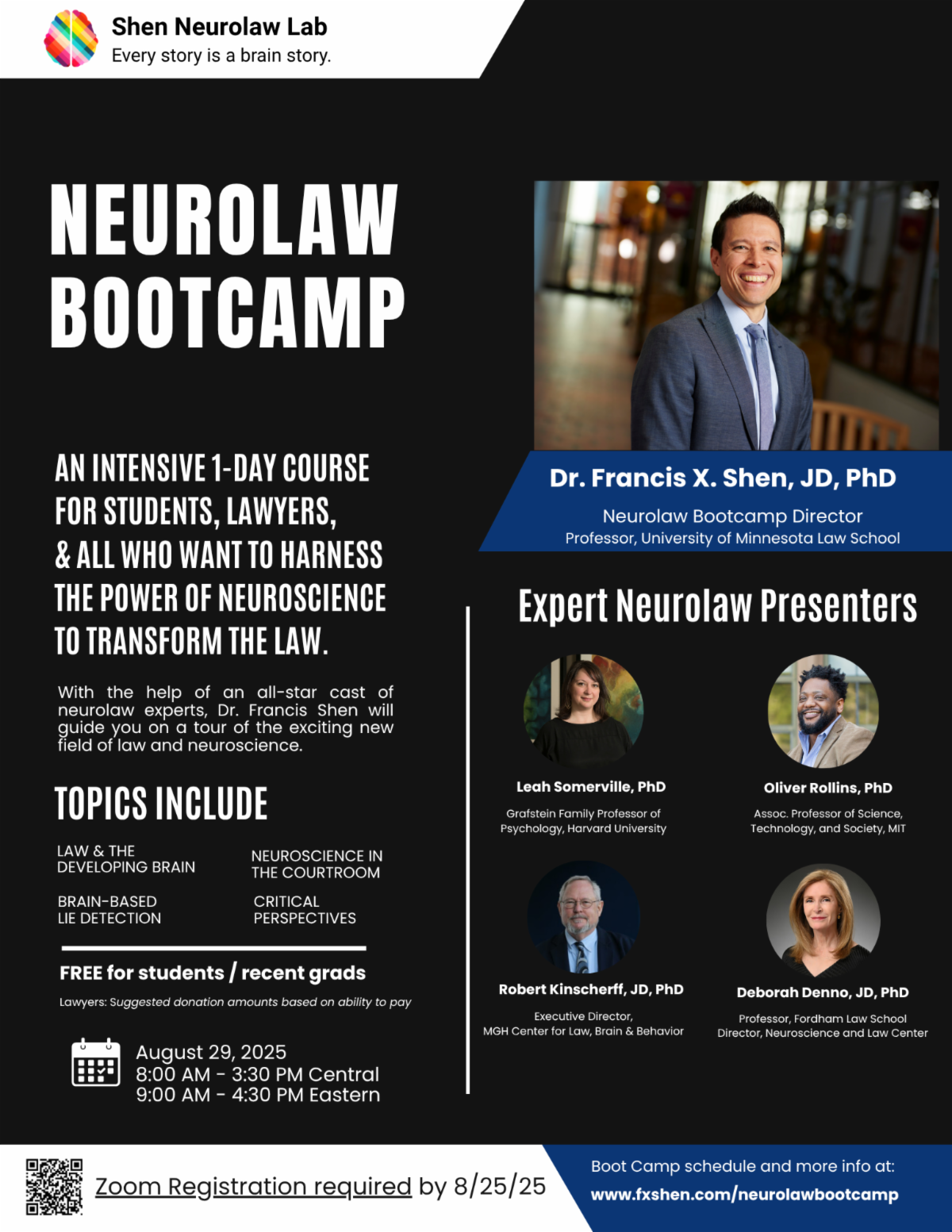
The Center for Law, Brain, and Behavior, the Dana Foundation, and the Neurotech Justice Accelerator at Mass General Brigham co-sponsored an intensive one-day virtual course for students, lawyers, and others interested in harnessing neuroscience to transform the law.
Organized by Neurolaw Bootcamp Director Dr. Francis X. Shen, the course featured national experts who engaged participants through both formal presentations and informal discussions. Highlights included a session on Law and the Developing Brain co-presented by CLBB Executive Director Robert Kinscherff, PhD, JD, and CLBB Affiliate Faculty Professor Leah Somerville, PhD. They explored the neuroscience that has profoundly influenced law and policy for adolescents and emerging adults in the criminal justice system, highlighting landmark cases that demonstrate the transformative potential of developmental neuroscience.
| | | | |