|
In Rome the poetry of history is being played out in scarlet and gold.
A united nations of queues snake their way around architecture that punctuates the story of power, intrigue, patronage and devotion.
Through the modern miracle of television and endless media we can witness the custom and curiosity that was designed for an era whose news was spread by gossip.
It was important not just to tell the news but to show the people…
… the Pope was dead.
Lying-in-state.
Paying tribute is only half the story. It was a device to demonstrate the truth of the day. At time when most people could hardly read, the news had to be seen and witnessed. Stories to be told and retold, the narrative woven into daily lives, to be passed on… ‘I was there’.
To be there, to be part of history is still important to people. Many in the queues will be there by happenstance. The chance and coincidence of an Easter Holiday in the eternal City whilst, yet again, it is making history.
For others it is a special journey. A pilgrimage. To witness an event, planned as early as 2015…
… Pope Francis had expressed the desire to be buried in the Basilica of Santa Maria Maggiore, a fifth-century church in Rome dedicated to the Blessed Virgin Mary.
After each of his more than 100 trips abroad, he would visit it, to pray and meditate. No Pope has been buried in Santa Maria Maggiore since the 17th century, when Pope Clement IX was laid to rest there.
Global attention on the death of a man whose soft power could be greater than any army. Whose influence could change the minds of leaders of men, friends and foes alike, all who pray-in-aid the same god.
A church, for some… a splendid, bejewelled anachronism for others… central to the lives of millions.
A public death of a global figure and a private death… for his surviving sister… mourning the death of a man she still calls Jeorge.
And so it is here; for the two thousand or so families who have lost a loved one, in the care of the NHS, over the Easter weekend. A punctuation mark in the history their family.
A blessed relief, a total shock. Expected or not, the finality of the moment leaves its mark.
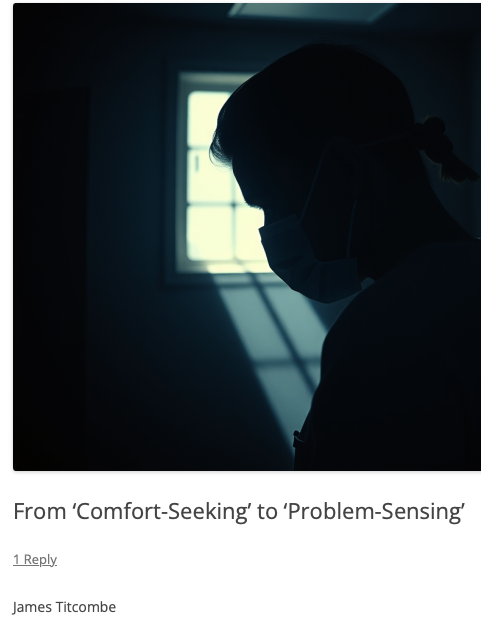
For young people, working on wards (and it is mainly younger doctors and nurses in the frontline of healthcare), they may never have experienced a death in their family.
Coming face-to-face with it, early in a career, especially on acute wards and care for the elderly, means they develop coping mechanisms. A detachment, to do their jobs.
Turning a death into a procedural event. The opposite to how a family might see it.
A disconnect emerges. Systemic pressures … time, understaffing, bureaucracy… limit their ability to provide truly compassionate care
The Francis Report into Mid Staffordshire famously highlighted the ‘depersonalisation’ of dying patients.
Compassion fatigue. Moral distress when healthcare workers know the right thing to do, but can’t do it because of the everyday constraints of staffing, policy and time.
Many healthcare workers learn to distance themselves emotionally from death, to stay functional. It’s an adaptive coping mechanism.
They wear a professional ‘armour.’
Without it, the emotional toll of frequent patient deaths could become unmanageable.
Many healthcare workers learn to distance themselves emotionally from death to stay functional…
… for families, detachment can appear cold or uncaring.
Talk to frontline professionals and you will find many struggle with subconscious fears about their own mortality, triggered by frequent contact with death. That’s when the candle flame of death becomes burnout.
Francis is the 266th Pope but he is the only Jeorge in his family. Special for so many reasons.
Of the two thousand or so, at Easter, whose life ended in the care the NHS, they will be special to someone.
Easter is over, the news will move on and families will try and find their new their normal...
... but let's not forget, the frontline staff who’s daily job is to cope with it all… they are very special to us all.
|