|
Use The Flywheel to Align Your Team
Most leadership teams do not lack ideas. They lack focus.
Sales wants more revenue. Operations wants fewer disruptions. Finance wants stronger margins. Service wants happier customers. HR wants better talent. Each goal may be valid—but without a shared strategic logic, the company becomes busy without building momentum.
A business flywheel solves that problem. It shows how a few connected actions reinforce one another to create profitable, sustainable growth.
The central question is simple:
What few actions, done consistently, will make the rest of our business stronger?
What a Flywheel Does
A flywheel is a visual model of how your company creates momentum. Each step enables the next:
- Serve the right customers well
- Earn trust and repeat business
- Generate profitable growth
- Reinvest in better capability
- Serve the right customers even better
The value is not the diagram. The value is the alignment it creates.
A flywheel gives leaders a common way to evaluate decisions:
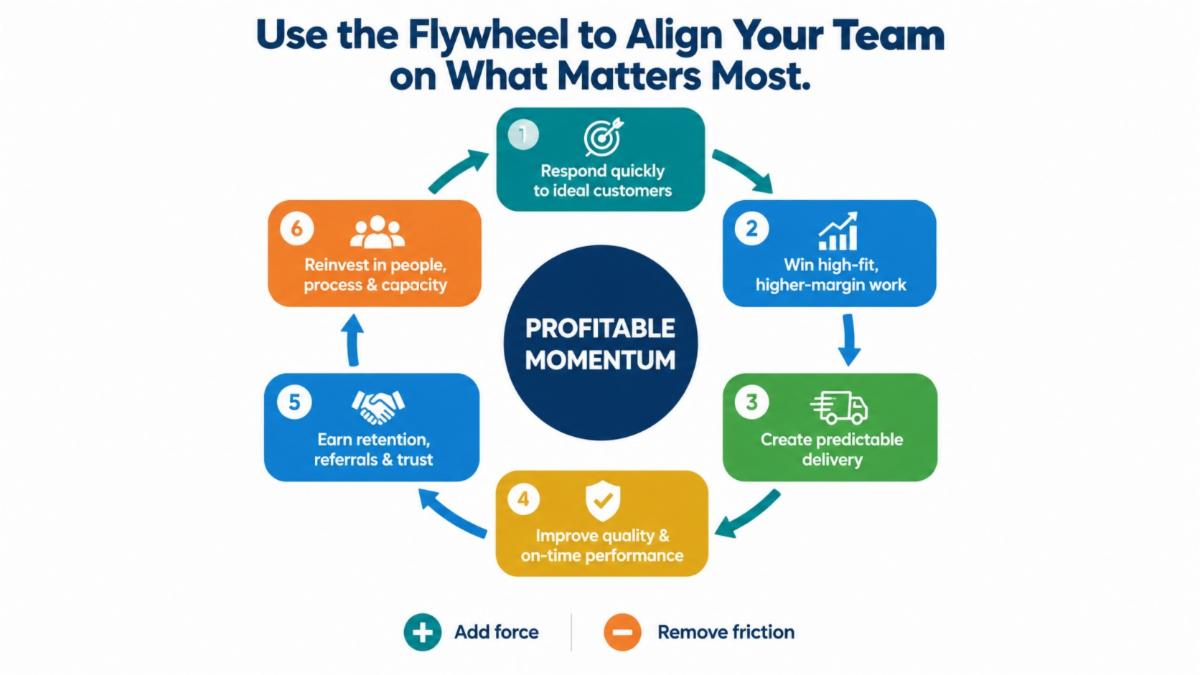
- Does this add force to our growth engine?
- Does it remove friction?
- Does it help us serve our best customers more effectively?
- Does it improve more than one part of the business?
- Or is it simply another project competing for attention?
Why Teams Get Misaligned
Misalignment happens when functions optimize locally instead of improving the whole business.
For example, sales may pursue low-margin work to hit a revenue target. Operations inherits difficult projects, schedules become unstable, quality suffers, and customers become frustrated. Revenue rises, but profit, capacity, and reputation decline.
The flywheel connects those decisions.
Instead of treating sales, operations, quality, customer service, and cash flow as separate conversations, the team sees one system. Every decision either strengthens or weakens the wheel.
What a Strong Flywheel Looks Like
A useful flywheel is customer-centered, specific, reinforcing, profitable, and measurable.
It starts with the customers you can serve exceptionally well. It uses observable outcomes rather than vague labels such as “great service.” Every step clearly enables the next. It improves margin, cash flow, retention, or enterprise value. It gives the team a way to see where momentum is building and where friction is slowing progress.
Here is an example for a B2B company:
Faster, more accurate response to ideal customers
→ win more high-fit, higher-margin work
→ create a more stable delivery workload
→ improve quality and on-time performance
→ earn retention, references, and referrals
→ generate stronger margins and cash for reinvestment
→ improve responsiveness and capability.
This model gives every function a role in the same strategy. Marketing attracts better-fit prospects. Sales qualifies, prices, and wins the right work. Operations delivers reliable quality and lead times. Customer service turns good outcomes into retention and referrals. Finance protects margin, cash, and investment discipline. Leadership removes barriers and keeps the organization focused on the system rather than isolated departmental wins.
Use the Flywheel to Prioritize
Before approving a new initiative, ask three questions:
- Does it add force? Will it improve customer value, speed, conversion, margin, retention, or capability?
- Does it remove friction? Will it reduce rework, delays, poor handoffs, complexity, unclear accountability, or customer effort?
- Does it strengthen multiple links? The best initiatives improve more than one stage of the flywheel.
For example, improving the quoting process can increase response speed, strengthen pricing discipline, reduce scope confusion, improve production planning, and raise margins. That is a high-leverage move because it improves the system—not just one department.
Make It an Operating Tool
Do not let the flywheel become a strategy-slide artifact. Use it in leadership meetings, quarterly planning, departmental goals, and performance reviews.
Each month, ask:
- Where are we gaining momentum?
- Where is friction slowing the wheel?
- Which customers or work types fit our strategy best?
- Which handoff is breaking down?
- What one action would create the greatest impact in the next 90 days?
Track only a small set of measures. For attracting ideal customers, track qualified opportunities and win rate. For selling profitably, track quote turnaround and gross margin. For delivery, track schedule adherence and on-time performance. For customer loyalty, track account-review discipline, retention, and referrals. For scale, track process adoption, EBITDA, and cash flow.
Start With One Push
Build the flywheel with your leadership team by answering five questions:
- What result are we trying to create?
- Which customers are most profitable and easiest to serve well?
- What outcome do they value most?
- What four to six actions create a reinforcing loop?
- What is the biggest source of friction today?
Then choose one 90-day action.
Not ten. One.
The goal is not to do more. It is to focus the team on the few actions that make everything else work better.
When people understand how their work turns the wheel, alignment becomes practical. They know what matters, why it matters, and where to put their energy.
Question for You to Ponder
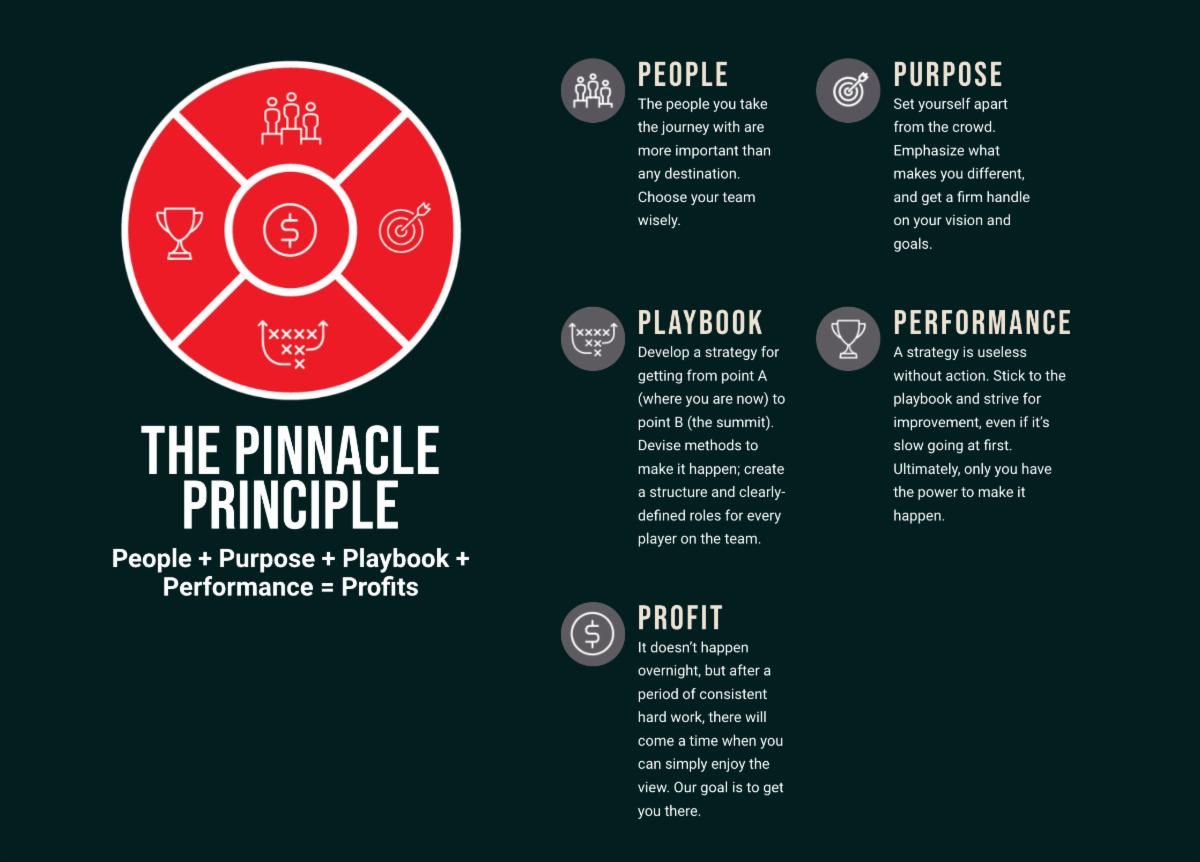
Are you ready to lead your business to its Pinnacle?
Outcome (if you act)
More valuable company, higher profit, and a better quality of life.
Call to Action
-
Ask me for a copy of the Path to Pinnacle
- Schedule a Meeting with Me
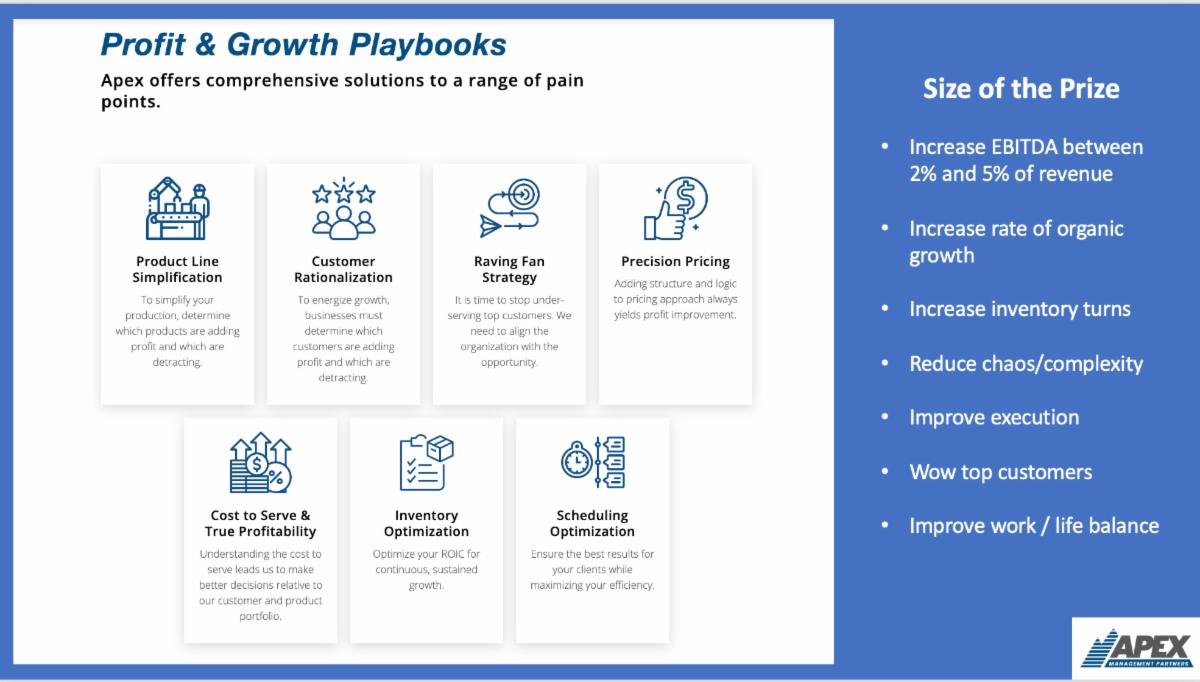
Our Mission: Accelerate Profitable Growth and Improve Execution
|