Havens Limited | Success Navigator
 

Using the Markets to Forecast Interest Rates: Rates Will Soon Begin to Fall

In early 2016, we published an article examining how the Federal Funds rate and the Federal Funds Futures market could be used to forecast future interest rates. With the Federal Reserve aggressively increasing rates over the last two years in response to economic conditions, it's timely to revisit and update our analysis. Understanding these mechanisms is more important than ever, as they have far-reaching implications for the economy, impacting everything from mortgage rates to corporate financing and investment strategies.


The current economic environment is marked by significant uncertainties, including lingering inflation, revisions to key employment data, and a slowing housing market. Given these developments, we felt it essential to provide an updated analysis to help readers make informed decisions in an increasingly volatile economic landscape.


This update will not only recap our 2016 predictions but also provide a detailed analysis of how the Federal Funds rate has evolved since then, and what we can expect moving forward. With the Federal Reserve poised to make critical decisions in the coming months, this article aims to equip you with the insights needed to navigate these changes effectively.


Understanding the Federal Funds Rate


The Federal Funds rate is the interest rate at which depository institutions (like banks and credit unions) lend reserve balances to other institutions overnight. This rate is crucial because it influences the cost of borrowing money across the economy. Higher Federal Funds rates make borrowing more expensive, which can slow economic growth, while lower rates make borrowing cheaper, encouraging spending and investment.


The Federal Reserve (often referred to as "the Fed") sets a target range for this rate as part of its monetary policy to control inflation and stabilize the economy. However, the actual Federal Funds rate is determined by the market, where banks negotiate rates for lending to each other based on their reserve requirements. The Fed influences this rate through open market operations, such as buying or selling government securities, which either increases or decreases the money supply, thus affecting the rate at which banks can lend.


The Role of the Federal Funds Futures Market


One of the ways to predict future movements in the Federal Funds rate is by analyzing the Federal Funds Futures market. Futures contracts are agreements to buy or sell an asset at a predetermined price at a specific time in the future. In the case of Federal Funds Futures, these contracts represent the market's collective expectation of where the Federal Funds rate will be at a future date.


These futures contracts are traded on exchanges such as the Chicago Board of Trade (CBOT) and can provide valuable insights into where traders expect interest rates to head. Because these markets involve real money and reflect the collective judgment of market participants, they are often more accurate predictors of future interest rates than individual forecasts.


For more detailed information on how the Federal Funds rate is determined and the role of the Federal Funds Futures market, you can refer to our previous article. However, this summary should provide you with a foundational understanding.


Review of Our 2016 Predictions


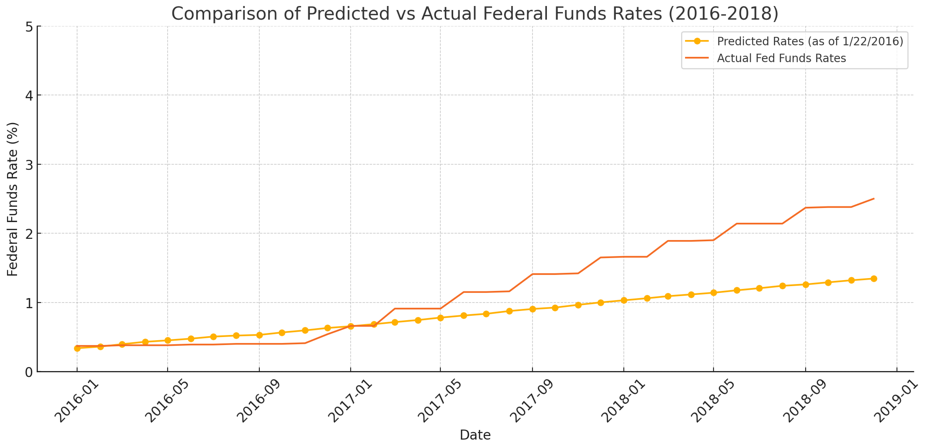
In January 2016, the Federal Funds Futures market predicted that the Federal Funds rate would gradually rise over the next few years, with an expected rate of around 1.345% by December 2018. As shown in the graph below, the market's predictions were accurate in forecasting the overall upward trend. While the actual rate increases were more aggressive, reaching 2.40% by December 2018, this reflected the Fed's stronger response to the economic conditions at the time.


Overall, the market's predictions effectively captured the direction of rate movements, highlighting the Federal Funds Futures market as a valuable tool for anticipating monetary policy, even as real-world outcomes sometimes outpace expectations.


Developments from 2019 to 2023


After reaching 2.50% in late 2018, the Federal Reserve continued to raise rates into 2019, reaching a target range of 1.50%-1.75% by the end of that year. However, as global growth slowed and trade tensions rose, the Fed shifted to a more accommodative stance, beginning to cut rates in the latter half of 2019.


The economic landscape changed dramatically in 2020 with the onset of the COVID-19 pandemic. In response to the severe economic downturn, the Fed slashed the Federal Funds target rate to near zero (0.00%-0.25%) in March 2020, where it remained until early 2022. This unprecedented move was part of a broader strategy to support the economy during the pandemic.


As the economy began to recover in 2021, inflationary pressures emerged, leading the Fed to begin raising rates again in 2022. By mid-2023, the Federal Funds target rate had increased to 5.25%-5.50%, as the Fed sought to combat rising inflation.


The Current Landscape: Impact on Commercial Real Estate and Housing Markets


As of August 2024, the Federal Funds target rate remains at 5.25%-5.50%, and the Federal Reserve continues to navigate a complex economic environment. One area significantly impacted by these rate increases is the commercial real estate and housing markets.


Higher interest rates have made borrowing more expensive, leading to a slowdown in both commercial real estate investments and home purchases. This has contributed to a cooling of the housing market, with fewer transactions and slower price growth compared to the booming post-pandemic market. In commercial real estate, higher borrowing costs have made it more difficult for developers to finance new projects, leading to a slowdown in construction and investment activity.


Inflation and employment data continue to be critical factors in the Fed’s decision-making process. Inflation, while moderating from its peak in 2022, remains above the Fed’s target, prompting continued vigilance. Recent adjustments to employment figures, such as the downward revision of 810,000 jobs from previous reports, have raised concerns about the strength of the labor market and the overall economy.


Future Predictions and Market Expectations


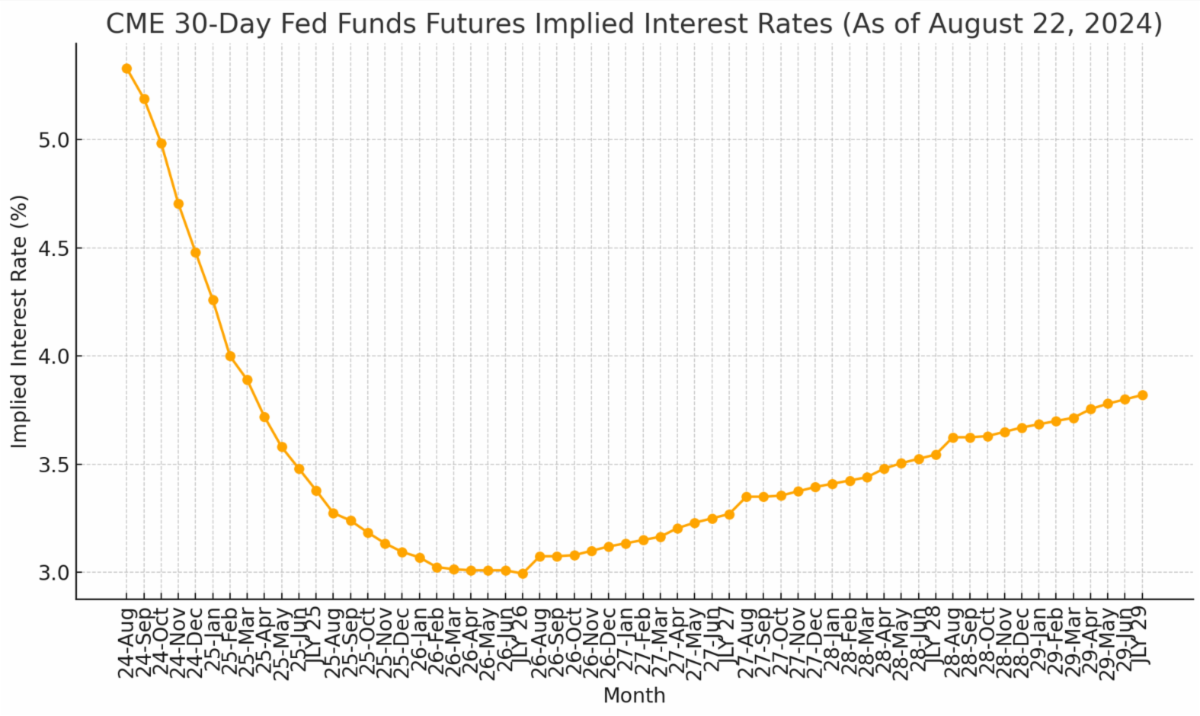
Looking ahead, the Federal Funds Futures market offers a clearer picture of where interest rates may be headed. As of August 2024, the futures data, as illustrated in the chart below, indicates that the market expects a significant decrease in interest rates over the next several months, with rates dropping below 4% by early 2025. This sharp decline suggests that the market anticipates the Federal Reserve will respond to weakening economic conditions, potentially including reduced inflation and slower growth, by lowering rates more aggressively than previously expected.


After this substantial drop, the market predicts that rates will stabilize at lower levels throughout 2025 and gradually begin to rise again in 2026, though remaining below 4% for the foreseeable future. This projection reflects the market's belief that, while inflationary pressures might ease, the Fed will continue to monitor economic indicators closely, making rate adjustments as necessary to support economic stability.

The upcoming Federal Reserve meeting on September 17-18, 2024 will be pivotal, with market participants closely watching for any signs that the Fed might start cutting rates sooner rather than later. Given the futures market's clear expectation of declining rates, as shown in the chart, there is speculation that the Fed may indeed begin to lower rates in response to evolving economic conditions, particularly if inflation continues to moderate and economic growth slows further.


Conclusion


The Federal Funds Futures market continues to be a crucial tool for forecasting future interest rate movements, offering valuable insights into the market's expectations. As we move into the latter part of 2024, the futures market suggests a potential shift in the economic landscape, with a significant decrease in interest rates anticipated in the near term. Key factors to watch will include inflation trends, the health of the labor market, and how the Federal Reserve responds to these evolving dynamics.


With commercial real estate and housing markets already under strain from higher rates, the Fed's actions in the coming months will play a pivotal role in shaping economic outcomes. Whether through rate cuts or other monetary policy measures, the Fed's decisions will have wide-reaching implications for financial planning, investment strategies, and business operations.


This article has provided a recap of past predictions and an updated analysis of the current and future interest rate environment. As the economic landscape shifts, staying informed on these dynamics will be essential for making sound financial and business decisions. 


Havens Limited Family of Companies
Havens Limited logo

Havens Limited, a law firm founded by Jim Havens in 1981, specializes in sophisticated commercial transactions, land use planning, sales financing, leasing and succession planning. 

VISIT OUR WEBSITE
Cardinal Title

Cardinal Title insures complex real estate transactions.

 
VISIT OUR WEBSITE
Rudolph Investment

Rudolph Management partners with our clients as joint owners or as owner’s representatives to complete the financing, entitlement, construction and stabilization of real estate assets.

VISIT OUR WEBSITE
 
We PROTECT, SUSTAIN and GROW the assets of our clients.
 
Havens Limited Projects