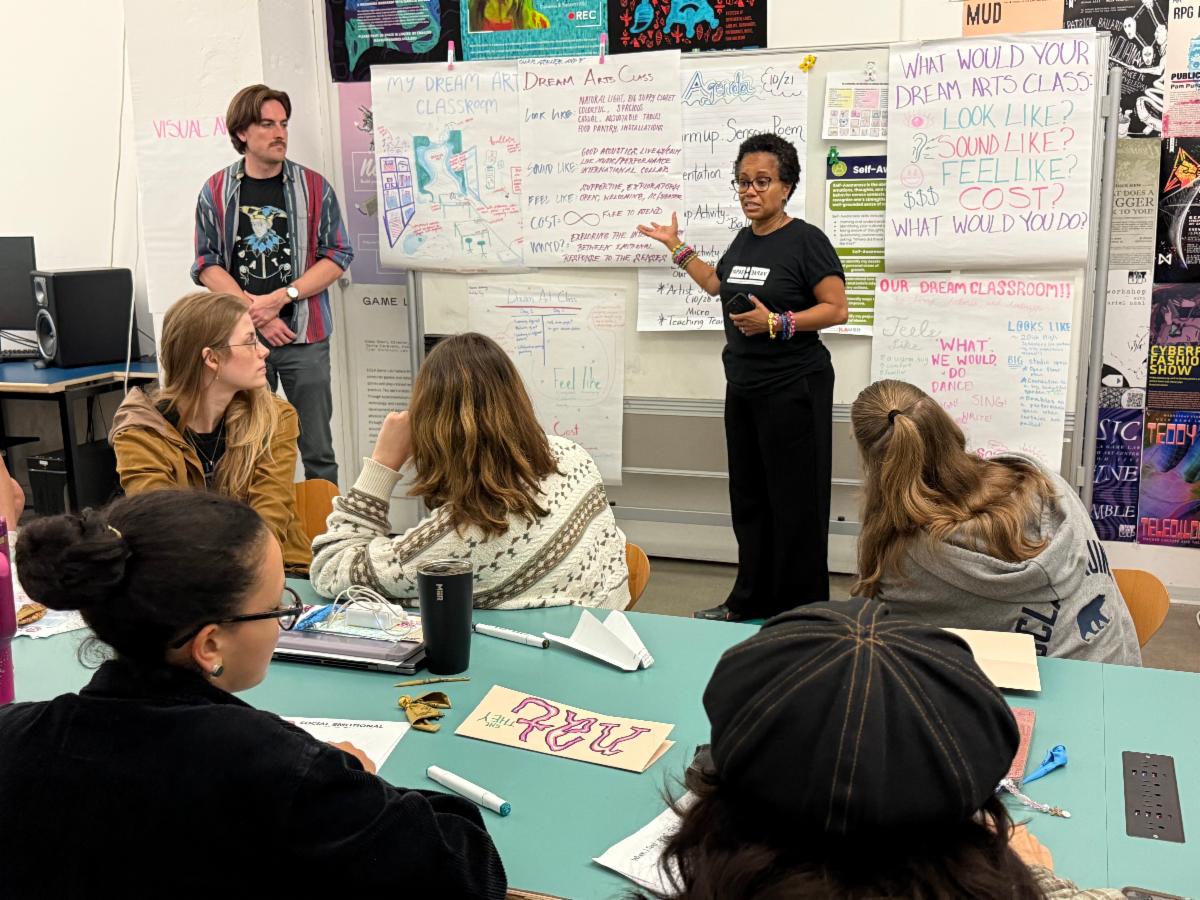
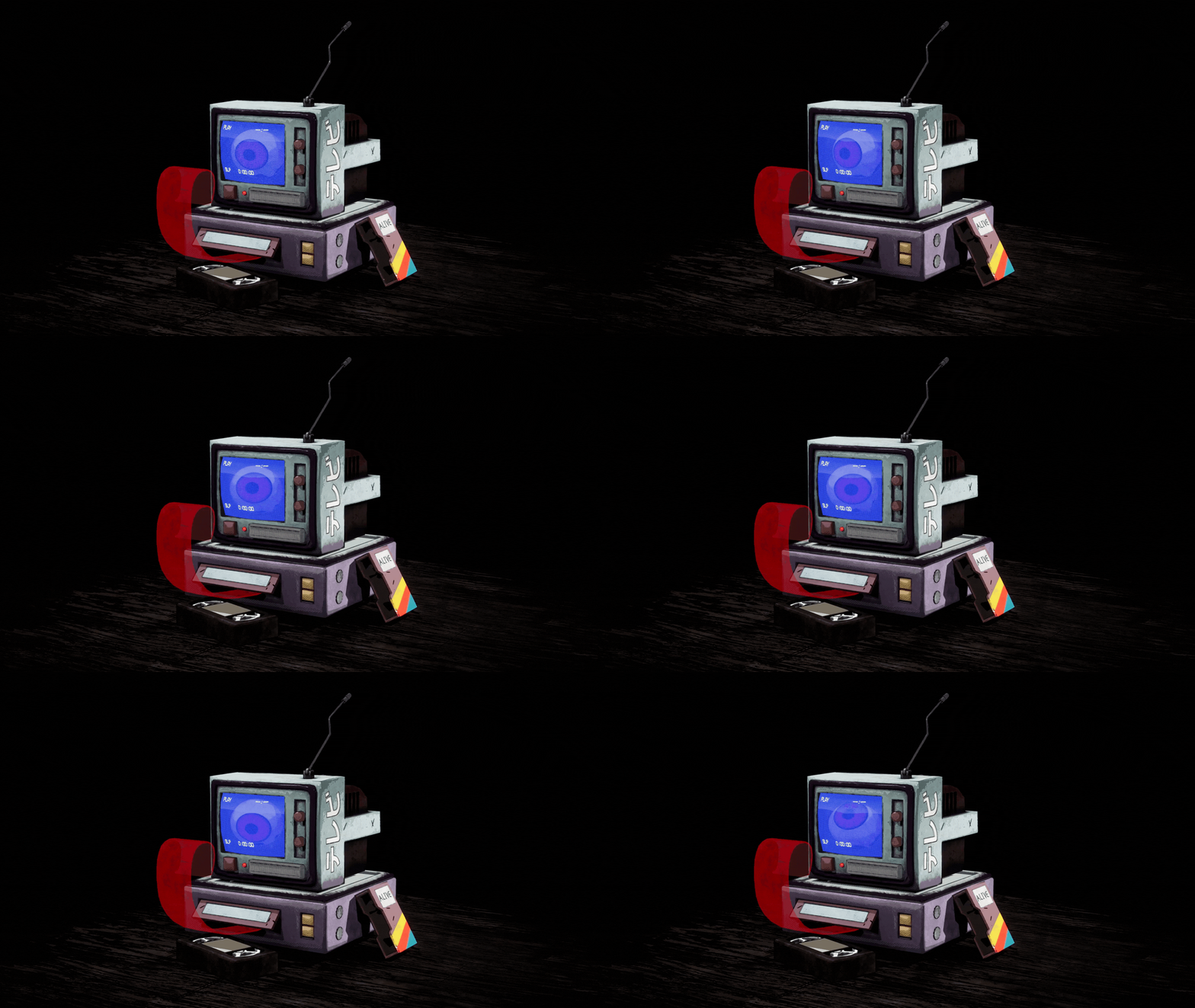
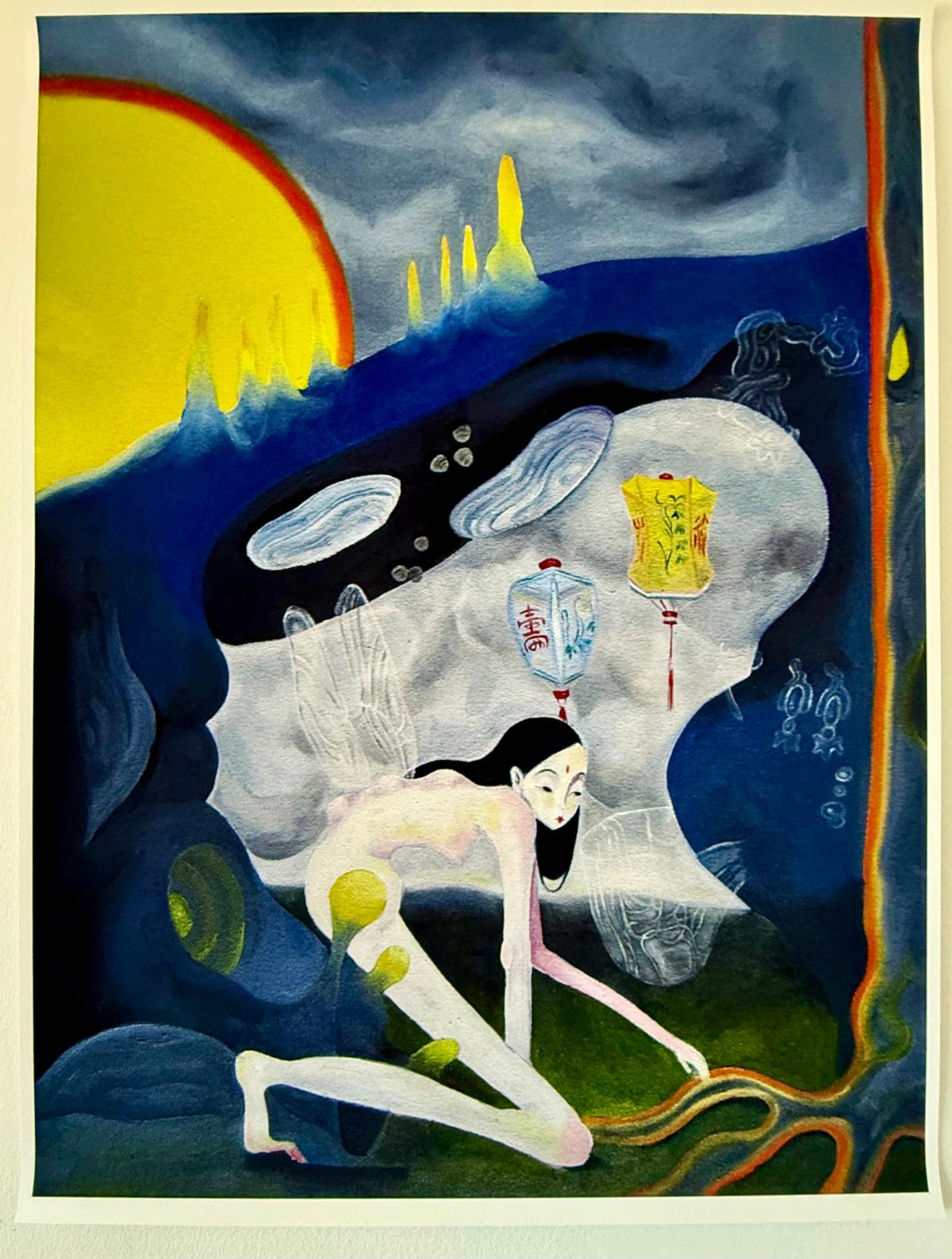
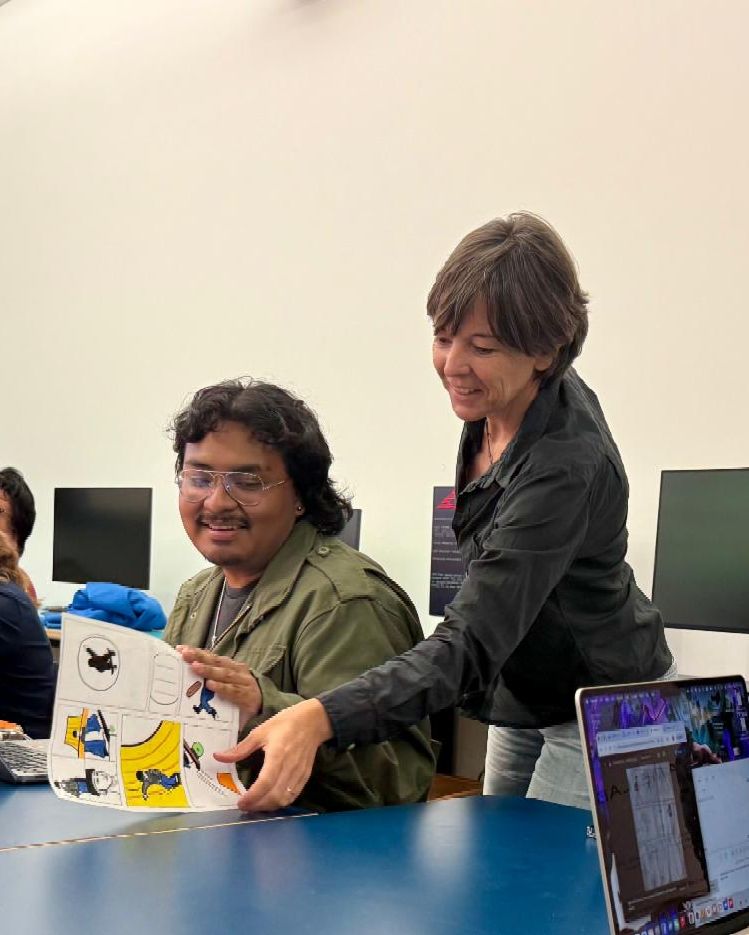
Lecturer Robin Branch-Scott and Teaching Assistant Andrew Child leading the AE M102 class in discussion. Photo by VAPAE staff. | | If you've visited the 8th floor of the Broad Art Center, you'll notice the walls are now adorned with various original pieces from several School of the Arts and Architecture students. Over the course of the spring and summer, Associate Dean Anya Booker led a call for students to submit their artwork to be part of the Inaugural Student Exhibition. Three VAPAE students, Luis Martinez, Kiki Ouyang, and Luis Ramirez, were part of this inaugural crop of student work. VAPAE students Luis and Kiki shared below what their process and inspiration was for creating their piece that was chosen for the exhibition. | Luis Martinez, Design|Media Arts & VAPAE Student | Asset, 2025 by Luis Martinez | VAPAE: "What was your process for creating your piece?" | Luis: This piece was created in Autodesk Maya, textured in Adobe Substance Painter and rendered in Unreal Engine. My process consisted of modeling a high-poly and a low-poly version. This process is primarily used for games as it saves rendering power and is more efficient. It took a couple of months to finish since I would work on it between classes and work. When creating this piece, I was mindful of being as accurate as the original concept by Andrey Melkoev. I remained faithful to the colors and textures. After modeling, I imported the low poly version of the model to Substance Painter where I baked on the details of the high-poly model to the low-poly version. This allowed me to get more details without the need for extra topology. After baking, I began texturing. From a custom glass texture to the scratches on the TV, I textured on different materials to give it different effects. After I was happy with the texturing, I imported the model into Unreal Engine where I used their lighting system and post process effects to render. I used a self-made “Toon-Shader” to give it a more stylized look. The last thing I did was animate the eye so it would move and look around. | VAPAE: "What was the inspiration behind this piece?" | Luis: This piece was inspired by a 2D concept drawing made by Andrey Melkoev. Although it was inspired and deeply influenced by Andrey Melkoev, I altered some aspects of the model to better fit in a game setting. I created the back of the model by adding cables and ports. Overall, my deep love for technology and all things horror drew me to this original concept | Kiki Ouyang, Art & VAPAE Student | The Outcast Immortal, 2025 by Kiki Ouyang | VAPAE: "What was your process for creating your piece?" | Kiki: The conceptual phase of this painting took much longer than the actual time spent creating it. I first began sketching the early version in my sketchbook. Not intentionally for this painting, but simply because one day, inspiration struck and I picked up my pen to draw. I really liked that initial sketch, so later I redrew it in more detail, experimenting with different background settings and approaches to the facial features. This piece is actually my first non-practice work done in oil paint, so during the process I explored different techniques and really enjoyed it. Compared to painting block by block, I was able to make choices about when to blend softly and when to emphasize certain details, which made the process both challenging and rewarding. | VAPAE: "What was the inspiration behind this piece?" | Kiki: The main inspiration for this painting came from William Cronon’s essay “The Trouble with Wilderness”, where he discusses the idea of “wilderness.” Cronon suggests that even Jesus might lose himself in the wilderness—but does this kind of loss also represent a form of renewal or rebirth? When freed from established frameworks, can an individual reconstruct themselves within that wilderness? These questions deeply influenced my creative process. In my work, I tried to portray a divine being who, after undergoing alienation, rediscovers and rebuilds themself within the wilderness. This deity serves both as a symbol of traditional culture and as a reflection of how modern society continually deconstructs and reconstructs cultural symbols. Through this image, I wanted to explore how contemporary culture reinterprets traditional myths, and to question whether, in doing so, we truly understand their original meanings—or if we are simply creating new myths that fit the needs of our present time. | | AE 101: From Viewing to Engagement: A Teaching Artist’s Practice of Comics and Illustrations in the
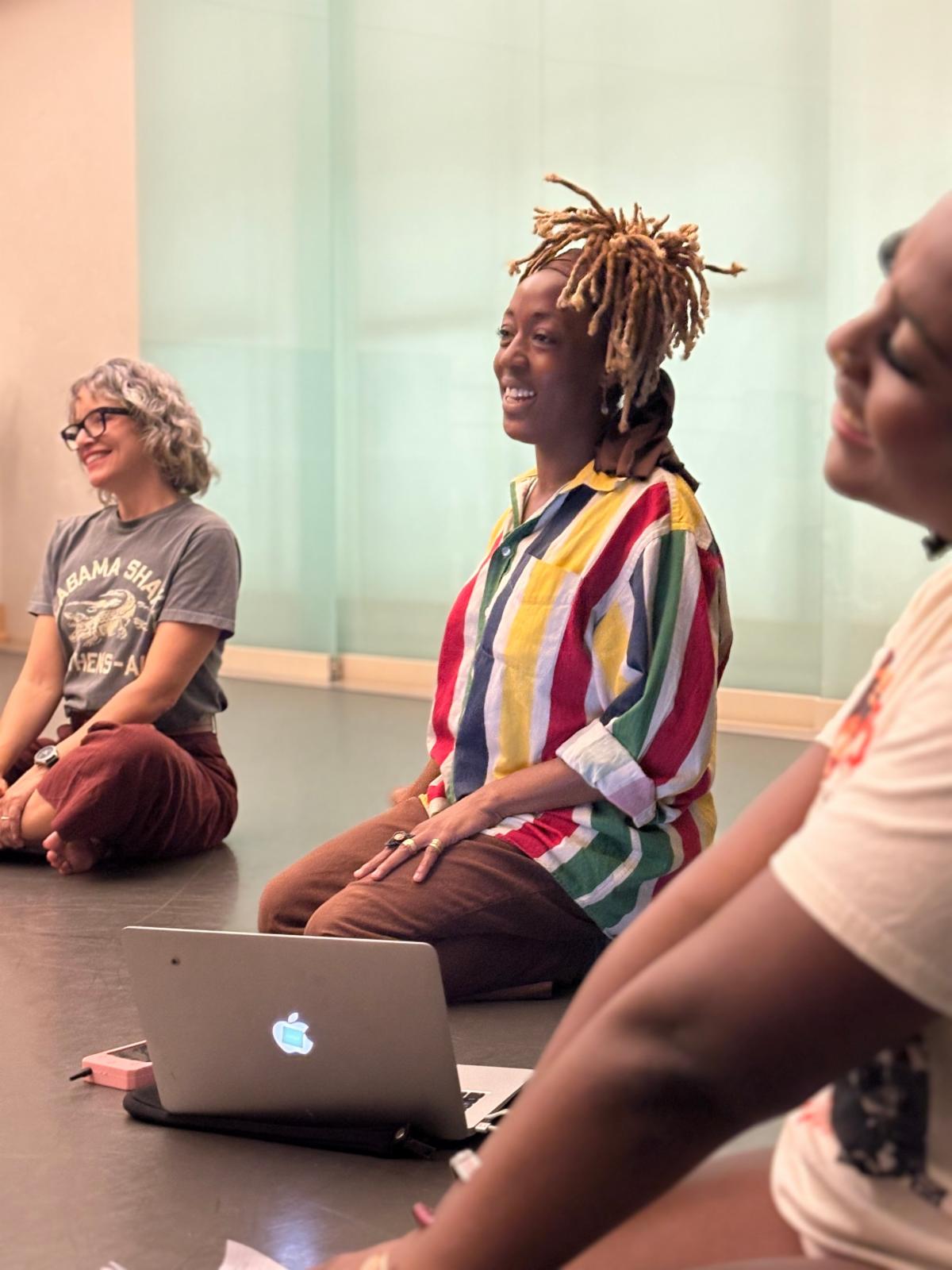
Photographic Archive | | Lecturer Marta Valier looking over student's story board project. Photo by VAPAE staff. | | This new AE 101 class is helping students explore the possibilities of working with comics, illustrations, and photography to mark memory and create personal archives. Students are working on memory pieces that will evolve into fully developed midterm projects and presentations. This past week, Lecturer Marta Valier and Teaching Associate Ashley Hannah looked through and responded to story boards their students have been developing. | | AE 101: Strategies for Facilitation: Body & Voice Awareness for Teaching & Public Speaking | | Guest Speaker Mylove West visited AE 101 to lead a workshop. Photo by VAPAE staff. | | |
AE 101 welcomed Imani West, an accomplished actor and vocal coach whose training at the David Geffen School of Drama at Yale University underpins a deeply resonant and grounded approach to performance. Their practice merges rigorous craft with a fierce commitment to authenticity and presence.
In their workshop, Imani brought their expertise in voice, articulation, and scansion into an interactive experience designed to help students discover their own supported, resonating vocal instrument. Through exercises that emphasized breath support, rhythm of speech, and physical embodiment of sound, participants were guided to find and occupy space — to speak with clarity, intention, and weight.
What made the session particularly powerful was its balance of technique and freedom: students practiced scansion and vocal clarity, then moved into expressing their own personalized writings and space-taking. Imani’s warm yet exacting style created a safe environment for risk, encouraging each voice to claim its full complex dimension. The result: many voices in the room shifted from timid to full-bodied, from tentative to resonant.
In short, Imani West didn't just teach ‘how to speak’, they helped our UCLA students be heard.
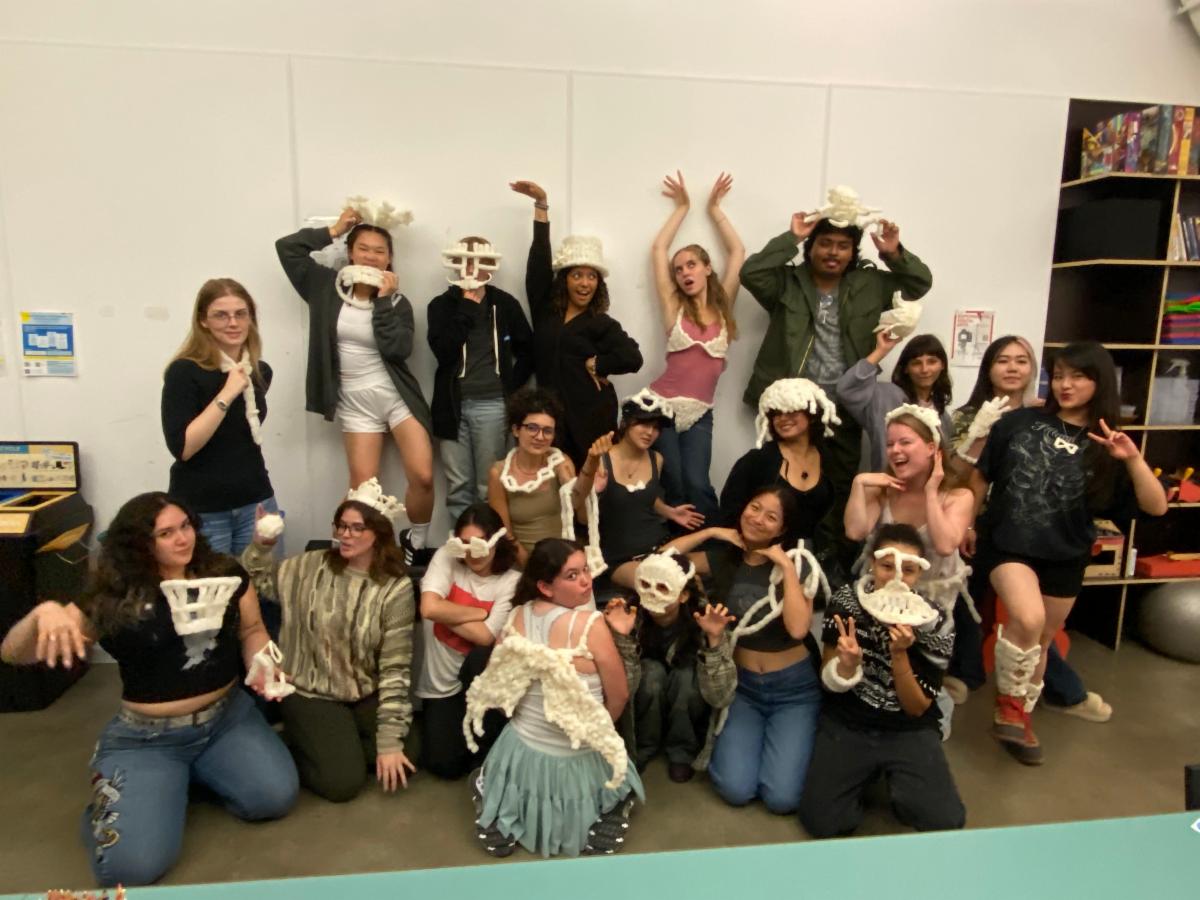
| | AE M102: Introduction to Arts Education for Multiple Publics: History, Theory & Practice | | AE M102 students modeling their wearable art made with packing peanuts. Photo by VAPAE staff. | | |
In Arts Ed M102, they have built a strong, community arts collective, through cultivating their creativity and reflecting on their personal art educational journeys, while also expanding their knowledge of educational theories for multiple publics. This dynamic group of talented artists have engaged in synthesizing the concepts presented in class discussions, readings, and podcasts to create original, exquisite works of art supported by culturally responsive journaling.
During week two, artists established community agreements and returned to the element of play, tapping into their imagination and freedom of expression, while listening to songs like “Vogue” from Madonna. They designed fun, one of a kind wearable art using packing peanuts.
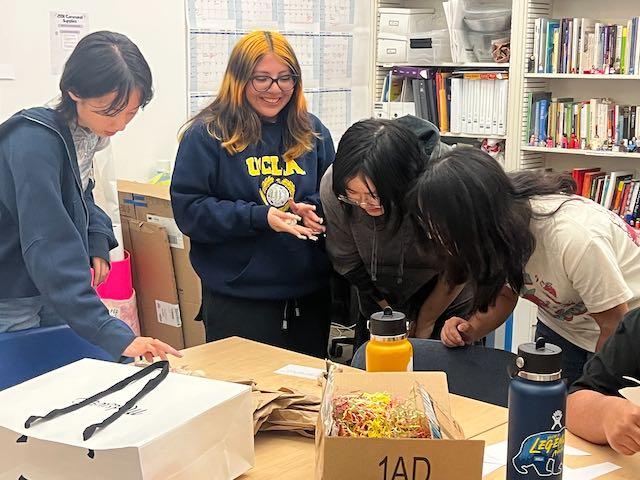
| | AE M192: Arts Education Teaching Practicum: Preparation, Observation, and Practice | | AE M192 students looking at their peer's friendly monsters pieces made in class. Photo by VAPAE staff. | | Teaching Assistant Kate Stone led the class in a workshop on "Hands-On Arts Education in Museum Spaces" featuring the work of artist Otani Workshop. Students created their own friendly monsters using a variety of materials while considering what it means to teach students in museum spaces and other cultural institutions. | | VAPAE relies on and is grateful for any and all support to help us maintain our mission to train the next generation of teaching artists and provide quality arts education to Title I schools throughout Los Angeles. Any amount is appreciated to help our program thrive. Check out our Giving Page to learn more. | | | | |