|
This Week's Contents
(scroll to see the full content of each article; you can click the cup below to compensate the writers)
| | |
Angelio Batle,
"REsurrection Lesson"
| |
Takahiko Hayashi,
"Breath of Life, Breath of Line"
| |
“Forecast Form: Art in the
Caribbean Diaspora, 1990s–Today"
| |
Please consider our sponsoring venues |
|
|
Angelio Batle, "REsurrection Lesson"
by DeWitt Cheng
| |
|
SFartsED Gallery, San Francisco, California
Continuing through June 29, 2024
Angelio Batle spent his childhood in Guam, absorbing that tropical island’s milieu. There were the jungle and rusted relics of the recent war, and the culture of the native Chamorro people, which combined with his family’s Philippine Catholicism. These influences toward the eclectic, idiosyncratic and personal religion of artmaking, one that many transcultural, transnational artists adopt. Batle placed his recumbent figure, a contemporary transi (a medieval carved skeleton tomb sculpture, a reminder of our transience) atop a vibrating bed sheeted with white mylar film. The oscillating skeleton would mark the mylar and gradually create a self-portrait. The graphite body would eventually vanish with use, to be replaced by self-generated likenesses, just as carbon-based life forms decay and metamorphose into, say, lead pencils, you and me.
|
|
|
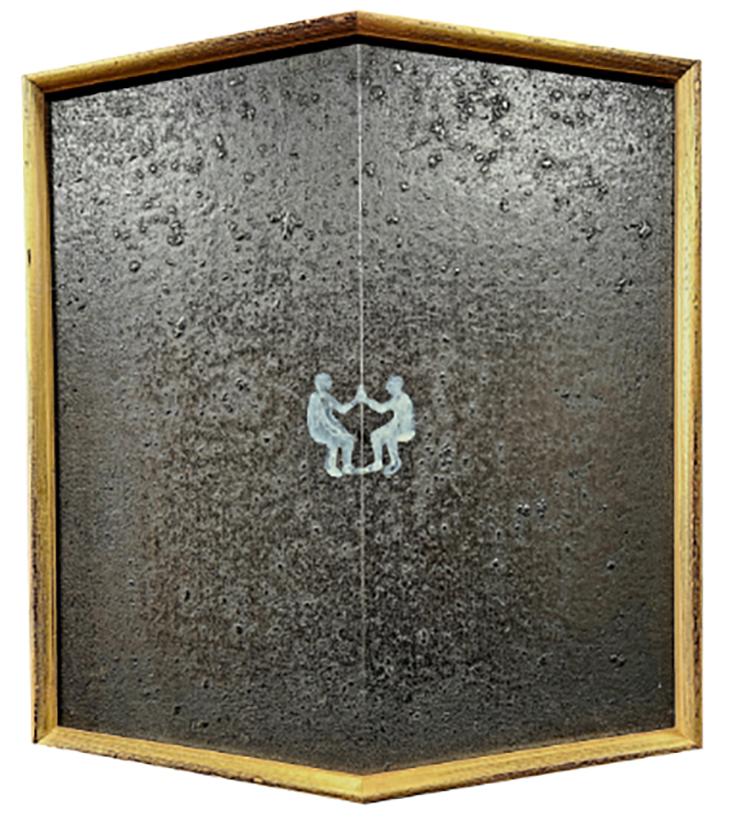
Angelio Batle, “Seated / Mirror,”
2024, graphite and acrylic on wood, 14 x 12”
| |
|
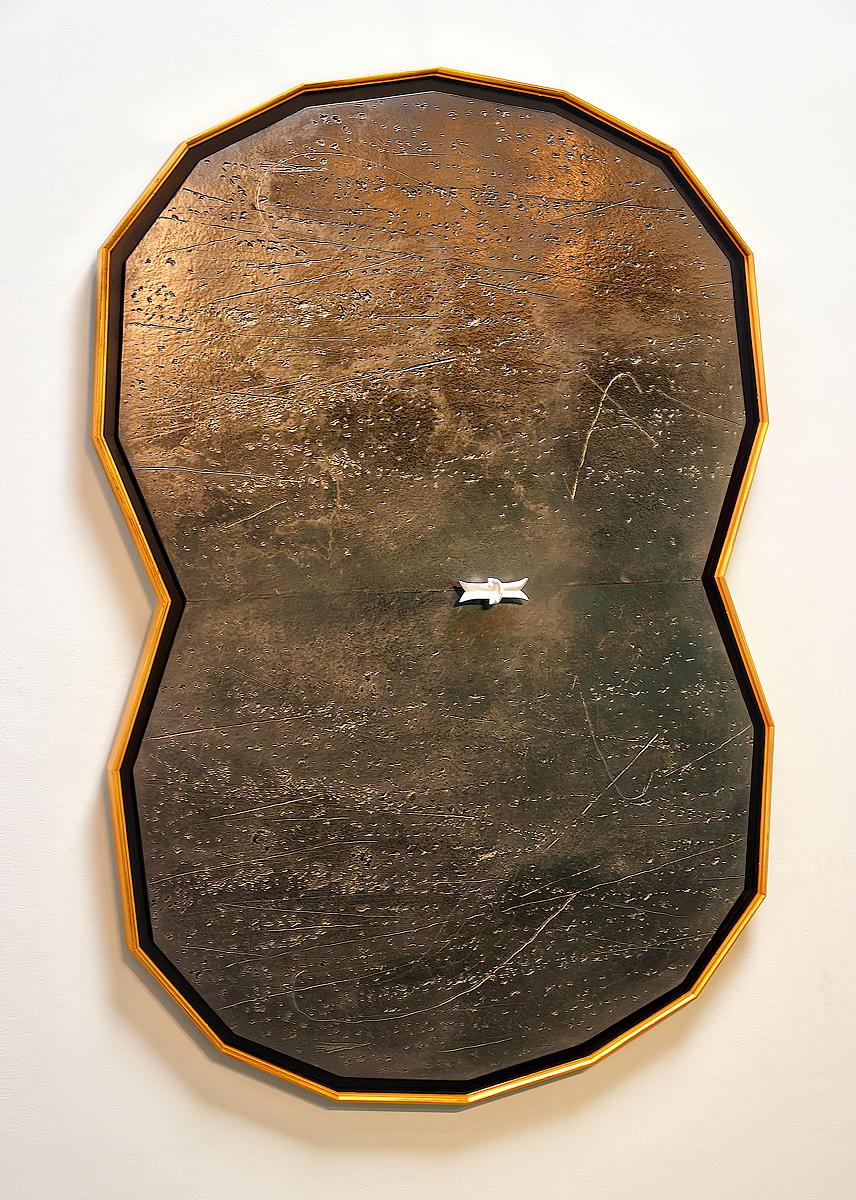
Angelio Batle, “Between Meteor Fields,”
2024, graphite on plywood, 60 x 42”
| |
All images courtesy of STatsED Gallery, San Francisco | |
|
Batle has used his mastery of cast graphite to create elegant, poetically charged sculptures of animal and plant life, including cast versions of his hand posed as if signing a touchscreen (a nod to M.C. Escher’s 1948 lithograph, “Drawing Hands”). There are shells, leaves, antlers, horses, dragonflies, rabbits, snakes, butterflies, and owls, each accompanied by brief summations of their symbolic uses in various cultures. The artist’s love of the natural world combines with his feeling for materials and materiality and a conceptual outlook that was inculcated working with ceramics in graduate school. His current approach has grown more sensuous and associative, less word-bound. Explains Batle, “The act of making marks lures ideas into the physical world. Hands perceive and reveal things that our eyes and conscious minds may never know … It's not the pencil that draws, but your hand.”
“REsurrection Lesson” includes approximately thirty graphite wall pieces, most made during 2024, and extends his impressive NEA residency show at the same gallery last summer. The title may refer to Christ’s rising from the tomb, or, more broadly, to the idea that nothing is lost in nature, that the constituent elements of matter are recombined and changed into other forms, like the graphite laid down during the Carboniferous Period more than three hundred million years ago. All the pieces are in graphite on plywood substrates, with the smaller ones displayed within thin gold frames Others, larger and unframed, are set atop wall-mounted shelves, and most feature carved and punctured surfaces that serve as rich backgrounds to the painted or ‘drawn’ (with a router bit) imagery. The rich, burnished slaty surfaces are particularly handsome in contrast to the blobs of resin, powdered with gold dust, that seep out from the drilled apertures, suggesting sap extruded from trees, or, in a more mythological or religious vein, exudations from weeping wounds. The square-format tablets suggest icons or relics from some forgotten past, excavated and battered but obdurate, bearing their obscure messages and images in an invented cuneiform.
| | |
|
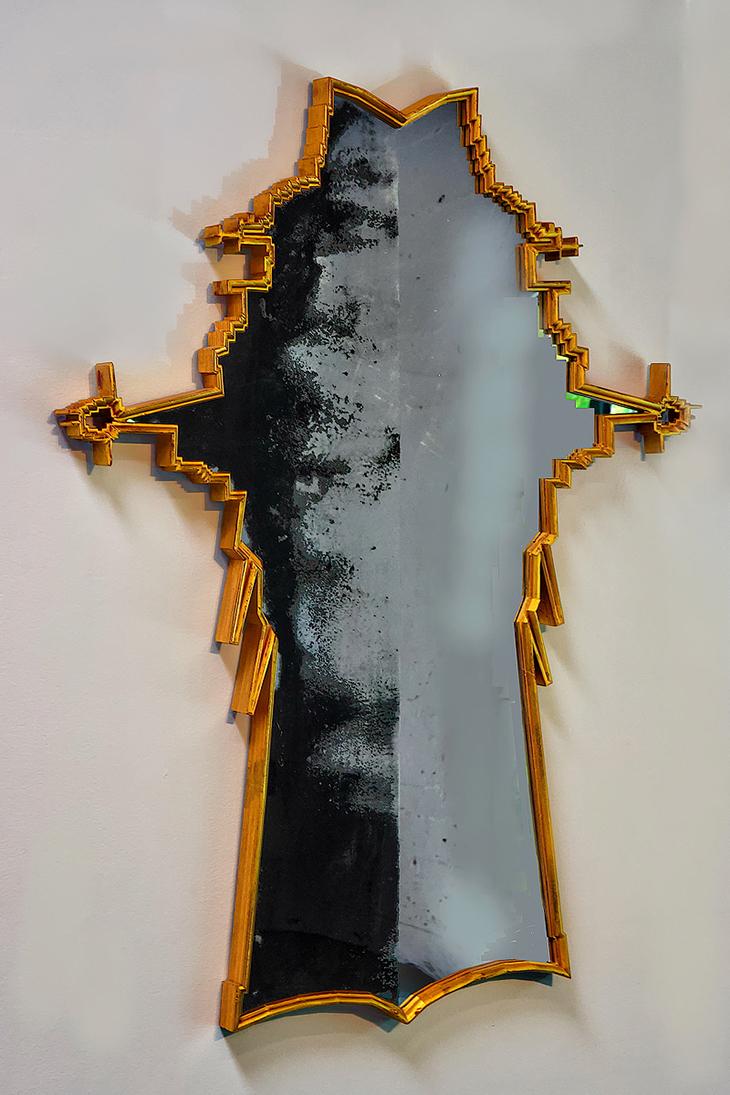
Angelio Batle, “USS Texas / Monster,”
2023, mirror in gold frame, 48 x 38”
| |
|
The mute, weathered artifacts display stoicism and perseverance without melodrama. They are mysterious and dignified, sometimes with an element of humor. The artist’s ideas derive not from words and theories but from working with materials with a what-if spirit of inquiry and experimentation. Batle remarked in an interview that carving is for him like drawing, and he works without preconceptions in complete freedom.
The themes of doubling, multiples, and mirrors appear throughout. In the five “Mirror” plaques, small pale silhouetted figures are reflected and reversed across vertical mirror edges or horizontal water-surface axes, and the oddly shaped frames. Conjoined trapezoids, instead of rectangles, suggest hinged rotating planes or folding screens. The twinning idea drives two of the larger pieces as well. “Between Meteor Fields,” with its solitary illuminated boatman at night that is mirrored in the dark water fading indiscernibly into the dark sky, are both framed within decagons hinged like oyster shells. “USS Texas/Monster” is a mirror made in the shape of the only battleship to have served in all of World War II’s amphibious landings. Doubled and rotated, it reads as a serviceable humanoid or robot; it is also a salute to the artist’s father, a Navy mechanic who during the 1950s tended the engines beneath various ships’ waterlines.
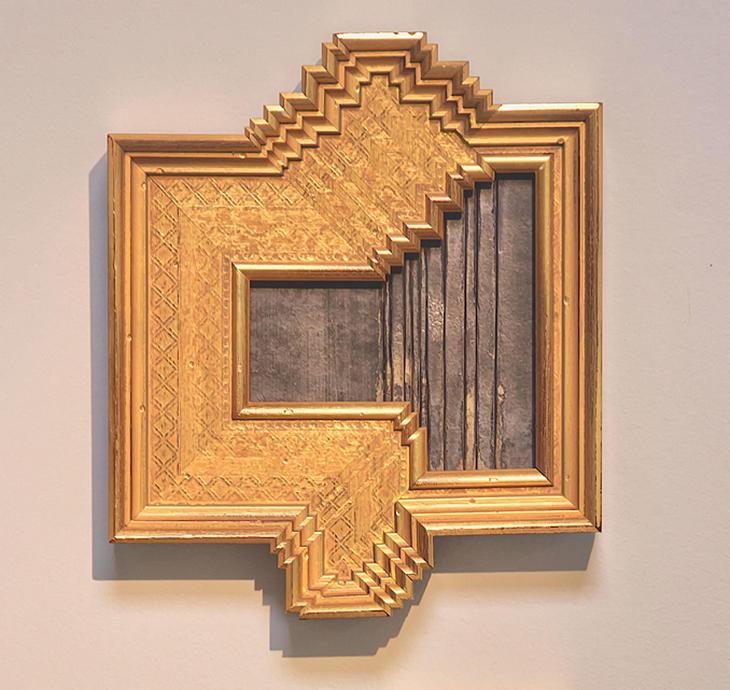
Two “Ruptured Frame” assemblages from 2023 employ gold picture frame molding in an original and satisfying way. Batle decided on the irregular external shape of the pieces, and then meticulously cut and glued the interior elements, working in toward the center, segment by segment. The oddball shapes suggest San Francisco’s Victorian houses, with their bay windows and mitered corners. The ornamental patterns stamped into the molding stock and created by the artist’s saw-cut edges evoke a vanished era of gilt elegance. The pieces’ apertures (or mat windows) composed of darker wood suggest redwood-paneled rooms and stair steps down into pictorial depth.
| | |
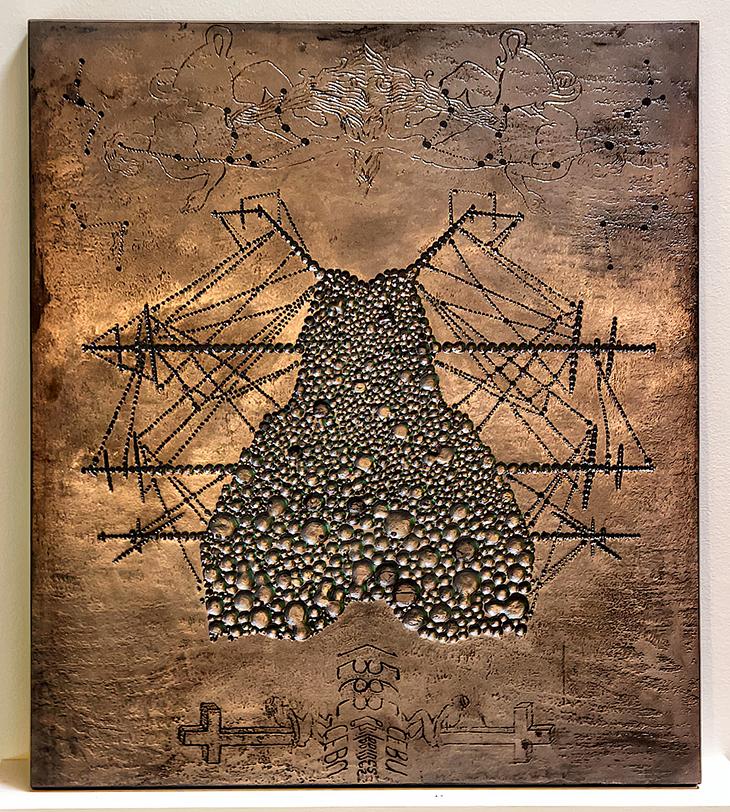
While most of the drilled works are ahistorical, two of the larger ones evoke Philippine history. “1988 Dewey’s USS Olympia” presents the flagship of Commodore Dewey during the Spanish-American War (in which the United States took the Philippines from Spain) as a doubled and rotated silhouette of the cruiser, its outline delineated by drill-bit craters or bullet holes. It also resembles a bead-encrusted gown, albeit one accessorized with smokestacks and antennae. “1565 Legaspi’s Spider Galleon” alludes to the fleet commanded by Miguel López de Legaspi to seize control of the Philippines for Spain, inaugurating the “Manila galleon” trade in spices, porcelain, and slaves between Manila and Acapulco. In Batle’s version, the galleon is doubled and rotated, forming another triangular costume form, with the masts and rigging suggesting spider webs and fatal entanglements. |
|
Angelio Batle, “Ruptured Frame 2,” 2023, gold frame, graphite, wood, 12 x 12” | | |
|
Related to the doubling/reflection idea is that of rotation, which results in multiple views of single figures. Examples include “Squatters, (with gold),” “Ate [sister] Sweeping,” and Self-Portrait Whirling (with gold),” and the isolated heads of grandfather or grandmother — “Lola’s Head (with gold),” “Lolo Speaking (with gold,” “Lolo’s Head (with gold”).
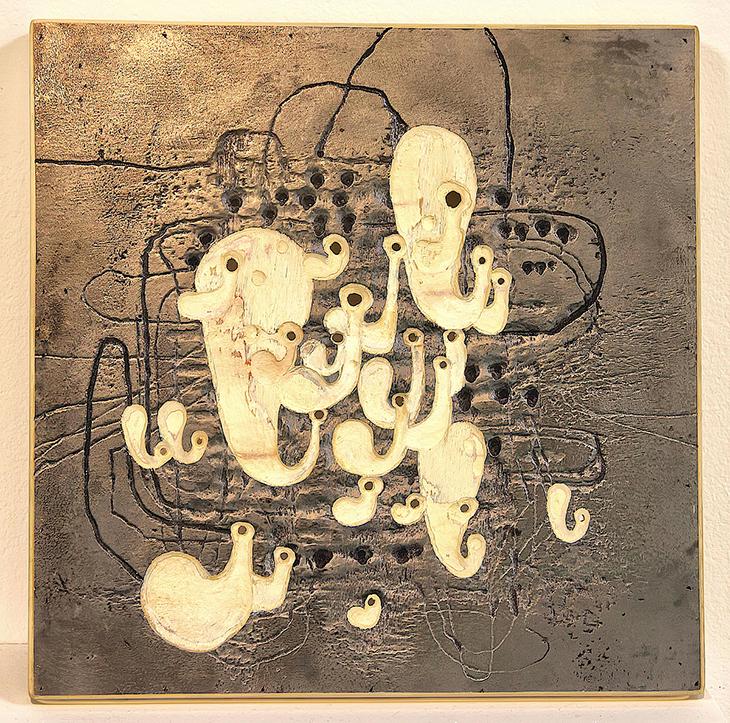
More abstract are “Fertile Field (with gold)” and “Fertile Field 2 (with gold),” both without obvious subject matter but still compellingly mysterious: excavated earth, with gold nuggets, perhaps; and the four Vapour pieces, “Reversing Vapours,” “Seventeen Vapours,” “Eighteen Vapours,” and “Vapours Talking,” featuring oblong biomorphic forms resembling fungi, caption balloons or cartoon ghosts.
| |
|
Angelio Batle, “1565 Legazpi’s Spider Galleon,”
2024, graphite on plywood, 31 x 36”
| |
|
Angelio Batle, “Reversing Vapours,”
2024, graphite on plywood, 12 x 12”
| |
An earlier work, “Ash Dancer” (2016), was a tour de force of a human skeleton, with every bone made from cast graphite mixed with resin, and silicone strings serving as ligaments. Batle’s father had recently died, and the artist considered the dark, shiny sculpture to be a symbol of mortality and a surrogate for fathers, sons, and the march of generations. While it would be hard for Batle to top “Ash Dancer” for audacity and invention, the new carved graphite works open up new territory to this virtuosic and intrepid explorer, who is so adept at putting everyday materials at the service of the invisible. | | |
|
DeWitt Cheng is an art writer/critic based in the San Francisco Bay Area. He has written for more than twenty years for regional and national publications, in print and online, He has written dozens of catalogue essays for artists, galleries and museums, and is the author of “Inside Out: The Paintings of William Harsh.” In addition, he served as the curator at Stanford Art Spaces from 2013 to 2016, and later Peninsula Museum of Art, from 2017 to 2020. | |
|
Takahiko Hiyashi, "Breath of Life, Breath of Line”
by Matthew Kangas
| |
|
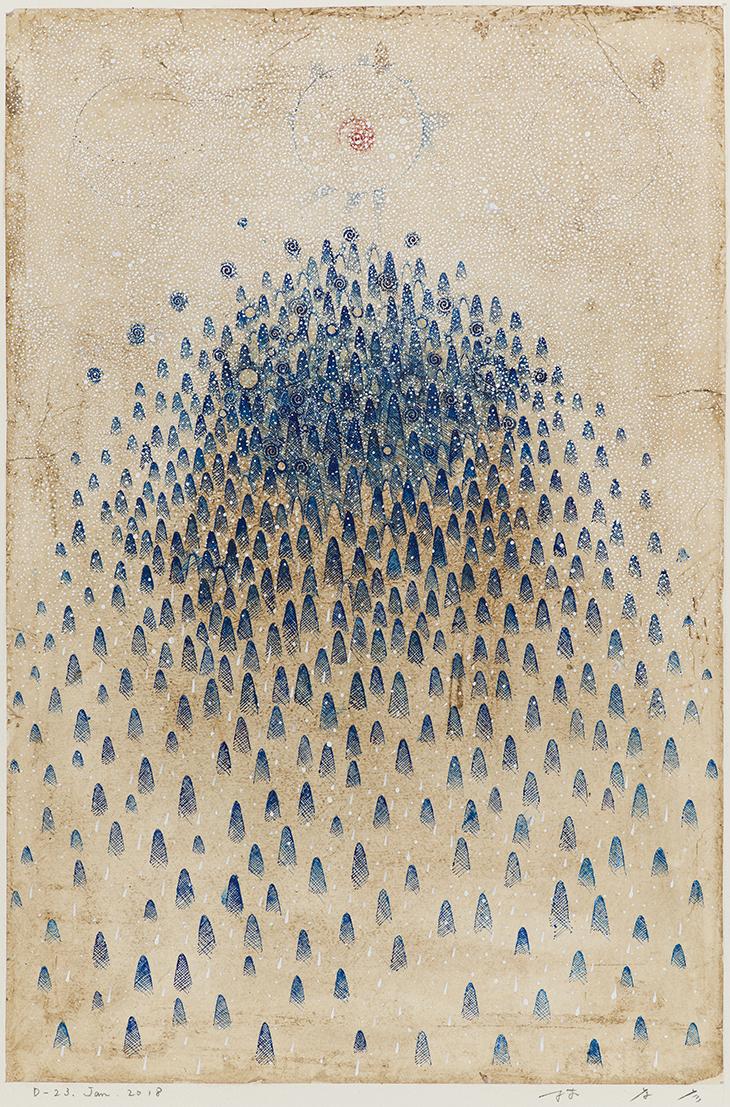
Takahiko Hayashi, “D-23. JAN 1018,” 2018, pigment
acrylic ink, original emulsion base on Gampi paper
mounted on Hahnemühle cotton rag, 16 1/2 x 11”.
All images courtesy of Froelick Gallery, Portland
| |
|
Froelick Gallery, Portland, Oregon
Continuing through July 13, 2024
The prominent Japanese printmaker Takahiko Hayashi continues to extend the parameters of traditional printmaking by etching, gluing, collaging, painting and otherwise expanding strict limits of paper size, printing techniques and impression methods. Not really multiples, each of Hayashi’s works has a different image, although all relate to the 63-year-old artist’s current theme of “Breath of Life, Breath of Line” with their puffs of color and air mixed with meandering and zigzagging lines surrounding and overlaying central, ghostly forms. Paper size and edges vary throughout to keep the eye moving as Hayashi repeatedly employs his strict palette of red, blue, green and black. This pushes the entire body of work towards being a serial suite, but always skirts this in favor of individual configurations of bubbles and lines.
The gallery is filled with flat and drooping handmade sheets of paper and parchment that are alternately inscribed, pooled with puddles of ink, and rubbed with pigmented acrylic. One feels the touch of the master’s hand, but what else is there? Apart from a technical prowess that often suffices for avid print collectors and the professional eye of curators, what is it that pushes Hayashi’s considerable studio abilities into the realm of art? Just as the other crafts — pottery, weaving, glass, and wood — have had to make their case for fine art status, it is fair to ask the same question of Hayashi’s particular form of printmaking. Although his statements have rigorously disclaimed interest in the current contemporary art scene with all its fickle vagaries, he vows an interest in the wider world as well as reflection on an unknowable future.
| |
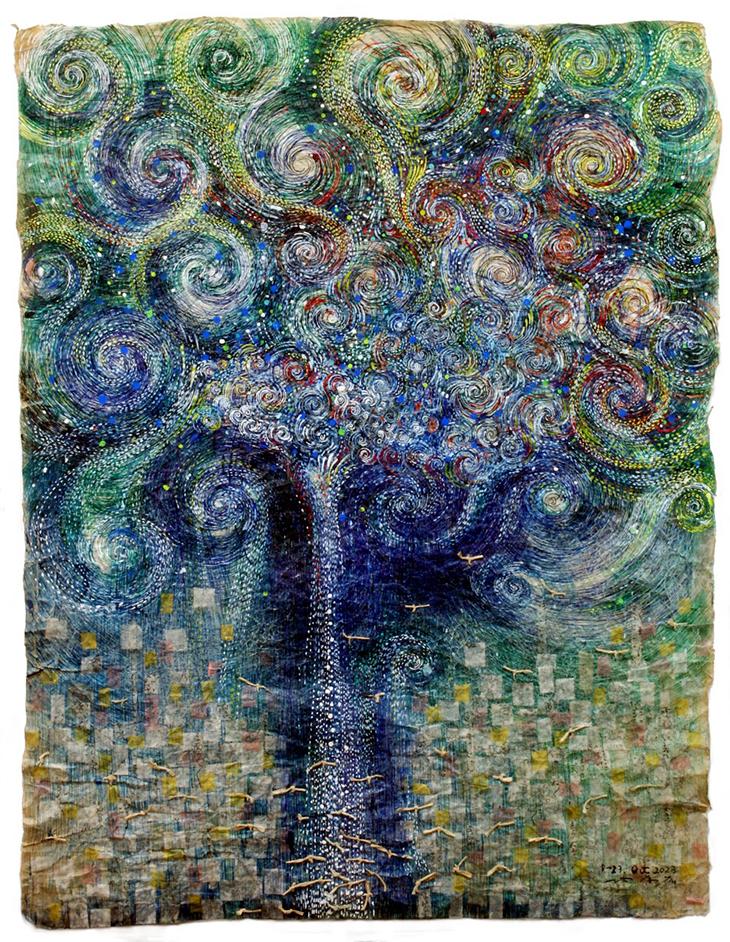
Gazing closely, the attentive viewer can unravel or unveil both identifiable imagery and deeper content, key to claiming aesthetic status for the crafts. Hayashi convincingly asserts that the image is the unformed or hidden human figure. For instance, “P-21 JAN 2024” features a central red figure covered with bursting red bubbles of energy while rising lines explode from the “head.” Similarly, two images exist simultaneously in “D-23 OCT 2023,” a tree with branches spiraling above and a darkened blue head below, just above its trunk. |
|
|
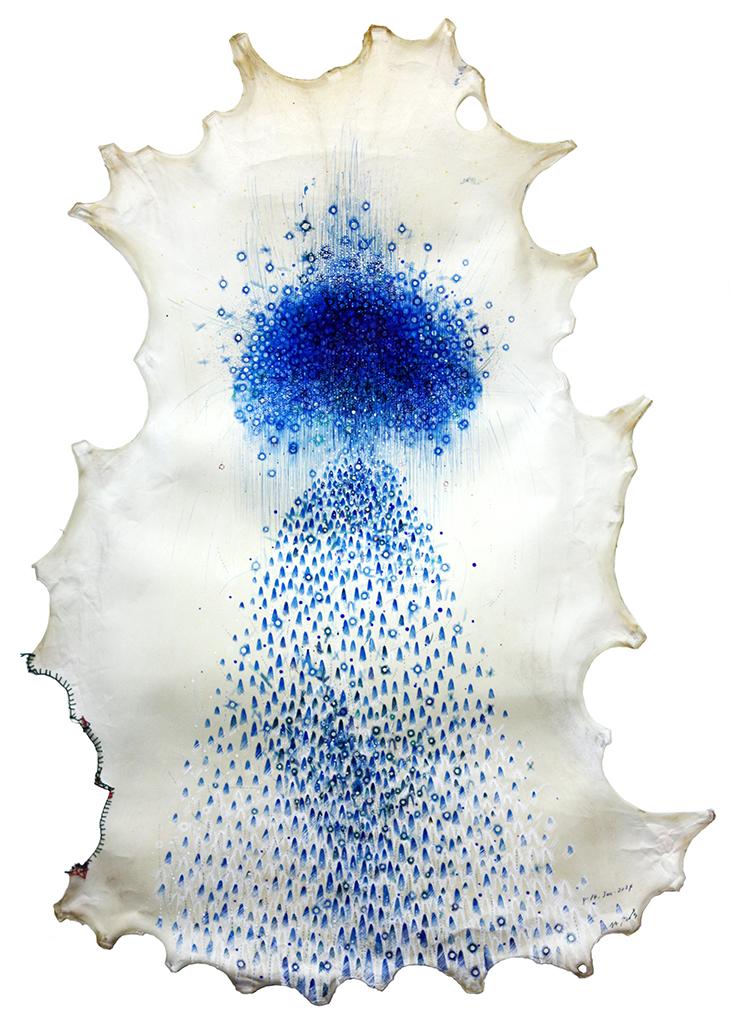
Takahiko Hayashi, “P-14. JAN 2024,”
2004, acrylic ink on parchment, 47 x 32 1/4”
| |
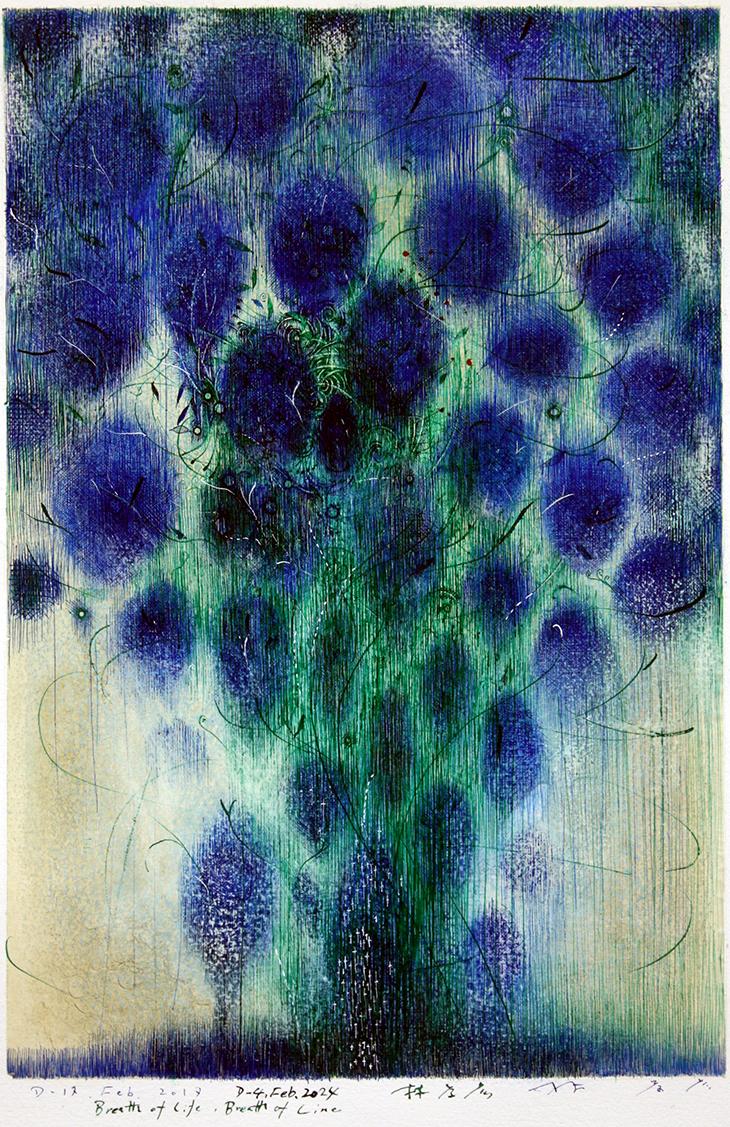
Takahiko Hayashi, “D-4. FEB 2024, Breath of Life, Breath of Line,” 2024, acrylic ink on Gampi paper mounted on cotton rag, 16 3/4 x 11” | | |
Landscape is also a predominant theme, even going so far as to suggest an endangered nature from climate change or the residue of nuclear fallout. This is most evident in “D-11 MAR 2024,” “D-22 JAN 2024 Things to be Unleashed,” and “D-6 FEB 2024 Dropping White Dots,” with their unmistakable mushroom clouds. Four tiny (seven-by-four-inch) copperplate etchings extend the bulging upper shape of the nuclear blast into four colors, brown, green, blue and yellow with an earthy brown base and ascending black shapes like birds — or souls of the dead. |
|
|
Nature, philosophy and religion are all intertwined in Japanese culture, a heady source Hayashi feeds on in provocative and beautifully appealing works like “P-12 DEC 2023,” with its blue energy dots exploding off the irregularly edged parchment page, and the exhibit title piece, “D-4 FEB 2024 Breath of Life, Breath of Line.” Blue, green and black balloons of color rise from the earth, extending into a troubled world to release stores of energy and globular spurts of life-giving breath. Another torn-edge work, “P-14 JAN 2024” resembles an animal skin with its white background. An upper blue blob hovers over a scattering of smaller blue dots. Energy is expended, but is it global warming or a process of enhancing and cooling, remediating climate change? Ambiguous, like all the others, we are free to contemplate each work or leave such questions unanswered.
Darkest of all, with its eyes and faces staring out at us from a blue and gold ground covered in dots and scratches, “P-28 AUG 2023” is another truncated parchment fragment. But at nearly three feet in height, it commands close inspection and acts as a shield or haunting emblem for the entirety of the show.
Hayashi has created an astoundingly varied body of work, all the while maintaining limits of size, color, surface, image and meaning that vibrate back and forth between philosophical questions and exquisite material execution.
| |
|
Takahiko Hayashi, “S-23. OCT 2023,” 2023, acrylic,
original emulsion base, Sukijimai Gampi paper, 25 1/2 x 19 3/4”
| | |
|
Matthew Kangas writes regularly for Visual Art Source eNewsletter; Ceramics: Art & Perception (Australia); and Preview (Canada). Besides reviewing for many years at Art in America, American Craft, Art Ltd., Vanguard and Seattle Times, he is the author of numerous catalogs and monographs, the latest being the award-winning Italo Scanga 1932-2001. Four anthologies of his critical essays, reviews and interviews were issued by Midmarch Arts Press (New York) and available on Amazon at Books by Matthew Kangas. | |
|
“Forecast Form: Art in the Caribbean Diaspora, 1990s–Today"
by Liz Goldner
| |
|
Museum of Contemporary Art San Diego (MCASD), La Jolla, California
Continuing Through July 28, 2024
“Forecast Form: Art in the Caribbean Diaspora, 1990s-Today” explores the work of 27 artists native to the Caribbean islands, with several now living elsewhere. They are of African, Indian, and Arab descent and address in their art issues of colonialism, migration, and race, while generally depicting the underside of Caribbean life.
The exhibition’s bellwether is the 1990s global, social, and political evolution and the concurrent emergence of multiculturalism. These ongoing developments continue to challenge our stereotyped notion of Caribbean culture as an exotic tropical paradise, serving mainly tourists and the very wealthy.
| |
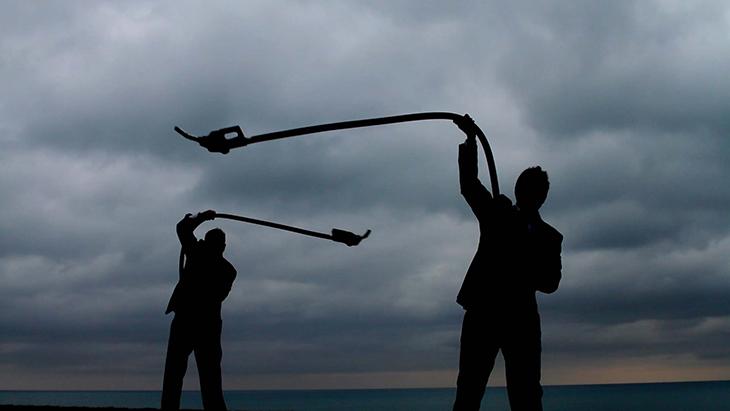
Christopher Cozier, “Gas Men,” 2014. All images courtesy of the Museum of Contemporary Art San Diego (MCASD) | |
|
“Forecast” refers to the island weather, which can become violent at a moment’s notice. It looks back to the earlier centuries of slave masters and their descendants. “Forecast” is also a metaphor for the island artists’ constantly shifting and exploratory approaches to their creativity, as expressed by the many conceptually speculative and emotionally defiant pieces on display. “Diaspora” refers to the artists and their ancestors’ dispersion from their homelands. More subjectively, the term refers to the artists’ evolving states of mind, in which they imaginatively transform and empower their previously subjugated personas in response to the legacy of slavery and abuse.
A dystopian vision triggered by the exhibition is the 2017 image of our then-President brazenly throwing paper towels into a crowd of Puerto Ricans in the aftermath of Hurricane Maria, which devastated their island that year. This image of a powerful white supremacist humiliating the Caribbean nation and its residents, 3,000 of whom eventually died from Maria’s effects, serves as the central metaphor for this exhibition. Curator Carla Acevedo-Yates (born in Puerto Rico) explains, “I was thinking a lot about the weather after Hurricane Maria; all the histories of pillage and colonialism came to light so much more because of the environmental destruction that happened there.”
|
|
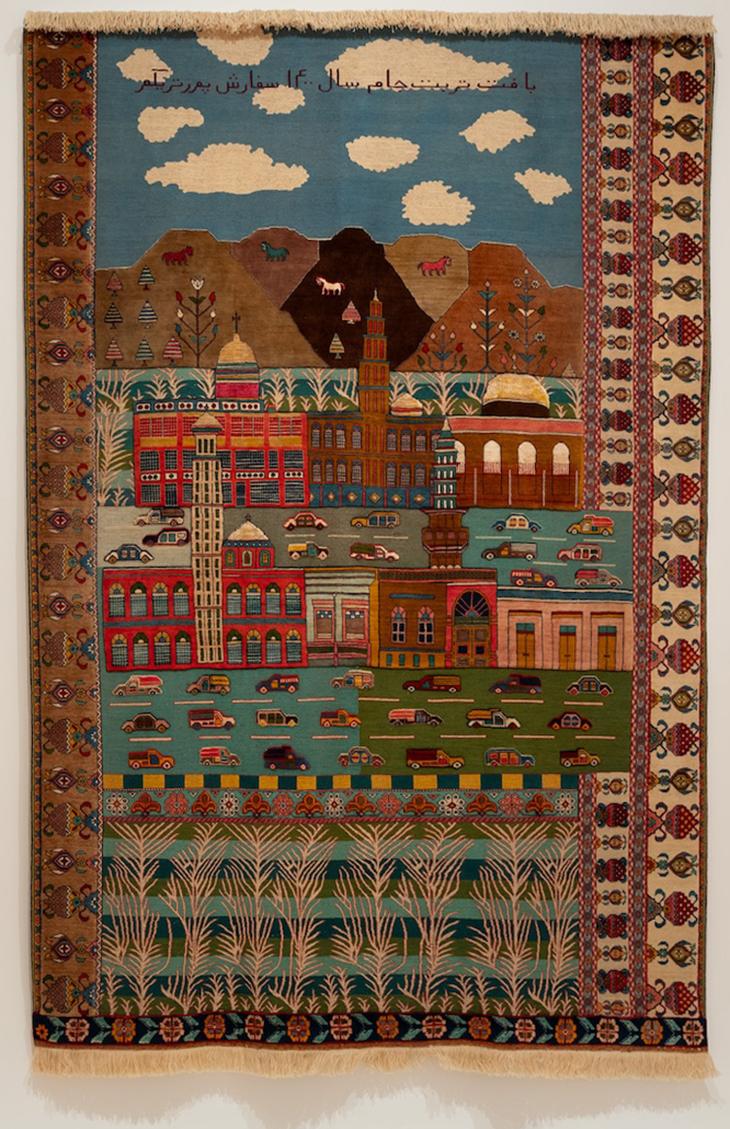
Alia Farid, “Mezquitas de Puerto Rico,” 2022 | |
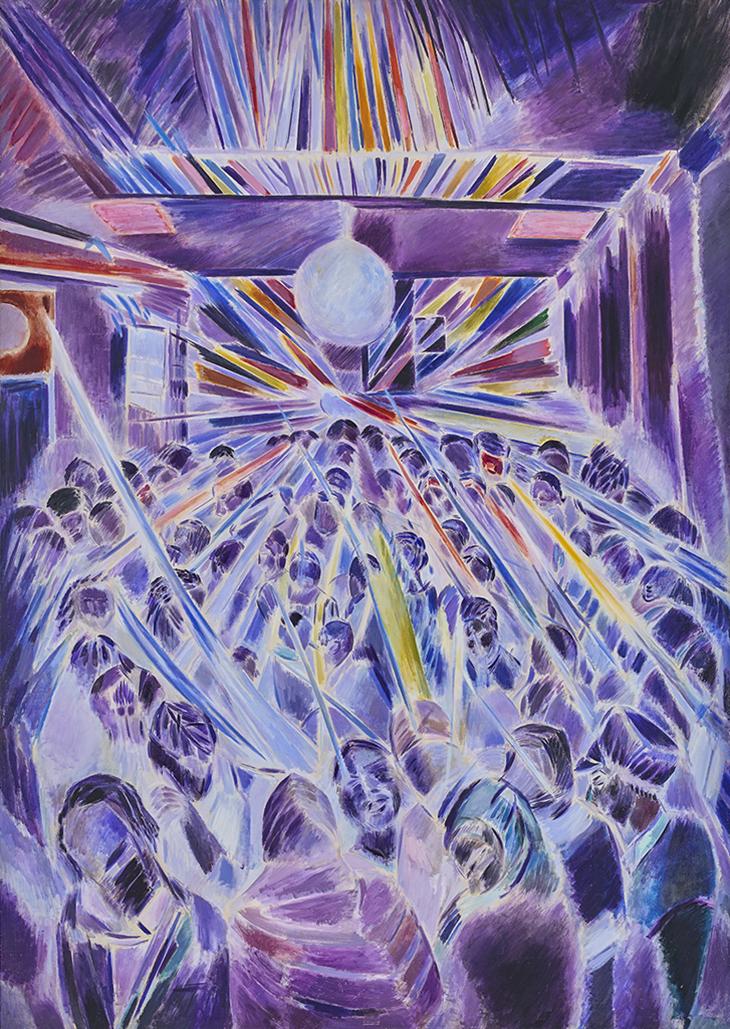
Denzil Forrester, “Night Strobe,” 1985 | |
|
Similar in style and intensity to the paper towel scenario are Christopher Cozier’s two videos, “Gas Men” (2014) and “Dem things does bit too?” (2014-15). Both address the impact of oil extraction, conditions derived from centuries of colonial rule and enslavement, forced labor, and corrupt politics in Trinidad. In the first video, two businessmen spin gas pump nozzles above their heads, mimicking the actions of movie star cowboys. In the second video, the two men point the nozzles at each other, expressing patriarchal violence.
Other artists in the exhibition also address violence, exposing it, railing against it, striving to eradicate it through their artistry. Joscelyn Gardner’s “Creole Portraits III: bringing down the flowers” (2009-11) is a collection of 13 portraits of faceless and enslaved Afro-Caribbean women, each piece composed of braided hair, a slave collar, and plants that induce abortion. These are based on the derisive content in English plantation owner/slave overseer Thomas Thistlewood’s diaries, which detail his thousands of acts of rape and sexual assault on immigrants who were hauled into Jamaica during the 18th century. The supposedly abortion-inducing plants serve as the works’ titles.
|
|
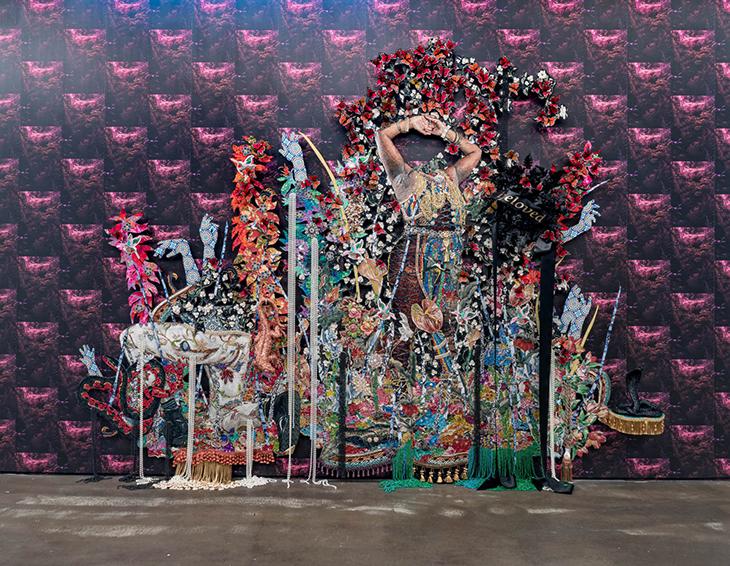
Ebony G. Patterson, “the wailing . . . guides us home . . . and there is a bellying on the land,” 2021 | |
|
Other artists in the exhibition also address violence, exposing it, railing against it, striving to eradicate it through their artistry. Joscelyn Gardner’s “Creole Portraits III: bringing down the flowers” (2009-11) is a collection of 13 portraits of faceless and enslaved Afro-Caribbean women, each piece composed of braided hair, a slave collar, and plants that induce abortion. These are based on the derisive content in English plantation owner/slave overseer Thomas Thistlewood’s diaries, which detail his thousands of acts of rape and sexual assault on immigrants who were hauled into Jamaica during the 18th century. The supposedly abortion-inducing plants serve as the works’ titles.
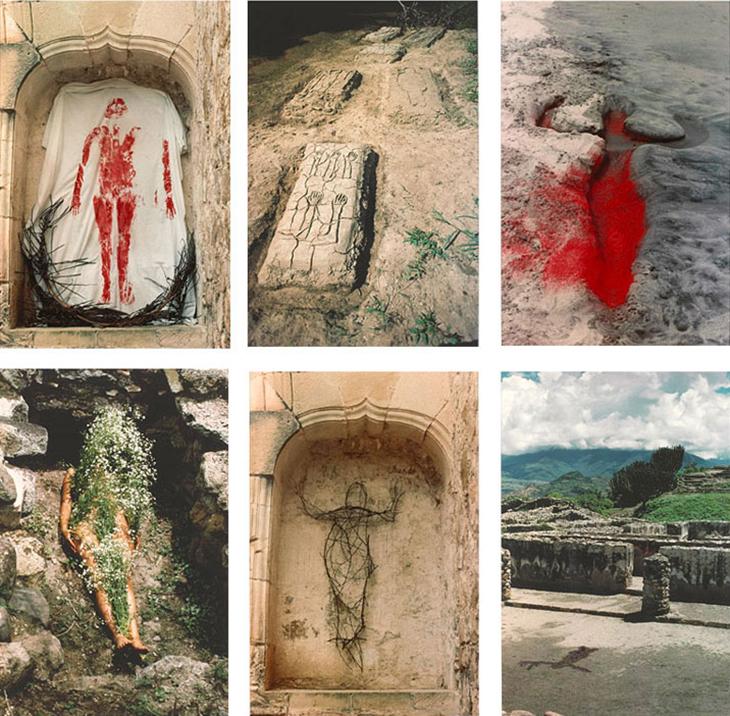
Cuban-born artist Ana Mendieta was exiled to the United States, where she grew up in foster homes. She explored violence, exile, identity, and belonging, often including her own naked body in ways that eerily foretold her notorious death at age 36.
|
|
Ana Mendieta, “Silueta Works in Mexico,” 1973-77 | |
|
Several photographs from her series “Untitled: Silueta Series, Mexico” (1993-1977) are woven throughout this show rather than installed as a group. They serve as periodic reminders within the larger context. The first image is of the impression of Mendieta’s body at the shore as it is about to be engulfed by the incoming tide, symbolic of a dissolving, fragmented identity. Later in the show another photo features a wooden frame, in a shape echoing her body, engulfed by fireworks.
Ebony G. Patterson’s “the wailing . . . guides us home . . . and there is a bellying on the land” (2021) is a large woven tapestry. Depicting the garden as a site of burial, renewal and transformation while conveying a simultaneous sense of beauty and violence, the artist employs beads, glitter, flower appliqués and other elements in creating a wildly attractive installation. It sardonically displays a headless woman, her hands held in the air, with a plant between her shoulders. The many monarch butterflies (an endangered species) in the piece represent the homeless, wandering black body.
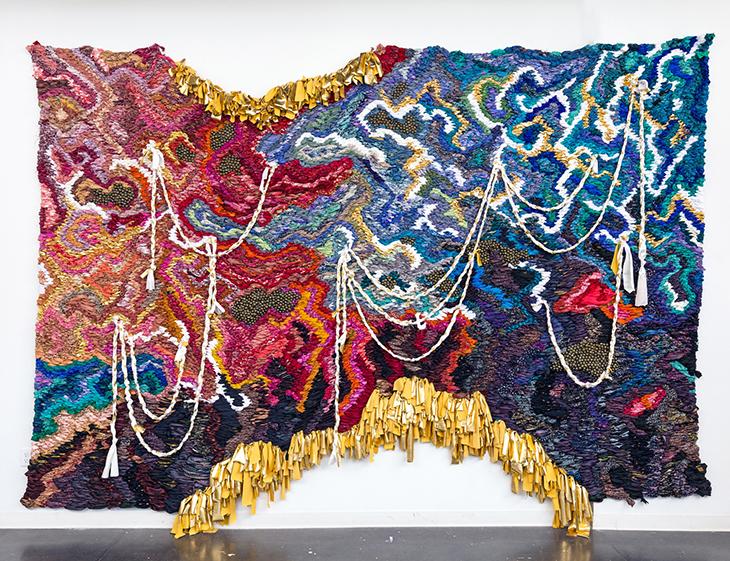
Yet all is not dark and foreboding in this exhibition. One of the more lyrical pieces is Suchitra Mattai’s “An Ocean Cradle” (2022). A Guyanan of Indian heritage, her large oceanic landscape wall hanging, woven from many vintage handmade saris, reflects physical movement across the oceans and empathetic movement across lineages. As saris are passed down from Indian families over generations, they carry memories of ancestors, often retaining their scents or perfume and spice. It is a magnificent object, one that metaphorically connects countless female descendants from the South Asian diaspora. It elevates female attire and domestic labor in the grand feminist aesthetic tradition.
|
|
Suchitra Mattai, “An Ocean Cradle,” 2022 | |
|
Alia Farid’s “Mezquitas de Puerto Rico (Hatillo)” (2014), a large prayer rug, illustrates mosques and other buildings that have migrated in style and form from the Arab world to that of the Caribbean. With these and other rich detailing, the tapestry imparts a message of shared histories, while conveying Latin American and Arab solidarity against colonialism. The colorful rug also contains sites of communal gathering, buildings from towns in Farid’s homeland of Kuwait, rolling hills, and rows of passing cars. The artist shared her initial design with women in Iran, who then provided their own patterns that were incorporated into the rug while weaving it, including the addition of intricate borders, composed of floral and geometric designs.
“Forecast Form” affords us an opportunity to examine the behaviors and effects of our collective colonial past, while it looks to a future in which personal and global aesthetic vision helps forge a more empathetic, non-violent world.
| | |
|
|
Liz Goldner is an award-winning art writer based in Laguna Beach. She has contributed to the LA Times, LA Weekly, KCET Artbound, Artillery, AICA-USA Magazine, Orange County Register, Art Ltd. and several other print and online publications. She has written reviews for ArtScene and Visual Art Source since 2009.
Liz Goldner’s Website
| | |
|
Visual Art Source is a nonprofit platform, our mission to further the discourse of both visual art, the the Visual Art eNewsletter, and social, political and cultural issues as seen through an art critical lens, The Democracy Chain eJournal.
You are invited to support the writers who make it all possible. Please click the any of the cups. Please forward the eNewsletter and while you are at it follow us on social media.
| |
| |
|
|
© 2024 TDC/VAS
Contact Information:
231 Cedar Heights Dr., Thousand Oaks, CA 91360
Ph: (213) 482-4724
| | | | | |