|
|
We ask that you consider making a payment, as little as $1, to any writer or each writer. Select one or more whose work you are impressed with, and drop some coin into their cup.
These folks are pros, and they have things to say, about art and more, that we think you want to read about. And ponder. And compensate them for.
20% of your contribution will be added to support our staff that produces and administers the Weekly Newsletter and the VAS website.
Hundreds of you have clicked through to the Payment Window. . .but so far precious few of you have actually paid our writers. Believe me, anything you chip in MEANS A LOT. Yes, even a buck! We are in a new world. . .and this is a new solution.
We all thank you!
|
|
|
This Week's Contents
(scroll to see the full content of each article; click the cup to compensate the writer):
|
|
Chris Revelle Drives a Pickaxe
through History’s Myths
|
|
Coming Soon to Your VAS
Gallery and Museum Announcements:
|
|
Chris Revelle Drives a Pickaxe through History’s Myths
by Lynn Trimble
|
|
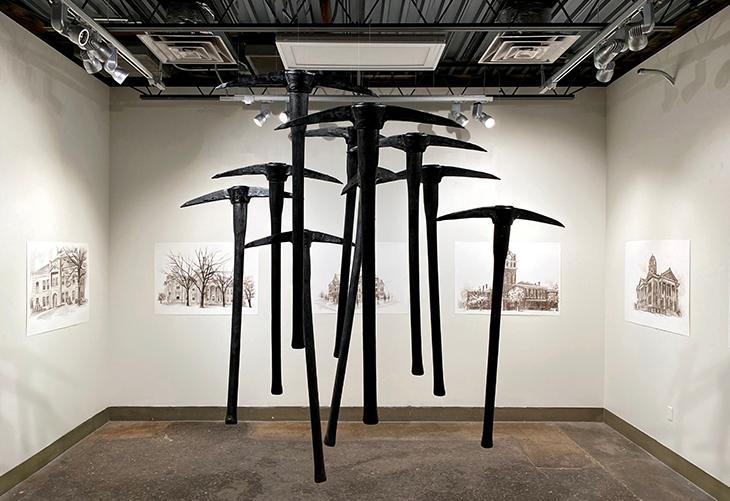
Chris Revelle, “Swing Low,” 2020, mixed media installation
|
|
|
Visible reminders of the ongoing fight for racial justice in America abound, as protesters march against police brutality, people recount the legacy of civil rights icon John Lewis, and community organizers work towards ending systemic racism. Artists are on the front lines, too. They’re elevating social justice issues through works that confront America’s past, prompt conversations about the present moment, and imagine a future stripped of racist ideologies and power structures.
|
|
Among these artists is Chris Revelle, a multidisciplinary artist who creates socially-engaged and politically-focused work. Most recently, he’s focused on slavery, including its ties to America’s origins, its existence before the Civil War, and its manifestations following adoption of the Thirteenth Amendment. Understanding his work requires careful consideration of the language of that amendment, including the following passage: “Neither slavery nor involuntary servitude, except as a punishment for crime whereof the party shall have been duly convicted, shall exist within the United States, or any place subject to their jurisdiction.”
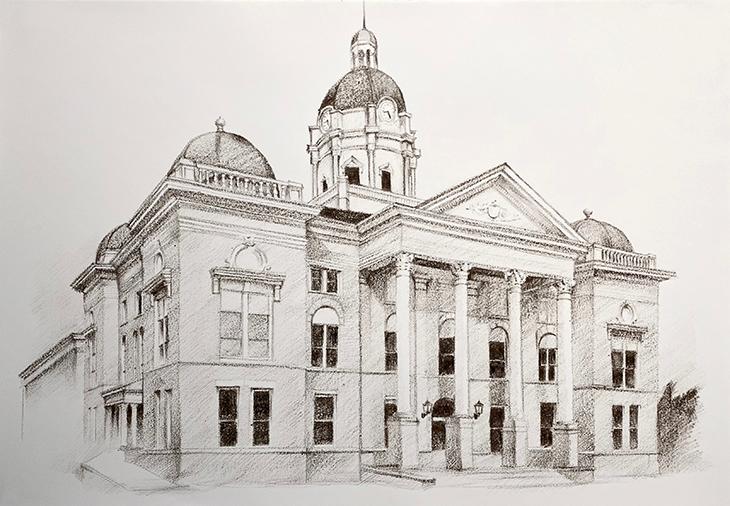
Revelle’s newest work, an installation titled “Swing Low,” addresses the ways systemic oppression continued after the war, as Southern states adopted “black codes” that marginalized and criminalized Blacks. The laws led to a convict leasing system that resulted in Blacks being forced to work in coal and iron mines. “The industrial new South was built on the backs of black bodies through violence and exploitation,” Revelle writes in his artist statement for “Swing Low.” For this piece, the artist started with the pickaxe, an object he describes as “the instrument of profit and torture in the mines.” First, he cast large-scale pickaxes using bituminous coal and wax, which reference both Black bodies and their labor. Then he drew a series of Southern courthouses, buildings which served to advance racism even after the slave auctions once held there were outlawed.
|
|
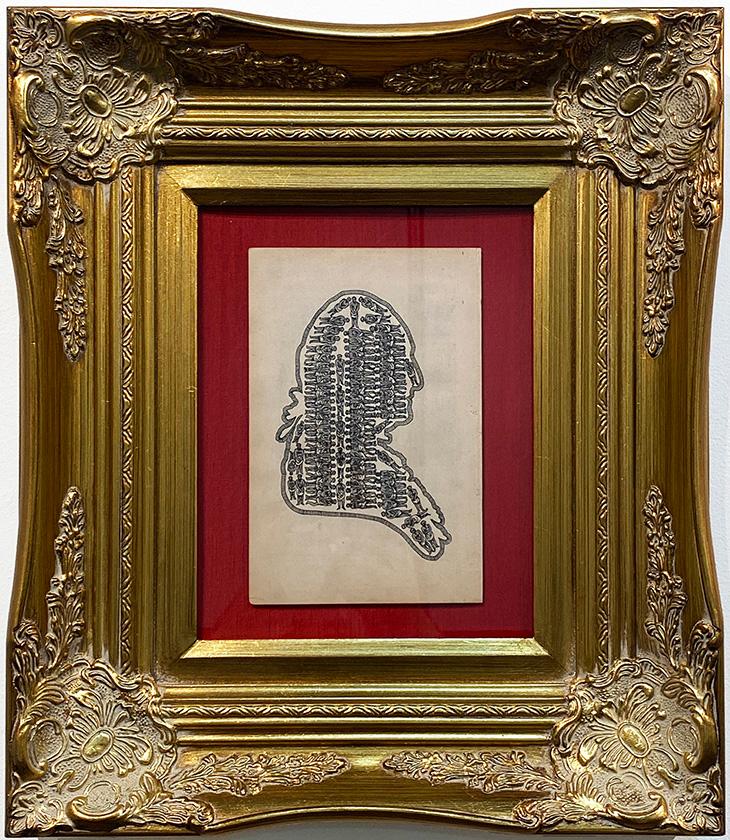
Chris Revelle, “The Foundation,” 2019, ink on paper, 16 x 14”
|
|
His installation comprises several pickaxes suspended in the center of a gallery space, where they conjure images of lynchings undertaken amid a mob seeking so-called justice. Revelle surrounds the sculptures with his drawings, made with remnants of other pickaxes that wore down and crumbled as the artist labored to replicate the Southern courthouses he implicates in promulgating the neo-slavery that helped to fuel the wealth of rising industrialization. With “Swing Low,” Revelle brings a powerful visual presence to contemporary conversations about criminal justice reform, generational wealth, and other social justice issues.
|
|
Through his larger body of work, Revelle addresses additional themes at the heart of current protests, including the call to remove Confederate monuments from public spaces. For a 2019 word titled “Graveyard,” the artist explored the ways that historical and contemporary speeches and writing reveal the racism rooted in American society. “The speeches, essays, declarations, and books by white Confederate, Southern, and Lost Cause politicians and writers unmasks their beliefs and intentions,” Revelle wrote in his artist statement for this piece, which comprises stone rubbings of racist language on imagined monuments. Revelle framed the large-scale graphite and paper rubbings, then tied them to wooden pallets using ratchet ties as a way to replicate the process of removing and relocating Confederate monuments. That same year, Revelle created a work called “Living Monuments,” using pro-Confederate books and lesson plans as source material. Revelle made resin casts of Jim Crow-era books, concealing the original text but adding words culled from speeches and writings by James Baldwin, then considered highly controversial, but today renowned for fearlessly calling out white supremacy.
|
|
Chris Revelle, “Shelby,” 2020, bituminous coal and wax on
paper (drawn with the pickaxes), 30 x 44”
|
|
Revelle’s work also addresses the hypocrisy inherent in the lives of America’s early leaders. Although the Declaration of Independence includes the words “all men are created equal,” for example, both George Washington and Thomas Jefferson were slave owners. It’s a topic that’s garnered renewed public discussion, as the musical
Hamilton
has fueled debate about the founding fathers. Modern-day civil rights leaders like John Lewis have been hailed as the founders for a new America. For “The Foundation,” Revelle used ink on paper to hybridize a silhouette portrait of George Washington with the diagram of an 18th century slave ship, creating a framed 16” x 14” work that speaks to slavery’s many iterations and impacts.
As protesters continue to march for racial justice, Revelle’s compelling body of work punctuates the role that artists can play in advancing the cause. “I want my work to have a visual impact,” Revelle says. “I hope it encourages dialogue and conversation.”
|
|
|
|
Lynn Trimble is a Phoenix-based art writer whose work ranges from arts reporting to arts criticism. During a freelance writing career spanning more than two decades, over 1,000 of her articles exploring arts and culture have been published in magazine, newspaper and online formats. Follow her work on Twitter
@ArtMuser
or Instagram
@artmusingsaz
.
|
|
Wait Til Next Year
by Margaret Hawkins
|
|
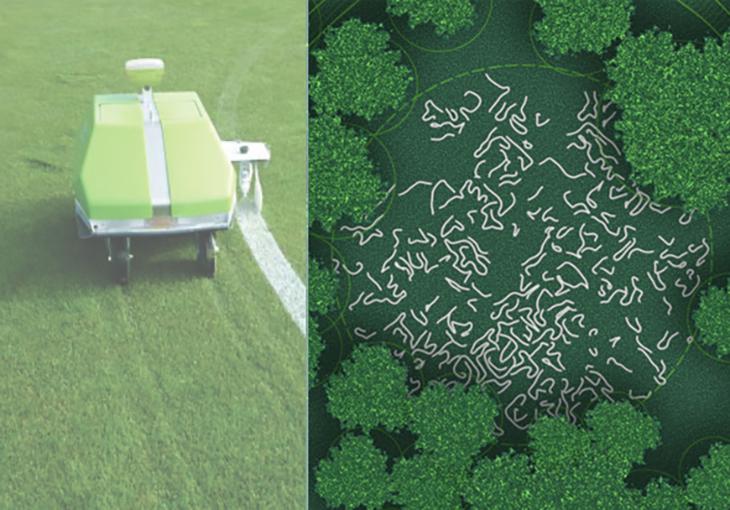
Ashley Bigham + Erik Herrmann of Outpost Office, “Drawing Fields,” 2020. GPS field marking
robots create a series of site-specific drawings or paintings at the Ragdale site
|
|
On Friday, July 24 Chicago woke up to the news that two statues memorializing Christopher Columbus had been temporarily removed from Chicago city parks.
No one was surprised. Protesters had been agitating for this removal for weeks and now, with federal troops heading to the city to further complicate things during this particularly bloody summer, the decision seemed to many to be wisely preemptive. We’ll handle our own problems, thank you very much, has been the mayor’s attitude. Not everyone was pleased, though; some in the Italian American community felt betrayed.
|
|
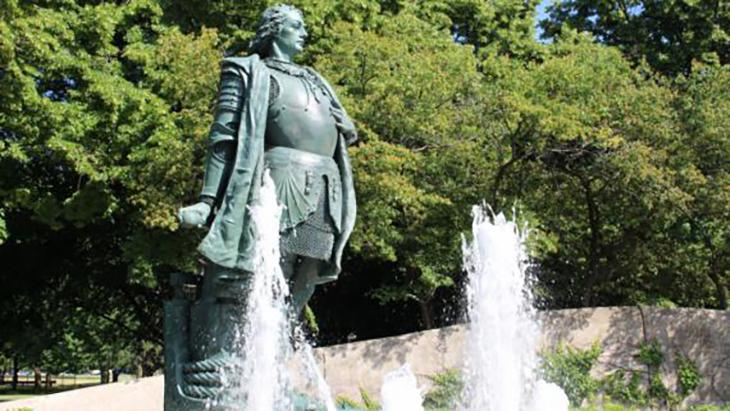
Moses Ezekiel, “Christopher Columbus Monument”
at Arrigo Park, Chicago, 1982
|
|
However you feel about Columbus, the statues weren’t especially memorable. I’ve lived or worked near one or the other for most of my life, and I have trouble conjuring a clear image of either. All I can picture is a bronze man with a puffed out chest standing on a pedestal, towering over me, neither beautiful nor inspiring, or even passingly interesting.
Do we really want our parks full of these artistically undistinguished memorials to dead white men famous for their roles in the colonial and violent past? Do we want figurative monuments at all? The answer from many has been a resounding no.
|
|
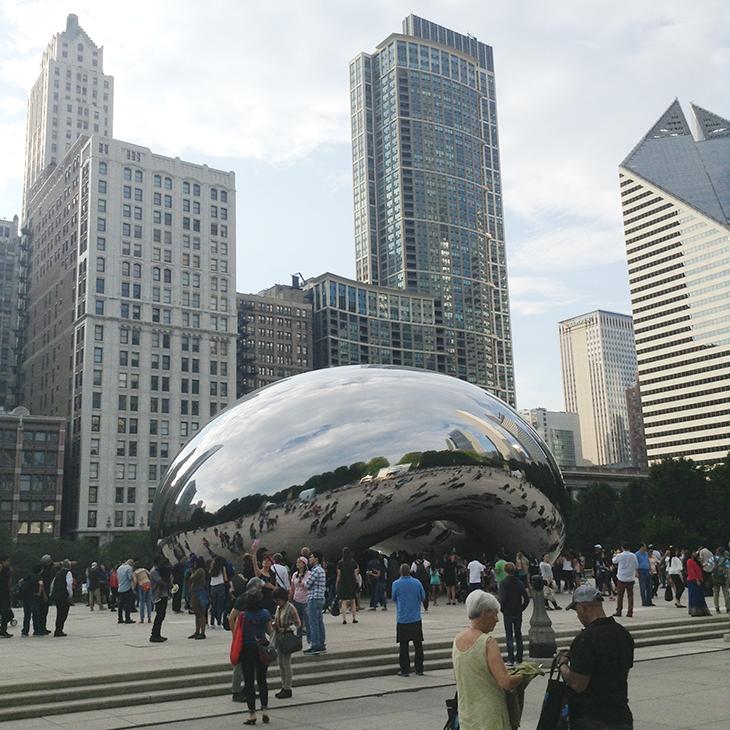
Which leads to the next question. With what do we replace these monuments, if anything? In a recent Weekly Newsletter, Matthew Kangas posed a solution: All new public art should be abstract. It’s a great idea. Let’s go forward with it for all new commissions immediately. Instead of invoking the inevitably imperfect biographies of ultimately fallible humans, abstract art in public spaces invites viewers to think their own thoughts, get lost in contemplation — of space, form, color, materiality, the relationship of nature to man and the manmade world. Allusion rather than literal representation frees the mind. Certainly in Chicago our best public art is abstract. Consider the sublime Bean, Anish Kapoor’s “Cloud Gate,” that hovers in Millennium Park like some mysterious spaceship that arrived in the night. Or perhaps it’s more a beached whale. Or a gigantic balloon, pregnant with a fantastic secret. The point of it is it doesn’t have a point, or not just one. It invites you to wonder.
|
|
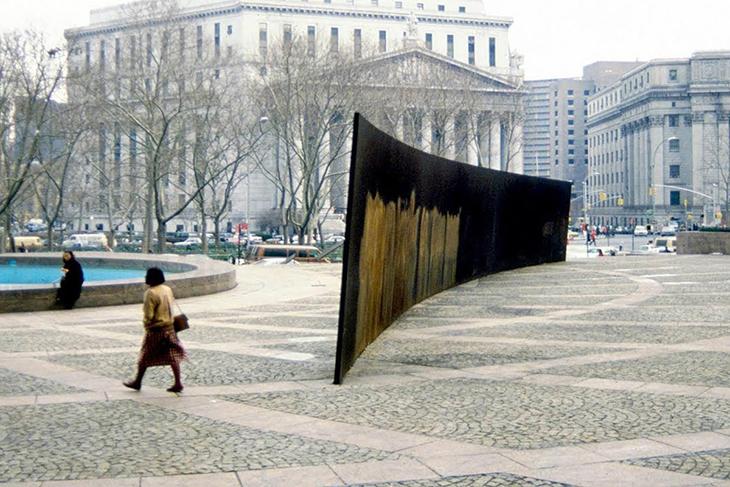
Richard Serra, “Tilted Arc,” 1981 (removed 1989),
unfinished steel plate, 120’ x 12’ x 2 1/2”
|
|
There’s still a problem though. Say we replace all these fusty monuments to military force — every single one was made by a man by a man, by the way — with works of abstract art. Can we agree on what that art should be, for all people to look at for the next hundred years or more?
Which is to say, do we want permanent public art at all? Art in public spaces is said to enrich us and at its best maybe it does. But there is always that uncomfortable sense of being told what to like, what to look at, of being assigned an experience. I love coming across art somewhere I’m not expecting it, but only if I love the art. The skeptical among us don’t like being told what to like by art experts, and the really smart experts understand that. Even as official an expert as Peter Schjeldahl defended the removal of Richard Serra’s “Tilted Arc” in Foley Federal Plaza in Manhattan back in 1989 on the grounds that “the public should have a say in public art.”
|
|
|
How about this instead: For every disgraced monument that’s pulled down we institute a program of temporary public art that replaces that work annually with something new? Not only would this be a reprieve for those for whom a particular work does not spark joy; transitory art would also combat the problem of familiarity-driven contempt. No one would have time to become bored with the thing. Any contempt would be the result of honest dislike. Which is invigorating! Before long, the thing would go away, good, bad or indifferent. Our parks would become like galleries, or outdoor museums, with changing exhibitions. And a public art program like this by its nature would provide more artists with commissions. Our city, our world, is full of artists and most will never get a shot at having their work widely seen. We talk about inclusiveness and democracy. Wouldn’t it be better to take a chance on more good artists rather than always sticking with the same few safely vetted art world stars? Why support a winner-take-all art economy when diversity is both kinder and richer?
|
|
Anish Kapoor, “Cloud Gate,” 2004 at Millennium
Park, Chicago, stainless steel, 33 x 42 x 66’
|
|
There are local precedents for this approach. In the 1990s the Evanston Art Center, which at the time occupied a crumbling mansion on the lake, hosted an annual summer installation on their front lawn. Often constructed from natural materials that changed over time, these installations stayed up through the fall, or until they fell apart. You could walk through them, smell them. Stuff dropped onto your hair. It was nice. The shows came and went with an admirable modesty, yielding their space as decay set in. Those shows are more vivid in my memory than any bronze figure I’ve seen in any park.
A current, edgier paradigm is the Ragdale Ring. Every year Ragdale, an artists’ community north of Chicago, chooses a team of architects to design a temporary outdoor performance space for their grounds. In the spring, when the winning project is picked, the design team shows up to build it. The next spring the whole thing comes down, to be replaced by something new. This year’s Ring, “Drawing Fields,” involves a GPS-controlled robot that creates large-scale paintings on the grounds that you can physically occupy, suggesting possible performance configurations. According to the architects, the work will “disappear with only rain, sun, growth and time. There’s no waste, no toxins and no messy clean up. In the matter of a few months, the site is ready for the next ring.”
I love it. And if you don’t? Wait til next year.
|
|
|
|
Margaret Hawkins
is a writer, critic and educator. Her books include “Lydia’s Party” (2015), “How We Got Barb Back” (2011) a memoir about family mental illness, and others. She wrote a column about art for the
Chicago Sun-Times
, was Chicago correspondent for
ARTnews
, and has written for a number of other publications including
The New York Times
, the
Chicago Tribune
,
Art & Antiques
and
Fabrik
. She teaches writing at the School of the Art Institute of Chicago and Loyola University. Visit
Margaret Hawkins' website
.
|
|
Through a Gallery Darkly
by Richard Speer
|
|
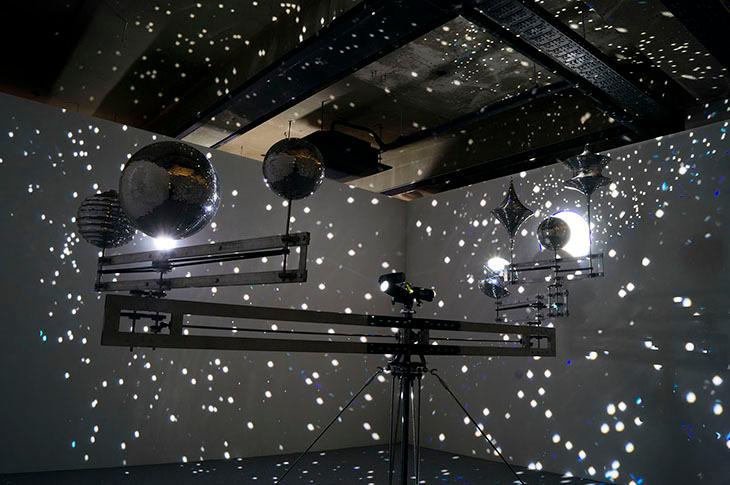
Kiichiro Adachi, “Orrery,” 2019, mirror, voter, aluminum, steel, stainless steel, LED light, mixed media, 15’ diameter x 6.6’ height
|
|
Two months ago I ventured into Elizabeth Leach Gallery for the first time since February’s “First Thursday” art walk. It felt both reassuring and unsettling to be back in an art gallery (now open by appointment only) and converse with Elizabeth and gallery director Daniel Peabody, all of us wearing masks and standing six feet apart. Notably, all of the artwork I saw that day and in subsequent outings has seemed marked by COVID-19, as if the art itself were amplifying the dread we are all feeling in this paranoia-inducing time. It telegraphs the tenuousness of life, the inevitability of death, and the feeling that everything is in a state of unsettling transition. Some exhibitions remind me of these things in quite personal terms.
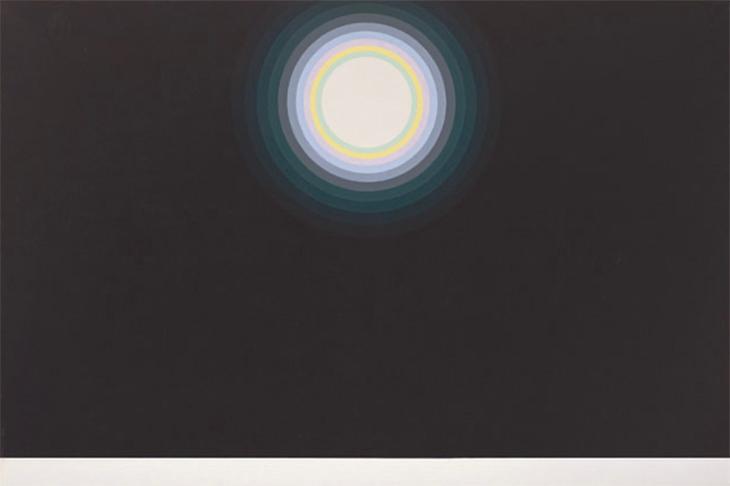
At Leach there were two shows up, one of paintings by the late Mary Henry, which really pushed my buttons emotionally. A West Coast treasure, Henry was a master of geometric abstraction who lived her last years on Whidbey Island, Washington. Back in May 2009, at age 96, she had a show at PDX Contemporary Art. It opened on May 5 of that year, and she died on May 20. My review of her show for
Willamette Week
newspaper was the last review of her work published in her lifetime, and to this day I get goosebumps remembering that show’s standout painting, “Full Moon Over the Mendocino Headlands” (1971).
Sometimes a painting is so evocative, it can draw a wellspring of superlatives from anybody who’s paying attention. That piece could have drawn blood from a stone. What it drew out of me remains one of my favorite passages I’ve ever been inspired to write in a review: “The painting posits horizon line, silvery orb, and cool, flat blackness stretching out implacably, evoking the chill of windswept cliffside, the white noise of surf pounding rock. Mystical in atmospherics, muscular in its graphic punch, it balances Zen quietude and Western grandiosity, intoning its soundtrack in the mind’s ear: part bamboo flute, part fugue — an Alan Hovhaness tone poem in acrylic paint.” Looking at Henry’s works at Leach, I felt in a time warp, as if the artist were still alive. I’m still in my thirties and Barack Obama has just been sworn in as U.S. President. Today, those times seem innocent to the point of prelapsarian.
|
|
|
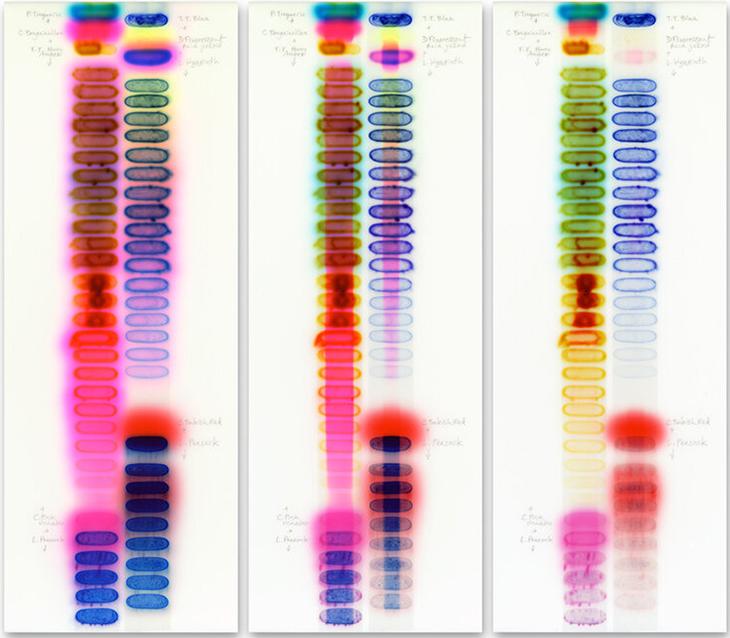
The other show was Jaq Chartier’s “Sun Tests.” Chartier has a career-long obsession with staining surfaces with volatile substances and watching those stains slowly brighten, darken, or hold fast. Part of the joy of her work is not knowing exactly what they’re going to do over time. Problem is, many if not most collectors don’t want something they paid good money for to change. If you bought a colorful painting, you don’t want it to blanch out on you six months later. For certain works in this show, instead of staining wood panels and then exhibiting them, she has captured images of stains on other panels as they migrate across their trajectory of chromatic metamorphosis. These are then transferred via a dye sublimation process onto aluminum, so that the image becomes permanent. Essentially she has taken a picture of change that will never change, a freeze-frame of something in the process of decaying into oblivion. Sounds a little like watching the news these days, doesn’t it?
The next month, Leach showed Matthew Picton’s “Eschatologies.” The subject matter was apropos enough: disease, destruction, and the end of times. In a series of virtuosically complex, conceptually and physically layered wall sculptures, Picton refers to Venice during the cholera epidemic of 1902; Richard Wagner’s opera “Götterdämmerung” (“Twilight of the Gods”), which concludes his fabled Ring Cycle with the fiery destruction of Valhalla; and Albrecht Dürer’s fearsome woodcut “The Four Horsemen” from his folio “The Apocalypse.” (1498). The show was put on the schedule well before the pandemic hit, so the parallels between its subject matter and our current predicament are purely coincidental.
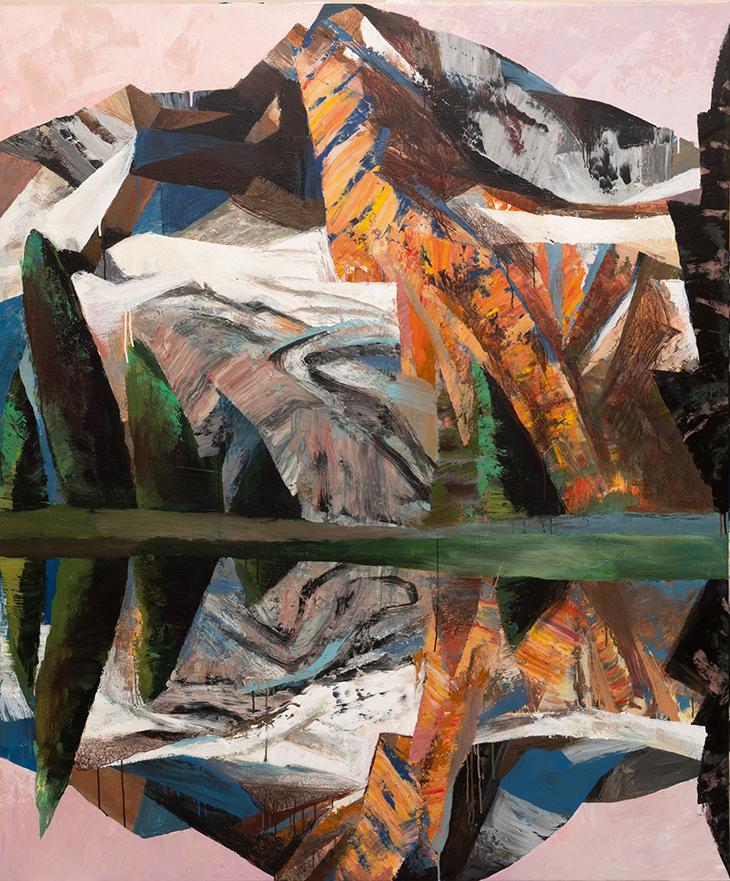
Two weeks ago I went to Russo Lee to see Lucinda Parker’s “Helens & Hood: Keep Safe Distance” and Sherrie Wolf’s “Memento.” Parker’s dramatic mountainscapes of the volcanic Cascade Range remind us of nature’s destructive power, particularly in light of the eruption of Mount St. Helens forty years ago this past May. Wolf’s luscious still lifes of flowers, vases, curios, and postcards of famous paintings are elegantly voluptuary on the surface, but any still-life show called “Memento” is by definition in the lineage of the
vanitas
genre and the
memento mori
. The comely blooms remind us of the chilling couplet that opens Robert Herrick’s “To the Virgins, to Make Much of Time”: “Gather ye rosebuds while ye may/Old Time is still a-flying;/And this same flower that smiles today/Tomorrow will be dying.” This is why Piet Mondrian turned away from nature, which he equated with “the tragic.” Contrasted with the withering and crumbling of all things organic, geometric abstraction seemed reassuringly perfected, pristine, inviolable. The aforementioned Mary Henry also favored the geometric over the organic, but did not shrink from associations with the natural world.
|
|
Jac Chartier, “SunTest #3 (Day 1, 12, 35),” 2019, time-based image capture, dye sublimation on aluminum, 50 x 18 1/2” each (triptych)
|
Lucinda Parker, “Looking Glass,” 2020, acrylic on canvas, 76 x 63”
|
|
So my art excursions have been pretty poignant lately, and maybe yours, such as they are, have been too. Art reflects the arc of history, and let’s face it, a lot of human history has been a downer. Who knows, maybe this is a time to take solace in more escapist fare: Jeff Koons’ “Popeyes,” “Incredible Hulks,” and balloon animals; or Takashi Murakami’s irrepressible smiley-face daisies. Lately I’ve been getting into Kiichiro Adachi’s eccentrically shaped disco-ball sculptures, which bring a smile to my lips during even the most depressing news cycles. Art can console, but it can also buoy. Surrounded by harbingers of life’s brevity, it’s instructive to remember the value of levity.
|
|
Mary Henry, “Full Moon Over the Mendocino Headlands,” 1971, acrylic on canvas, 48 x 72”
|
|
|
|
Richard Speer
is based in Portland, Oregon, where for 13 years he was art critic for Willamette Week newspaper. He is the author of "The Space of Effusion: Sam Francis in Japan" (Scheidegger & Spiess, September 2020) and co-curator of the exhibition "Sam Francis in Japan: Emptiness Overflowing" (LACMA, April-September 2021).
Richard Speer's website
Photo: Adam Bailey
|
|
|
|
Contact Information:
PO Box 2029, Thousand Oaks, CA 91358 •
Ph:
(213) 282-3444
|
|
|
|
|
|
|
|