|
|
We ask that you consider making a payment to any writer or each writer. Select one or more whose work you are impressed with, and drop some coin into their cup. These pros have things to say about art and more that we think you want to read about. And ponder. And compensate them for. 20% of your contribution will be added to support our staff that produces and administers the Weekly Newsletter and the VAS website.
Anything you chip in MEANS A LOT. Yes, even a buck!
We are in a new world. . .and this is a new solution. We all thank you!
|
|
|
This Week's Contents
(scroll to see the full content of each article; please click the cup and compensate the writer)
|
|
Brian Sanchez and Neon Saltwater,
“Energy Drink”
|
Hymns to Silence:
The Minimal Photos of Jacques Garnier
|
Jason Karolak,
"Fictionless"
|
|
|
Brian Sanchez and Neon Saltwater, “Energy Drink”
by Matthew Kangas
|
|
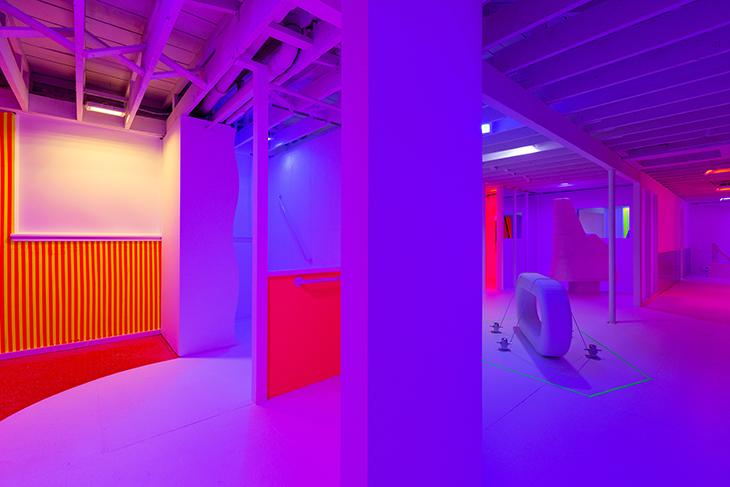
Brian Sanchez and Neon Saltwater: (left) “Shower,” 2021, sculpture, 36 x 48 x 98”. (center) “Carmelita,” 2021, sculpture, 32 x 60 x 12”. (right
of center) “Big Sleep,” 2021, sculpture, 54 x 78 x 20”. Photo: Rafael Soldi, Courtesy of the artists and Museum of Museums, Seattle, WA
|
|
Museum of Museums, Seattle, Washington
Continuing through August 29, 2021
The extensive, immersive installation, “Energy Drink,” by the artist team Brian Sanchez and Neon Saltwater presents a number of possible interpretations: a gay dystopian environment for a “happy” couple; a hallucinatory fun house revolving around domestic symbols in a heightened chromatic wrap-around setting; or discrete activity areas for urbanites who must have access to gyms, spas, art galleries, sculpture studios, gay bars and lounges. Filling the entire second floor of the gallery — a repurposing of the first International Style building dedicated as a medical clinic in Seattle — “Energy Drink” is a surprising descendent of the Light and Space Movement from Southern California, especially James Turrell, and of New York minimalist Dan Flavin.
|
|
Instead of a meditative, chapel-like setting, Sanchez, an abstract painter who has also shown in San Francisco, Los Angeles and Tokyo, and Saltwater, an art director with clients like Barney’s New York and Starbucks, combined their talents to create a hushed lay-out of “rooms” that are identified by the activities that occur within them. Examples here are their version of a gym, with its weight-lifting bench; and a bedroom, with its absurdly large double bed which becomes a giant flat sculpture bathed in pink, orange, blue and green light. Like a rainbow flag of Gay Liberation, “Energy Drink” was enormously popular when it debuted last year, and was afforded an extended run due to the pandemic. The location in Seattle’s premier gay neighborhood, Capitol Hill, with its many bars and restaurants, contributes to visitors’ pleasure as they wandered through the darkened, but garishly lit, rooms. As if exploring a private home without the owners present, “Energy Drink” also parodies the insane real estate market in Seattle. Anything and everything is available for residents as rents climb alarmingly and drive out groups like the historic gay population on the Hill.
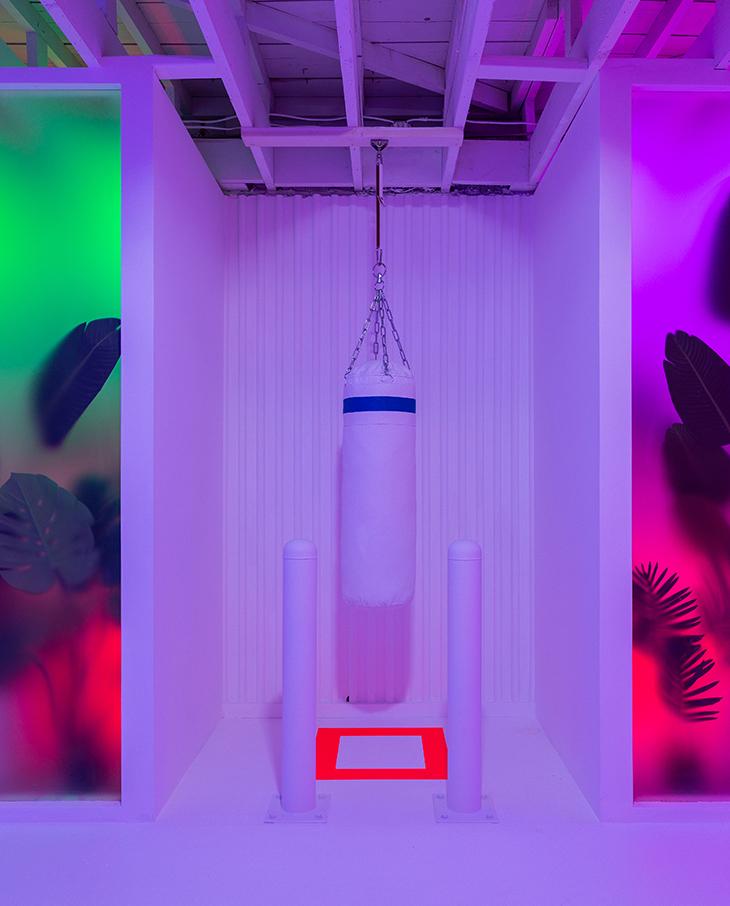
Is it possible for such an ornate and candy-colored environment to have a political dimension by calling attention to precarious living situations of urban gays in Seattle? On one level, the possibility of abstraction to carry any content intensifies discussion of the collaboration. For example, the pink punching bag could be read as a weapon or defensive object. On another level, the off-kilter environment, recalling a silent gay disco, spoofs the seriousness of Robert Irwin and Turrell, offering instead glowing lights devoid of spiritual resonance. Fizzy and funny, “Energy Drink” seduces us with its inviting, mysterious corners. A photographic blow-up of a stuffed toy animal may allude to young gays as “cubs,” in search of older “bears.”
|
|
Brian Sanchez and Neon Saltwater: (center) “War Bag,” 2021, installation, 64 x 96 x 30”. (left and right) “Frosted Light Vitrines with Plants,” 2021, 42 x 96 x 30”. Photo: Rafael Soldi, Courtesy of the artists and Museum of Museums, Seattle, WA
|
|
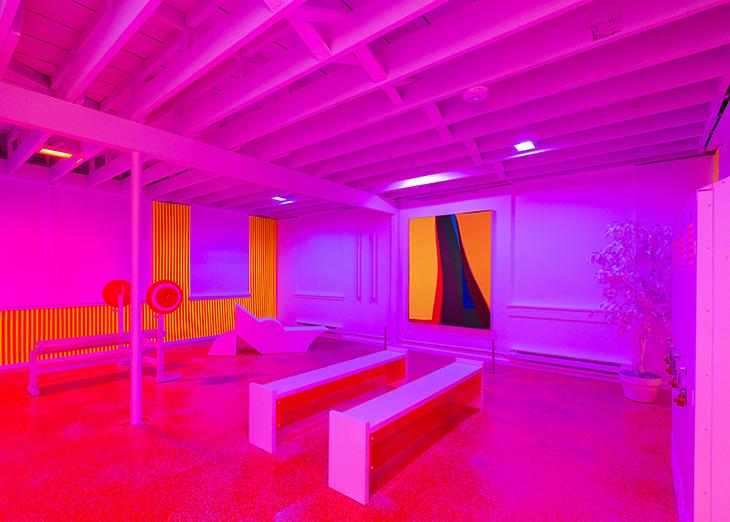
A few steps away, two rectangular benches suggest seating in a gay steam bath. Across the street from the gallery is the site where the city’s oldest gay sauna, Crystal Steam Baths, existed until the entire block was razed to make way for one of the Swedish Hospital’s parking structures. With Seattle’s history of site-related public art, such an allusion is inescapable.
Sanchez’s hard-edge abstract paintings are hung in various places. Thus, modernism has become a source for satire, too, as Sanchez and Saltwater riff on its requirements of simplicity, chromatic purity and a spiritual aura. Far from spiritual, “Energy Drink” is closer to Pop art, like the furnished-room-size installations of Andrea Zittel or early Claes Oldenburg.
|
|
Brian Sanchez and Neon Saltwater: (left) “Bench Press,” 2021, sculpture, 52 x 50 x 48”. (center) “Booter,” 2021, sculpture, 18 x 60 x 24”. (center) “2 Benches,” 2021, sculpture, 12 x 72 x 18”. (above center) “Turn In,” 2021, painting, 64 x 48”. (above right) “White Tree,” 2021. (below right) “Gym Lockers,” 2021. “Gym Walls,” 2021. Photo: Rafael Soldi, Courtesy of the artists and Museum of Museums, Seattle, WA
|
|
Saltwater’s lighting design creates a seamless, flowing path throughout, highlighting sculptural objects and furniture, and throbbing with overlapping orange, purple and acid green pools of light. No one would want to live in such an interior: it has to be an anti-paradigm of sorts, a commentary on the special struggles and conflicts inherent among gay couples, so stressed are they by social issues and economic pressures. The fantasy apartment should be a safe space, but is quite public. Viewers are unwitting voyeurs, deliciously drawn to participate in actions that comprise a vicarious aesthetics of art, design and sex, redefining sculpture while reinforcing its central core of three-dimensional reality. |
|
|
|
Matthew Kangas is a corresponding editor for Art in America and Sculpture magazine. He has written for numerous publications including the Seattle Times, Artweek, Preview and Art Ltd. Four collections of his reviews, interviews and essays have been published in New York by Midmarch Arts Press and are available at Amazon. Books by Matthew Kangas at Amazon. He is also the author of the recent award-winning monograph Italo Scanga 1932-2001.
|
|
Hymns to Silence: The Minimal Photos of Jacques Garnier
by Liz Goldner
|
|
Laguna Art Museum, Laguna Beach, California
Continuing through October 24, 2021
Two dozen black and white photographs — all portraying the pared down exteriors of Southern California buildings — are expressions of Jacques Garnier’s passion for architecture, art history and poetry.
While the photos on exhibit at Laguna Art Museum evoke modern art movements including Minimalism and Hard-edge, they also reflect Garnier’s active engagement with verse. Marie Stone writes in the exhibition catalog, “There are photographers who hone their skills like poets, evoking emotion through absence, provoking an audience’s curiosity with what isn’t shown, and stirring something subconscious in the imagination.” She adds that his work “incorporates many principles found in poetry — repetition, ambiguity, negative space, and abstraction.” Garnier, who is also a published poet, explains, “Poetry is often about ambiguity, about what I leave out. With this series, I leave out all details, all distractions except for basic structures” [of the buildings].
By approaching his deconstructed images with skillful use of light and dark, much of the contrast achieved with Photoshop, his photos bridge reductivism with the form-follows-function aspects of modern architecture.
Garnier’s images of buildings, from the mundane to the renowned, further evoke the work of 20th century photographers such as Paul Strand, as well as abstract painting. But they go further. With his compassionate and formalistic eye, he elevates reductive images to heightened visual harmony, grace, even to meditative states. An interview with Garnier revealed that when he began working on this series, shortly before the start of the pandemic, his desire was to de-clutter his photos and to focus on angles and views of structures that most people don’t normally pay attention to.
|
|
Jacques Garnier, "Ostinato," Langston Library, UCI, Irvine, 2020 |
|
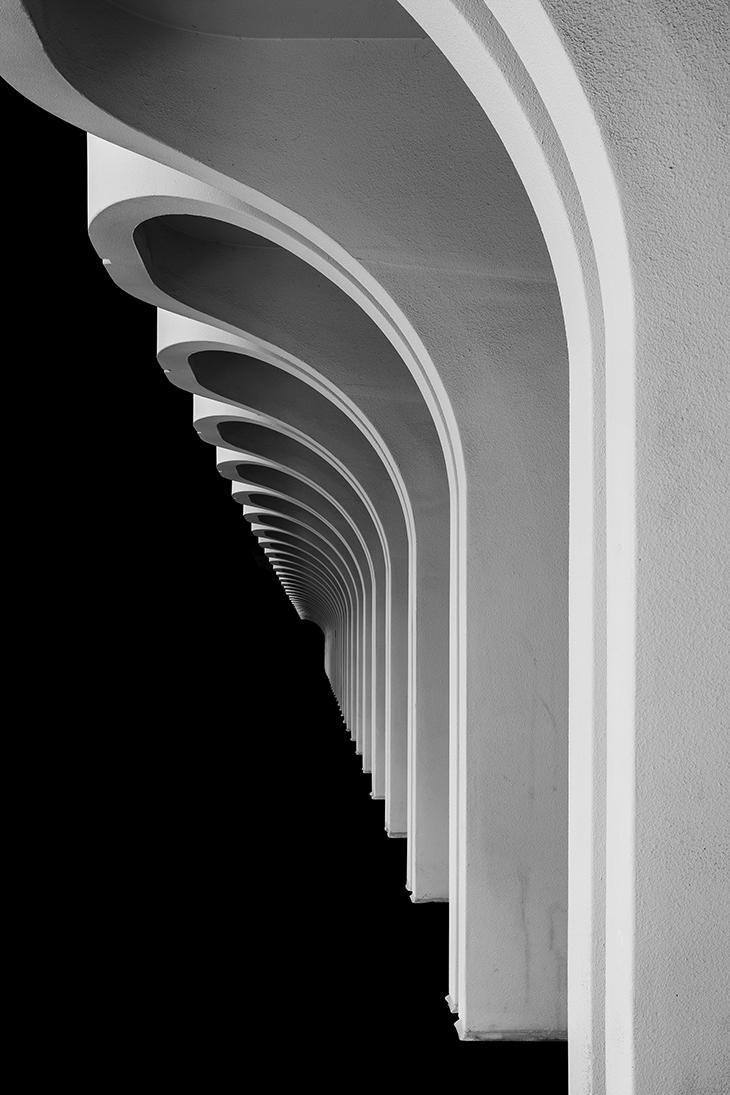
He researched buildings throughout the Southland on Google Earth, visited them, observed their exteriors from various angles, and envisioned them set against negative black backgrounds with all streets, cars, people and foliage removed, by using contemporary digital tools. He explained in the catalog, “The negative space of these deconstructed images is the pause between the notes of the music, a disruption, to make you create your own interpretation and to enjoy the silence. This emptiness allows for potential.” |
|
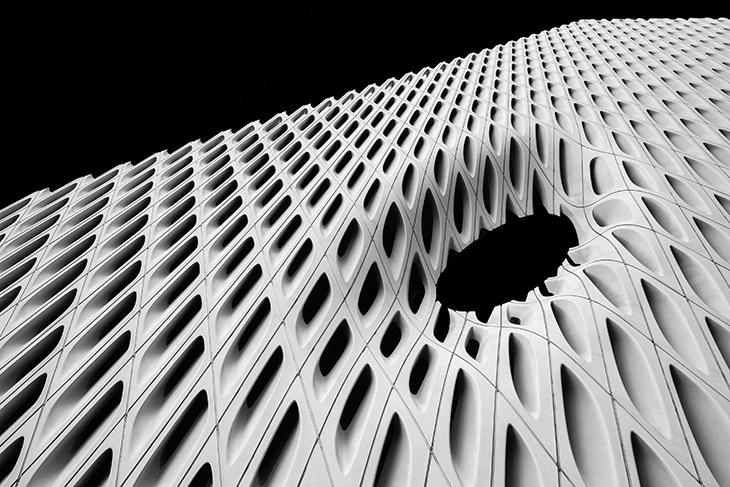
Jacques Garnier, "The Veil and the Vault," The Broad, Los Angeles, 2020 |
|
“The Veil and the Vault” (2020) illustrates a side wall of The Broad Museum in Los Angeles. Eschewing the museum’s well-known facade, the photographer concentrates on a small portion of the exterior’s veil-like design. |
|
Jacques Garnier, “Taj Mahal,"
Taj Mahal Medical Center, Laguna Hills, 2018
|
|
Set against a black Photoshopped background, the image reveals unusual details involved in planning and constructing the building’s outer surface, bringing to life an aspect of museum that few people take time to see.
“Ascension” (2020) focuses our attention on a portion of the nearby Walt Disney Concert Hall. The detail reveals an angled peak — soaring into the stark black sky — that most of us probably do not notice. Yet Garnier, with his poetic eye, has stripped away familiar aspects of the concert hall to concentrate on this one elegant feature.
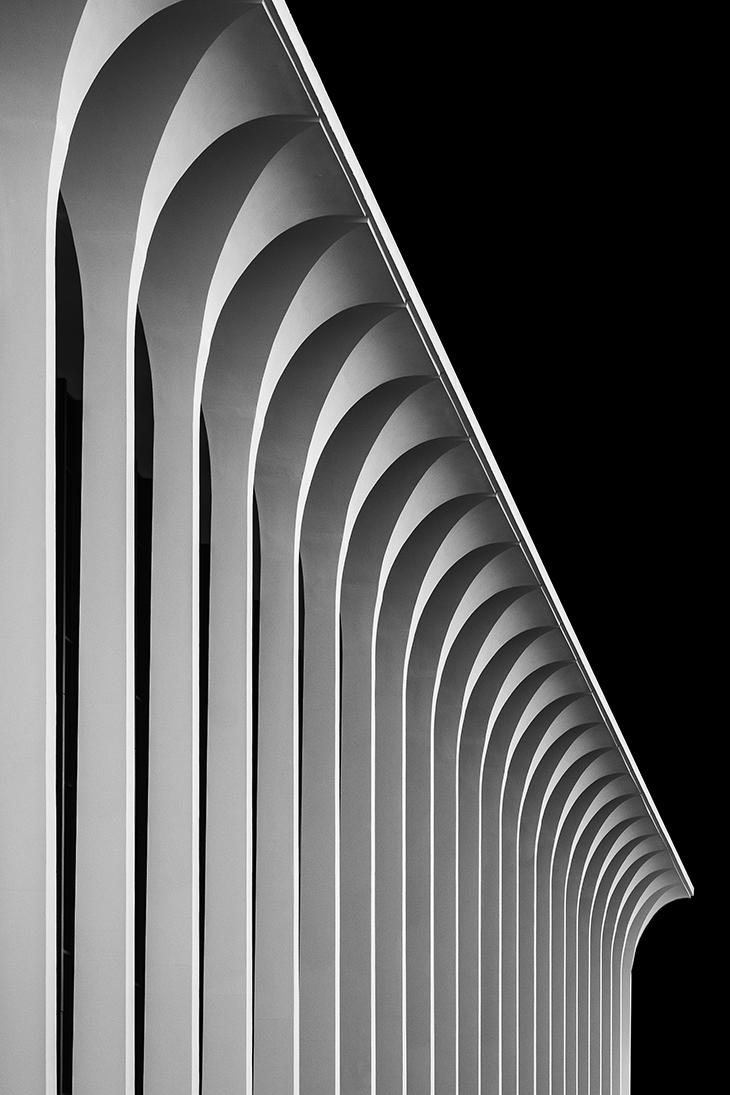
The contrasting “Infinitum” (2020) selects the diminishing size and powerful rhythm of a series of armed doorways at York Hall at UC San Diego. The image elevates the seemingly dull drone of the doorways to a spiritually uplifting ambiance.
The intriguing “Shul” (2020), an exterior wall of Sinai Temple in Los Angeles features a design that appears Islamic in origin — at least as the camera captures it. As Douglas McCulloh writes in the catalog, “These photographs dwell in the zone between report and fabrication.”
Garnier’s inimitable perspective on many other buildings — including a Los Angeles police building, a side view of the Segerstrom Center for the Arts in Costa Mesa, an angled shot of the Taj Mahal Medical Center in Laguna Hills, and an upward-looking image of the Wilshire Grand Tower in downtown Los Angeles — reduces them to their basic designs in order to enrich them with felt response. He further defines them by situating them against stark, black backgrounds. They express the vision of a photographer who is striving to create a new paradigm for how we respond to architecture.
|
|
|
|
Liz Goldner is an award-winning art writer based in Laguna Beach. She has contributed to the LA Times, LA Weekly, KCET Artbound, Artillery, AICA-USA Magazine, Orange County Register, Art Ltd. and several other print and online publications. She has written reviews for ArtScene and Visual Art Source since 2009.
|
|
Jason Karolak, "Fictionless"
by Donna Tennant
|
|
Jason Karolak, “Untitled (P-2001),”
2020, oil on linen, 66 x 58”
|
|
Jason Karolak, “Untitled (P-2010),”
2020, oil on linen, 66 x 58”
|
|
Jason Karolak, “Untitled (P-2007),”
2020, oil on linen, 66 x 58”
|
|
All images courtesy of the artist and David Shelton Gallery, Photography by Peter Molick. |
|
David Shelton Gallery, Houston, Texas
Continuing through July 10, 2021
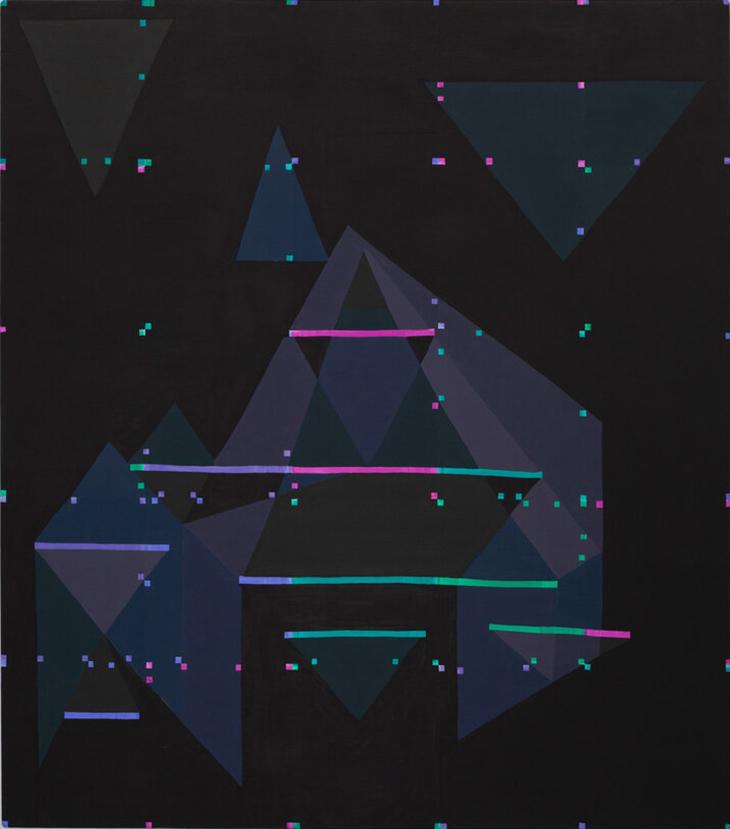
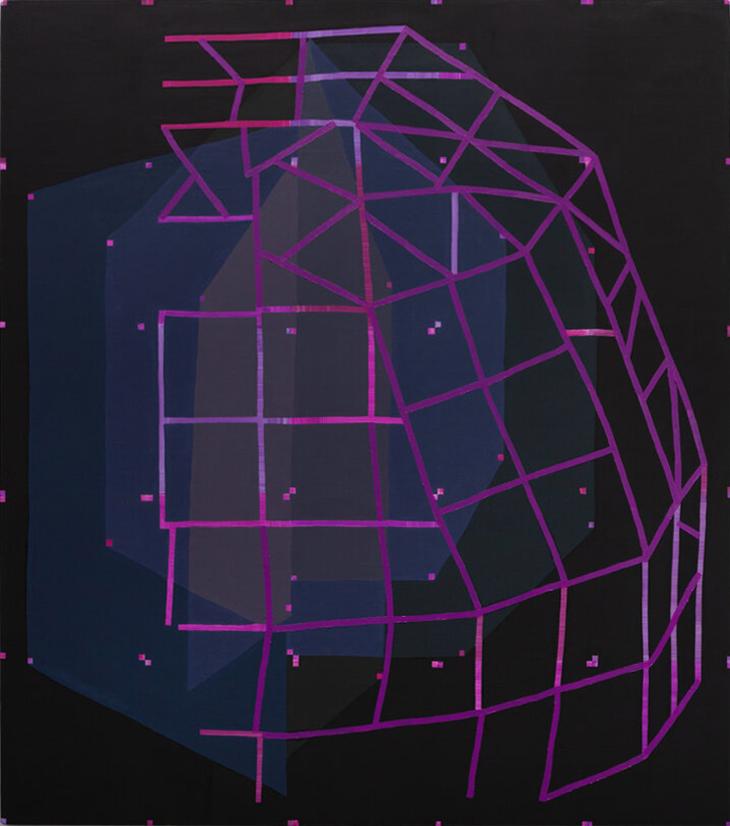
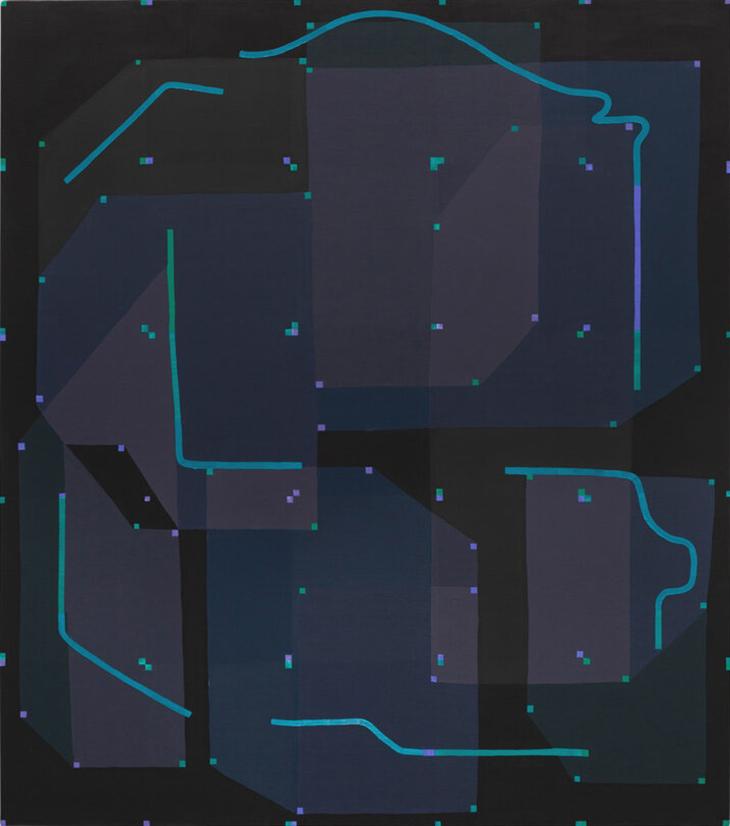
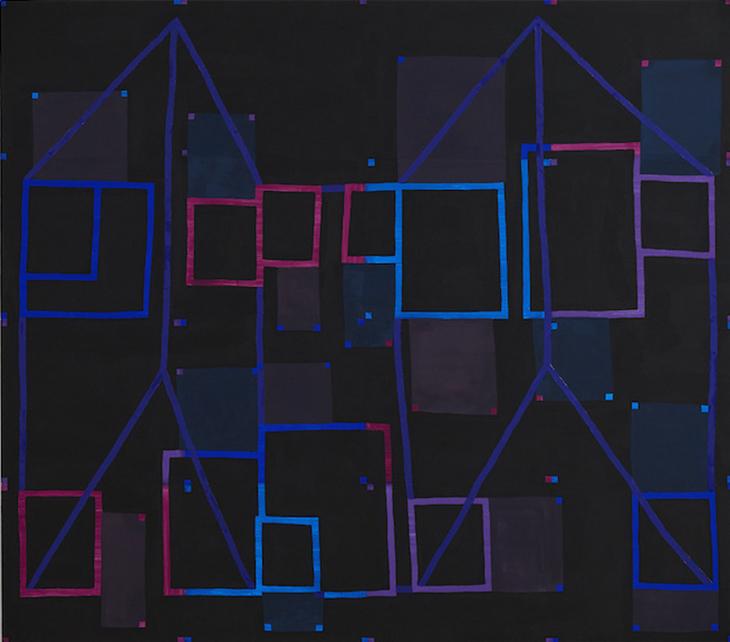
Jason Karolak uses oil on linen to create luminous compositions of neon-like color that jumps off from black backgrounds. He produces complex three-dimensional universes in which overlapping geometric shapes are highlighted with glowing dots and dashes of color. The dark grounds and squares, rectangles, parallelograms and other two-dimensional forms are overlaid with vivid pink, purple, green and blue linear patterns. Some paintings could be aerial views of a nocturnal landscape, while others resemble architectural elevations, circuit boards, labyrinths or mazes.
Karolak was raised in rural Michigan and attended high school at Cranbrook Academy before moving to Brooklyn in 1994 to study at Pratt Institute. He has spent more than half his life in New York City, and that influence is unmistakable. His interest in bright color, sound and music became heightened from living in Brooklyn’s Fort Greene neighborhood in the mid-1990s, where he listened to hip hop and frequented the neighborhood bodegas. He distills the city’s frenetic barrage of sights, sounds, graffiti, and compressed architecture into these thoughtful abstractions. Karolak has referred to life in Brooklyn as “a patchwork of various geometries grounded in observations of the physical world, which include architecture, space, light and the scale of the human body.”
Karolak admits to a “voracious appetite for color” and an interest in “imperfect geometry.” Variations on the grid is a familiar component of modernist art, but he brings to it a distinctive approach that results in a fresh vision. He has expressed a desire to maintain a certain “crudeness” in which the flow of the line is interrupted. According to the artist, these paintings evolve from drawing. He translates his explorations in pencil into larger ink on paper pieces and then into paintings. Karolak’s work feels, and is, organic rather than formulaic in its evolution. One is conscious of the physical activity of the artist moving the loaded brush across the surface while not overthinking where it is supposed to go. Working in this manner, he strips away specifics, leaving behind something more essential. The result is subtly reflective paintings that resonate between your eye and mind.
|
|
Jason Karolak, “Untitled (P-1901),” 2019, oil on linen, 58 x 66” |
|
|
|
Donna Tennant is a Houston-based art writer who writes reviews for various publications. Over the past 40 years, she has written about art for local and national publications, including Visual Art Source, Houston Chronicle, ARTnews, Southwest Art, Artlies, and the Houston Press. She has a bachelor of arts in art history from the University of Rochester and a master of arts in art history from the University of New Mexico.
|
|
|
|
Contact Information:
PO Box 2029, Thousand Oaks, CA 91358 • Ph: (213) 482-4724
|
|
|
|
|
|
|
|