July 31, 2023

VHC Digest

Meet Chinwe Mary Joe Maduabum, Visiting Scholar

“Chinwe Mary Joe Maduabum (“Mary Joe”) is a PhD student in the Birmingham Law School, University of Birmingham, United Kingdom. In addition to conducting doctoral studies in law, Mary Joe is an Assistant Director with over fifteen years of working experience in the Nigerian Communications Commission (NCC), Nigeria’s independent national regulatory authority for telecommunications. She led the Post Licensing Unit of Licensing & Authorisation Department; the Academia Research Support Unit of the Research and Development; as well as the Emerging Technologies Research Unit of Research and Development and is currently providing leadership in the Risk Management Unit of NCC’s Corporate Planning, Strategy and Risk Management Department. Her passion for telecommunications and the desire to learn how best to regulate the sector propelled her to enroll in LLM in Information Technology and Telecommunications Law at the University of Strathclyde, Glasgow where she graduated with distinction.


Mary Joe successfully passed her PhD progress review panel at the University of Birmingham in April 2023. Shortly thereafter, she was awarded the prestigious (UK) Turing mobility scholarship to pursue critical doctoral archival work at the Feminist and Legal Theory Project at Emory Law.


Mary Joe’s doctoral work examines Intellectual Property Rights (IPRs) with a particular focus on patents under the WTO Agreement on Trade-Related Aspects of Intellectual Property Rights (“TRIPS”), access to medicines, decolonization of IP regimes and health inequalities.


The overall objective of her doctoral research is to contribute new legal perspectives on vaccine inequalities as experienced in the Global South, with particular focus on Nigeria. The ultimate aim is to identify socio-legal tools to determine flexibilities in IP standards of protection in the Global South while being mindful of domestic idiosyncrasies.


Mary Joe will be at Emory until August 25. Please let us know if you are interested in meeting with her.

‘The Underlying Values of German and English Contract Law’

by Dr. Timothy Dodsworth

Dr. Timothy Dodsworth, Senior Lecturer in Law and Director of Education (Law), Newcastle University, Newcastle upon Tyne, England, came to the Center for International and Comparative Law as a Visiting Scholar in July. Dr. Dodsworth presented on ‘The Underlying Values of German and English Contract Law’ and gave an interview for our podcast, Voices in Vulnerability, where he discussed his research into values and contract law and how vulnerability theory might be applied to remake contract law. Listen to the podcast episode here.

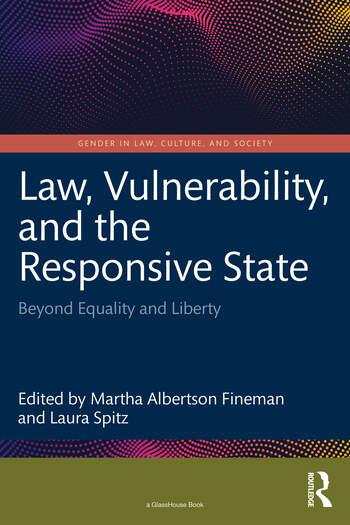
Law, Vulnerability, and the Responsive State: Beyond Equality and Liberty

by Martha Albertson Fineman and Laura Spitz, Editors

In this book, multiple authors explore how vulnerability theory can provide the basis for a reconceptualization of the liberal ideas of autonomy, equality, and freedom. The object is to achieve a truly comprehensive and inclusive notion of what constitutes social justice or a universal or common good. In particular, when recognizing that many social or institutional relationships entail uneven positions of dependence and reliance, it seems apparent that individualized notions of equality or freedom are inadequate and must be reformulated by incorporating asymmetric or unequal allocations of responsibility, requiring appropriate limitations on the individual.


This book, covering areas such as employment, corporation, health, and family law, will appeal to scholars and students in law, vulnerability studies, gender studies, critical legal and political theory, politics, philosophy, and sociology.


Pre-order the book here.

How Feminist Legal Theory Can Make a Difference

"Little Girl From Harlem" (1995) by Soraida Martinez

Join us on Tuesday, August 2 for the second workshop in the 2023 Virtual Summer Feminist Legal Theory Series. This second session will look at the Feminist Judgments Project, considering its approach to integrating feminist theory into law by rewriting (and thus critiquing) judicial opinions to reflect feminist principles and methods in major areas of law.

See the video from the first session here. Register here.

“Guilt-Free Markets? Unconscionability, Conscience, and Emotions”

by Hila Keren

'Professor Keren enters the discussion on unconscionably from a unique angle: focused less on the bottom line of jurisprudence and more on the law’s expressive power—the fact that the law’s impact extends beyond its ability to sanction or reward behaviors. Specifically, she argues that the way in which courts frame and discuss both market misbehaviors and the harms they cause may have an immense impact on other peoples’ behaviors, a potential that is currently unrecognized. Judicial reviews that reach the public domain have the power to encourage or discourage future wrongful behaviors and, more broadly, to influence the social and ethical norms governing the market.


Her Article begins with a fundamental premise that receives far too little consideration in traditional, economic, and even behavioral legal analyses, asserting emotions play a leading role in shaping moral judgments and altering actions. Considering the impact of law in the domain of the emotions is key to understanding how unconscionability-based messages may curb exploitative behavior by fostering self-restraint.'  Read more here.

Connect with us
Facebook  Twitter