|
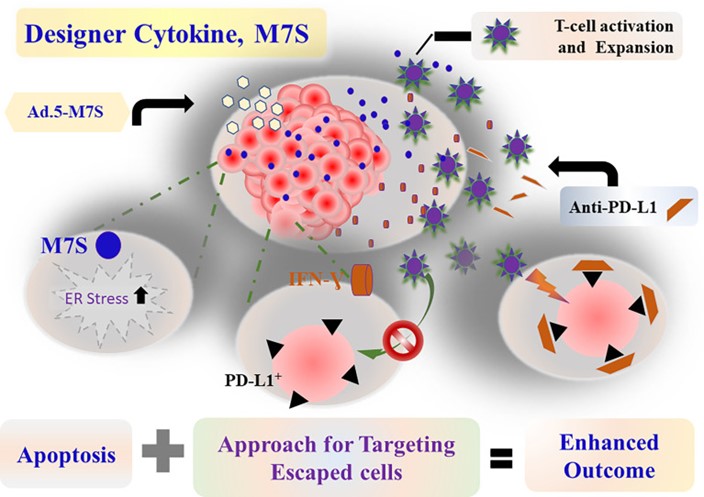
M7S was engineered in a two-step process by first replacing the endogenous secretory motif with an alternate secretory motif to boost secretion. Among four different signaling peptides, the insulin secretory motif significantly enhanced the secretion of MDA-7 (IL-24) protein and was chosen for M7S. The second modification engineered in M7S was designed to enhance the stability of MDA-7 (IL-24), which was accomplished by replacing lysine at position K122 with arginine. This engineered "M7S Superkine" with increased secretion and stability retained cancer specificity. Compared to parental MDA-7 (IL-24), M7S (IL-24S) was superior in promoting anti-tumor and bystander effects leading to improved outcomes in multiple cancer xenograft models. Additionally, combinatorial therapy using MDA-7 (IL-24) or M7S (IL-24S) with a checkpoint inhibitor, anti-PD-L1, dramatically reduced tumor progression in murine B16 melanoma cells. These results portend that M7S (IL-24S) promotes the re-emergence of an immunosuppressive tumor microenvironment, providing a solid rationale for prospective translational applications of this therapeutic designer cytokine.
Publication:
* Pradhan AK, Bhoopathi P, Maji S, Kumar A, Guo C, Mannangatti P, Li J, Wang XY, Sarkar D, Emdad L, Das SK, Fisher PB. Enhanced Cancer Therapy Using an Engineered Designer Cytokine Alone and in Combination with an Immune Checkpoint Inhibitor. Front Oncol. 2022 Mar 24;12:812560. PMCID: PMC8988683
About the Investigators: Paul B. Fisher, MPh, PhD, FNAI, is Professor and Chair of the VCU Department of Human and Molecular Genetics (HMG), Director of the VCU Institute of Molecular Medicine (VIMM) and Thelma Newmeyer Corman Chair in Cancer Research in the VCU Massey Cancer Center (MCC), Virginia Commonwealth University, School of Medicine, Richmond, VA. Anjan K. Pradhan, PhD, lead investigator on this project, is an Instructor in the Department of Human and Molecular Genetics (HMG). He performed much of the biological and animal work. Santanu Maji, PhD is a postdoc in HMG and Praveen Bhoopathi, PhD Instructor in HMG contributed equally to this study. Chunqing Guo, PhD, and Jiong Li, PhD, are Assistant Professors in VCU. Swadesh K. Das, PhD, Luni Emdad, MBBS, PhD, are Associate Professors in HMG and Members of the VIMM. They are major contributors to these studies. Devanand Sarkar, MBBS, PhD and Xiang-Yang Wang, PhD are Professors in HMG and Associate Directors of Cancer Therapeutics and Immunology, respectively, in the VIMM. Padmanabhan Mannangatti, Ph.D., is a senior technician and laboratory manager in the Fisher laboratory who contributed to the animal therapeutic studies The study was supported in part by NIH/National Cancer Institute (NCI) Grants R01 CA244993 (to D.S. and P.B.F.), CA259599 (to P.B.F. and X.-Y.W.) and CA099326 and CA229812 (to X.-Y.W.); the National Foundation for Cancer Research; and a Sponsored Research Agreement between VCU and ILCT Therapeutics (to L.E.). P.B.F. holds the Thelma Newmeyer Corman Chair in Cancer Research at the MCC. D.S. is the Harrison Foundation Distinguish Professor in Cancer Research at the MCC. X.-Y.W. holds the Harry and Judy Wason Chair in Cancer Research at the MCC. Services and products in support of the research project were generated by the VCU MCC Flow Cytometry Shared Resource and Cancer Mouse Models Core Laboratory, supported, in part, with funding from NIH/NCI Cancer Center Support Grant P30 CA016059.
|