|
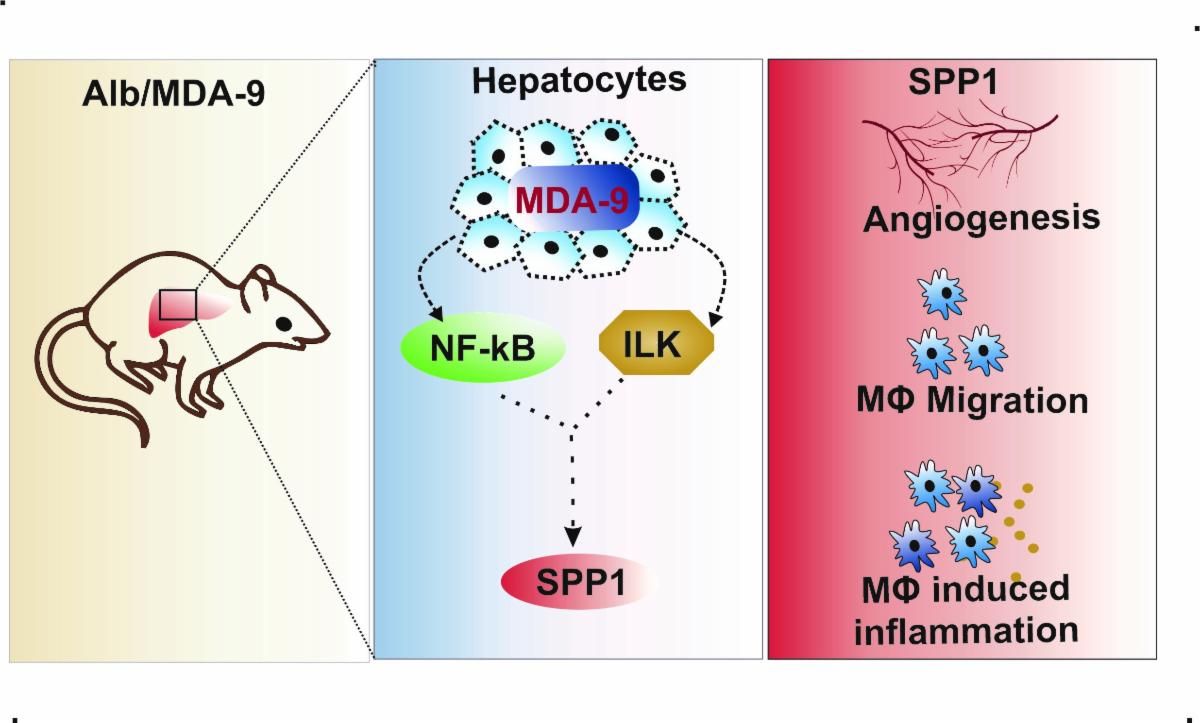
HCC is a disease of chronic inflammation. Liver-resident macrophages (Kupffer cells) and infiltration of monocyte-derived macrophages play a central role in generating a pro-inflammatory and pro-tumorigenic milieu as a consequence of HCC-inducing risk factors, such as viral hepatitis, alcoholism and non-alcoholic fatty liver disease (NAFLD). These underlying conditions cause hepatocyte damage with release of cytokines, such as IL-1b, that activate NF-kB in macrophages resulting in the production of proinflammatory cytokines like IL-6. IL-6 in turn activates STAT3 in hepatocytes leading to tumorigenesis. In this context, the present studies identify that MDA-9 plays a key role by activating NF-kB which induces Spp1 causing macrophage migration. It was demonstrated that MDA-9 overexpression in hepatocytes induced pro-inflammatory cytokines and Spp1 thereby stimulating macrophage recruitment and inflammation. Collectively, these studies establish MDA-9 as a key inflammation activator.
These observations establish the rationale that MDA-9 inhibition, either alone or in combination, might be an effective treatment approach for HCC. The next step in these studies is to address this hypothesis by using PDZ1i, a novel MDA-9 inhibitor, discovered by Dr. Fisher and shown by his team to be a potent inhibitor of the major stages of cancer progression and metastasis.
This work was supported in part by The National Cancer Institute (NCI) Grants 1R01CA230561-01A1 (DS), 1R01CA240004-01 (DS) and 1R01CA244993-01 (DS and PBF), and The National Institute of Diabetes and Digestive and Kidney Diseases (NIDDK) Grant 2R01DK107451-05 (DS). Services in support of this project were provided by the VCU Massey Cancer Center Transgenic/Knock-out Mouse Facility, Tissue and Data Acquisition and Analysis Core, Bioinformatics core and Flow Cytometry Shared Resource supported in part with funding from NIH-NCI Cancer Center Support Grant P30 CA016059. Data was generated at the Genomics Core Facility at Virginia Commonwealth University, and in the Genome Sequencing Facility at UT Health San Antonio which is supported by NIH-NCI Grant P30 CA054174, NIH Shared Instrument grant 1S10OD021805-01, and CPRIT Core Facility Award (RP160732).
Publication:
* Manna D, Reghupaty SC, Camarena MDC, Mendoza RG, Subler MA, Koblinski JE, Martin R, Dozmorov MG, Mukhopadhyay ND, Liu J, Qu X, Das SK, Lai Z, Windle JJ, Fisher PB, Sarkar D. Melanoma differentiation associated gene-9/syndecan binding protein promotes hepatocellular carcinoma. Hepatology. 2022 Sep 19. DOI: 10.1002/hep.32797
About the Investigators: Devanand Sarkar is Professor of Human and Molecular Genetics, VCU School of Medicine (VCU SOM), as well as the Harrison Foundation Distinguished Professor in Cancer Research. He is Associate Director for Training and Education of the Massey Cancer Center (MCC), and Associate Scientific Director, Cancer Therapeutics, VCU Institute of Molecular Medicine. Paul B. Fisher, MPh, PhD, FNAI, is Professor and Chair of the VCU Department of Human and Molecular Genetics (HMG), Director of the VCU Institute of Molecular Medicine (VIMM) and Thelma Newmeyer Corman Chair in Cancer Research in the VCU Massey Cancer Center (MCC), VCU SOM. Jolene J. Windle is the Irene Shaw Grigg Professor of Genetics in Human and Molecular Genetics, and a Member of the VIMM, VCU SOM, and the Director of the VCU Transgenic/Knockout Mouse Core. Jinze Liu is Professor of Biostatistics, VCU SOM and Director of Bioinformatics Shared Resources, MCC. Jennifer E. Koblinski is Associate Professor of Pathology, VCU SOM, as well as Director of Cancer Mouse Models Core and Co-Director of Tissue and Data Acquisition and Analysis Core, MCC. Rebecca K. Martin is Assistant Professor of Microbiology & Immunology, VCU SOM and Director of Flow Cytometry Shared Resource, MCC. Mikhail G. Dozmorov is Associate Professor of Biostatistics and Pathology, VCU SOM. Nitai Mukhopadhyay is Associate Professor of Biostatistics, VCU SOM. Mark A. Subler is Associate Professor of Human and Molecular Genetics, VCU SOM. Swadesh K. Das is Associate Professor of Human and Molecular Genetics, and a Member of the VIMM, VCU SOM. Debashri Manna is a post-doctoral fellow in Human and Molecular Genetics, VCU SOM. Saranya Chidambaranathan Reghupaty and Maria Del Carmen Camarena are graduate students in C. Kenneth and Dianne Wright Center for Clinical and Translational Research, VCU. Rachel Mendoza is a Laboratory and Research Manager in Human and Molecular Genetics, VCU SOM. Xufeng Qu is a Bioinformatics Specialist in the Bioinformatics Shared Resources, MCC. Zhao Lai is the Director of the Genome Sequencing Facility of Greehey Children’s Cancer Research Institute at UT Health San Antonio.
|