|
Innovative approach to study contact-specific gene regulation during embryogenesis
Starting from conception, cells within a developing organism constantly communicate with each other. These interactions between neighboring cells can cause those cells to evolve in a specific manner. Up until now, the nature of these changes and how they occur has not been adequately characterized. In a recent article published in PNAS, Drs. Madan and Gogna with VCU and VIMM colleagues, Drs. Vudatha, Winn, Trevino, and Fisher, and external colleagues, Drs. Kim, Rothová, Rhee, Weng, Palma, Liao, David, Amit, Hajkarim, Gutiérrez-García, Moreno, Brickman and Won, have shown that embryonic cells in physical contact with each other can induce specific alterations at a genetic level. The authors plan to use this method of studying cell-cell interactions to further their understanding of cancer development and progression.
Highlights of the study:
- Physical contact between neighboring cells is known to induce transcriptional changes in the interacting partners.
- Current single cell RNA sequencing (scRNA-seq) technology isolates the tissue into individual cells, making it hard to determine the potential transcriptomic changes due to cell-cell interactions.
- In this study the authors combined RNA sequencing of physically interacting cells (PIC-seq) and computational algorithms to identify cell type contact-dependent transcriptional profiles focusing on endoderm development.
- The authors have computationally identified and experimentally validated specific gene expression patterns depending on the presence of specific neighboring cell types.
- This study suggests a new innovative approach to disentangle the role of cell–cell interactions during embryogenesis.
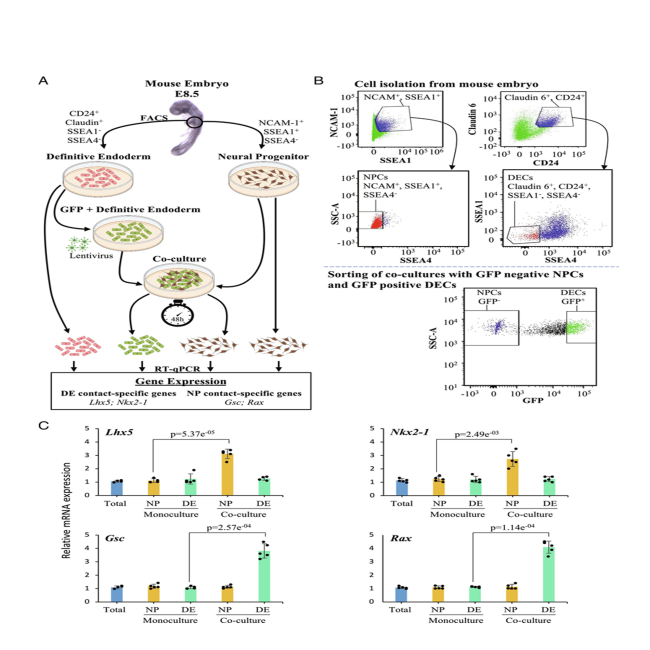
Development of multicellular organisms is orchestrated by persistent cell–cell communication between neighboring partners. Direct interaction between different cell types can induce molecular signals that dictate lineage specification and cell fate decisions. Current single-cell RNA-seq technology cannot adequately analyze cell–cell contact-dependent gene expression, mainly due to the loss of spatial information. To overcome this obstacle and resolve cell–cell contact-specific gene expression during embryogenesis, the authors performed RNA sequencing of physically interacting cells (PIC-seq) and assessed them alongside similar single-cell transcriptomes derived from developing mouse embryos between embryonic day (E) 7.5 and E9.5. Analysis of the PIC-seq data identified gene expression signatures that were dependent on the presence of specific neighboring cell types. The computational predictions, which were validated experimentally, demonstrated that neural progenitor (NP) cells upregulate Lhx5 and Nkx2-1 genes, when exclusively interacting with the definitive endoderm (DE) cells (Fig. 1). Moreover, there was a reciprocal impact on the transcriptome of the DE cells, as they tend to upregulate Rax and Gsc genes when in contact with the NP cells. Using individual cell transcriptome data, they formulated a means of computationally predicting the impact of one cell type on the transcriptome of its neighboring cell types. The authors have further developed a distinctive spatial-t-distributed stochastic neighboring embedding to display the pseudospatial distribution of cells in a 2-dimensional space. In summary, they describe an pioneering approach to study contact-specific gene regulation during embryogenesis.*
This work was supported by a Novo Nordisk Foundation grant (NNF21CC0073729 and previously NNF17CC0027852). The authors thank the reNEW Genomics Platform (H. Neil, M. Michaut and H. Wollmann), reNEW Flow Cytometry Platform (G. dela Cruz and P. van Dieken), Teresa E. Knudsen, Molly Lowndes, and Yan Fung Wong for critical reading of this manuscript. This work was also supported by the Lundbeck Foundation (R324-2019-1649 and R313–2019–421) and Cedars-Sinai startup Funds to K.J.W., by Virginia Commonwealth University Startup Funds, VCU Institute of Molecular Medicine (VIMM), VCU Massey Cancer Center Startup Funds (MCC), Swiss Cancer League, Seeds of Science, Swiss National Science Foundation, Fundação para a Ciência e a Tecnologia, and Fundamental Mandates (Stichting tegen Kanker—Fondation contre le Cancer) to R.G. The National Research Foundation of Korea (NRF) grant funded by the Korea government (MSIT) to J.K. (No. 2021R1F1A1063914 and 2021M3H9A2096988); La Caixa Funding (LCF/BQ/PR20/11770006) to E.M.; Lundbeck Foundation (R198- 2015-412), Independent Research Fund Denmark (8020-00100B and 6110- 00009), the Novo Nordisk Foundation (NNF17OC0028218), the Danish National Research Foundation (DNRF116) to J.M.B.; Fundação para a Ciência e a Tecnologia Grant 2020.05319.BD to A.M.P; and Thelma Newmeyer Corman Chair in Cancer Research, VIMM and MCC developmental funds, HMG developmental funds, and NIH grants NIH/National Cancer Institute R01 CA259599 and R01 CA244993 to P.B.F.
Publication:
* Kim J, Rothová MM, Madan E, Rhee S, Weng G, Palma AM, Liao L, David E, Amit I, Hajkarim MC, Vudatha V, Gutiérrez-García A, Moreno E, Winn R, Trevino J, Fisher PB, Brickman JM, Gogna R, Won KJ. Neighbor-specific gene expression revealed from physically interacting cells during mouse embryonic development. Proc Natl Acad Sci U S A. 2023 Jan 10;120(2):e2205371120. PMCID: PMC9926237
About the Investigators: Junil Kim, Guangzheng Weng, Linbu Liao, Morteza Chalabi Hajkarim are research fellows, Biotech Research and Innovation Centre, University of Copenhagen, Copenhagen N 2200, Denmark. Junil Kim is also affiliated with School of Systems Biomedical Science, Soongsil University, Dongjak-Gu, Seoul 06978, Republic of Korea. Michaela Mrugala Rothová and Joshua M. Brickman are research fellows, in Novo Nordisk Foundation Center for Stem Cell Medicine (reNEW), University of Copenhagen, Copenhagen 2200, Denmark. Esha Madan, António M Palma, Andrés Gutiérrez-García, and Eduardo Moreno are/were research fellows, Champalimaud Centre for the Unknown, Lisbon 1400-038, Portugal. Esha Madan is currently an Assistant Professor in the Department of Surgery and an Affiliate member in the Department of Human and Molecular Genetics. She is also a member of the VCU Institute of Molecular Medicine (VIMM) and the VCU Massey Cancer Center (MCC) in the VCU School of Medicine (VCU SOM). Siyeon Rhee is a research fellow in the Department of Biology, Stanford University, Stanford, CA. Eyal David, Ido Amit are research fellows in the Department of Immunology, Weizmann Institute of Science, Rehovot 7610001, Israel; Vignesh Vudatha is a Research Resident in General Surgery Residency Program in VCU SOM. Robert A. Winn, Director and Lipman Chair in Oncology, VCU MCC, Senior associate dean for cancer innovation and professor of pulmonary disease and critical care medicine, VCU SOM. Jose G. Trevino, Associate Professor & Chair, Division of Surgical Oncology, Surgeon-in-Chief, VCU MCC, VCU SOM. Paul B. Fisher, MPh, PhD, FNAI, is Professor and Chair of the VCU Department of Human and Molecular Genetics (HMG), Director of the VCU Institute of Molecular Medicine (VIMM) and Thelma Newmeyer Corman Chair in Cancer Research in the VCU MCC, VCU SOM. Rajan Gogna, Lab Head: Cell Competition in Tumor Microenvironment Laboratory, Associate Director- Tumor Microenvironment Program, VIMM, Assistant Professor, Department of Human & Molecular Genetics, VCU SOM. Kyoung Jae Won, Research Scientist, Computational Biomedicine, Cedars-Sinai Medical Center, Los Angeles, CA 90069
|