|
Cell Competition in Carcinogenesis
Within a group of cells, changes can occur at a genetic level that render some cells “less fit” than others. Through competition, these populations of cells can become less prevalent, while “more fit” cells flourish. In a recent review article published in Cancer Research, Madan with VCU, Drs. Vudatha, Trevino, Winn, Fisher and Gogna, and external colleagues, Drs. Palma, Ntarajan, Won, Graham, Drapkin and McDonald, have reviewed the concept of cell competition and how it applies to the cancer environment. While competition occurs between cells within a tumor, the same interactions are also observed between cancerous and non-cancerous tissues. Expanding our knowledge in this area of cancer dynamics will allow us to uncover new therapeutic targets.
Highlights of the review:
- Cancer clonal evolution is dependent on cell-extrinsic interactions between additional cells as well as cues from the microenvironment.
- Observational findings from various human tissues and experimental models suggest CC may be a crucial mediator of clonal dynamics in normal tissues and throughout tumorigenesis, as it has been implicated in initial tissue transformation, field cancerization, and tumor outgrowth at the expense of normal tissue.
- CC offers a distinct lens into the evolution of premalignant lesions into malignant cancers.
- With the advancement of our understandings of CC, new potential therapeutic targets will be uncovered and specific genomic changes that will allow more accurate staging of premalignant and metastatic cancers and lead to enhanced prognostication of therapeutic responses.
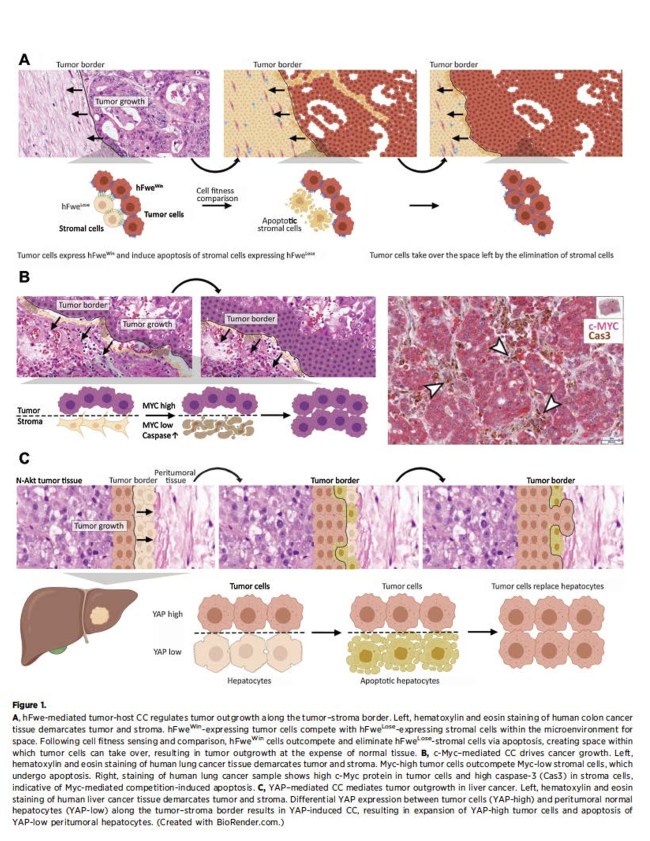
The majority of human cancers evolve over time through the stepwise accumulation of somatic mutations followed by clonal selection akin to Darwinian evolution. However, the in-depth mechanisms that govern clonal dynamics and selection remain elusive, particularly during the earliest stages of tissue transformation. Cell competition (CC), often referred to as survival of the fittest at the cellular level, results in the elimination of less fit cells by their more fit neighbors supporting optimal organism health and function. Alternatively, CC may allow an uncontrolled expansion of super-fit cancer cells to outcompete their less fit neighbors thereby fueling tumorigenesis. Recent research discussed in this Cancer Research review highlights the various non–cell-autonomous principles, including inter-clonal competition and cancer-microenvironment competition supporting the ability of a tumor to progress from the initial stages to tissue colonization. In addition, authors extend current insights from CC-mediated clonal interactions and selection in normal tissues to better comprehend those factors that contribute to cancer development clonal interactions and selection in normal tissues to better comprehend those factors that contribute to cancer development (Fig. 1).
This work leading to this review was supported by ERC to E. Madan, SNSF, Swiss Cancer League, LB692, and FCT LB506 to R. Gogna. Research work was also provided by NIH SPORE P50 CA228991 (to R. Drapkin), NIH/NCI R01 CA244993 (to Devanand Sarkar and P.B. Fisher), NIH/NCI R01 CA259599 (to P.B. Fisher and X.-Y. Wang), the U.S. Department of Defense (OC170094, OC180420), a grant from Virginia’s Commonwealth Health Research Board (P.B. Fisher), the VCU Massey Cancer Center core grant NIH-NCI Cancer Center Support Grant P30 CA016059 (to J.G. Trevino, R.A. Winn, P.B. Fisher, and R. Gogna), the Dr. Miriam and Sheldon G. Adelson Medical Research Foundation (to R. Drapkin), the Honorable Tina Brozman Foundation for Ovarian Cancer Research (to R. Drapkin), The Penn Medicine Abramson Cancer Center - Ovarian Cancer Translational Center of Excellence (to R. Drapkin), The Basser Center for BRCA (to R. Drapkin), and the Claneil Foundation (to R. Drapkin). T.A. Graham acknowledges support from Cancer Research U.K. (A19771). S.A. McDonald also acknowledges support from Cancer Research U.K. (A21446 and A29072). Support from the Thelma Newmeyer Corman Endowment (to P.B. Fisher) is also acknowledged.
Publication:
* Madan E, Palma AM, Vudatha V, Trevino JG, Natarajan KN, Winn RA, Won KJ, Graham TA, Drapkin R, McDonald SAC, Fisher PB, Gogna R. Cell Competition in Carcinogenesis. Cancer Res. 2022 Dec 16;82(24):4487-4496. PMID: 36214625 DOI: 10.1158/0008-5472.CAN-22-2217
About the Investigators: Esha Madan and António M Palma were research fellows, Champalimaud Centre for the Unknown, Lisbon 1400-038, Portugal. Esha Madan is currently an Assistant Professor in the Department of Surgery and an Affiliate member in the Department of Human and Molecular Genetics. She is also a member of the VCU Institute of Molecular Medicine (VIMM) and the VCU Massey Cancer Center (MCC) in the VCU SOM. Vignesh Vudatha is a Research Resident in General Surgery Residency Program, VCU School of Medicine (VCU SOM). Jose G. Trevino, Associate Professor & Chair, Division of Surgical Oncology, Surgeon-in-Chief, VCU MCC, VCU SOM. Kedar Nath Natarajan is an Assistant Professor at Department of Biochemistry and Molecular Biology at The University of Southern Denmark. Robert A. Winn, Director and Lipman Chair in Oncology, VCU MCC, Senior associate dean for cancer innovation and professor of pulmonary disease and critical care medicine, VCU SOM. Kyoung Jae Won, Research Scientist, Computational Biomedicine, Cedars-Sinai. Trevor A. Graham, Professor of Genomics and Evolution, Evolution and Cancer Laboratory, Centre for Cancer Genomics and Computational Biology, Barts Cancer Institute, Barts and The London School of Medicine and Dentistry. Ronny Drapkin, Franklin Payne Associate Professor of Pathology in Obstetrics & Gynecology, Director, Gynecologic Cancer Research, Basser Center for BRCA, University of Pennsylvania. Stuart A C McDonald, Reader in Gastroenterology, Centre for Cancer Genomics and Computational Biology, Barts Cancer Institute, London. Paul B. Fisher, MPh, PhD, FNAI, is Professor and Chair of the VCU Department of Human and Molecular Genetics (HMG), Director of the VCU Institute of Molecular Medicine (VIMM) and Thelma Newmeyer Corman Chair in Cancer Research in the VCU MCC, VCU SOM. Rajan Gogna, Lab Head: Cell Competition in Tumor Microenvironment Laboratory, Co-Director Tumor Microenvironment Program, VIMM, Assistant Professor, Department of Human & Molecular Genetics, member of the VCU MCC, VCU SOM.
|