|
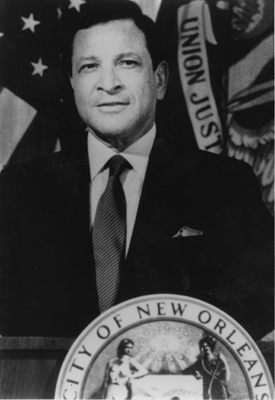
ERNEST NATHAN "DUTCH" MORIAL (1929-1989)
Born in New Orleans, Louisiana on October 9, 1929, Ernest “Dutch” Morial grew up in the city’s English and French-speaking Seventh Ward. His father was a cigar maker and his mother was a seamstress. Graduating from Xavier University, a historically black Catholic institution in 1951, he became the first African American to receive a law degree from Louisiana State University in 1954. Battling segregation in the courtroom, he was elected president of the local NAACP chapter. In 1967 Morial became the first African American elected to the Louisiana State legislature since Reconstruction. Later, he became the first Juvenile Court judge in 1970, and the first Circuit Court of Appeals judge of his race in Louisiana in 1974.
In 1977 Morial was elected the first African American mayor of New Orleans, with 95% of the black vote, and 20% of the white vote, mostly from the city’s middle and upper-class Uptown neighborhoods. Morial was reelected to his second term in March 1982.
Morial redoubled the city's commitment to affirmative action in hiring city workers and introduced minority hiring quotas for city contractors. The proportion of black employees on the city's workforce increased from 40% in 1977 to 53% in 1985 under Morial's tenure. Under Morial's administration, the number of black officers in the NOPD was increased to make up one-third of the force.
Morial was responsible for getting federal Urban Development Action Grant (UDAG) funding for several major projects, including Canal Place and the Jax Brewery development in the French Quarter. He continued to support the previous mayor Moon Landrieu’s emphasis on tourism and tried to diversify the economy by developing the Almonaster-Michoud Industrial District in New Orleans East, now called the New Orleans Regional Business Park.
Downtown New Orleans underwent an impressive building boom, with multiple office towers constructed to house the headquarters, or large regional offices, for companies such as Freeport-McMoRan, Pan American Life Insurance, Exxon, Chevron, Gulf Oil, Amoco, Mobil, Murphy Oil and Texaco. By the mid-1980s, these firms, with other large employers, such as Royal Dutch Shell, Louisiana Land and Exploration, and McDermott International, employed thousands of white-collar workers downtown, with thousands more employed by others providing services to them.
Morial was prevented by the city charter from seeking a third term.
New Orleans renamed its convention center, which spans over 10 blocks, the Ernest N. Morial Convention Center in 1992 for the late mayor. The convention center has been a major economic engine for the city's large tourist industry and, in 2005, became a highly publicized national symbol when it served as a makeshift evacuation center in the aftermath of Hurricane Katrina.
In 1997, the Louisiana State University Health Sciences Center posthumously honored Morial with the dedication of the Ernest N. Morial Asthma, Allergy and Respiratory Disease Center. The facility is Louisiana's first comprehensive center for the education, prevention, treatment and research of asthma and other respiratory diseases. "Dutch" suffered and eventually died from complications associated with asthma.
Many observers felt that only death prevented him from entering the 1990 mayoral race. Four years later, in 1994, his son Marc Morial was elected mayor of New Orleans.
Morial was the 23rd general president of Alpha Phi Alpha, the first intercollegiate Greek-letter organization established for African Americans. In 1993, Morial was named one of the first thirteen inductees into the Louisiana Political Museum and Hall of Fame in Winnfield, the first African American so honored.
A public school in New Orleans East was named after him: Ernest N. Morial Elementary.
Primary Source: Wikipedia and BlackPast
|