|
Dear friends of VTIPG and the Community Change Collaborative,
We share five articles each week that we find timely and meaningful that address concerns related to the state of our democracy and civil society. We aim to offer pieces that illuminate significant dimensions of our country's policy and governance challenges and the state of social norms that sustain the possibility of addressing those concerns. Please note, the views expressed in these essays do not necessarily reflect the perspectives of VTIPG faculty or staff or of Virginia Tech. We upload these articles and stories to our website. You may find that archive at News and Opportunities at http://ipg.vt.edu. Thank you to IPG Community-Based Research Manager Lara Nagle for serving as guest editor this week.
All five articles this week focus on the Trump administration's attack on bedrock environmental regulations and the systematic dismantling of environmental health protections in favor of enriching an exclusive minority of corporate and fossil fuel interests.
If you would like to suggest an article for consideration, please contact us below.
-
Our first piece this week, from the New York Times, discusses the administration's decision to redefine a decades'-old understanding of "harm" to animals listed under the Endangered Species Act (ESA), opening up drilling, mining, and development in critical habitats.
-
A second selection, published by Politico, reports on data centers avoiding federal permits for construction in part due to codification of Sackett ruling that significantly reduced the number of streams and wetlands protected by the Clean Water Act (CWA).
-
Our third story, from BBC News, analyzes the reversal of an Obama-era policy to limit the Environmental Protection Agency's ability to determine which greenhouse gases are harmful to the environment, in an effort to deregulate vehicle emissions.
-
Our fourth selection, from Earth, recaps the staggering reversal of progress to address climate change so far in President Trump's second term.
-
Last, we feature a piece from KUER that discusses the reduction of federal protection for two Utah National Monuments, opening the door to development in these natural habitats.
Brief synopses of these articles appear below. We hope the perspectives they offer encourage reflection and conversation!
Best wishes,
Billy Parvatam
VTIPG Communications Coordinator
pbilly97@vt.edu.
| | | Photo: Piping plovers need undisturbed beaches to nest and raise their young. Source: New York Times. |
Trump, ending decades of protection, opens wild habitats to drilling and mining
This New York Times article by Catrin Einhorn and Maxine Joselow discusses the Trump administration's decision to allow farming, drilling, mining, and real estate development on the habitats of endangered animals. The Departments of Interior and Commerce rescinded a well-established, broad definition of "harm" to no longer include damage to or destruction of habitats that animals rely on to survive. Even though research has found that habitat modification or degradation is the main driver of biodiversity loss around the world, this policy change was made without a thorough scientific review and has been strongly opposed by public commenters as well as attorneys general from over a dozen states. Endangered species lost protections in March, when administration officials exempted oil and gas drilling in the Gulf of Mexico from protections for whales and other affected species. Environmental groups have promised to take this case to court, but with a conservative majority on the Supreme Court, there is a risk that this narrower definition of harm could become enshrined into law.
Einhorn, C., & Joselow, M. (2026, July 10). "Trump, ending decades of protection, opens wild habitats to drilling and mining." New York Times. https://www.nytimes.com/2026/07/10/climate/endangered-species-act-harm.html?unlocked_article_code=1.xVA.Legp.aawayjaVO7Iu&smid=url-share
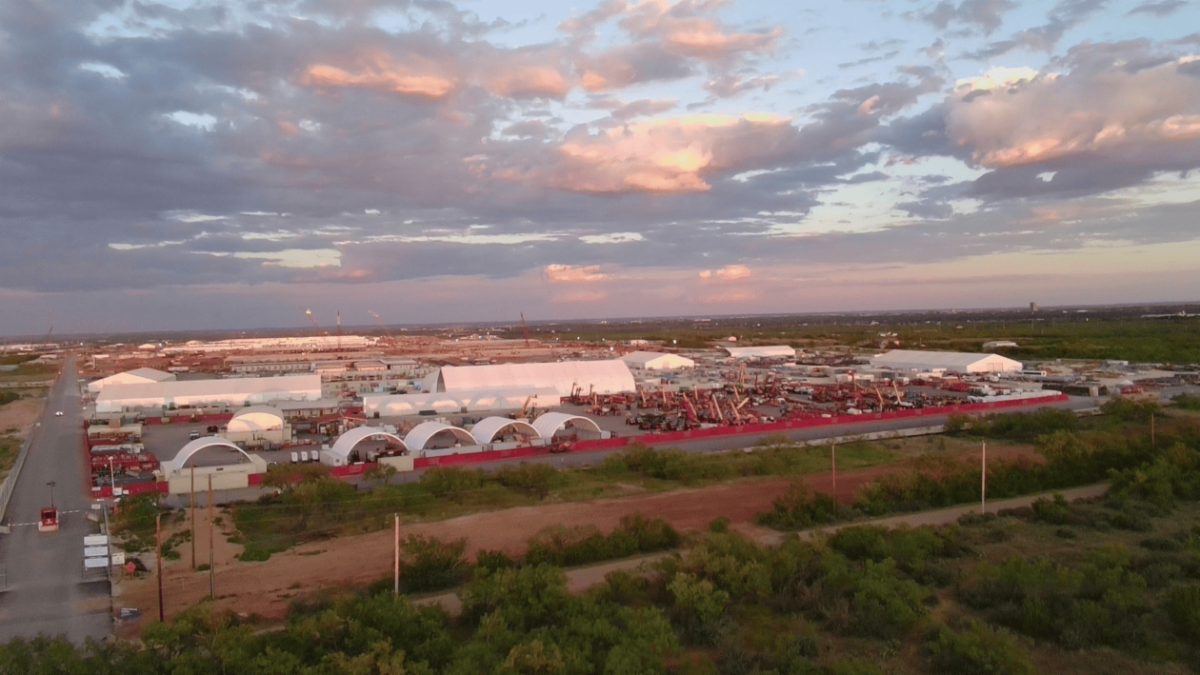
| | Photo: The Stargate artificial intelligence data center complex in Abilene, Texas. Source: Politico. | |
The 'time-consuming' permits dozens of data centers are skipping
This Politico piece by Miranda Willson discusses a 2023 Supreme Court ruling (Sackett v. Environmental Protection Agency) that considerably shrank the number of streams and wetlands protected by the Clean Water Act (CWA) and is now being further codified by Trump's EPA. Prior to this change, the CWA was one of the only legal mechanisms through which public citizens could challenge the construction of environmentally-damaging development, such as data centers and oil pipelines. CWA permit applications also historically have triggered environmental review under the National Environmental Policy Act (NEPA), which requires community input and thorough environmental impact assessments. Development in areas with streams, wetlands, and bodies of water that no longer fall under the CWA can still have serious and lasting consequences for local flooding and water quality degradation. Data centers pose several air and water quality concerns, in addition to the risk of driving up energy costs if unregulated. The lack of federal permitting and oversight is leading to fast-tracked data center projects that the public and state agencies have little knowledge about. It also puts the onus on states to enforce damages, some of which cannot implement more stringent policies than what is allowed at the federal level. Trump has additionally opened up the nationwide permitting program to AI data centers so that projects applying for a permit have an accelerated review that doesn't require public notice, and they do not need to comply with site-specific monitoring or reporting requirements. As one affected resident in Ohio noted, "It's not even about data centers anymore at this point. It's like, what's happening to our democracy and what's happening to our right to clean water and clean air?"
Willson, M. (2026, July 8). "The ‘time-consuming’ permits dozens of data centers are skipping." Politico. https://www.politico.com/news/2026/07/08/trump-data-centers-water-supreme-court-00958383
| | Photo: The Environmental Protection Agency. Source: Wikipedia. | |
Trump revokes landmark EPA ruling that greenhouse gases endanger public health
This BBC News article analyzed President Trump's decision to reverse an Environmental Protection Agency (EPA) scientific ruling made during the Obama Administration concluding that a number of greenhouse gases were a threat to public health, a finding that has become the basis for federal government efforts to curb emissions from any fossil fuel combustion, including pollution from power plants, methane from landfills, oil and gas pipeline emissions, and vehicle pollution. In 2009, the EPA had ruled that six greenhouse gases were a danger to the planet and to human health, and the agency became key to federal efforts in an era of divided Congressional control. While the Trump Administration claims the deregulation will make vehicles more affordable, Americans will spend more at the pump to fill up gas-guzzling vehicles, and communities will experience higher rates of lung and heart disease. The Environmental Defense Fund analyzed the health impacts of this policy and found that the action would result in up to 58,000 additional premature deaths and 37 million more asthma attacks. Automakers are scrapping plans for fuel-efficient and electric models despite spending billions on research and development in these areas. Inefficient vehicles will also not sell well internationally because other countries are imposing stricter fuel efficiency standards. This is another ruling that if challenged legally and it escalates to the Supreme Court, there is a risk it will become a permanent law that can only be overturned by Congressional legislation.
McGrath, M. (2026, February 13). "Trump revokes landmark EPA ruling that greenhouse gases endanger public health." BBC News. https://www.bbc.com/news/articles/cn0zdd7yl4vo
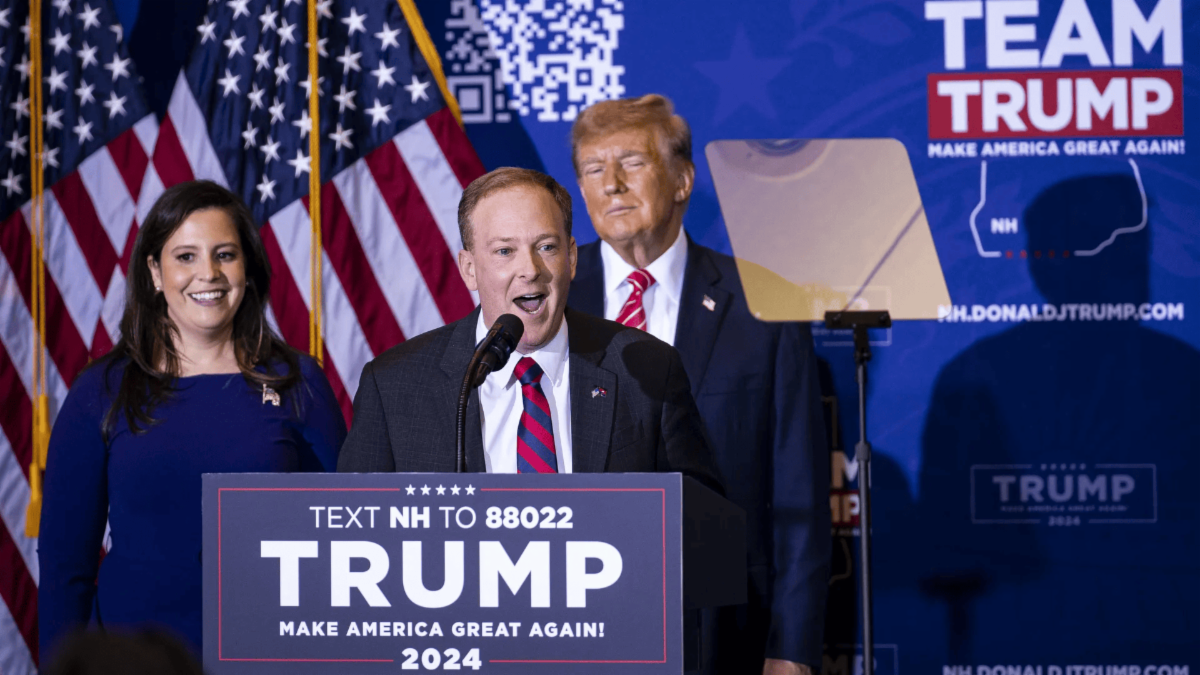
| | Photo: President Trump selected Lee Zeldin to run the Environmental Protection Agency in his second term. Source: Axios. | |
One year of Trump: How the US reversed climate progress
This piece by environmental think thank Earth.org recounts the damage the Trump administration has done to U.S. climate policy in the first year of his second term under the false premise that the country is facing a "national energy emergency." Among the most dramatic backpedaling, the administration has issued a series of executive orders that expedite leases and streamline permitting for coal mining on federal lands, as well as opening up the Artic National Wildlife Refuge for drilling. Additionally, they have blocked billions of dollars in funding for clean energy projects across the country and have repeatedly lied about the competitive efficiency of wind and solar power. The Trump administration has rescinded dozens of environmental rules, including "national air quality standards for particulate matter, limits on wastewater discharges for oil and gas extraction facilities, and regulations on power plant emissions and vehicle pollution" and has pulled back unspent funding from the $5 billion National Electric Vehicle (EV) Infrastructure Fund to build out an EV nationwide charging infrastructure. In addition, tens of thousands of federal workers fired from agencies such as the National Oceanic and Atmospheric Administration (NOAA), the Environmental Protection Agency (EPA), and the U.S. Agency for International Development (USAID) has led to the suppression of climate research at home and abroad. Lastly, Trump has yanked the U.S. out of 60 international agreements to fight climate change including the Paris agreement, the Intergovernmental Panel on Climate Change (IPCC), and a global plastic treaty aimed at capping petroleum-based plastics production, debilitating America's ability to advance a rational climate agenda and set an example for the world.
Igini, M. (2026, January 20). "One year of Trump: How the US reversed climate progress." Earth. https://earth.org/one-year-of-trump-how-the-us-reversed-climate-progress-at-home-and-abroad/
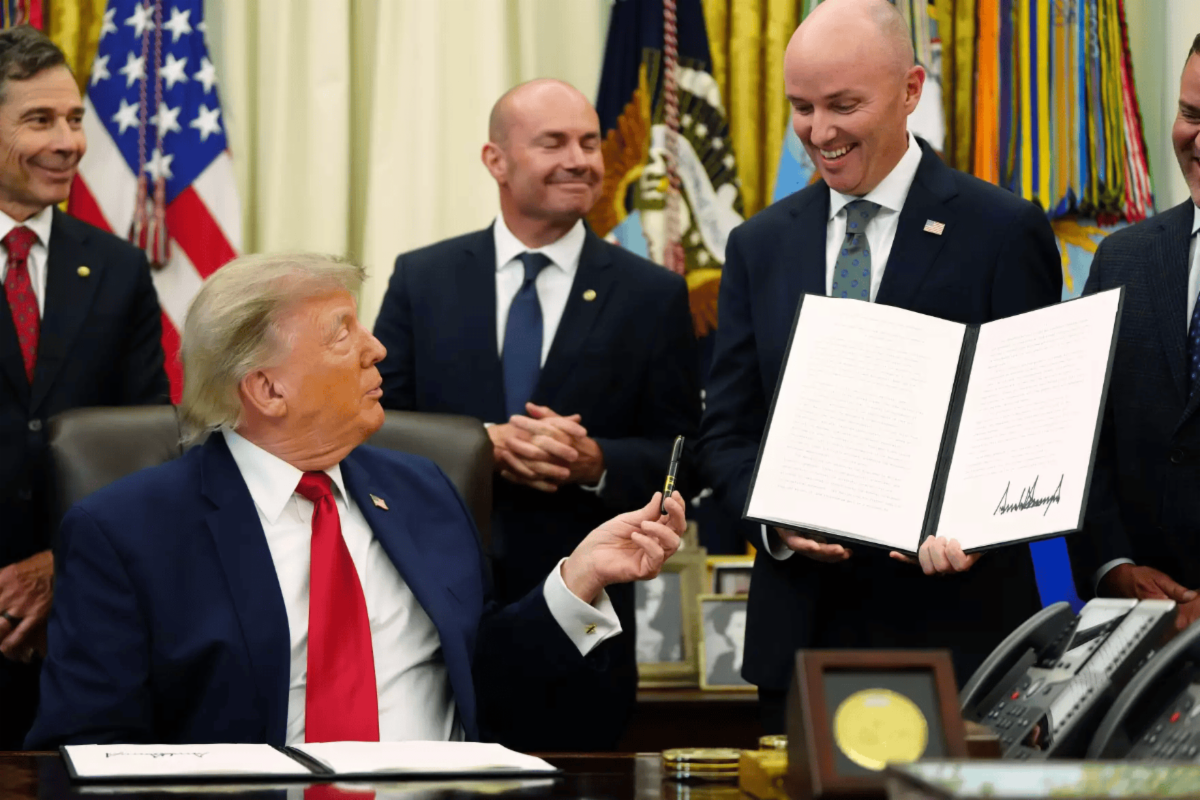
| | Photo: President Donald Trump hands a pen to Utah Gov. Spencer Cox after signing executive orders modifying the Grand Staircase-Escalante National Monument and the Bears Ears National Monument in the Oval Office of the White House, July 13, 2026, in Washington. Source: KUER. | |
Trump slashes Utah’s bears ears and Grand Staircase-Escalante by 90%
This KUER article discusses the administration's decision to shrink the Grand Staircase-Escalante and Bear Ears National Monuments by approximately 90 percent each. President Trump had previously reduced the boundaries during his first term in 2017, before they were restored in 2021 by President Biden. The dramatic reduction in protections for these culturally and environmentally significant monuments opens the land up for mining and development, projects that will likely be fast-tracked due to the changes in the public and environmental review processes noted above. Additionally, Trump's executive order was made without regard for local Indigenous communities and historical artifacts dating back hundreds to thousands of years. Although Republican politicians have argued that the moves are supported by a majority of Utah residents, polling suggests many Utahns want to protect the full monuments.
Condos, D. (2026, July 13). "Trump slashes Utah’s bears ears and Grand Staircase-Escalante by 90%." KUER. https://www.kuer.org/politics-government/2026-07-13/trump-shrinks-bears-ears-grand-staircase-escalante-utah
| |
Institute for Policy and Governance
201 W. Roanoke Street
Blacksburg, VA 24061
| | | | |