Volume 46, Issue 10 | May 9, 2025 | |
Biweekly member communication from your
DuPage County Medical Society
| | Public Health Experts Start Vaccine Integrity Project | | |
A group of public health experts is launching the Vaccine Integrity Project in response to concerns about the safety of vaccines and potential actions to limit their use.
Funded by a foundation supported by Walmart heiress Christy Walton, the initiative is led by Michael Osterholm, PhD, MPH, director of the Center for Infectious Disease Research and Policy at the University of Minnesota, alongside former FDA Commissioner Margaret Hamburg, MD, and former National Academy of Medicine President Harvey Fineberg, MD, PhD.
The project aims to determine the necessary steps to safeguard vaccine policies in the U.S., including the possible need for an independent body to evaluate vaccine safety and effectiveness. The initiative arises amid controversies surrounding U.S. Health and Human Services (HHS) Secretary Robert F. Kennedy Jr., who has spread mixed messages about vaccines and has proposed an autism study that many experts fear could falsely link vaccines to the condition.
The Vaccine Integrity Project will begin with information-gathering sessions involving experts from various fields to assess needs moving forward. Osterholm emphasized the importance of being prepared, especially in light of recent legislative proposals labeling mRNA vaccine technology a "weapon of mass destruction."
Hamburg and Fineberg noted in an opinion piece that allowing vaccine-preventable diseases to resurge would lead to unnecessary suffering and deaths. They called for proactive measures to ensure vaccine accessibility and encourage lifesaving immunizations. The feedback phase of the project will run from this month until early August, aiming for consensus on protecting the vaccine enterprise.
HHS spokesperson Andrew Nixon was critical, calling the project a "self-appointed echo chamber" focused on restoring credibility to "a public health bureaucracy that failed millions during the COVID-19 pandemic."
Learn More
| | CDC Advisory Committee's Future in Doubt | | |
Public health experts are concerned about the future of the Healthcare Infection Control Practices Advisory Committee (HICPAC) at the Center for Disease Control and Prevention (CDC), as several members have received termination letters and its webpage has been archived.
HICPAC develops guidelines for preventing healthcare-associated infections and operates with less visibility than the CDC’s Advisory Committee on Immunization Practices (ACIP). Recently, it faced backlash over revisions to its infection control guidance, raising concerns that crucial guidance for patient safety could be at risk if the committee is disbanded. Kristy Weinshel, executive director of the Society for Healthcare Epidemiology of America (SHEA), called the potential loss of HICPAC a significant setback for infection prevention.
Carol McLay, president of the Association for Professionals in Infection Control and Epidemiology, stated that dismantling HICPAC could lead to increased healthcare-associated infections, reflecting a broader trend of weakening public health infrastructure.
The exact number of members who have received termination notices is unclear, but some have been confirmed. Additionally, a meeting scheduled for March 6-7 was canceled without rescheduling. There has been no official announcement from the CDC or the Department of Health and Human Services (HHS) regarding HICPAC's status.
Unlike ACIP, which requires congressional action to dissolve, HICPAC operates under the Federal Advisory Committee Act, which mandates frequent charter renewals. Its charter was due for renewal on January 19, 2025, but this did not occur. Despite these challenges, members anticipated continuing their work on essential infection prevention guidance.
HICPAC, created in 1991, consists of experts from various fields and meets regularly to develop recommendations for hospitals and healthcare systems. Its loss would be a significant blow to healthcare, as highlighted by Hilary Babcock, a former HICPAC chair, who emphasized the importance of its guidelines for ensuring patient safety and minimizing infection risks.
Learn More
| | |
House Speaker Mike Johnson announced this week that Republicans will not pursue federal funding cuts to Medicaid, a move that likely would result in millions losing health insurance coverage.
As of October, over 72 million people in the U.S. were enrolled in Medicaid, benefiting children, the elderly, and individuals with disabilities. The House of Representatives passed a budget reconciliation bill in April that called for an $880 billion reduction in the budget of the Department of Health and Human Services (HHS) over the next decade, raising concerns about potential Medicaid cuts.
Johnson confirmed that the GOP will not seek changes to the Enhanced Federal Medical Assistance Percentage (FMAP), which determines federal Medicaid funding. FMAP rates vary by state, with poorer states receiving more support. Under the Affordable Care Act (ACA), states expanding Medicaid receive a permanent 90% FMAP for that population.
Reductions in FMAP could lead states to drop their Medicaid expansions, risking coverage for millions. Twelve states have laws that would end expansion if federal funding decreases. The Urban Institute estimates that 10.8 million more people could be uninsured if these trigger laws are activated.
Johnson also suggested that per capita funding caps for Medicaid are unlikely. Some Republican lawmakers, including New York's Mike Lawler, oppose changes to FMAP and per capita caps. Texas Representative Chip Roy has not ruled out supporting some changes, stating it is necessary to prioritize vulnerable populations.
A markup for the bill is scheduled for the week of May 12.
Learn More
| | "Bird Flu" Cases Declining | | |
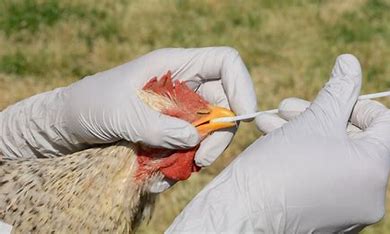
The detection of H5N1 avian influenza has slowed in both animals and humans, but ongoing surveillance remains essential, according to Centers for Disease Control and Prevention (CDC) researchers.
In dairy cattle, case numbers increased during the fall and early winter but declined in January. Poultry flock cases also fell after February, with a decrease observed in backyard flocks last month. Alicia Budd, MPH, from the National Center for Immunization and Respiratory Diseases (NCIRD), noted that fewer animal infections lead to fewer human cases.
During a recent Clinician Outreach and Communication Activity (COCA) call, Todd Davis, PhD, explained that any seasonality noted in other countries corresponds primarily to migratory bird patterns, making poultry and dairy cattle most at risk of exposure during migration seasons. However, James Lawler, MD, from the University of Nebraska Medical Center, emphasized that in the U.S., dairy cow transmission mainly occurs through cow-to-cow contact rather than from wild birds.
Since the outbreak began in 2022, there have been 70 confirmed human cases across 13 states, primarily linked to dairy cattle and commercial poultry. Among these cases, four patients were hospitalized, and there was one reported death.
Over 169 million poultry and 1,049 herds in 17 states have been affected by the current outbreak. Budd stated that overall public risk remains low, mainly affecting those with prolonged exposure to infected animals. Lawler acknowledged reporting challenges but noted a lull in H5N1 transmission. He cautioned that renewed outbreaks, potentially of new subtypes, are likely as the current situation evolves.
Learn more
| | New KFF Poll Tracks Trust in Vaccines | | |
One of the Trump Administration's goals is reforming various government health agencies. A Kaiser Family Foundation Tracking Poll shows that trust in these agencies for reliable vaccine information has shifted since the Biden administration.
Trust among Republicans has increased by approximately 10 percentage points, while trust among Democrats has sharply declined. Currently 70% of Democrats trust the Centers for Disease Control and Prevention (CDC) – down from 88% in 2023 – and 67% trust the Food and Drug Administration (FDA) – down from 86%.
Less than half of the public feels confident in these agencies, with only 32% believing they can operate independently. About 60% – including three-quarters of Democrats and nearly half of Republicans – think the CDC and FDA do not pay enough attention to scientific evidence in their decisions. Moreover, 30% believe these agencies give too much weight to the views of officials and pharmaceutical companies.
While most adults are "somewhat confident" in the safety of routine vaccines like those for measles (83%) and flu (74%), confidence in the COVID-19 vaccine is lower – only 56% express at least some confidence. Among Democrats, 87% feel confident, compared to just 30% of Republicans.
Perceptions of mRNA vaccine technology are mixed, with 32% viewing it as "generally safe" and 16% as "generally unsafe." However, 52% say they lack enough information to decide. About 45% have heard the false claim that mRNA vaccines alter DNA; only 3% consider it "definitely true," while 26% think it is "probably true." Notably, significant portions of Republicans (37%), independents (33%), and Hispanic adults (38%) lean toward believing this myth.
Learn more
| | May Is Mental Health Awareness Month | |
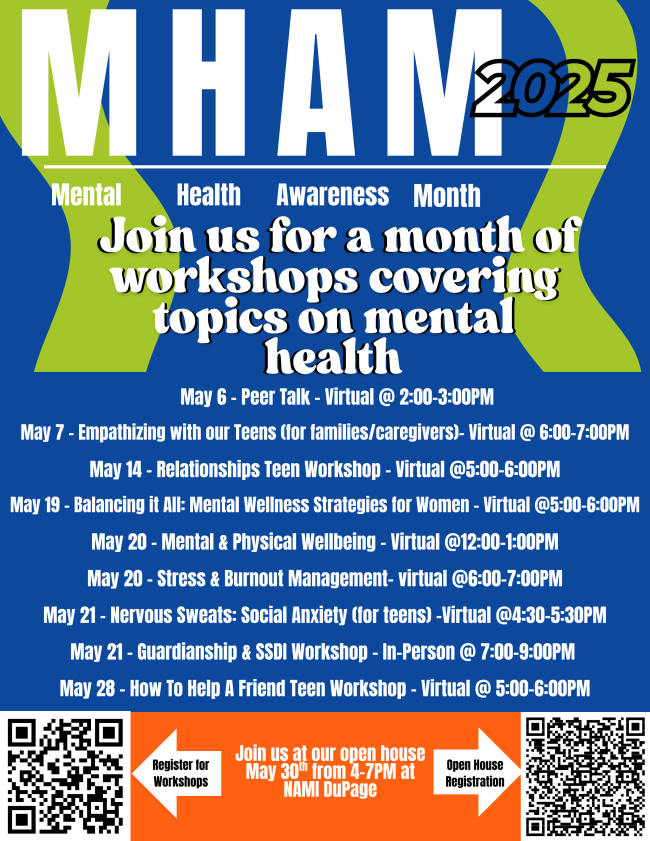
This month NAMI DuPage will host a series of workshops to highlight mental health in recognition of Mental Health Awareness Month.
Workshops will cover a variety of topics, including Teen Relationships, Mental Wellness Strategies for Women, Stress and Burnout Management, Social Anxiety, Guardianship, and a teen workshop titled How to Help a Friend. For the complete schedule, please refer to the NAMI brochure.
Additional mental health resources can be found at 211DuPage.gov, which includes Crisis Intervention Helplines, Counseling Services, Support Groups, and Substance Use Disorder Treatment Programs.
Learn More
| | |
Be connected. Be a leader.
DuPage County Medical Society
Advancing quality healthcare delivery, promoting physician education and professional collaboration, and enhancing public health.
| | | | |